














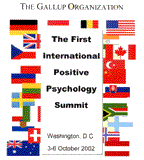
 A group of upstart scientists, scholars and researchers in the field of psychology have decided that it is more important to focus on what is right with people than what is wrong with people. 200 psychologists from 20 countries convened this weekend in Washington, D.C. for the first annual international summit to exchange research and ideas on such topics as love, flow, wisdom and well-being.
“The world has an appetite for this type of stuff,” declares Dr. Martin Seligman of the University of Pennsylvania, the self-described cheerleader of the new positive psychology movement. Seligman, a former president of the American Psychological Association, founded the Positive Psychology Network and authored the new book, Authentic Happiness: Using the New Positive Psychology To Realize Your Potential For Lasting Fulfillment. He sees the most exciting prospects for this work in simple but dramatic terms. “We can change for the better the total amount of happiness in the world.”
But what about today’s new world, marked by fears of terrorism and a new anxiety about the future? Since September 11th, Seligman has determined that one of the best ways to help suffering people is to focus on positive things. A parade of studies presented this weekend confirmed the experience that positive emotions, when generated, cause negative emotion to dissipate rapidly. Thus, researchers are hoping to prevent depression before it occurs.
Well, Seligman’s group was awarded a $2.8 million grant from the Department of Education to augment a 9th grade language arts curriculum with an emphasis on human strengths and positive emotions contained within the course literature. The grant will fund a long term study to trace the lives of students who took the course, and compare outcomes to those from students who took the same course but without the positive psychology enrichment.
Judging from the research presentations at the summit, adolescents who are taught the tools to well-being will live happier lives than those who are not. For instance, one study asked whether character predicts happiness in adolescence (U. of Penn). The results indicated that, yes, kids with self-described virtues were happier, and that “nice guys DON’T finish last.”
What would be the outcome if more psychologists, teachers, therapists, AND parents focused on what people were doing right? The foremost proponent of the movement, Dr. Seligman, believes that, “An era of good feeling literally is possible.” (OCT. 6, 2002)
Some Highlights of the 4-day First International Positive Psychology Summit sponsored byThe Gallup Organization: “The heart really is an organ of emotion. It’s not just a metaphor.”- Jonathan Haidt, the University of Virgina
Haidt reported on his work with the phenomenon he terms, Elevation. When presented with a moving act of charity, the body experiences a warm feeling in the chest or throat, a response that is generated by the vagas nerve. Most importantly, a strong desire is felt in ourselves to do similar charitable acts also. Thus, “efforts to promote and publicize altruism may therefore have widespread and cost-effective results.” (The Positive Emotion of Elevation by Jonathan Haidt)
“You don’t have to think the world is a good place to be happy.”– Michael Poulin and collegues, University of California Irvin.
Poulin and others studied 933 people outside of New York City about the Assumption in Beliefs About the Self and the World Post 9/11. The surprising thing to most people would be the finding that these New Yorkers, within weeks of the attacks of September 11, still saw the world as a good place and still saw people as good. The determining factor was that they viewed themselves in a positive light. “Individuals with a strong sense of meaning in life were able to leverage worries they felt about the terrorist events into positive life changes.”-Michael Steger, University of Minnesota
Three months after 9/11, a sample of 188 Midwestern college students revealed that possesion of a strong sense of meaning or purpose in your life protected you from detrimental effects of post-traumatic stress. Somehow this meaning was a resource that gave people a tool for growth, such as a greater appreciation of family and friends, changing their life for the better.
“Some research states that reliving the stress may not be helpful, and may even be hurtful.” – Jane Henry, Open University
In Strategies for Achieving Well Being, 300 people from 20 nationalities were studied to find out what provided them with the greatest subjective well being. The top three were:
- Quieting the Mind. This could be meditation, fishing, following intuitive urgings, or being in nature.
- Physical activity. Including exercise, painting watercolors, dancing, or anything that requires a focus of creativity or body.
- Social Support. “Most therapists don’t prescribe staying in touch with your friends,” lamented Henry. But, social groups, socializing activities, like getting out for the evening, or receiving reassurance from others such as a spouse, are top strategies for staying mentally healthy.