














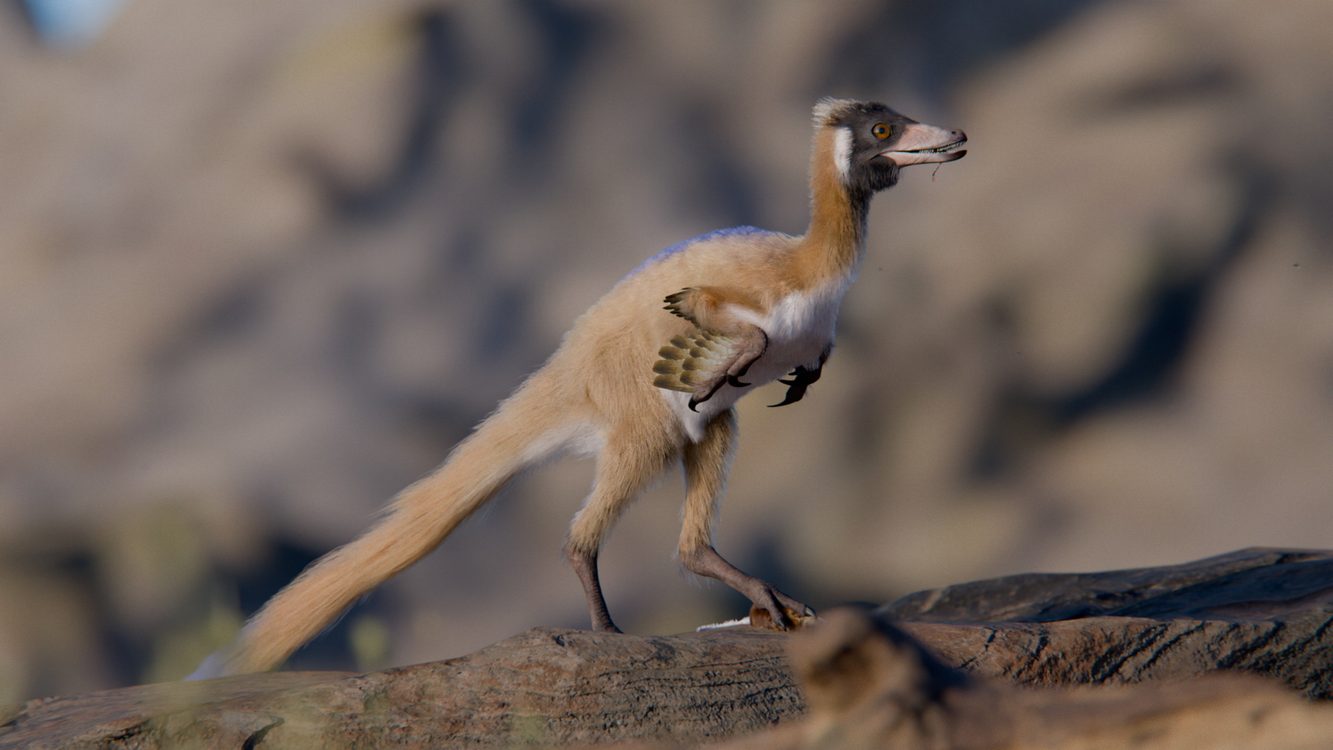
As it often tends to, the fossilized remains of a tiny bird-like dinosaur are rewriting history.
A team of North and South American scientists described Alnashetri cerropoliciensis as the “missing link”—not from dinosaurs to birds, as the phrase has often been used to describe—but for finally understanding a mysterious group of small, widespread prehistoric animals.
Yet further, they team likened the discovery of the dino’s near-complete skeleton to a “paleontological Rosetta Stone.”
Alnashetri belongs to a group of bird-like dinosaurs, known as Alvarezsaurs, that are famous for their tiny teeth and stubby arms ending in a single large thumb claw.
But, for decades, they have remained a mystery because most of the well-preserved fossils were found in Asia, while records from South America were fragmented and difficult to interpret.
In 2014, the almost complete fossil of Alnashetri was discovered in the northern part of Patagonia, Argentina, by an international team led by University of Minnesota Twin Cities researcher Professor Peter Makovicky and his Argentinean colleague Dr. Sebastian Apesteguía.
The newer, more complete specimen allowed the team to finally map the group’s strange anatomy, and they’ve spent the last decade carefully preparing and piecing together the fossils to avoid damaging the small bones.
“Going from fragmentary skeletons that are hard to interpret, to having a near complete and articulated animal is like finding a paleontological Rosetta Stone,” said Dr. Makovicky. “We now have a reference point that allows us to accurately identify more scrappy finds and map out evolutionary transitions in anatomy and body size.”
He says the discovery of the nearly complete skeleton opens up a new understanding of how its lineage evolved, shrank, and spread across the ancient world.
“We have already found the next chapter of the Alvarezsaurid story there, and it’s in the lab being prepared right now,” said Dr. Makovicky.
MORE BIRD-LIKE DINOS: Bizarre Creature From China Had a Dinosaur Head on Bird’s Body – a Missing Link From 120 Million Years Ago
Microscopic analysis of the bones confirmed the animal was an adult at least four years of age. The largest species are the size of an average human, very small for dinosaurs, and Alnashetri itself weighed less than 2 lbs. making it one of the smallest dinosaurs known from South America.
Unlike its later relatives, Alnashetri had long arms and larger teeth, which the corresponding published research says proves that some Alvarezsaurs evolved to be tiny long before they developed the specialized features thought to be adaptations for an “ant-eating” diet.
MISSING LINKS: Newly Unveiled T-Rex Relative Was Sitting in Museum Drawer for 50 Years and ‘Rewrites’ Family Tree
The researchers said their worldwide distribution was caused by the breakup of the Pangea supercontinent.
“After more than 20 years of work, the La Buitrera fossil area has given us a unique insight into small dinosaurs and other vertebrates like no other site in South America,” said Dr. Apesteguía, a researcher at Universidad Maimónides in Buenos Aires, Argentina.
SHARE The Deep Insights Gleaned Into This Little Dino On Social Media…