











A German shepherd named Astro who has been missing from his family for more than 9 years is finally home, thanks to the microchip embedded in the dog before his adoption from a shelter. The family had even moved three times after the dog left home. (MSNBC.com has the story)
After 9 Years, Missing Dog Returns to Family
U2’s Surprise Rooftop Gig (Video)
Traffic on Regent Street in London came to a halt as rock legends U2 performed on a roof top for thousands of commuters.
Video may take a moment to load…
These Uncertain Times?
“These uncertain times…” It’s hard to go through the day and not see or hear the use of this phrase. But what does it really mean?
What is being described as our modern state is really the norm. We are surrounded by uncertainty all the time.
I heard an authoritative radio voice usher the phrase three times today. “In these uncertain times, it’s important to find a lawyer you can trust.” Well, this had me spitting out my coffee in laughter.
A little while later, it was, “Are you looking for a safe place to invest your money, in these uncertain times?” to which I replied, “What money?”
Building a Bridge to Save Lives
The Nithi River used to claim as many as 50 lives each year near the Kenyan villages of Kajuki and Mutino.
But a Rotary club project between Meru, Kenya, and Middleton/Manchester, England, helped fund a new bridge that allows villagers to cross the river safely, while transforming the economies of the communities in the process.
Before the bridge was constructed, Mutino villagers had to make a 30 mile roundtrip journey to cross the river at a safe point, making it difficult to reach Kajuki for supplies and medical services. Often in emergencies, villagers would try to ford the river, and many died as a result. (In this photo, Mutino villagers ford the Nithi River during the dry season, courtesy of John Brooker)
Gharials Get Back Into the Ganges
131 gharials, the critically endangered long-snouted crocodile native to the Northern Indian sub-continent, were recently re-introduced to the river Ganges by WWF-India officials.
The gharials are responding well, according to WWF, since their release on February 12 into the Hastinapur Wildlife Sanctuary in Uttar Pradesh.
“An estimate indicates that barely 1,400 individuals survive in the wild in India,” said Dr Parikshit Gautam, Director, Freshwater & Wetlands Conservation Program, WWF-India. “For its conservation it is essential to locate viable alternative habitats for this species in crisis.”
Clean Living Way to Beat Cancer (w/ Video)
Over 40% of breast and bowel cancer cases in rich countries are preventable through diet, physical activity and weight control alone, experts say.
Simple measures like cycling to work and swapping fatty foods for fruit can make all the difference for these and many other cancers, they say. (Read the full story in BBC)
(Photo courtesy of Sun Star)
Hyundai Selling Cars and Peace of Mind
January car sales plummeted for most major automakers, but Hyundai saw a 14 percent sales jump thanks to their innovative Assurance program that allows buyers to return cars – no strings attached – if they lose their jobs in the first year of ownership. (US News Rankings and Reviews)
Co-op Mocks Recession, Doles Out $231 Million
What recession?
A Minnesota grain and energy cooperative sent $231 million on Friday to its members — and there’s more on the way — in what they called the largest-ever distribution from a U.S. co-op.
The checks mailed to members of CHS Inc., a Fortune 200 company, ranged from a few hundred dollars to just over $1 million, said a spokeswoman of the co-op, whose earnings have more than tripled in the past four years, selling grain, feed, food, and energy.
Let’s Join! (Full story at Minn. Star-Tribune)
Renew Your Wardrobe for Free With Clothing Swaps
Typically women use 20 percent of their clothes 80 percent of the time. The reason? Sometimes it’s just hard to let go. But, the idea to host clothing swaps between friends or local women is gaining momentum. Suzanne Agasi is the diva of clothing swaps having hosted 175 events while maintaining a website devoted to her events www.clothingswap.org.
“People hold on to clothes that don’t really fit or look good because it was expensive,” she said. “They are painful to get rid of, but it’s time we just let go and give it to a friend.”
Read more about swapping with friends and using Meetup.com on Boston.com.
The today show featured one of her swanky swap parties in this video.
Congress Easing Restrictions on Cuba Travel
The US House of Representatives has passed a bill that should lead to the easing of restrictions on Cuban-Americans wanting to travel to Cuba. The bill would allow Cuban-Americans to visit Cuba once a year instead of once every three years.
Under the bill, Cuban Americans should be able to spend $170 a day on the island, more than three times the current daily limit of $50. It also creates a general travel licence for Americans who sell food and medical supplies to Cuba. (Read more at BBC News)
More than 100 Million of the World’s Poorest Have Received Microloan
More than 106 million of the world’s poorest families received a microloan in 2007, surpassing a goal set ten years earlier, according to a report released last month by the Microcredit Summit Campaign. Microloans are used to help people living in extreme poverty start or expand a range of tiny businesses such as husking rice, selling tortillas, and delivering cell phone services to remote villages.
“This is a tremendous achievement that many people thought was far too difficult to reach,” said Nobel Peace Prize laureate and Grameen Bank founder Muhammad Yunus who was present for the announcement. “What makes it even more remarkable is that loans to more than 100 million very poor families now touch the lives of more than half a billion family members around the world. That is half of the world’s poorest people.”
Even though microloans were first made in the developing world in the 1970s, for decades, this quiet revolution gained ground largely unnoticed by world leaders and development specialists until the United Nations declared 2005 as the Year of Microcredit and the following year Muhammad Yunus and Grameen Bank received the Nobel Peace Prize.
At the first Microcredit Summit in 1997, when the ambitious goal was originally set, organizers say that fewer than 8 million very poor clients had a microloan. That number grew by more than 1,300 percent in the ten years that followed, culminating in 2007, when microloans went to 88 million of the world’s poorest women.
The Campaign organized 12 conferences during that period, attended by more than 14,000 delegates examining trends, debating ideas, and sharing innovations. “Spending less than $12 million, the amount of microloans in the hands of the poor expanded from an estimated $1 billion to $15 billion,” said Alex Counts, President and CEO of Grameen Foundation, “demonstrating the significant leverage possible when an international campaign is able to mobilize people and institutions on a global scale.”
While the world’s financial markets are gripped by a global economic crisis, microbanking has spread to the most destitute corners of the world, spurred by internet websites like Kiva.org which lets users lend small amounts directly to micro-businesses — with payback rates that traditional banks would envy.
From Beggar to Home Owner
One of the innovators highlighted in the report is Jamii Bora, a Kenyan microfinance institution that started in 1999 with loans to 50 beggars in Mathare Valley Slum in Nairobi and now reaches 200,000 members. Jamii Bora is building a new town that provides another contrast to the current financial crisis by providing sub-prime mortgages to some of the poorest people in the world but does so in a way that gets the fundamentals right. The new town has 2,000 houses and 3,000 business spaces. Each house has two bedrooms, a kitchen, a living room, and a bathroom and the monthly mortgage is the same as a one-room shack in the slums. Potential buyers must have successfully repaid three self-employment loans to qualify for a mortgage. “Every person’s dream is to move out of the slums,” said Jamii Bora’s founder Ingrid Munro, “not patch up the slums.”
Jorimon Khan, who lives in Bangladesh, is one of the clients mentioned in the report. Married in 1962 at the age of 10, Jorimon had her first child at 15. Her family of four lived on her husband’s wages as a day laborer which amounted to less than 20 cents a day. In 1980 she received her first loan of $10 from Grameen Bank and began to husk and sell rice. For the first time in her life, Jorimon Khan and her family were able to eat three meals a day. “At first I was afraid to take the loan,” Khan remembered. “People told me that if I didn’t repay it, the bank people would kill me for the money. So yes, I was very scared. But when I finally paid back that first $10, I felt brave. So I asked for more money. After that I asked for $33.”
In 1980 Jorimon Khan was among the first 10,000 microfinance clients in the developing world. Now Jorimon Khan is one of more than 100 million clients and the Microcredit Summit has set its sights on reaching 175 million of the world’s poorest families by 2015 and ensuring that 100 million of those families move above the $1 a day threshold. (The Campaign counts the world’s poorest as those who live in the bottom half of those living below their nation’s poverty line, or any of the nearly 1 billion people living on less than $1.25 a day.)
Click here to view the 2009 State of the Campaign Report (Also available in Spanish, French, and Arabic).
The Microcredit Summit Campaign is a project of the RESULTS Educational Fund, a U.S.-based grassroots advocacy organization committed to ending hunger and poverty. The Campaign brings together microcredit practitioners, advocates, educational institutions, donor agencies, international financial institutions, non-governmental organizations and others involved with microcredit to promote best practices in the field, to stimulate the interchanging of knowledge, and to work towards reaching bold measurable goals. For more information, visit www.microcreditsummit.org.
Green Energy Stimulus Worldwide Tops $200 Billion
Governments around the world have committed more than $200 billion toward technologies to cut dependence on fossil fuels, which should help keep green development moving despite the global economic crunch, an analyst for Deutsche Bank said on Tuesday.
Governments in the United States, Europe and Asia have also developed more than 250 policies since July last year that support alternative energy such as solar and wind power and climate-change mitigation.
Stevie Wonder In Performance at the White House Wins Gershwin Prize on PBS Tonight
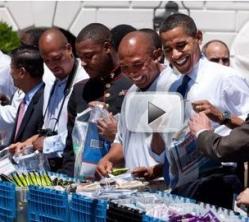
“Stevie Wonder In Performance at the White House: The Library of Congress Gershwin Prize” will showcase an evening of celebration with President and Mrs. Obama at the White House in honor of American musician Stevie Wonder’s receipt of the Gershwin Prize for Popular Song.
The concert on Wednesday night featured performances by Wonder himself and Tony Bennett, Diana Krall, Martina McBride, Esperanza Spalding, Will.i.am, and the gospel duo Mary Mary. The sixty-minute program will air tonight, Thursday, February 26, at 8 p.m. ET on PBS stations throughout the US.
The program is the first for the Obama administration in a 30-year series of ‘In Performance at the White House’ — broadcasts linking every president since 1978. Each ‘In Performance at the White House’ is produced by WETA, the Public Television station in the nation’s capital, and offers viewers a unique front row seat, right next to the First Family, for the best in music, dance and Broadway theater.
Michelle Obama opened the concert on a personal note telling stories about how Wonder had been a part of her life. “Tonight it is a huge thrill for me as we honor a man whose music and lyrics I fell in love with when I was a little girl. The first album I ever bought was Steve Wonder’s ‘Talking Book.’ I’d go to my grandfather’s, because he’d blast music throughout the house. And that’s where he and I would sit and listen to Stevie’s music together. Songs about life, love, romance, heartache, despair. He would let me listen to these songs over and over and over and over again. Years later, I discovered what Stevie meant when he sang about love. Barack and I chose the song, ‘You and I’ as our wedding song.”
What Iran’s Jews say
ESFAHAN, Iran – Over the entrance to a synagogue nestled in this ancient city is a banner saying: “Congratulations on the 30th anniversary of the Islamic Revolution from the Jewish community of Esfahan.”
The reality of Iranian civility toward Jews tells us more about Iran – its sophistication and culture – than all the inflammatory rhetoric of its leaders.
That may be because I’m a Jew and have seldom been treated with such consistent warmth as in Iran. Or perhaps I was impressed that all the fury over Gaza, trumpeted on posters and Iranian television, never spilled over into insults or violence toward Jews. (Photo: Rabbi shakes hands with Iranian President Mahmoud Ahmadinejad, www.mehrnews.ir)
MIT Students Create Bicycle-Powered Washing Machine (w/ Video)
Thanks to some MIT students, many people living without electricity in developing countries may benefit from a new human-powered washing machine that could save them precious time and hard labor.
The availability of a washing machine could also make a difference for the entire community by cutting down on the water pollution created in open streams and lakes from doing wash by hand.
The pedal-powered machine, built by MIT students and staff mostly from bicycle parts and empty barrels, could also be built locally, and thereby create jobs. The machine was designed to be easy and inexpensive to manufacture, using parts and tools that are readily available almost everywhere in the developing world.
(Photo: Students test the machine with orphans in Ventanilla, Peru, by Gwyndaf Jones)
The “motor” of the machine consists of a bicycle frame, with the chain running forward to a gear at the end of the washer drum’s shaft. The highest gear is the spin cycle, and the lowest gear is the wash cycle.
Testing the Machine in Peru
Under development for almost four years, the new machine — dubbed “bicilavadora,” combining the Spanish words for bicycle and washing machine — got its most rigorous workout last month when a team of MIT students took the latest prototype to an orphanage in the slums called Ventanilla outside Lima, Peru. With 670 resident children, the home generates enough laundry to keep the washer perpetually busy.
Lisa Tacoronte, a junior in mechanical engineering who worked on the project recalled setting up the machine. “Many of the children would watch us work, ask us questions at the same time or try to help us by holding things, or handing us tools while we built it.”
An earlier version of the washing machine, developed by mechanical engineering graduate student Radu Raduta, won first prize in the MIT IDEAS competition in 2005. That resulted in some funding for further development, which led Raduta to improve the design of the machine’s inner drum so that it could be more easily manufactured and transported.
The machine’s outer housing is made from a standard oil drum cut apart and welded back together to make a much shorter barrel, because “a full 55-gallon barrel is more laundry than any human can pedal,” explains Gwyndaf Jones, a D-Lab instructor who worked on the earlier version and who led this year’s Peru field trip. The inner, rotating drum is made from a set of identical plastic pieces bolted together, which can be taken apart and stored flat for easy transportation. That was the key part of Raduta’s design.
“The hardest part to build is the inner drum,” Raduta explains, “because it’s submerged in water, and full of clothing that can have metal buttons, which abrades the inner walls. It has to be stiff enough to keep its shape, but if it’s bare steel it will rust, and paint will peel off.” The key part of his thesis research was figuring out how to make the drum strong enough, cheap enough and easy and inexpensive to ship. His latest version is made from molded plastic panels, and when disassembled it is compact enough to fit in a suitcase — which is how the students took it to Peru for the January trip.
Back to the Drawing Board
The test was not a total success: Some water leaked around the edges of the barrel, which could cause rust, and very inexpensive bearings used for the shaft were too stiff. But the basic design was well proven out, and with a few small changes an updated version should be able to handle the intensive workload. Further tests will be carried out this spring by other students.
While crucial pieces such as the inner drum segments were brought along from MIT, others including the outer drum and its supporting structure were built on-site. “We improvised for whatever we didn’t have and often learned how from locals like Wilbur and Gennard,” two of the older orphanage residents, Tacoronte says. “For example, we were unable to cut the two sides for the door on the outer drum that were parallel to the curved surface. Wilbur took up a chisel and went at it with a hammer. The door was done in seconds.”
She found the experience very inspiring. “The more time I spent there and the more amazing people I met, the more passionate and determined I became about finishing the lavadora and making sure it worked,” she says. After the first test run, with the high-gear spin cycle successfully eliminating most of the water from the drum, she says, “The moment they pulled out the merely damp sheets was exhilarating.”
Watch the brief video below, showing the wash and spin gears
Supreme Court Upholds Gun Ban for Domestic Abusers
In a 7-2 decision yesterday, the U.S. Supreme Court upheld the federal law that bans convicted domestic violence abusers from owning guns.
“Firearms and domestic strife are a potentially deadly combination nationwide,” Justice Ruth Bader Ginsburg wrote.
“We are delighted,” said Sue Else, President of the National Network to End Domestic Violence (NNEDV). “Batterers should not have access to guns. This decision is a major victory for victims of domestic violence and their families.”
Duke Ellington is First African- American to Solo on U.S. Coin
Just in time for the closing of Black History Month, the U.S. Mint launched a new coin Tuesday featuring jazz legend Duke Ellington, making him the first African-American to appear by himself on a circulating U.S. coin.
Ellington won the honor of gracing the Washington, DC state quarter by a vote of D.C. residents, beating out abolitionist Frederick Douglass and astronomer Benjamin Banneker. (Read more at CNN.com)
National Guard Goes Green to Conserve Energy, Cut Costs
Green energy and conservation has become a top priority for the National Guard. Efforts nationally since 2001 to conserve energy and fuel include a wind turbine outside the New Mexico National Guard headquarters, a solar array providing power for a New Jersey training center, and the Ohio Air National Guard’s alternative energy site in Toledo.
Every building under the military construction program now must meet the U.S. Green Building Council’s silver rating. (Read full AP report, via WTOP)
(Trenton training center’s solar array- photo by Dept.of Military and Veterans Affairs)
UNICEF Opens 200th School in Indonesia
The United Nations Children’s Fund (UNICEF) has opened its 200th school in Indonesia’s Aceh-Nias region, which was devastated by the December 2004 tsunami. As is the case with all UNICEF-built schools, it is both earthquake-resistant and child-friendly.
“With its child-friendly and earthquake-resistant schools, UNICEF has been setting new standards in reconstruction in Indonesia,” said Jean Metenier, Chief Field Officer of UNICEF Aceh and Nias. (Read more in Hindu Business Line)
Iran Invited by Group of Eight to Meeting on Afghanistan
Iran said on Monday it had been invited by Group of Eight president, Italy, to an international meeting on Afghanistan, which is also expected to be attended by the United States. Italy wants to hold a conference to bring the world’s richest countries together with Saudi Arabia, United Arab Emirates, India, China, and Turkey, among others, to find ways of bringing stability to Afghanistan and Pakistan. It also seeks to involve Iran, which shares borders with both of those countries. (Read more at Reuters)