














Ozone levels have stabilized or increased slightly in the past 10 years thanks to an agreement to ban CFC’s signed in 1987 and honored by 180 nations. (Yahoo News)
Aussie Skin Cancer Trial a Success

A new treatment for skin cancer made from the sap of a common garden weed has proven effective on 71 percent of basal cell carcinomas (BCCs). In phase II test results released this week in Australia, the PEP005 Topical gel cleared up the most common type of skin cancer in just two applications on two consecutive days.
Petty spurge (Euphorbia peplus) has been used for years in Australia to treat cancerous spots on the skin. A toxic, milky sap within the plant normally causes blisters and rash, but when applied directly to a cancerous growth causes swelling and an enlarged sore which eventually develops a scab that dries and falls off. . .
The Brisbane-based company called Peplin (named for the plant?) claims to have identified the molecule responsible for that activity and formulated a gel and developed a manufacturing technology. Peplin believes the molecule penetrates the skin and destroys the malignant tissue.
The company’s managing director and chief executive, Michael Aldridge said, “This is the first time two days of therapy have shown to be effective in clearing skin cancers.” Peplin hopes to start phase III trials later this year.
BCC’s develop typically on older caucasians with a history of sun exposure. The trials involved 60 people throughout Australia, a country where a quarter million people were treated for such skin cancers in 2002.
Petty spurge is an erect garden weed, a prolific seeder originally native to Europe. It is also naturalized throughout North America.
Nepal Lawmakers Match Communist Rebels Cease Fire, Call for Forgiveness
Nepal’s new Cabinet on Wednesday matched communist rebels’ cease-fire declaration and said it would drop terrorism charges against them in an effort to end a decade-old insurgency that has killed 13,000 people.
The rebels had joined with a seven-party alliance to force King Gyandendra to relinquish power last week and, in a dramatic reversal, the guerrillas now appear to be headed for a role in the political mainstream.
Read more here.
In Southern Sudan, 250 demobilized child soldiers trade weapons for textbooks
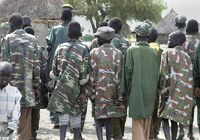
UNICEF officials, parents, and local and military leaders celebrated the demobilization of 250 youngsters from armed forces and groups in Southern Sudan last week. The release was the largest of its kind since a peace accord ended two decades of civil war in January 2005, and committed the two sides to child demobilization throughout the country.
The children handed over their weapons and uniforms in a ceremony and received a set of second-hand clothes along with textbooks from the local school.
Since 2001, an estimated 20,000 children from the former southern rebel forces, the Sudan People’s Liberation Movement/Army (SPLA), have been disarmed, demobilized and returned to their families and communities with UNICEF support….
Palestinian Business Leaders Call for Unity, Peace
Financial Times reports on the Palestinian business leaders who are speaking up now in favor of a peace plan with Israel. Whether it is the Arab Peace Plan or a new one, my feeling is it won't be long before Hamas is pressured to give up its stand against Israel and act in behalf of moving forward with civil behavior. Economic pressures to change will likely be too much for the fledgling government to resist.
The unprecedented entry of the business community into the political debate reflected the growing economic crisis in the Palestinian territories.
Schools Take Action on Overweight Kids

In response to a steep rise in obesity among children, some public schools are taking action. It shocked me to learn that only 6 percent of elementary schools in Chicago have any recess for kids to run on playgrounds for 20 minutes. One school, Nettelhorst, made the decision to bring back recess.
Startling results have occured in schools that have replaced junk food with whole food. Higher grades, calmer kids, healthier bodies. The US Congress is getting in on the act this year with new legislation for schools that would require new minimum nutrition standards for lunches.
Dietary experts say today’s nutritional standards in schools make no sense. “Jelly beans and lollipops are not allowed, but donuts, french fries, and soda are,” reports an article in the CS Monitor that details the new legislation. Teaching kids why salad is good for their bodies is also key to instituting change…
Nettelhorst was part of a pilot project that put salad bars in three Chicago elementary schools. A study of the project showed that without any nutrition education, few kids chose the salads; with education, the number doubled. On some days, nearly a third of Nettelhorst students choose salad. No junk food is available.
The Good News Network reported in 2002 on an alternative school for troubled youth in Appleton, Wisconsin that instituted a whole foods diet removing all food dyes and preservatives from the teen’s meals, and saw respect, achievement, and discipline prevail where once kids packed weapons, took drugs, and exhibited “terrible rudeness.”
Before 1997 the teens ingested a slurry of behavior-altering chemicals that left them irritable, fidgety, and unable to concentrate. The culprit chemicals were not cocaine, speed, or marijuana, but the industrial food additives found on grocers’ shelves… The Appleton revolution is part of a growing body of evidence that points to extensive chemical processing of children’s foods as a leading culprit in the 20 year surge of cases of hyperactivity (A.D.D./A.D.H.D.), depression and obesity in America’s children.
Scientific Studies Build the Case For Nutrition Reform
• The Center for Science in the Public Interest released a report in 1999 concluding that in 17 of 23 studies evidence strongly indicates that for some children behavioral disorders are caused or aggravated by certain food additives and artificial food colors. The Center joined a group of physicians and scientists urging the Department of Health and Human Services to advise parents and doctors to try changing the diets of children with ADHD before placing them on stimulant drugs like Ritalin, with their side effects. A NIH report suggested that the government “consider banning synthetic dyes in foods consumed widely by children.” (“Diet, A.D.H.D. and Behavior,” www.cspinet.org)
• The New York City Board of Education, in 1979, instituted dietary changes in 803 schools that raised test scores a whopping 15 percentile points by gradually removing synthetic colors and flavors and some preservatives, and by reducing sugar in the foods served at breakfast and lunch. Before the change, test scores ranked in the 39th percentile. Four years later the students scored in the 55th percentile. (International Journal of Biosocial Research, Vol. 8, No. 2, 1986.)
• A double-blind University of Oxford study published in the British Journal of Psychiatry (2002) reported that over a nine month period half of a group of 231 adult male prisoners were given vitamins, minerals and Omega-3 fatty acids. They committed 26.3% fewer offenses than in previous months and 40% fewer violent offenses. The men who received the placebo pills continued to behave as they had all along. The Researchers hailed the improvements as ‘huge’.
• The Feingold Association newsletter, Pure Facts, described 10 year-old Bradlea Fletcher’s school science fair project on the effect of food dyes. She took 8 mice and ran them through a maze for 6 days. Then she divided them in half and added 2 drops of yellow food dye to one cage’s water dish, then timed them for 6 days more. The mice with the dyes were 50% slower than in earlier runs, while the normal mice improved their time by 25%. Additionally, the tainted mice became harder to catch and aggressive — one even bit her, while the normal mice became tamer.
Convict Mends Life Stitching Artwork While in Prison
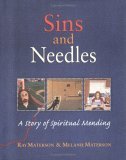
 The most inspirational stories to me are convicts who transform themselves with some activity or study while in prison. GNN has featured inmates whose restoration came from the practices of meditation, training guide dogs, and by joining a Toastmasters club in prison — which boosted self-esteem and detoured the entire group from re-offending upon release.
Another path to transformation for convicts is through the arts. Ray Materson is an ex-con who found his passion in prison by embroiding tiny works with shiny fibers unraveled from socks. He used the rim of a Rubbermaid bowl for the hoop and started creating sports team logos for himself and fellow inmates….
Common Ground Found on What Makes American
Despite heated debate over illegal immigration, there is more uniting the country on the issue of national identity than dividing it.
We are more open and tolerant than we were in previous decades with a greater acceptance of multiculturalism, says a new survey covered in the CS Monitor.
UN Reports Positive Trends in Afghanistan
The senior United Nations envoy to Afghanistan reported encouraging economic growth for that struggling nation. The country’s gross domestic product (GDP) has risen by 13.8 percent in the last year after a rise of 8 percent the year before. Growth was only found in three quarters of the country, however, and he acknowledged that the security situation in the south has not stabilized….
Heartier Job Market for Grads in 2006
College grads looking for their first jobs this spring will have an easier time than in recent years.
Job-market analysts and career counselors see hiring growth in many sectors of the economy. Nationwide, employers plan to hire 13.8 percent more new graduates than they did last year… Hiring of grads in the Northeast is predicted to rise 24.8 percent… 20 percent said they planned to increase starting salaries to make job offers more attractive. (CS Monitor)
The Top 100 Best Corporate Citizens of 2006

Business Ethics Magazine has released its annual survey of the "100 Best Corporate Citizens."
This year’s list is led by Green Mountain Coffee Roasters of Waterbury, Vermont, cited for its pioneering work in the fair trade of coffee (paying growers stable and fair prices) and its support of non-profits that save the environment or feed the hungry. Its Heifer Hope coffee blend, for instance, was created to support Heifer International’s fight against world hunger. It is one of four new "Partnership Coffees" that allow consumers to support good causes. Green Mountain has been among the top ten companies on Business Ethics’ list for four years running.
Now in its seventh year, the list for 2006 is striking because of the dominance of seven technology firms among the top ten….
Rhode Island Embarks on Statewide Broadband
America’s smallest state is seeking to become its first to offer a wireless broadband network from border to border.
Reuters reports on the innovative ideas hatching out of Rhode Island’s plan to drape the state with a wireless broadband network, such as linking up restaurants with the Health Department. (It may only cost residents $20 per month?)
I know if North Carolina sported wireless broadband in the mountains I would have saved a lot of gas money and spent many more enjoyable hours at the Ginger Cascades camp this weekend.
G is for Ginger Cascades Girl Scout Camp
EDITOR’S BLOG
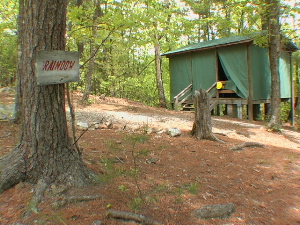
This weekend I brought our kids and myself to the Ginger Cascades Girl Scout camp in the Blue Ridge Mountains of North Carolina. For your daily dose of News to Enthuse, I’m making a car trip once a day with my laptop to surf the local library’s WiFi network in Hickory, NC. So, updates will not be as plentiful while I enjoy some time off this weekend. (Hickory, by the way, is a small and stately city with a handsome historical district. It hosts two college campuses and many young families pushing strollers on sidewalks lined with huge trees and manicured lanes.
A group of NC homeschoolers rented the camp and handled details for 30 families so we could play (and sometimes learn) together for four days. Most of us are “unschoolers” and practice natural learning. We don’t believe our kids need textbooks, curriculums, and most certainly, standardized tests, to become smart, educated, lifelong learners. In fact, those things often deter the creative kid by setting up a pattern of rebellion, resentment or apathy toward learning. (Sound familiar?)
Defying bombs, Baghdad school teaches music, ballet
Shiite and Sunni students travel side by side each day through dangerous territory to attend Baghdad’s Music and Ballet school. The school building is alongside a US military base, a typical target of suicide and mortar attacks by insurgents. But the kids, in tutus and carrying violins, "find solace in the school away from Baghdad’s daily bloodshed," reports Reuters.
Art and music truly are the great equalizers in the world. I can imagine the warring troops sitting down together to enjoy a concert and ballet by these kids…
Prince Harry Continues Diana’s AIDS Work in Africa
Prince Harry is launching a charity in Lesotho to support children orphaned by Aids, in memory of his mother Diana. The Charity will support small projects for the local people and orphanage. A celebrity polo match is in the works to raise funds and money has already been donated by Harry from a 2004 television documentary featuring the southern African kingdom.
"Come back to this place in 25 years, you will see a massive difference. You will be surprised," he said. (BBC full report)
Annual Jazz & Heritage Festival in New Orleans Emotional Homecoming

The New Orleans Jazz and Heritage Festival gets under way this weekend, the first since Hurricane Katrina, with more headliners and more emotion than in other years through its 35 year history.
From Bruce Springsteen to Elvis Costello, Fats Domino and Bob Dylan, the Dave Matthews Band and Paul Simon, Lionel Richie and Jimmy Buffet, 90 percent of the performers this year are from Louisiana. Hometowner, Ani DiFranco will make her comeback after a year without performing due to tendinitis in her wrists.
The New Orleans Jazz Festival generally draws around 400,000 people and boosts the city’s economy by up to $300 million dollars.
Computers from UN War Crimes Court Benefit Survivors in Bosnia
The United Nations war crimes tribunal for the former Yugoslavia yesterday sent 306 old computers to Bosnia and Herzegovina, scene of most of the crimes during the Balkan conflict of the 1990s, as part of its initiative to use its replaced office equipment to benefit the victims of the strife.
The shipment, donated through AidNet Foundation, a humanitarian organization based in Sarajevo, Bosnia’s capital, will be distributed to schools, youth centres and non-governmental organizations in both entities of the country – the Republika Srpska and the Federation of Bosnia and Herzegovina.
Plug-In Hybrids Get 100+ MPG
CalCars, a nonprofit organization that promotes so-called “plug-in hybrids,” has added batteries and plugs to several Toyota Prius hybrids, getting gas mileage as high as 130 miles per gallon. (the online technology publication Red Herring)
Putin’s Pipeline to Veer Away from Precious Lake
Russian president
UPDATE: I read on May 1 that the lake is the world’s oldest and deepest, containing 20 percent of Earth’s surface fresh water (25 million years old and 1,700 metres deep).
Nepal Rebels Call Three-Month Cease-Fire
Maoist rebels in Nepal declared a unilateral three-month cease-fire in response to recent democratic moves by the king to reinstate parliament. A statement by the group said offensive military action will cease beginning April 27, respecting “the aspiration for the constituent assembly, a democratic republic, and peace that is seen on the street.” The Maoist insurgency to overthrow the monarchy began in 1996 and cost the lives of at least 13,000 people. (more at nyt.com)