












A neat feat of calculation and deduction may have solved one of our solar system’s greatest mysteries.
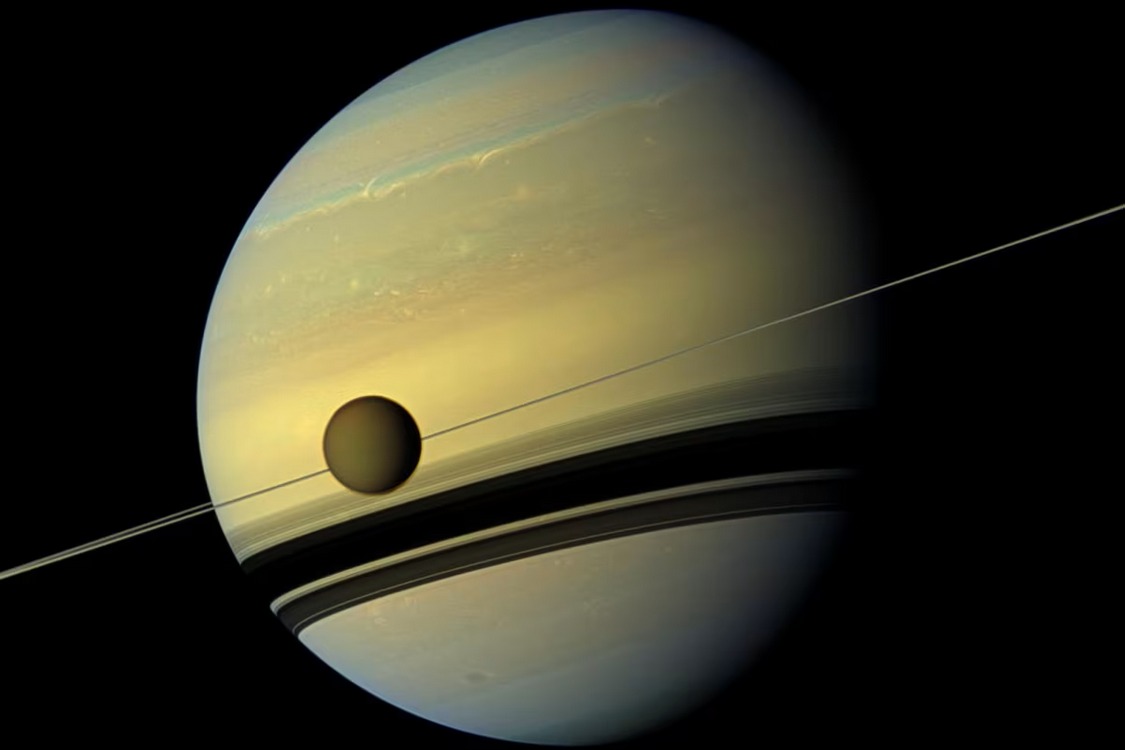
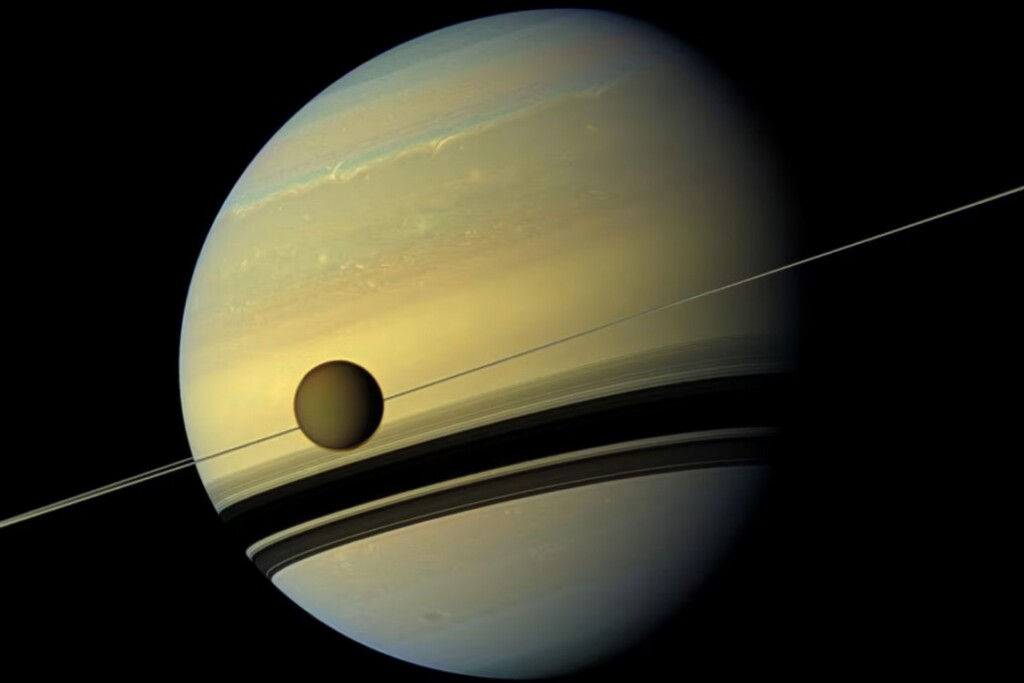
Titan, the largest moon of Saturn, is bigger than Mercury, yet for all its conspicuousness, scientists don’t know exactly how it came to be so large that it’s gravitational influence causes Saturn to tilt and wobble.
There are some 274 moons that orbit Saturn, the solar-system’s second largest planet, and Matija Ćuk, a research scientist at the SETI Institute in Mountain View, California, proposes a theory that one of these collided with Titan in the planet’s ancient past, enlarging it in the process.
Ćuk believes it might have been the precursor to Hyperion, the largest nonspherical Saturnine moon, but which is tiny in comparison to Titan.
Ćuk put data collected by NASA’s Cassini Probe which visited Saturn between 2004 and 2017 together with new research and computer simulations to present the idea that an extra moon colliding with Titan set off a chain reaction that not only explains Titan’s size, but Saturn’s characteristic wobble and tilt, and even its famous rings, saying the theory “explains everything.”
Even as the James Webb Space Telescope has pushed the boundaries of understanding the university farther than we could have ever imagined, the discovery demonstrates how much is left to know about our own cosmic cul-de-sac.
“I propose that there was an extra moon about half a billion years ago that collided with Titan, that actually became part of Titan,” Ćuk told CNN about his research, accepted for publication in The Planetary Science Journal.
“From this event, Titan could have perturbed some of the inner moons into more collisions, which created the rings sometime later, maybe 100 million years ago.”
Previously, scientists estimated that the orbital force of Neptune accounted for the wobble of Saturn. This concept in astronomy is known as “resonance,” but data from Cassini showed they weren’t sufficiently synced up to explain this.
Then in 2022, scientists proposed that a lost moon called Chrysalis had spun too close to Saturn, broke apart, and formed its rings as well as its tilt and wobble.
Refining the concept, Ćuk showed that if you look closely, Saturn is wobbling a bit too fast for Neptune’s resonance to account for, but subtracting backwards in time, around when Saturn’s rings are thought to have formed, the wobble is very closely aligned with Neptune.
Adding in an extra moon, around 1,000-times larger than Hyperion, makes the resonance between Neptune and Saturn exact.
MORE SOLAR-SYSTEM SCIENCE: New Webb Image Captures Clearest View of Neptune’s Rings, Revealing the Ice Giant in Whole New Light
In other words, when Saturn had both the proto-Hyperion moon and proto-Titan, its resonance with Neptune was so close as to fit into established calculations on how the orbital force of one planet can affect others, but a collision between the moons sped up its wobble and accounted for why the Neptune theory seemed improbable.
CNN reached out to William B. Hubbard, professor emeritus of planetary sciences at the University of Arizona, who wasn’t involved in Ćuk’s research, to ask for comment.
LOCAL (RELATIVELY) NEWS: This Tiny Moon of Saturn Is the Smallest Case of a Subsurface Ocean Ever Found in the Solar System
Professor Hubbard concluded that Ćuk’s theory fits the billing better than did earlier theories about the Chrysalis moon.
This was the same conclusion as Carl Murray, an emeritus professor of mathematics and astronomy at Queen Mary University of London, who wasn’t involved in the work but was a member of the Cassini team. Murray called it “highly probable.”
SHARE This Local Astronomy Seemingly Solved…