














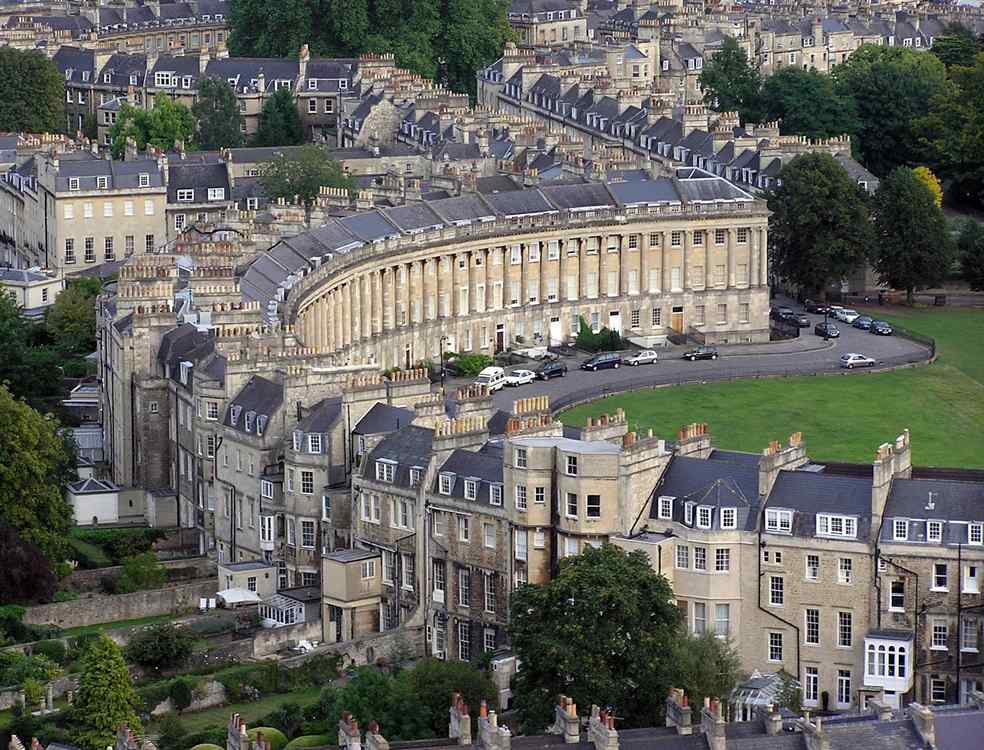
298 years ago today, John Wood the Younger, a famous British architect who gave the nation such famous works as the Royal Crescent and the Circus in Bath, was born. His craft and determination in succeeding in his father’s storied reputation as a Bath builder elevated the cityscape to be one of the most striking and romantic of any in Britain. His magnum opus is without question the Royal Crescent, a row of 30 terraced houses laid out in a sweeping crescent of Palladian splendor, considered the finest example of Georgian-era architecture outside London. READ more about his works… (1728)
Bath got its name from the exquisitely-preserved, Roman-era public baths, and that architectural legacy was carried on by the British natives, who built one of the most stunning urban environments of northern Europe during the Middle Ages and Early Modern period. John Wood the Elder, fond of druidism and freemasonry, was born in the city and designed several residential features, including the Queen Square and the Circus, before dying without having seen the latter built.
He was succeeded by his son, John Wood the Younger, who completed the Circus from his father’s plans, and proceeded to design and build Gay Street, a line of Georgian rowhouses that connects the Circus—a perfectly circular collection of mansions situated around an elegant traffic circle with three exits, to Queen Square, another row of mansions built by his father. John Wood lived on 41 Gay Street, while Jane Austin lived at number 25.
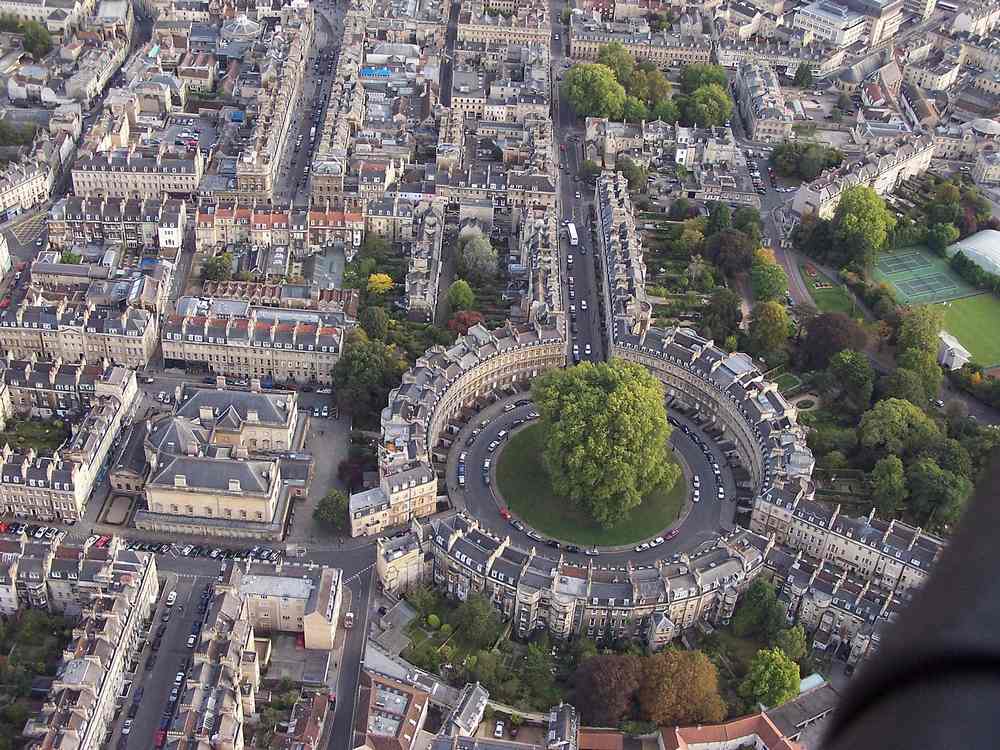
They are 3 components that make up the most important architectural feature of Bath city center, all of which the Younger Wood attempted to usurp with his Royal Crescent. The 500-foot-long (150 m) crescent has 114 Ionic columns on the first floor. Each original purchaser bought a length of the façade, and then employed their own architect to build a house behind the facade to their own specifications; hence what can appear to be two houses is occasionally just one.
This system of town planning is betrayed at the rear and can be seen from the road behind the Crescent: while the front is uniform and symmetrical, the rear is a mixture of differing roof heights, juxtapositions, and fenestration. This architecture, described as “Queen Anne fronts and Mary-Anne backs,” occurs repeatedly in Bath. It was the first crescent of terraced houses to be built and an example of “rus in urbe” (the country in the city) with its views over the parkland opposite.
In front of the Royal Crescent is a “ha-ha,” a ditch on which the inner side is vertical and faced with stone, with the outer face sloped and turfed, making an effective but invisible partition between the lower and upper lawns. The ha-ha is designed so as not to interrupt the view from Royal Victoria Park, and to be invisible until seen from close by.
John Cleese, one of the 6 members of Monty Python, still lives in the Crescent
MORE Good News on this Date:
- Hiram Rhodes Revels, a Republican from Mississippi, became the first black member of US Congress (1870)
- People in Amsterdam protested against Nazis and anti-Jewish laws (1941)
- Soviet leader Nikita Khrushchev denounced the brutality of Joseph Stalin in his speech, On the Personality Cult and its Consequences (1956)
- Court rulings banned certain corporal punishment in British schools under the Human Rights Convention (1982)
- Van Halen’s song Jump started a five-week run at #1 on the US singles chart (1984)
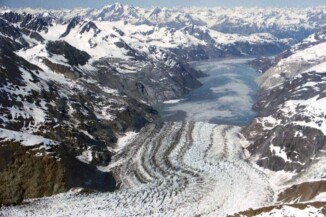
101 years ago today, President Calvin Coolidge invoked the Antiquities Act to protect Glacier Bay, a long narrow fjord bisecting the Fairweather Range and Takhinsha Mountains lined with the mouths of glaciers. Originally established as Glacier Bay National Monument, the inestimable value of the unspoiled Alaskan coastal ecosystem saw the property expanded into a National Park and Preserve, and eventually a UNESCO Natural Heritage Site—one of the largest on Earth at 3.3 million square miles.
National Park Service personnel were not stationed at Glacier Bay until nearly 25 years after its creation when a seasonal outfit quartered at Bartlett Cove. It wasn’t until 1966 that the first visitors were able to come and see what the president of their fathers’ lifetimes had protected high in the frigid Bearing Sea.
During the Nixon Administration, the Alaska Native Claims Settlement Act, which ended a dispute between the Federal Government and Alaskan tribal nations over land claims, included a provision to add 80,000,000 acres to the national park system. Expansion proposals for Glacier Bay at the time involved extending the borders to the Alsek River—which was eventually done by President Carter—to create Glacier Bay National Park and Preserve, with the preserve component welcoming out-of-state hunters and trappers.
There are 1,045 glaciers in total in the park’s boundaries, including seven tidewater glaciers that run down to the bay and calve icebergs into it. (1925)
77 years ago today, the great Lebanese/French scholar and writer Amin Maalouf was born. His bibliography has been translated into over 40 languages worldwide and contains a mixture of award-winning fiction and non-fiction books. In 1984, Maalouf published what for scholars and historians of the Middle Ages was a huge spanner in the works of one of the most famous events during that period. The Crusades Through Arab Eyes uses Arab and Turkic chroniclers as sources to tell a tale that is essentially the complete opposite of the story of the Crusades known in the West.
Maalouf worked as the director of An-Nahar, a Beirut-based daily newspaper, until the start of the Lebanese Civil War in 1975, when he moved to Paris, which became his permanent home. After the crusades, Maalouf began writing fiction novels that reflected his life experiences of inter-linguistic migration, voyaging, and disruption of daily life through tumultuous events. He’s won numerous awards for his work.
Keeping with his historical work, the novels explore the vast, colorful, and diverse lands within the Arab Empire and before. In 2020, he was awarded the National Order of Merit by President Emmanuel Macron. (1949)
Happy 45th Birthday to the most successful Asian footballer of all time: Park Ji-sung. As a member of the Manchester United squad during the middle 2000s, Park made 134 appearances while scoring 19 goals for the Red Devils. His time in Manchester made him the first South Korean player in the club’s history, and the first Asian to captain the squad. He won four English Premier League titles, the UEFA Champion’s League, and the FIFA Club World Cup, making him both the most decorated South Korean and Asian footballer in the sport’s history.

Park received much acclaim at Manchester United for his speed, off-the-ball movement, work rate, and energy, which saw him deployed all over the midfield, including in the middle of the pitch, in a holding role, in a box-to-box role or on either wing, where he operated as a defensive winger, incessantly pressing the opponent players. Moreover, Park was known as a big game player, as he was often used by Sir Alex Ferguson in big league games or European games where there was an extra emphasis on defensive work.
There are players that win plaudits for skill, numbers of goals and assists, and attitude, and then there are players ranked for their work ethic. Park, whose nickname was “Three Lungs” is certainly among this latter group, with Italian World Cup winner Andrea Pirlo describing him as “the first nuclear-powered South Korean in history, in the sense that he rushed about the pitch at the speed of an electron.” Manchester United legend Wayne Rooney agreed, saying he was almost as important as Christiano Ronaldo “because of what [he] did for the team.”
For his country, Park was captain of the South Korean squad which finished 4th place in the 2002 World Cup, and he represented his nation 100 times, scoring 13 goals. WATCH highlights of his time at Man United below. (1981)
185 years ago today, French artist Pierre-Auguste Renoir, a pioneer in the development of the Impressionist style, was born. A celebrator of beauty and sensuality, Renoir was inspired by the style and subjects of previous modern painters Camille Pissarro and Edouard Manet.
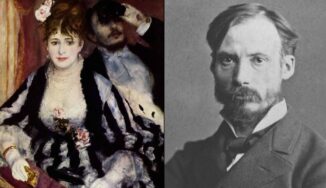
After a series of rejections, he joined forces with Monet, Sisley, Pissarro, and several other artists to mount the first Impressionist exhibition in April 1874, in which Renoir displayed six paintings that were well received. That same year, two of his works were shown in London.
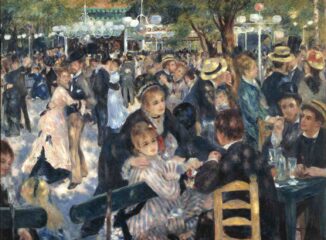
Dance at Le Moulin de la Galette is a typically-Impressionist snapshot of real life from this early period, and one of his most celebrated masterpieces. The 1876 work depicts a typical Sunday afternoon as working-class Parisians would dress up and spend time dancing, drinking, and eating galettes into the evening at the club in Paris’s Montmartre district.
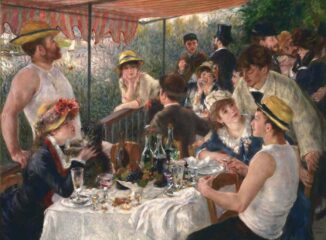
In 1890, Renoir painted the highly successful Luncheon of the Boating Party, with his wife and friends posing as models. The 66-inch wide canvas was purchased from Renoir’s son in 1923 for $125,000 by industrialist Duncan Phillips, who had spent a decade in pursuit of the work. It hangs in his Washington, DC art museum, The Phillips Collection and its presence helped to popularize the style among Americans. WATCH a short bio… (1841)
40 years ago today, a new female president, Corazon Aquino, was sworn into office as jubilant supporters in the Philippines cheered the end of 20 years of authoritarian dictatorship under Ferdinand Marcos. Ms. Aquino was later selected as Time Magazine’s Woman of the Year. Before bravely leading the restoration of democracy in her country, she had not held any other elective office.

A self-proclaimed “plain housewife”, she was married to Senator Benigno Aquino, Jr., the staunchest critic of President Marcos who was assassinated three years earlier. When the dictator called for snap elections, Aquino ran for president with a former senator as her running mate. After the elections were held on February 7, Marcos was proclaimed the winner amid allegations of fraud, and Aquino called for massive civil disobedience. Defections from the Armed Forces and the support of the local Catholic hierarchy fueled the People Power Revolution that ousted Marcos and secured Aquino’s accession.
She served as president for six years, pushing through civil and human rights–as well as economic–reforms. When Corazon died of cancer in 2009, hundreds of thousands of Filipinos filled the streets to say a final farewell to their beloved “Cory.” (1986)
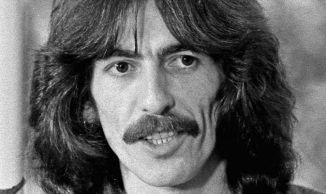
And, 83 years ago today, guitarist-songwriter George Harrison was born in Liverpool, England. His mother, Louise, wanted only for him to be happy, and the shop assistant recognized that “nothing made George quite as happy as making music.” The Beatle who injected Eastern influences and meditation teachings into the ‘fab four,’ his original compositions for the band included While My Guitar Gently Weeps, Here Comes the Sun and Something.
A successful solo artist, he released the critically acclaimed triple LP, All Things Must Pass (with My Sweet Lord) and produced the first charity benefit show, Concert for Bangladesh. He also formed the supergroup, the Traveling Wilburys. WATCH him play Here Comes the Sun–with Ringo on drums… (1943)
And, 31 years ago today, Frank Sinatra sang to a live audience for the last time, performing with his band before 1,200 invited guests on the closing night of the Frank Sinatra Desert Classic golf tournament.
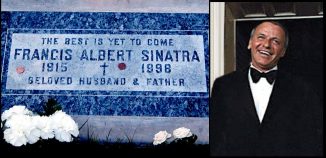
His closing song that night, at 80 years old, was The Best is Yet to Come. Esquire reported that evening that Sinatra was “clear, tough, on the money” and “in absolute control.” The words “The Best is Yet to Come” are etched on Sinatra’s tombstone in Cathedral City, California. WATCH the actual performance below…
Born to Italian immigrants in Hoboken, New Jersey, Ol’ Blue Eyes’ was one of the best-selling music artists of all time, having sold more than 150 million records worldwide in his six-decade career. He also made millions swoon in films like From Here to Eternity—which earned him an Oscar—and other acclaimed Hollywood movies. (1995)
SHARE the Milestones, Music, and Memories…