














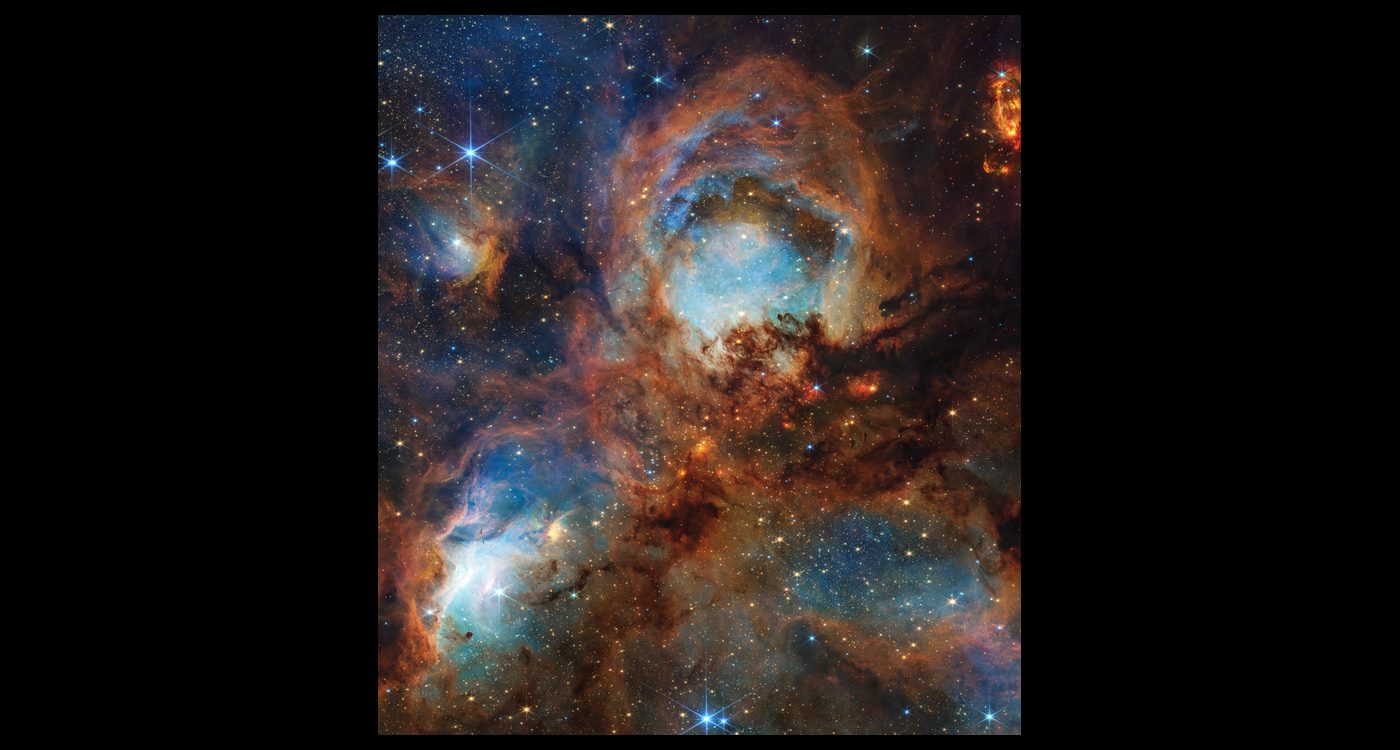
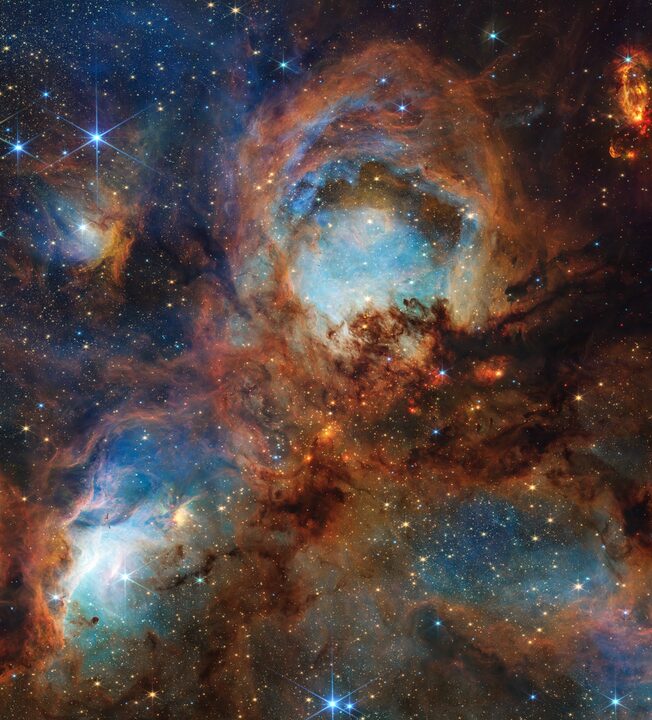
NASA’s James Webb Space Telescope has clawed back the thick, dusty layers of a section within the Cat’s Paw Nebula to mark the start of its 3rd year of operations.
The image it reveals shows a star-forming region where massive stars are in their very earliest stages of birth, helping scientists chart all the little steps between something like our Sun and the gas and dust which created it.
Located approximately 4,000 light-years away in the constellation Scorpius, the Cat’s Paw Nebula offers scientists the opportunity to study the turbulent cloud-to-star process in great detail.
Webb’s observation of the nebula in near-infrared light builds upon previous studies by NASA’s Hubble and retired Spitzer Space Telescope in visible and infrared-light, respectively.
With its unparalleled resolution, Webb shows never-before-seen structural details and features. Massive young stars are carving away at nearby gas and dust, while their starlight is producing a bright nebulous glow represented in blue.
It’s a temporary scene where the disruptive young stars have a brief but important role in the region’s larger story. As a consequence of these massive stars’ lively behavior, the local star formation process will eventually come to a stop.
The nebula takes its name from the cavernous clouds of dust shaped like the toe pads of a feline paw. The toe pad at the top is nicknamed the “Opera House” for its circular, tiered-like structure. The primary drivers for the area’s cloudy blue glow are most likely toward its bottom: either the light from the bright yellowish stars or from a nearby source still hidden behind the dense, dark brown dust.
Just below the orange-brown tiers of dust is one of many bright yellow star with diffraction spikes seen throughout the image. While this massive star has carved away at its immediate surroundings, it has been unable to push the gas and dust away to greater distances, creating a compact shell of surrounding material.
Look closely to notice small patches, like the tuning fork-shaped area to the Opera House’s immediate left, that contain fewer stars. These seemingly vacant zones indicate the presence of dense foreground filaments of dust that are home to still-forming stars and block the light of stars in the background.
Toward the image’s center are small, fiery red clumps scattered amongst the brown dust. These glowing red sources mark regions where massive star formation is underway, albeit in an obscured manner.
WEBB’S RECENT WORK:
- LOOK at All the Dark Matter in This New Image from the James Webb Telescope
- James Webb Telescope Debuts New Trick: Blocking Out Stars and Photographing Their Planets
- Beyond the ‘Dragon Arc’ Astronomers Unveil a Treasure Trove of Hidden Stars
- See the Stunning New Image of Uranus – Showing Rings and its Moons Clearer Than Ever
Some blue-white stars, like the one in the lower left toe pad, seem to be more sharply resolved than others. This is because any intervening material between the star and the telescope has been dissipated by stellar radiation.
Near the bottom are small, dense filaments of dust which have managed to remain despite the intense radiation, suggesting that they are dense enough to form protostars. A small section of yellow at the right notes the location of a still-enshrouded massive star that has managed to shine through intervening material.
One eye-catching aspect of this Webb image is the bright, red-orange oval at top right. Its low count of background stars implies it is a dense area just beginning its star-formation process.
A couple of visible and still-veiled stars are scattered throughout this region, which are contributing to the illumination of the material in the middle. Some still-enveloped stars leave hints of their presence, like a bow shock at the bottom left, which indicates an energetic ejection of gas and dust from a bright source.
WATCH a video tour of the region offered by our space administration…
CELEBRATE Webb’s Three Years Of Brilliant Service With Your Friends…