













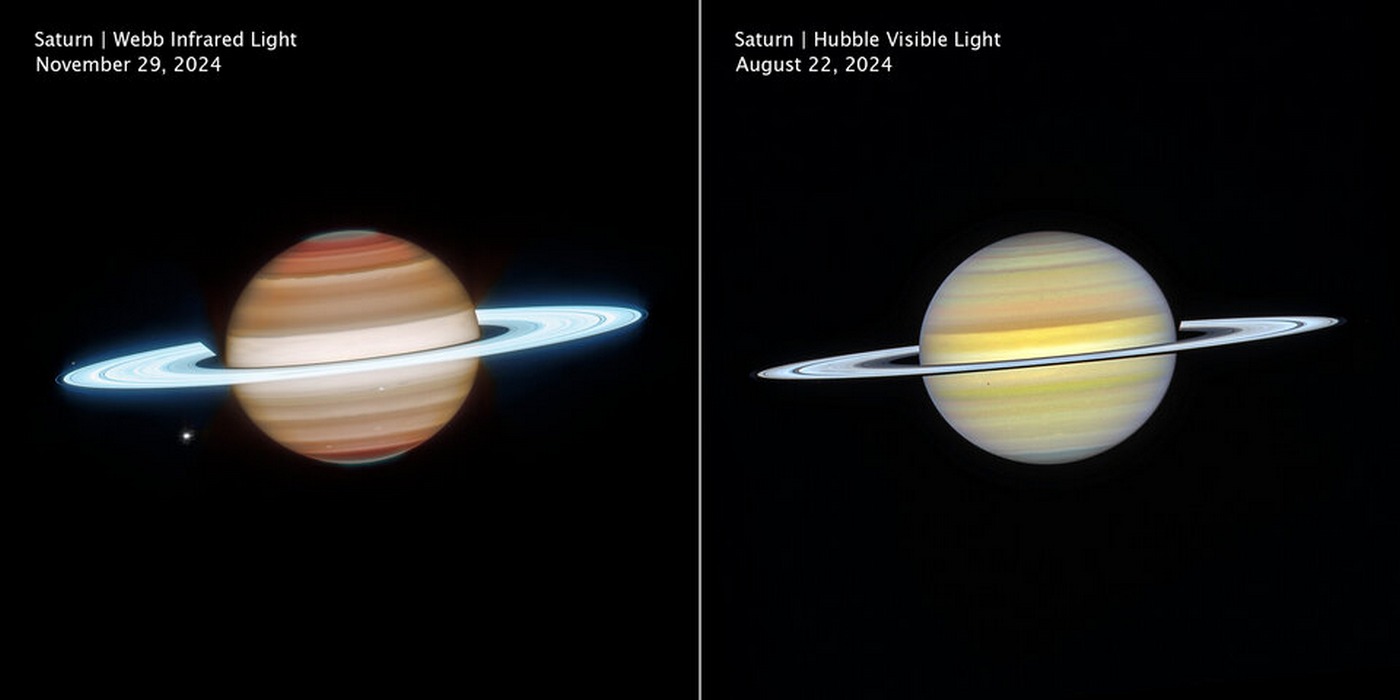
Storms, ribbons, and its iconic rings in screaming electric blue, Saturn appears like you’ve never seen it before in a new set of images released by our flagship space telescopes James Webb and Hubble.
Whether you want to call it peeling an onion or cutting through a 7 layer cake, the combination of these two observatories, the former imaging in infrared light and the latter in visible light, help deepen the story of Saturn’s atmosphere and weather.
The Hubble image seen here was captured as part of a more than a decade long monitoring program called OPAL (Outer Planet Atmospheres Legacy) in August 2024, while the Webb image was captured a few months later using Director’s Discretionary Time.
Hubble helps see more subtle variations in color across the world, while Webb’s infrared view allows operators to image the deep clouds below the stormy atmosphere.
In the Webb image, a long-lived jet stream known as the ‘ribbon wave’ meanders across the northern mid-latitudes, influenced by otherwise undetectable atmospheric waves. Just below that, a small spot represents a lingering remnant from the ‘Great Springtime Storm’ of 2011 to 2012.
Several other storms dotting the southern hemisphere of Saturn are visible in Webb’s image, as well.
All these features are shaped by powerful winds and waves beneath the visible cloud deck, making Saturn a natural laboratory for studying fluid dynamics under extreme conditions.
Several of the pointed edges of Saturn’s iconic hexagon-shaped jet stream at its north pole, discovered by the Voyager spacecraft in 1981, are also faintly visible in both images. It remains one of the Solar System’s most intriguing weather patterns.
Its persistence over decades highlights the stability of certain large-scale atmospheric processes on giant planets. These are likely the last high-resolution looks we’ll see of the famous hexagon until the 2040’s, as the northern pole enters winter and will shift into darkness for 15 years.
In Webb’s infrared observations, Saturn’s poles appear distinctly grey-green, indicating light emitting at wavelengths around 4.3 microns. This distinct feature could come from a layer of high-altitude aerosols in Saturn’s atmosphere that scatters light differently at those latitudes. Another possible explanation is auroral activity, as charged molecules interacting with the planet’s magnetic field can produce glowing emissions near the poles.
Also in Webb’s infrared image, the rings are extremely bright because they are made of highly reflective water ice. In both images, we’re seeing the sunlit face of the rings, a little less so in the Hubble image, hence the shadows visible underneath on the planet.
RINGS AND AURORAE: New Webb Image Captures Clearest View of Neptune’s Rings, Revealing the Ice Giant in Whole New Light
Saturn’s orbit around the Sun, combined with the position of Earth in its annual orbit, determines our changing viewing angle of Saturn’s face and ring. The planet is tilted on its axis to a greater degree than Earth, which allows for occasionally exceptional views of the rings, and occasionally poor views.
The images also contain subtle ring features such as spokes and structure in the B ring (the thick central region of the rings) that appear differently between the two observatories. The F ring, the outermost ring, looks thin and crisp in the Webb image, while it only slightly glows in the Hubble image.
MORE PLANETARY SCIENCE: Citizen Scientist Spots Earth-like Planet: Now Astrophysicists Will Focus Most Powerful Telescopes on it
These 2024 observations, taken 14 weeks apart, show the planet moving from northern summer toward the 2025 equinox. As Saturn transitions into southern spring, and later southern summer in the 2030’s, Hubble and Webb will have progressively better views of that hemisphere.
Hubble’s observations of Saturn for decades have built a record of its evolving atmosphere. Programs like OPAL, with its annual monitoring, have allowed scientists to track storms, banding patterns, and seasonal shifts over time. Webb now adds powerful infrared capabilities to this ongoing record, extending what researchers can measure about Saturn’s atmospheric structure and dynamic processes.
SHARE These Beautiful Images Of Our Ringed Neighbor With Your Friends…