













Reprinted with permission from World at Large News
In South Africa, a strategy 6 years in the making to protect rhinos from poaching, as ingenious as it is dramatic, is now being implemented on the ground in the country’s game reserves and parks.
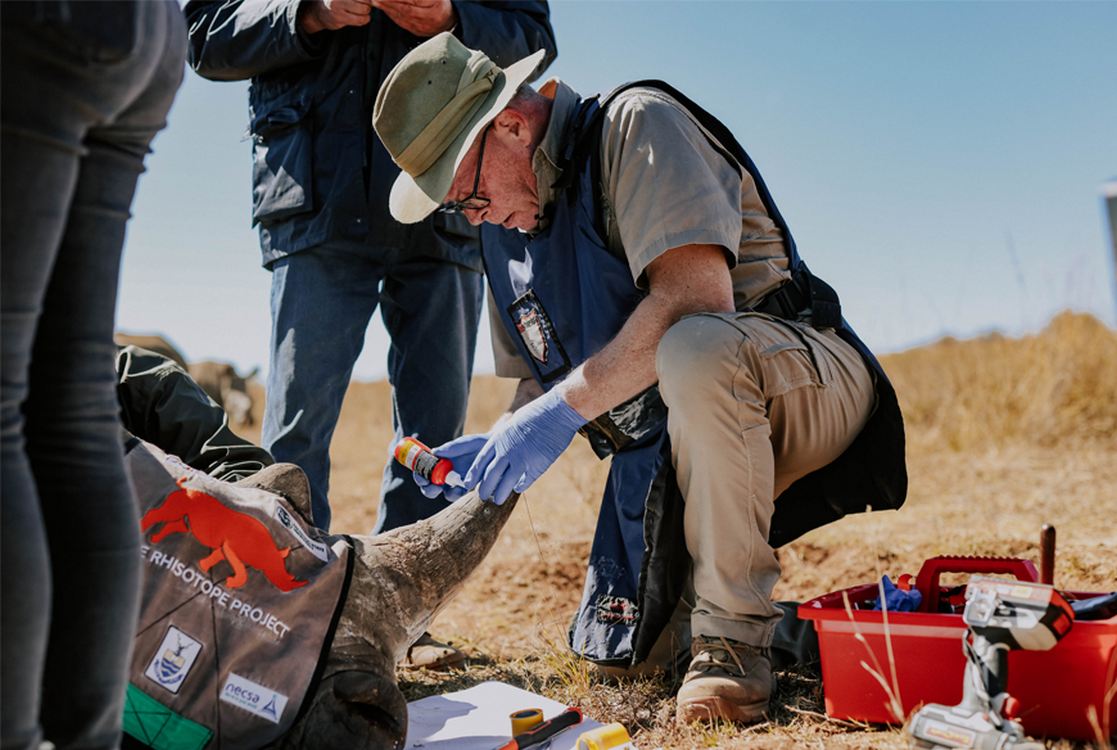
Called the Rhisotope Project, it involves embedding non-harmful radioactive isotopes into the horns of rhinos, thereby rendering them impossible to traffic across borders due to existing infrastructure at seaports and airports to prevent nuclear terrorism and proliferation.
Even if the isotope is found and removed, the residue on the horn—and anything it touches—can be detected. Undertaken by the University of Witwatersrand-Johannesburg, field tests have confirmed that the radioactivity of the isotopes can be identified even if a single horn is hidden inside a standard, 40-foot steel shipping container.
The Rhisotope Project was launched, a release from “Wits” University elaborates, to combat the high levels of illegal poaching of South Africa’s rhinos. Home to the largest population of the rhinoceros species anywhere on Earth, South Africa has been combatting rhino poachers, as they threaten to wipe out the already small populations of white rhino (Ceratotherium simum) and black rhino (Diceros bicornis), classified by the International Union for Conservation of Nature (IUCN) as “Near Threatened” and “Critically-Endangered” respectively.
“Our goal is to deploy the Rhisotope technology at scale to help protect one of Africa’s most iconic and threatened species. By doing so, we safeguard not just rhinos but a vital part of our natural heritage,” Jessica Babich, CEO of the Rhisotope Project, said in a statement.
Roughly 11,000 machines capable of detecting radiation are installed at points-of-entry across the world’s 200-odd countries, and have been designed to allow staff to make such detections with minimal effort and training. By contrast, few places have infrastructure or training programs that specialize in detecting trafficked animal parts.
There was skepticism early on about whether the radioactive material would hurt the rhinos, but other conservationists working to protect the mega mammals have called it “a magical idea”.
A decade in the making
“There was an attempt to use nuclear technology back in 2015/16 when a completely different group was trying to work with NECSA (Nuclear Energy Corporation of South Africa) and some major funding to see if using nuclear technology to protect rhinos was feasible. But it wasn’t, they gave it up very, very quickly because the type of technology they were using wasn’t going to work in the field,” Babich told WaL.
She explained that it was overly cumbersome, and the idea was later put to Professor James Larkin, Chief Scientific Officer of the Rhisotope Project and scientist specializing in radiology at Witwatersrand University. It was he who proposed using isotopes.
“The idea grew out of a question of whether or not radioactivity could be used to ‘poison’ a horn,” Professor Larkin told WaL via email. “From my point of view that is an emphatic ‘no’. I came up with the idea to use radioactive seeds to devalue the horn and make it much easier to track across international borders. So basically the idea, good or bad, is mine”.
NECSA and Wits worked together with the International Atomic Energy Agency (IAEA) to advance Larkin’s idea, and in 2024, inaugurated a testing phase at a rhino nursery in the UNESCO Waterberg Biosphere Reserve in the northern province of Limpopo. The animals were monitored 24/7 for 6 months for any signs that the radioisotopes might have been affecting them.
Then, using a technique known as biological dosimetry, researchers cultured blood samples and examined the formation of micronuclei in white blood cells—a proven indicator of cellular damage. No such damage was found in the 20 rhinos, and represented a major step in the feasibility of nuclear-powered wildlife trafficking prevention.
“We have demonstrated, beyond scientific doubt, that the process is completely safe for the animal and effective in making the horn detectable through international customs nuclear security systems,” Professor Larkin said last summer.
Private rhinos, public good
For the observer, one characteristic of South African wildlands and wildlife that might seem like an impediment to the project is the fact that thousands of rhinoceroses live on privately-owned land.
“Private rhino owners in South Africa are incredibly important. Believe it or not, the vast majority [sic] are privately-owned rhinos—greater than that in national parks like Kruger,” Babich said. “All of the populations are incredible important, but as a not-for-profit company we are actively looking for partners and collaborators to gain funding support so that we can offer to treat as many rhinos as possible as quickly as possible, and we are in discussions with quite a few people and places that would like the technology put in”.
PREVENTING POACHING: India’s Rhino Stronghold Sees 86% Drop in Poaching and Five-Fold Increase in Rhinos
1 kilogram of rhino horn on the black market has been reported widely to cost around $65,000, which would make the double-horned black rhinoceros worth $130,000 dead. As has been repeated exhaustively, the material of a rhino’s horn is the same as that of a human’s fingernails and hair: keratin, a simple, crude protein that confers no medicinal properties despite the horn’s use as a medicinal tea.
Various strategies have been employed to combat rhino poaching, from funneling millions into the arsenals and training camps of anti-poaching security teams, to one man’s quest to breed captive rhinos and farm them for their horns with the intent to flood the market, crash the price, and disincentivize the poachers.
Babich explained that if using radioisotopes does deter poachers, it would save the nation’s private landowners whose lands include rhinos a lot of money that they are otherwise paying to hire, train, and equip anti-poaching security teams, and to de-horn rhinos, another of the common anti-poaching strategies. That, though, has to be done every 18 to 24 months.
“With the isotopes the rhino gets to keep its horn, and we only have to come back after a 5-year period just to top up the dosage, so it will ultimately be more cost-effective in the long-run”.
One of the nuclear scientists from Witwatersrand University involved at the periphery of the project was Professor Nithaya Chetty, dean of the science faculty at Wits. He had previously told Africa News that studies on de-horned rhinoceroses showed that even though it’s somewhat effective at deterring poachers, it negatively affects the rhinos’ social habits and hierarchy.
MORE STORIES LIKE THIS: Nuclear Waste from Unused Weapons Is Being Safely Turned to Glass After Leaking for Years
Having seen the project move from a face-to-face proposal, to a rough idea, to development, testing, success, and deployment, Professor Larkin was contemplative when asked about it.
“Feelings? A certain amount of pride that I have done the research and shown the idea is viable,” he told WaL. “Hope that the idea is taken up at scale and maybe the hope that we have really made a difference to the rhino population and they are around for a few more generations”. WaL
WATCH the testing in action below…
SHARE This Ambitious Way To Protect These Magnificent Creatures…
So sad that this had to be done, but I’m so happy that SOMETHING is being done ❤️
The “friendly isotope” has been used to recover kidnapped scientists in the past. Technology today can track it from aircraft…