














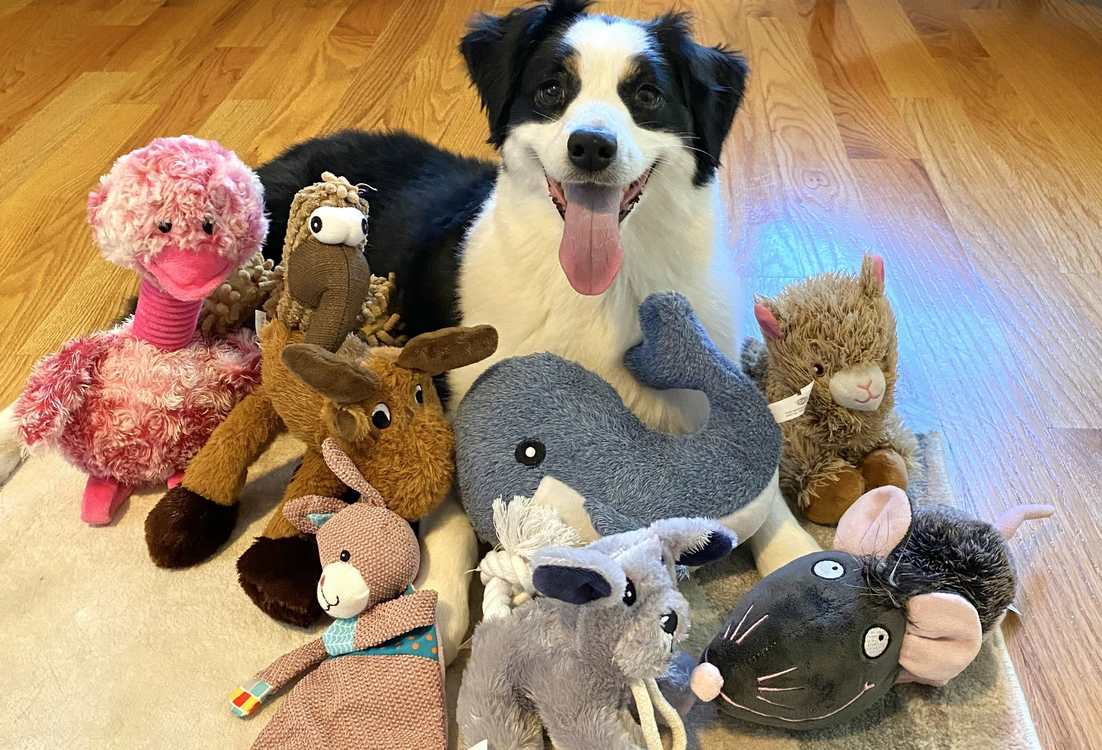
Clever canines that have a talent for learning vocabulary can pick up new words by simply overhearing their handlers’ conversations, say scientists.
Parents and dog owners know that some words should not be spoken, but only spelled, to prevent small ears from eavesdropping on the conversation, and previous research has shown that, at the age of 18 months, toddlers can already learn new words by overhearing other people.
Now a groundbreaking study, published in the journal Science, reveals that a special group of dogs are also able to learn names for objects just by overhearing their owners’ interactions.
Similarly to the 18-month-old toddlers, scientists say gifted dogs also excel in learning from both situations of direct speech, and indirect speech.
Although dogs excel at learning actions such as “sit” or “down”, the research team explained that only a very small group of canines have shown the ability to learn object names.
Dubbed Gifted Word Learner (GWL) dogs, they can quickly learn hundreds of toy names through natural play sessions with their owners. Until now, it wasn’t known whether GWL dogs could also learn new object labels when not directly addressed.
Children can, but they must monitor the speakers’ gaze and attention, detect communicative cues, and extract the target words from a continuous stream of speech.
“Our findings show that the socio-cognitive processes enabling word learning from overheard speech are not uniquely human,” said lead author on the study, Dr. Shany Dror. “Under the right conditions, some dogs present behaviors strikingly similar to those of young children.”
In an experiment, the research team tested 10 gifted dogs in two situations. In the first, owners introduced two new toys and repeatedly labelled them while interacting directly with the dog.
In the second, the dogs passively watched as their owners talked to another person about the toys, without addressing the dog at all. Overall, in each situation, the dogs heard the name of each new toy for a total of only eight minutes, distributed across several brief exposure sessions.
To test whether the dogs had learned the new labels, the toys were placed in a different room, and the owners asked the dogs to retrieve each toy by name. The dog’s performance was very accurate already at the first trials of the test, with 80% correct choices in the addressed condition and 100% in the overhearing condition.

Overall, the gifted dogs performed just as well when learning from overheard speech, as when they were directly taught, mirroring findings from studies of toddlers.
In a second experiment, the researchers introduced a new challenge where owners first showed the dogs the toys and then placed them inside a bucket, naming the toys only when they were out of the dogs’ sight.
WHY CATS SIT IN BOXES: Why Cats Love to Sit in Boxes – Even Fake Ones, According to Science
The research team explained that it created a temporal separation between seeing the object and hearing its name. Despite the discontinuity, most of the gifted dogs successfully found the named toy.
The authors suggest that the ability to learn from overheard speech may rely on general “socio-cognitive mechanisms” shared across species, rather than being uniquely tied to human language.
But the researchers emphasized that GWL dogs are extremely rare, and their “remarkable” abilities likely reflect a combination of individual predispositions and unique life experiences.
MORE STORIES LIKE THIS: Dogs Trained to Sniff Out Post-Traumatic Stress – by Smelling Patients’ Breath – With 90% Accuracy
Dr. Dror added that the dogs provide an exceptional model for exploring some of the cognitive abilities that enabled humans to develop language.
“But we do not suggest that all dogs learn in this way—far from it,” she said.
The researchers encourage dog owners who believe their dogs know multiple toy names, to contact them at the Genius Dog Challenge Research project at ELTE University in Budapest, Hungary.
SHARE This Story With Any Genius Dog-Owners You Know…