













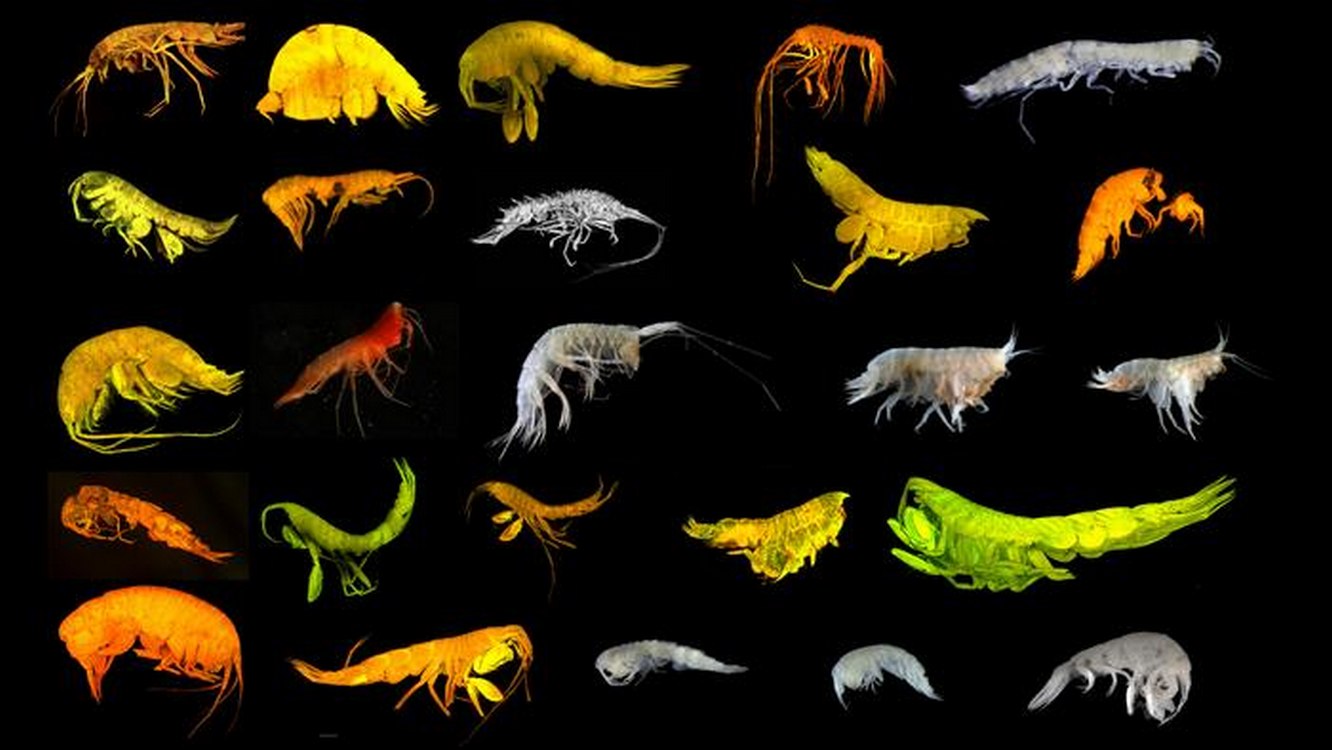
A recent international survey of a deep sea zone near Mexico turned up 24 species of shrimp-like animals called amphipods, including a whole new taxonomic family, called Mirabestiidae.
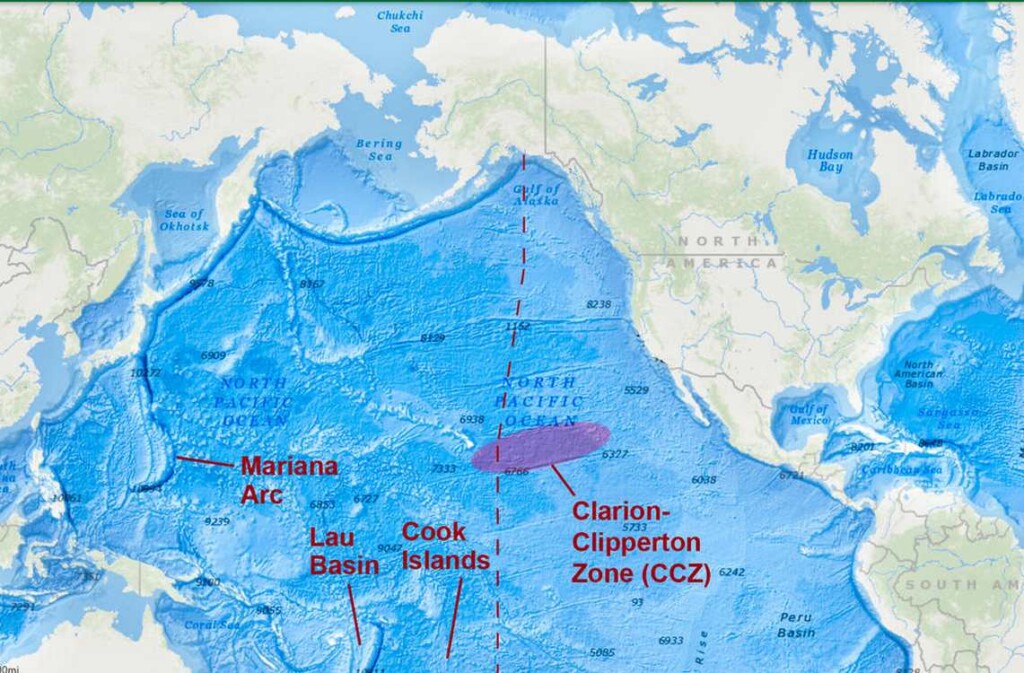
The survey took place in the Clarion-Clipperton Zone (CCZ) between Hawaii and Mexico, where a fractious seabed can range in depth from 10,000 to 20,000 feet.
Over 10,000 species of amphipods have been described by science, yet they’re such a diverse order of animals, an expedition such as this can still scoop out handfuls of new ones—and in all different colors too.
“To find a new superfamily is incredibly exciting, and very rarely happens so this is a discovery we will all remember,” said Dr. Tammy Horton of the UK’s National Oceanographic Center (NOC) in Southampton.
“With more than 90% of species in the CCZ still unnamed, each species described is a vital step towards improving our understanding of this fascinating ecosystem.”
The NOC was joined by partners and aspiring scientists from all across Europe, as well as New Zealand and Canada, for a weeks-long taxonomy workshop organized at the University of Lodz, Poland, led by Dr. Anna Jażdżewska.
The expedition and workshop were organized under the International Seabed Authority’s Sustainable Seabed Knowledge Initiative (SSKI) which aims to describe 1,000 new species by the end of the decade in order to possess a better understanding of deep-seabed biodiversity when making decisions about deep-sea mining.
“The team’s findings provide information that is crucial for future conservation and policy decisions, and it highlights how important it is for this work to continue,” Dr. Jażdżewska said in a statement.
Stretching 1.7 million square miles across the eastern Pacific Ocean, the CCZ was discovered by the Scripps Institution of Oceanography in 1954. It’s been an extremely well-surveyed area of the deep seabed, though that in itself isn’t saying much, and indeed 42% of all known deep sea species were first described in the CCZ.
The expedition uncovered a new family, called Mirabestiidae, and even a new superfamily Mirabestioidea, revealing completely new evolutionary branches. Two new genera were also discovered: Mirabestia and Pseudolepechinella.
DEEP SEA SCIENCE: Bizarre Deep-Sea Creature – a ‘Death Ball’ Sponge – Discovered in One of the Most Remote Corners of the Planet
For readers who lack a mental flowchart of taxonomy hierarchies, one famous family from above sea level is Felidae, containing all cats wild and domestic. Felidae is nested inside of the superorder Feliformia, which in addition to all the cats, contains civets, hyena, mongoose, and the curious fossa of Madagascar.
Two genera nested inside the family Felidae are Panthera, containing the tiger and the lion, and Lynx.
MORE STORIES LIKE THIS: New Caledonia Bans ‘Dangerous’ Seabed Mining for Half a Century in the South Pacific
In the CCZ, students and professors alike reveled in pulling up one new species after another, before taking them back to a frigid Poland for analysis.
Creatures were named in honor of both Horton and Jażdżewska, the organizers of the expedition and workshop, while others named species after relatives, impressions from the experience, and even a video game character that one of the amphipods resembled.
SHARE This Bonanza Discovery Deep Under The Sea With Your Friends…