














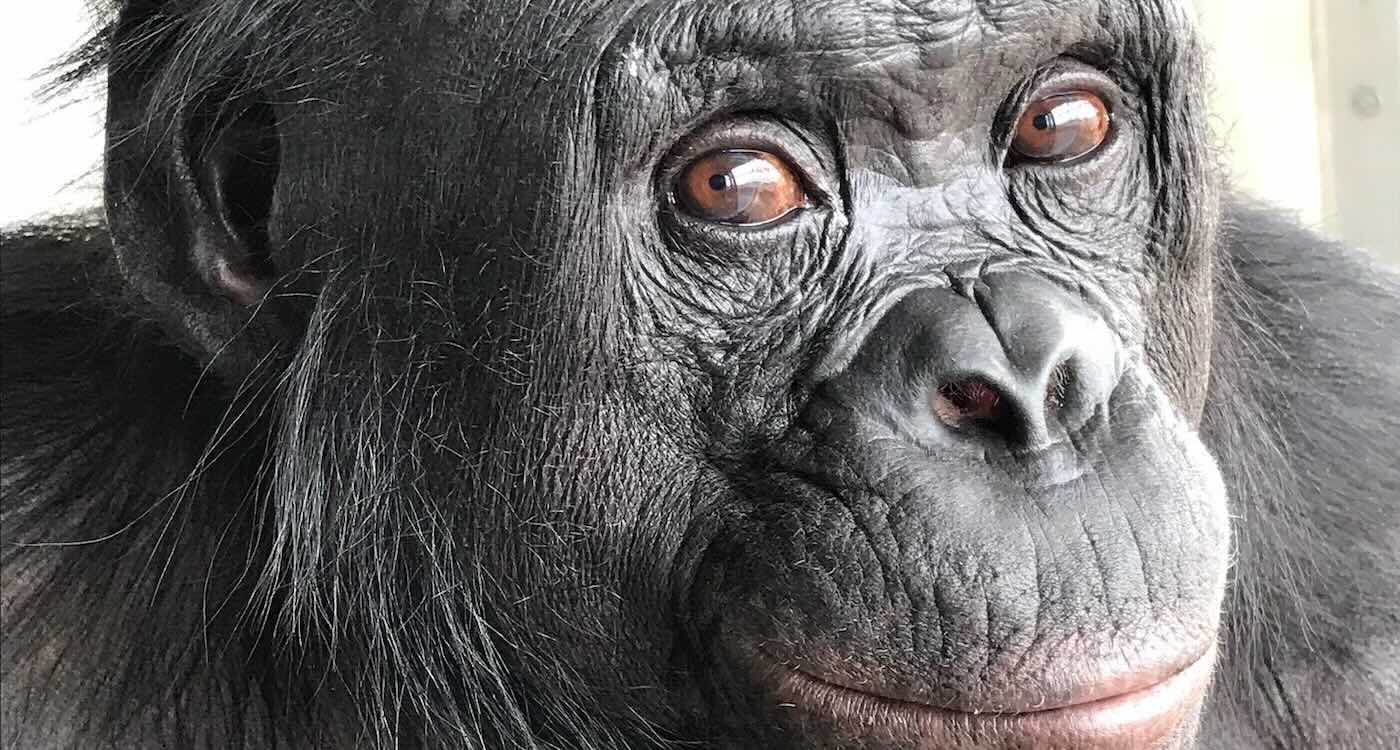
Apes share the human ability to imagine and pretend, suggests new research that included a series of tea party experiments.
Scientists at Johns Hopkins University in Baltimore, Maryland, called it the first study to show the capacity for pretending is not unique to mankind.
They learned that apes can use their imagination and play pretend. One bonobo engaged with cups of imaginary juice and bowls of pretend grapes “consistently and robustly” across three experiments, challenging long-held assumptions about the abilities of animals.
The findings, published this week in the journal Science, suggest that the capacity to understand pretend objects is within the cognitive potential of, at least, an “enculturated ape”, and likely dates back six to nine million years, to our common evolutionary ancestors.
“It really is game-changing that their mental lives go beyond the here and now,” said study co-author Dr. Christopher Krupenye.
“Imagination has long been seen as a critical element of what it is to be human, but the idea that it may not be exclusive to our species is really transformative.
“Jane Goodall discovered that chimps make tools and that led to a change in the definition of what it means to be human—and this, too, really invites us to reconsider what makes us special and what mental life is out there among other creatures.”
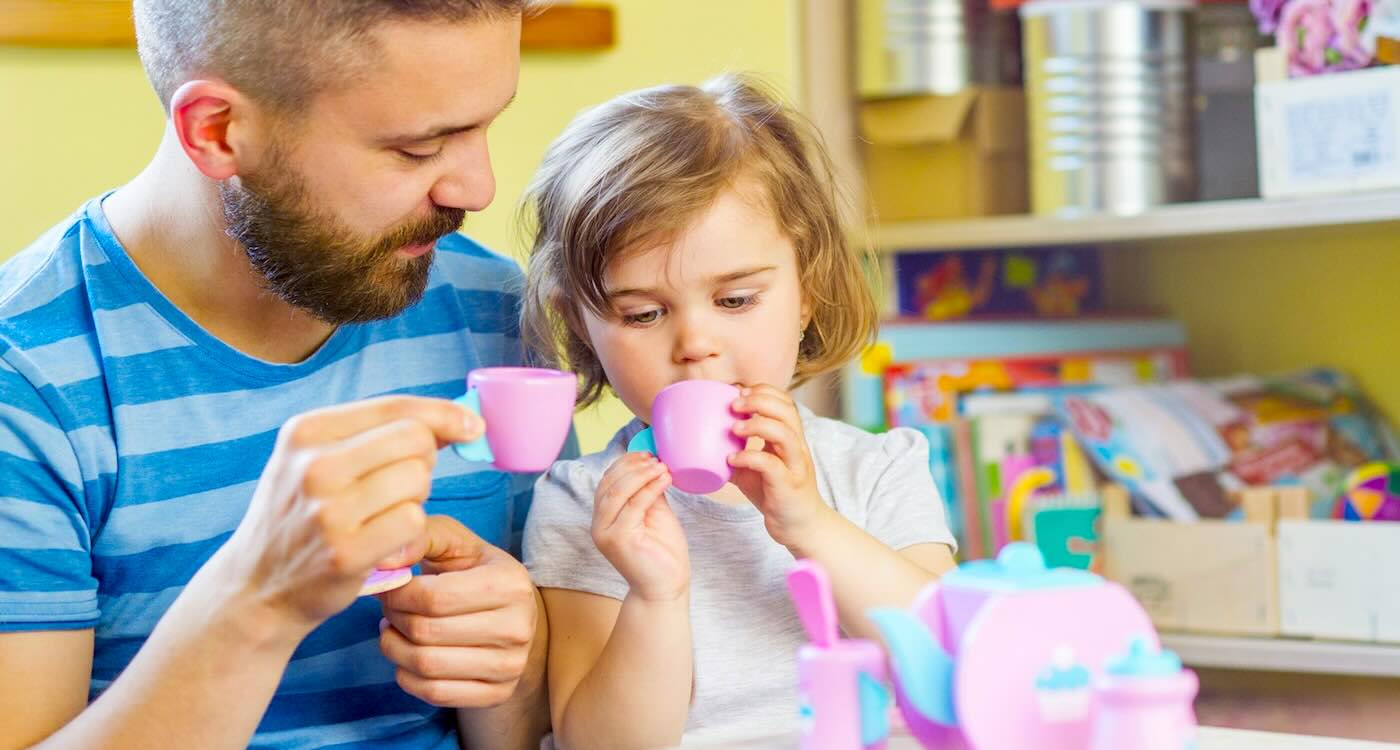
He said that, by the age of two, human children can engage in pretend scenarios, like tea parties. Even at 15-months-old, infants show measures of surprise when they see a person “drinking” from a cup after pretending to empty it.
There had been no previous studies of pretend behavior in non-human animals, despite several reports of animals seemingly engaging in pretending behavior from both the wild and in zoos or captivity.
For instance, in the wild, young female chimps have been observed carrying and playing with sticks, holding them like mothers would hold their infants. And a chimp in captivity seemed to drag imaginary blocks along the floor after playing with real wooden blocks.
Dr. Krupenye and co-author Amalia Bastos, a former Johns Hopkins postdoctoral fellow who is now a lecturer at the University of St. Andrews in Scotland, wondered if they could test the capacity to pretend in a controlled environment.
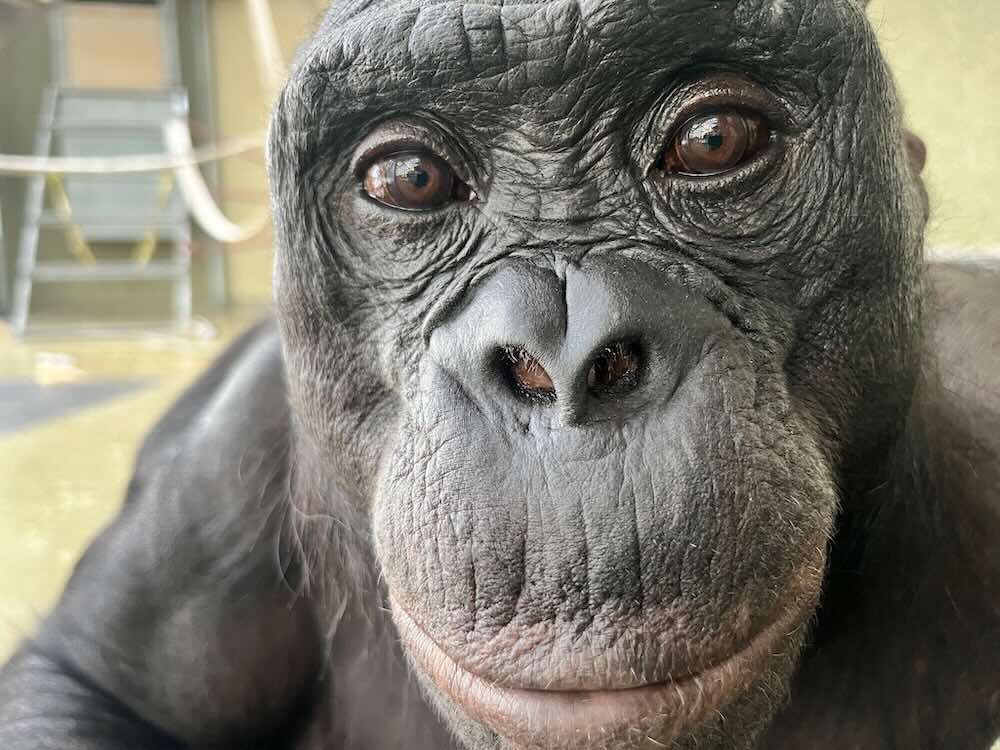
They created experiments similar to a child’s tea party to test Kanzi, a 43-year-old bonobo living at Ape Initiative in Iowa, is the world’s only research center and sanctuary dedicated exclusively to the study and conservation of bonobos, our closest primate relative.
Kanzi had been anecdotally reported to engage in pretense, and could respond to verbal prompts by pointing.
In each test, a researcher and Kanzi faced one another, tea party-style, across a table. In the first task there were two transparent cups on the table, both empty, alongside an empty transparent pitcher.
The researcher tipped the pitcher to “pour” a little pretend juice into each cup, then pretended to dump the juice out of one cup, shaking it a bit to really get it out.
The researcher then asked Kanzi: “Where’s the juice?”
The bonobo pointed to the correct cup that still contained pretend juice, even when the researcher changed the position of the cup filled with pretend juice.
In case Kanzi thought there was real juice in the cup, even if he couldn’t see it, the team ran a second experiment, during which a cup of real juice was placed alongside the cup of pretend juice.
When Kanzi was asked what he wanted, he pointed toward the real juice almost every time.
A third experiment repeated the same concept, except with grapes. A researcher pretended to sample a grape from an empty container, then placed it inside one of the two jars.
After pretending to empty one of the containers, he asked Kanzi: “Where’s the grape?”
Kanzi again indicated the location of the pretend object. The researchers said Kanzi wasn’t perfect, but he was consistently correct.
“It’s extremely striking and very exciting that the data seem to suggest that apes, in their minds, can conceive of things that are not there,” said Dr. Bastos.
“Kanzi is able to generate an idea of this pretend object and, at the same time, know it’s not real.”
MORE AMAZING APES:
• Ape Treating His Wound Using Medicinal Plant is a World First for a Wild Animal
• Apes Remember Friends Even Though They’ve Not Seen Them for 25 Years (LOOK)
• Monkeying Around? Apes Have a Sense of Humor– Researchers Categorize Their Clowning in Video
The researchers now want to test whether other apes and animals can engage in pretend play or track pretend objects. They also hope to explore other facets of imagination in apes, perhaps their ability to think about the future or to think about what’s going on in the minds of others.
“Imagination is one of those things that in humans gives us a rich mental life,” said Dr. Krupenye.
“And if some roots of imagination are shared with apes, that should make people question their assumption that other animals are just living robotic lifestyles constrained to the present. We should be compelled by these findings to care for these creatures with rich and beautiful minds and ensure they continue to exist.”
SHARE THE FASCINATING NEWS With Friends on Social Media…