














For a planet to be habitable, it’s generally considered to need liquid water. To have liquid water, a planet needs an atmosphere.
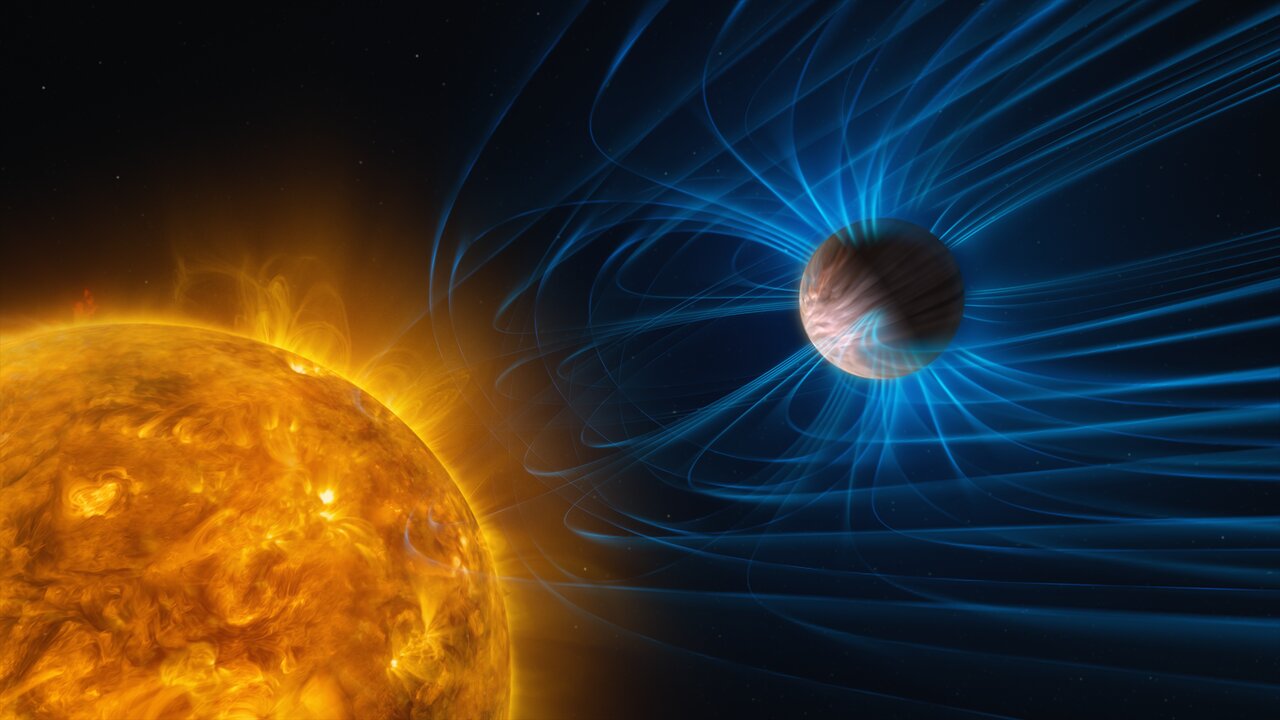
To have an atmosphere, it’s understood a world needs a magnetosphere, and for the first time ever, a team of astronomers has found the strongest evidence yet of magnetic fields—like Earth and Jupiter, but unlike Mars—around exoplanets.
Indeed the departure of Mars’ atmosphere and therefore his water is attributed to the departure of his magnetosphere.
Observations on 7 very hot, Jupiter-like exoplanets made with the European Southern Observatory’s Very Large Telescope (ESO’s VLT) and the Gemini North telescope, allowed astronomers to capture a key detail of planet formation and sustainment, but they had originally set out to simply measure the wind speeds on these distant worlds.
The researchers measured wind speeds on the worlds and determined that the winds on these planets are most likely governed by magnetic fields, providing the first robust measurement of magnetism on planets outside the solar system.
“This breakthrough opens a completely new window on exoplanet research. It’s the first time we can compare the magnetic environments of other worlds—a key step toward ultimately understanding which planets can stay alive, keep their water, and perhaps even, one day, host life as we know it,” says Julia Seidel, an astronomer at the Laboratoire Lagrange, Observatoire de la Côte d’Azur, France and lead author of the study published last week in Nature Astronomy.
Earth’s magnetic field influences our atmosphere in complex ways, and is therefore a key factor in understanding what keeps the planet habitable for life. Magnetic fields are also present in other Solar System planets, like Jupiter and Saturn. However, for the past 15 years, no one succeeded in directly measuring the strength of the magnetic fields of exoplanets.
Seidel and her team didn’t actually set out to measure magnetic fields but winds. They measured wind speeds on 7 exoplanets orbiting different stars; all gas giants like Jupiter, but each tidally locked to its host star and very close to it. Just as we always see only one side of the Moon, these planets always keep one face towards the star, resulting in a scorching hot day side and a freezing cold night side.
This temperature difference creates a climate completely different from the one on our planet, with extremely strong winds. The wind speeds in their sample ranged from around 7,200 kilometers per hour to over 25,000 kmph; in comparison, the fastest winds measured on Jupiter reach speeds of around 1,500 kmph.
“In the beginning we set out to check if the atmospheric winds behaved the same way for all hot planets,” explains Seidel. But when they looked at how the wind speeds varied with planet temperature, they saw a very intriguing pattern emerge: the hotter the planet, the slower the wind.
“This is totally counter intuitive because, all things being equal, hot planets have more energy to accelerate the winds! Something must happen that slows down the wind speeds for hotter objects,” says study co-author Vivien Parmentier, a professor at the Laboratoire Lagrange.
EXOPLANETS TO DAZZLE: Welcome to the Lemon-Shaped Planet Where Rain Turns to Diamonds
The team concluded that the most consistent explanation for this mystery is the presence of planet-wide magnetic fields, since these fields can work as a brake, slowing down the motion of charged particles in the atmosphere. The data therefore allowed the researchers to infer the strength of the magnetic field in each of the studied planets. They found them to be comparable in strength to those found in our solar system: approximately 4-times as strong as Saturn’s or about half the strength of Jupiter’s.
“Here on Earth, we know the beauty of the northern and southern lights, where particles from the Sun hit our magnetic field and are guided toward the poles, colliding with gases in the atmosphere to produce colorful displays of green, pink, and purple,” explains study co-author Bibiana Prinoth, an astronomer at the ESO station in Garching, Germany.
Similarly, we know magnetized planets in our solar system have aurorae that work in identical or almost identical ways. On the studied exoplanets, the magnetically driven aurorae could be even more dramatic.
EXOPLANETS TO PONDER: James Webb Space Telescope’s First Look at an Atmosphere on Habitable Zone Exoplanet
The team eagerly anticipates the arrival of ESO’s Extremely Large Telescope, which will help to characterize not only large, Jupiter-like exoplanets but also smaller ones like Earth, possibly even detecting gases that could produce aurorae on these distant worlds.
Prinoth hypothesizes what a sky on these uninhabitable worlds might look like: one filled not with stars behind a vast screen of colorful light dancing across a planet that’s half in perpetual day and half in endless night.
BEAM This Story Into Your Friends’ News Feeds On Social Media…