












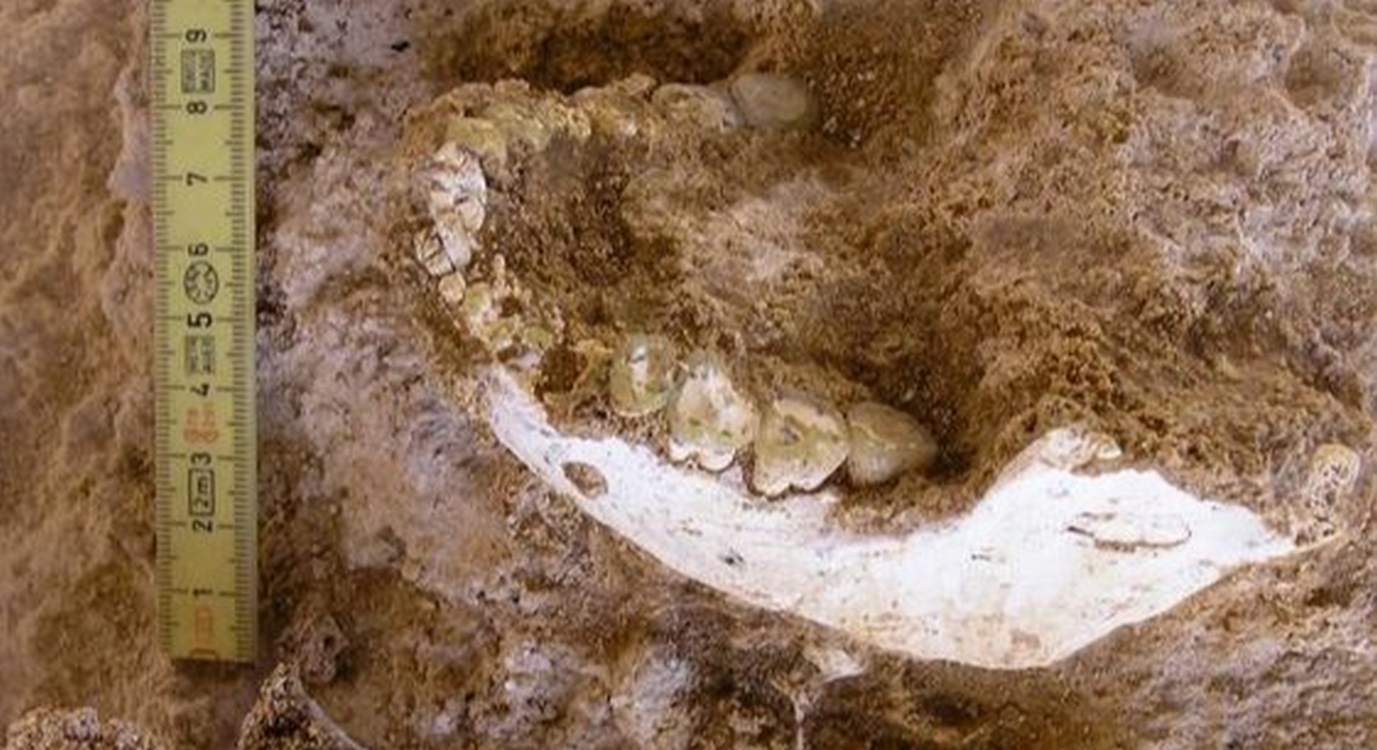
Remains of an early human ancestor from a critically important period in our evolutionary history have been found in Morocco.
Dated back 700,000 years using precise geo-magnetic methods, the assemblage of jawbones and teeth may come from the epoch during which African and Eurasian hominins diverged from their common ancestor.
The discovery was found in a cave at Thomas Quarry near Casablaca, called Grotte à Hominidés. A nearly-complete adult jawbone, a partial adult jawbone, the jawbone of a child, a vertebrae and some teeth were discovered along with a femur that bared the teeth marks of a predator.
At the time, the coastal landscape would have looked very different than today’s desert. A lush coastal wetland, it would have looked much like parts of sub-Saharan Africa today, where crocodiles, hyenas, hippos, and large cats dealt among the greenery.
The oldest known remains of our species, Homo sapiens, were also found in Morocco—at Jebel Irhoud—which dated back 330,000 years. Before us, there were a number of hominins, and scientists aren’t sure who came first, and from where.
Jean-Jacques Hublin, an anthropologist at the Max Planck Institute for Evolutionary Anthropology in Germany and the lead author of the new paper presenting the discovery, believes the finds reinforce a deep-African origin of our species, rather than a Eurasian one.
There is limited hard evidence to support what is a generally-accepted theory of human evolution: that the African hominin lineage branched off into Homo sapiens while the lineage of Eurasia evolved into the Neanderthals and Denisovans.
What evidence there is comes primarily from Gran Dolina, Spain, where fossils including cranial fragments revealed the existence of a creature named Homo antecessor, which lived in Europe between 772,000 and 949,000 years ago. The Grotte à Hominidés fossils bear a striking resemblance to the Spanish fossils.
The Gran Dolina Homo antecessor was what reinforced this theory, that Homo sapiens migrated out of Africa before evolving into distinct groups across Eurasia. Previously it had been believed that hominins existed across the Old World, and that a species spread out of Africa and replaced all the others.
Considering the speed of evolution, the Gran Dolina hominin and the distinctly different Grotte à Hominidés man almost certainly lived in the same period, and that the mosaic of traits and facial features suggest a common ancestor that had also lived on both sides of the Mediterranean.
THE PALEO TIMES: Fossil of Neanderthal Child with Down Syndrome Hints at Early Humans’ Compassion
In short, neither Homo sapiens, nor potentially even our predecessors, H. antecessor and Homo heidelbergensis, were the ones that migrated out of Africa, but that the travel bug may have bit an even more distant relative.
The limitations in the fossil evidence make it difficult to say concretely. It’s believed that Homo sapiens in Africa, and the Neanderthals and Denisovans in Eurasia, all come from a common ancestor that lived after Homo erectus, but there’s a big time gap between H. erectus and H. heidelbergensis, our second-closest relative.
MORE EARLY MAN: Staggering Finds Show Early Humans Lived Alongside the Very Apes They Evolved from
Could the Moroccan individual fit in that gap? Dr. Hublin, speaking to the New York Times, declined to be drawn into specifics.
“Human evolution is largely a history of extinctions,” he said. “It is difficult to say whether the small Grotte à Hominidés population left any descendants, but it provides a good picture of what the last common ancestor may have been like.”
SHARE This Big Step Towards Understanding Our Past…