














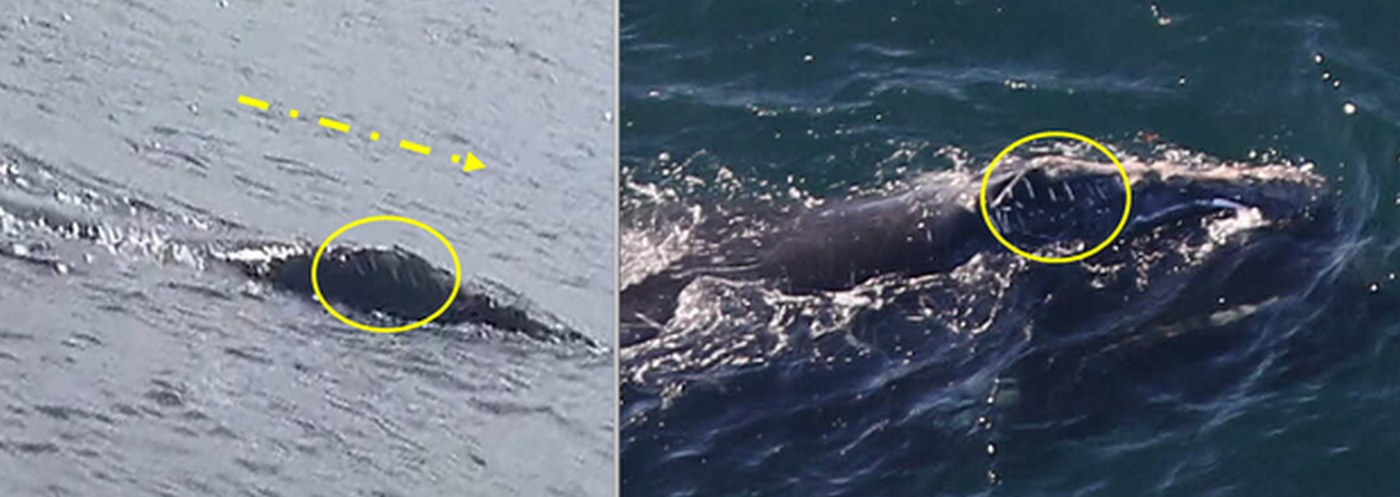
“But where else would one expect to find a right whale with Irish connections if not off Boston?”
They were the words of Padraig Whooley with the Irish Whale & Dolphin Group, spoken in reference to a never-before-seen migratory pattern in the Critically Endangered North Atlantic right whale, as he noticed how it mirrored in humorous parody a pattern ever so common among the animal’s distant mammalian relations on land—Ireland to Boston.
But make no mistake about it, an Irish N. Atlantic right whale emigrating to Boston has never been seen before, and the mere appearance of the individual adult in Irish waters was itself a sighting not recorded in 100 years.
It may have happened before—when thousands of these gentle giants moved up and down the eastern and western coasts of the Atlantic Ocean, but no record of such an event exists.
The right whale was first seen in Ireland’s Donegal Bay in July 2024. According to CBS News Boston, the New England Aquarium says a sighting of a scarred-up right whale in Boston on November 19th was the same animal.
Ian Schosberg with the Center for Coastal Studies, surveyed the animal in the waters about 23-miles off the coast, and didn’t realize at the time the true rarity of the event: for him it was just a delight to make the first NA right whale sighting of the year.
“The next day, when the Aquarium’s catalog team sent over a potential match, I was shocked,” Schosberg said in a statement. “I remembered the Irish whale sighting from July 2024 and how we’d tried to match that to a known individual in the catalog without success.”
The fact that scientists can identify individual right whales isn’t in and of itself something incredible, as there are only 380 or so of these animals left on planet Earth.
Recently, NA right whales, whose populations from the east and the west were thought not to cross the Atlantic except in cases of rare vagrancies, have been making several headline voyages.
The Irish sighting was a once-in-a-century event, but in May of this year, news came out that two whales named Curlew and Koala had spent the several months cruising down from the Mid-Atlantic coast to the tropical Caribbean seas, something described as a “once in a lifetime” event.
WHANDERING WHALES: Majestic Sei Whales Reappear in Argentine Waters After Nearly a Century
Right whales are extremely rare vagrants in the Gulf of Mexico, and there has never been a North Atlantic right whale sighting in Bahamian seas, where Curlew and Koala eventually arrived. Typically this time of year sees these giant baleens going in the exact opposite direction—further north.
Reporting on the Irish whale, CBS News paraphrased researchers explaining that these unusual sightings suggest the animals as a whole might still searching for the right habitat as they gradually return from the brink of extinction.
WHALE-OF-A-STORY: Gray Whale, Extinct for Centuries in Atlantic, Is Spotted in Cape Cod
The three subspecies of right whale are some of the largest baleens on Earth, capable of growing to between 43 and 52 feet in length, and weighing between 89 and 100 tons. While the blue whale may be bigger, the right whale has—by a factor of ten—the largest testes of any animal on Earth, weighing 1,000 pounds each, and measuring to a height of 6.6 feet, and a diameter of 2.58 feet.
SHARE This Irish Immigrant To Boston Waters With Your Friends…