














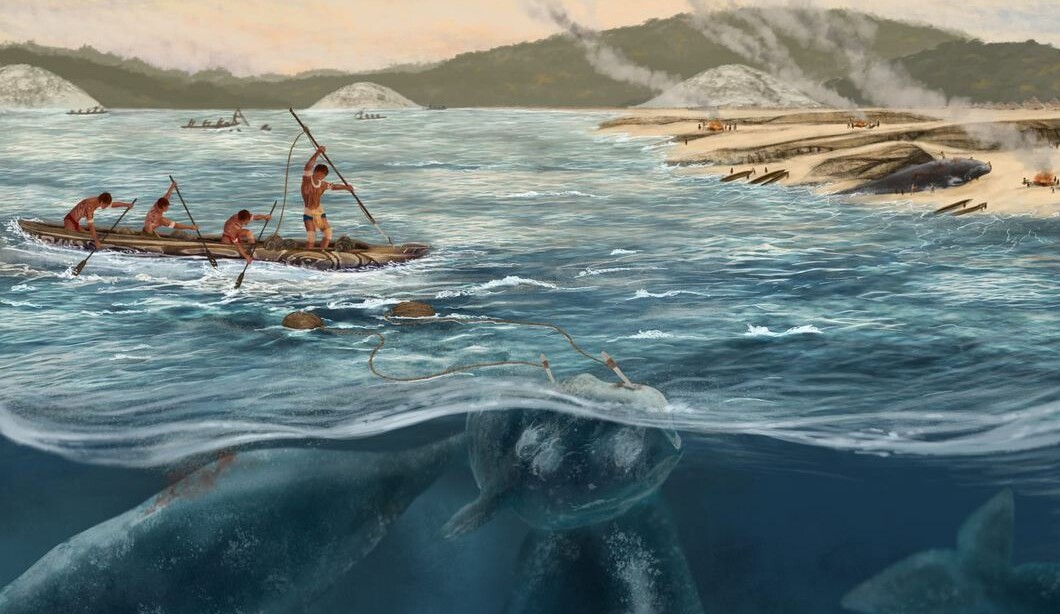
How do you hunt a whale when your boat is made of logs lashed with vines and your harpoon is carved from animal bone?
That’s what Spanish researchers were left wondering when they discovered evidence from a museum in southern Brazil that indigenous people 5,000 years ago were hunting large baleen whales like the humpback before they’d discovered sailing, and before metallurgy.
A study presenting the analysis of the museum artifacts proposes that groups inhabiting the area greatly prized not only whales as game animals, but the activity of whaling as an important, potentially sacred event.
That evidence comes from the site where the artifacts were discovered. In the area around Brazil’s Babitonga Bay, hundreds of man-made mounds of shells, refuse, bones, and marine remains called “sambaquis” were disassembled during coastal development between 1940 and 1960.
Archaeologists recovered some 9,000 artifacts from the shell mounds, and stored them in a local museum. Among the trove were whale bones buried in the mounds next to human skeletons.
Many years later, according to Smithsonian Magazine, a team of researchers from Spain and Brazil examined the artifacts more closely, and as soon as André Carlo Colonese saw the whale bones, he realized he was looking at something special.
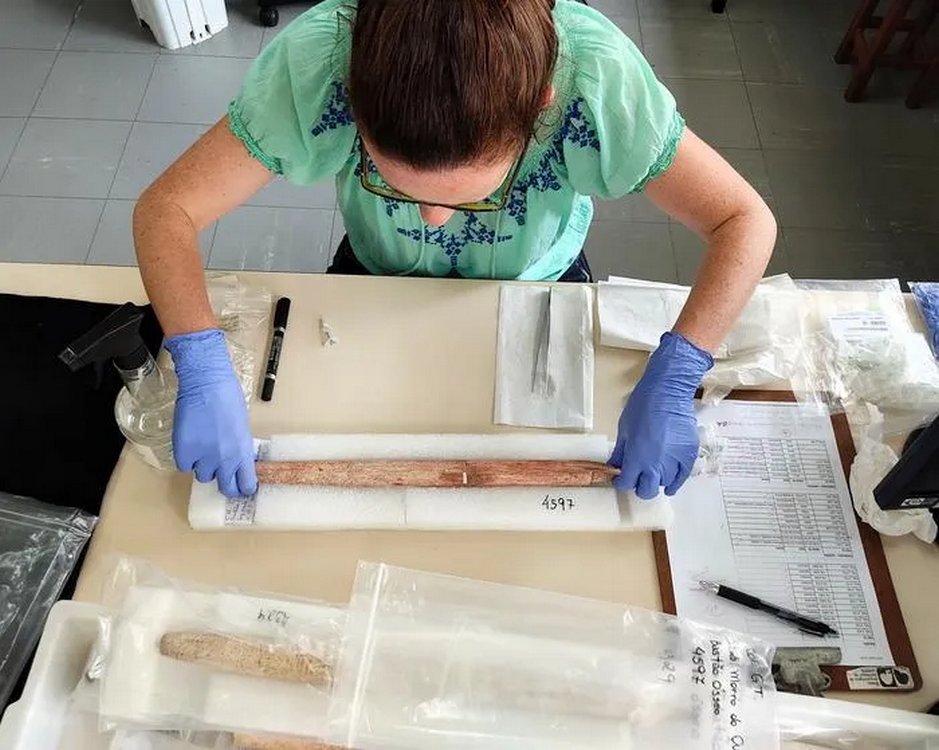
“The curators went in back and brought out dusty boxes with whale bone artifacts inside,” Colonese tells Science. “The moment they took them out, I said, ‘Guys, these are harpoons.’”
Using state of the art techniques, the study co-author from the Autonomous University of Barcelona and his colleagues identified the harpoons as being carved from the bones of southern right whales, humpback whales, sei whales, and even the largest whale on Earth, the blue whale.
With the size of their quarry and their bones, it’s not surprising that the bone-carved harpoons were quite long; longer than lead author Kristina McGrath’s forearm.
“The data reveals that these communities had the knowledge, tools, and specialized strategies to hunt large whales thousands of years earlier than we had previously assumed,” McGrath, said in a statement.
Indeed, it’s believed whaling began among postglacial societies in North America about half as many years earlier. The Sambaqui builders were previously believed to have carved their tools from dead whales that had washed up on the beach—the most rational explanation considering the force required to spear one from a raft in a time before iron.
Living off so much marine life as they did, one can imagine the taking of a whale to be a monumental event; an invaluable resource worthy of celebration.
MORE STORIES LIKE THIS: Scientists Use Stones to Build Canoe Like Their Ancestors and Sailed it 140 Miles Across Dangerous Waters
“You can imagine a big feast where everyone eats a lot of meat and blubber, and at the same time they collect oil,” Colonese tells National Geographic. “You can store the oil for a very long time, you can use it as fuel. And then you have all the bones… A whale is very valuable.”
The results also offer important ecological insights. The abundance of humpback whale remains suggest that their historical distribution extended much further south than the current main breeding areas off the coast of Brazil.
ANCIENTS THAT IMPRESS: This Bronze Age Ship Replica, Made from Reeds and Goat Hair, Just Sailed 50 Nautical Miles
“The recent increase in sightings in southern Brazil may therefore reflect a historical recolonization process, with implications for conservation. Reconstructing whale distributions before the impact of industrial whaling is essential to understanding their recovery dynamics,” Marta Cremer, co-author of the paper, said in a statement.
SHARE This Impressive Discovery And Even More Impressive Feat Of Ancient Hunting…