













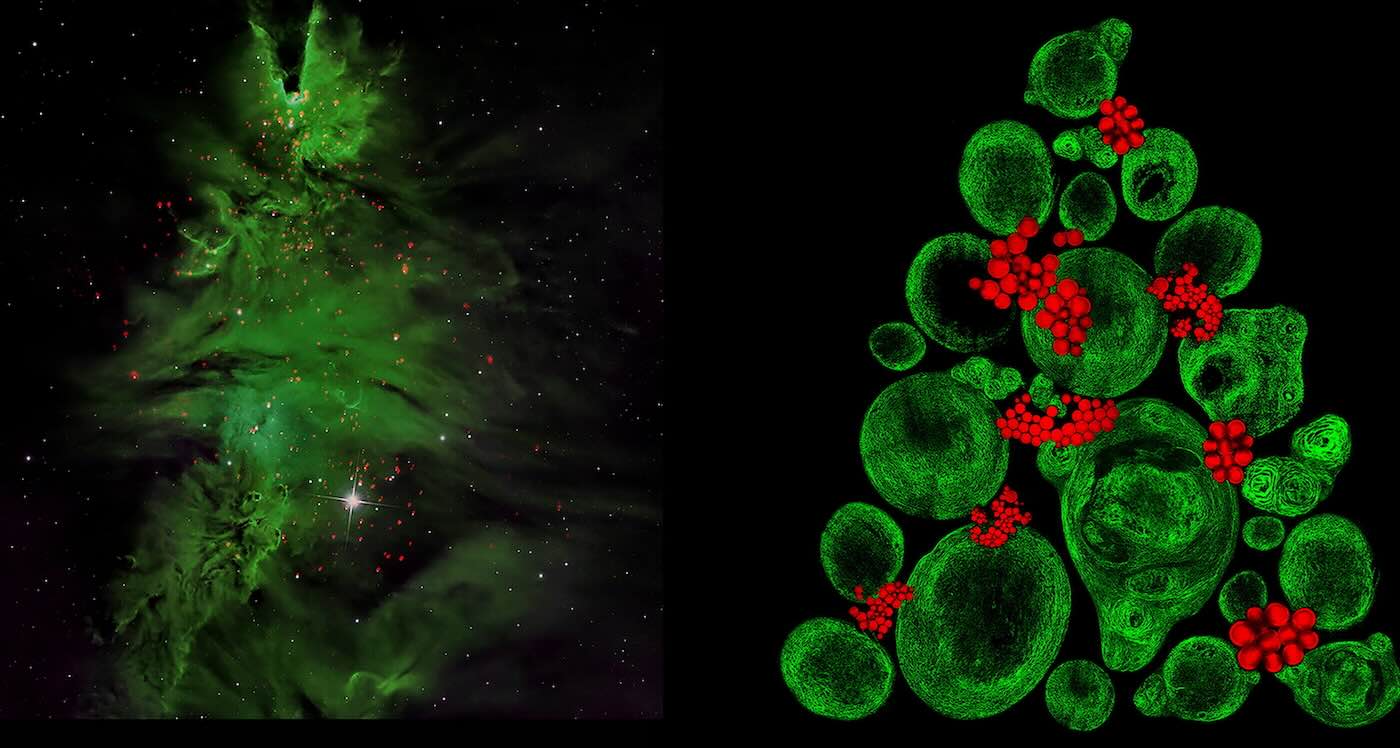
A microscopic ‘Christmas tree’ is a seasonal highlight of a remarkable science project that found eerie comparisons between the vast and the tiny.
Curated by NASA’s Chandra X-ray Observatory, the series of pairings reveal stunning connections between the vast universe and the microscopic world that we cannot see with the naked eye.
Dubbed “New Perspectives”, the project takes space-based images and creates side-by-side comparisons with winning images from the Nikon Small World contest, an annual microscopy competition.
Highlights include a cluster of young stars, nicknamed the Christmas Tree Cluster, paired with collagen fibers and fat cells captured under a laser microscope.
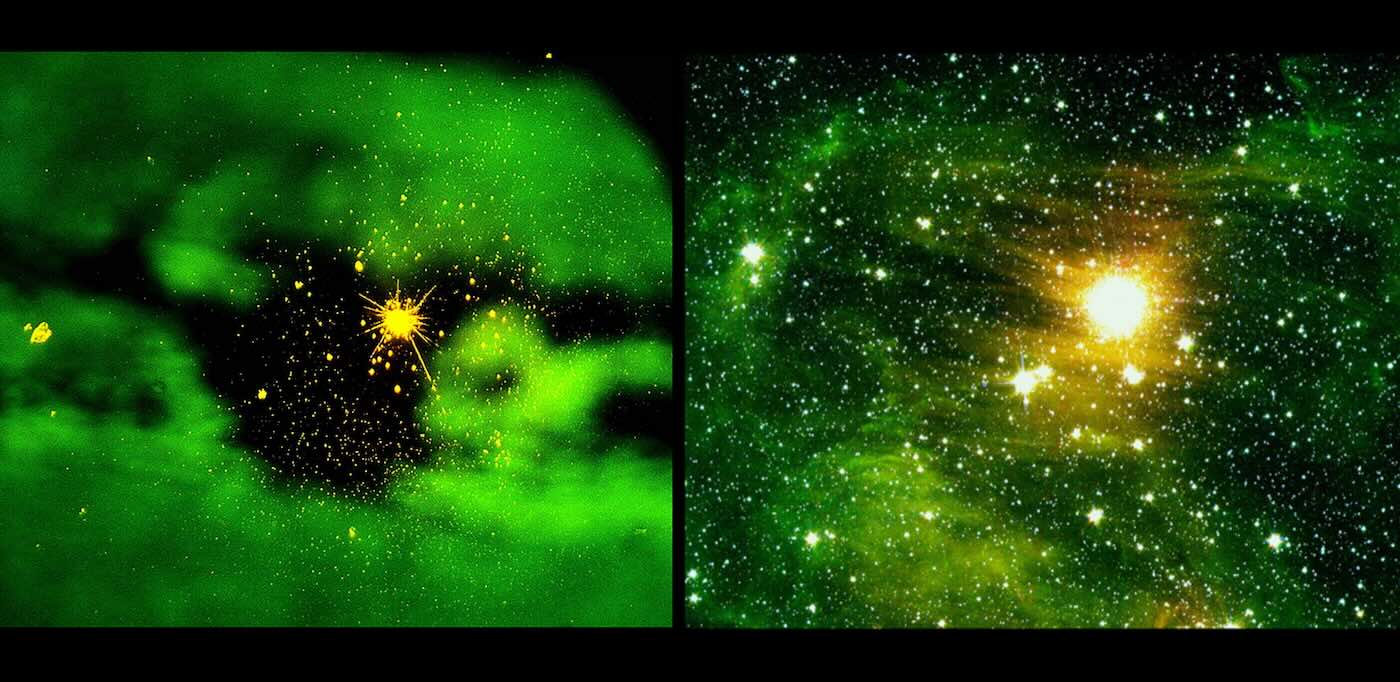
Another eye-catching duo (pictured below) compares a section of heart tissue exposed to radiation, with tiny dots and tracks showing the effect of high-energy particles on cells with a bright young star seen in infrared light wrapped in the gas and dust of a stellar nursery.
“Whether we’re studying a galaxy cluster millions of light-years away or a crystal formation at the micro-meter scale, these images remind us of the shared beauty and complexity that define the natural world,” said Dr. Kimberly Arcand, Chandra’s emerging technology scientist who led the project.
Operated by the Smithsonian Astrophysical Observatory, Chandra is one of NASA’s “Great Observatories”, which includes the Hubble and James Webb Space Telescopes that have offered unparalleled X-ray images of the cosmos for over a quarter century.
The “New Perspectives” project takes these space-based images and creates side-by-side comparisons with winning images from the Nikon Small World contest, an annual free microscopy competition that announced its latest winners in October.
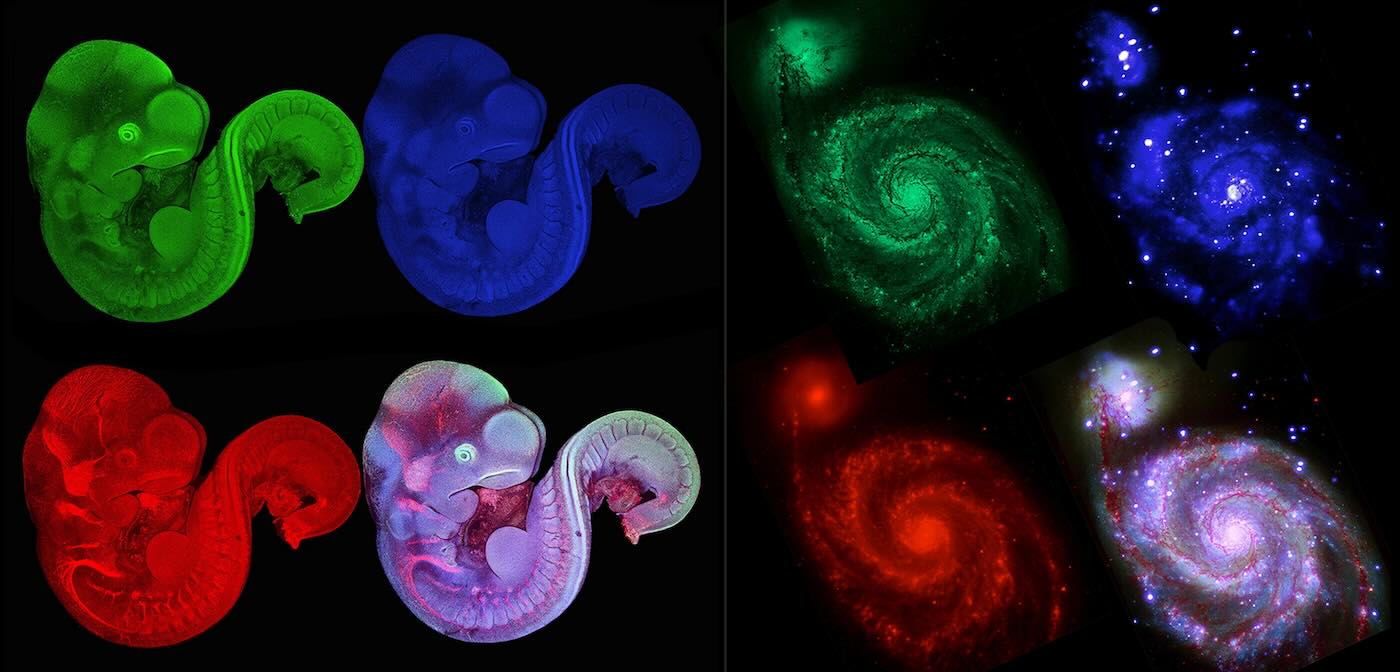
Providing a new way to look at images from science, the goal of New Perspectives is to realize the benefits from looking at our world from different points of view.
Astronomy and microscopy are both fields that are built on the challenge of making the invisible visible. Each discipline relies on light and data to reveal hidden structures, whether across the vastness of space or within the intricacies of living cells.
While their goals differ in scale, the equipment of telescopes and microscopes reflects a shared purpose: to greatly extend human vision. Telescopes (“light buckets”) collect faint light across vast distances with mirrors and detectors, often orbiting in space to avoid Earth’s atmosphere.
Microscopes, by contrast, are more of light funnels, focusing on the tiny, using lenses, lasers, or electron beams to magnify the minute worlds around us.
LOOK: Tiny Van Gogh Gallery Created Inside a Watch By an Artist With a Microscope

Despite these differences, the two fields can converge through a common visual language.
MORE OF NATURE’S MAGIC:
• A Star-Shaped Sand Found in Japan With A Huge Secret Hidden Inside
• Otherworldly Scenes Show Plants Breathing in Close-Up Detail: A Long Sought Discovery
• Astro-Photographer Finds a Cosmic Grinch in a Holiday-Themed Star Cluster
Astronomy and microscopy remind us that vision is both a tool and a construction. By transforming the invisible into the visible, these disciplines not only advance science but also reshape how we perceive our place in the cosmos and the complexity of life itself.
ARTISTS AND SCIENTISTS WILL LOVE THIS–So Share it on Social Media…