












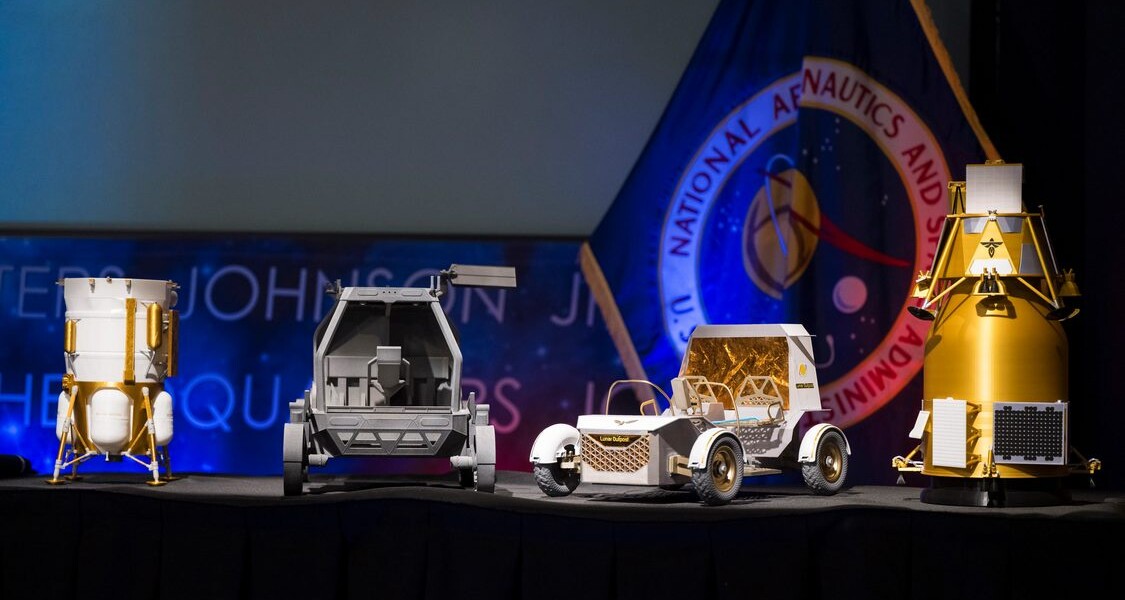
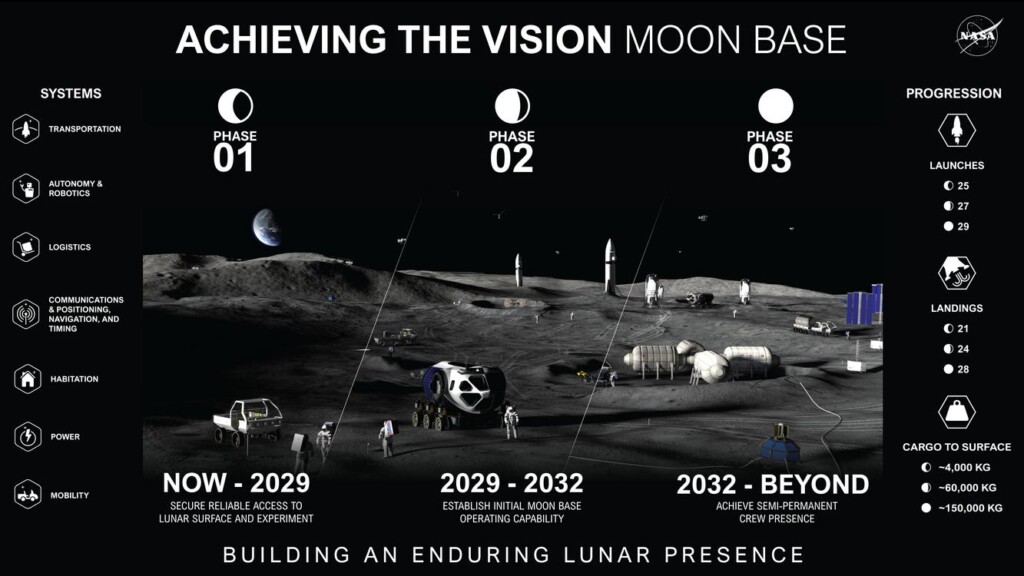
NASA recently announced details of its first three missions of the Moon Base program, a series of landings on the Lunar south pole.
Moon Base is the first stage of establishing a semi-permanent human presence on our satellite, and the data gathered during missions I, II, and III will inform the first visit of humans to the Moon since Apollo 11 in 1969.
Both Moon Base I and II are targeted for 2026. The first mission will utilize Blue Origin’s Mark 1 Endurance lander to drop two critical science instruments on the Moon. The first will gather data on how thrusters impact the regolithic Lunar surface, while the Laser Retroreflective Array will help orbiting spacecraft determine a more precise landing location using reflected laser light.
Moon Base II will see Astrobotic, another commercial spaceflight company, get a crack at the Moon with its Griffin lander. The delivery will include 1,100 pounds of equipment, including Astrolab’s FLIP rover, a “Lunar terrain vehicle” or LTV, that will gather crucial data on how wheels, treads, tires, pitch, yaw, acceleration, braking, etc. changes when done on the surface of the Moon in microgravity.
“The Moon Base will be America’s and humanity’s first outpost on another celestial world,” said NASA Administrator Jared Isaacman at the announcement event on Tuesday.
“Every mission, crewed and uncrewed, will be a learning opportunity as we return to the lunar surface, build the infrastructure to stay, and master the skills required to live and operate in one of the most demanding and dangerous environments imaginable.”
The Moon Base missions are the first of more than a dozen missions that will be announced this year, each designed to generate operational data and reduce risk ahead of crewed Artemis surface activities later this decade.
Moon Base III will include payloads from the European Space Agency and the Korea Astronomy and Space Science Institute.
The agency also shared new updates on MoonFall, a mission that will send four drones to fly short hops on the lunar surface as they survey potential landing sites for Artemis astronauts.
NASA‘s Jet Propulsion Laboratory in Southern California has been developing the design and testing prototype hardware and has selected Firefly Aerospace to build the spacecraft that will transport the drones from Earth orbit to the Moon. Launch is targeted for 2028.
Trillions of dollars worth of resources are found on the Moon—all contained in an environment that’s devoid of any trees to cut down, rivers to pollute, or animals to drive to extinction.
WHAT’S NASA UP TO: Humanity’s Long-Awaited Return to Lunar Space Captured with Brilliant Photographs Aboard Artemis II
Particular among the Moon’s riches is helium-3, a light, stable isotope of helium that costs $2,000 per liter, which is needed for cryogenic supercooling and can also can take the place of other fuels in nuclear fusion reactors, powering them at a lower cost.
Just a few tons of helium-3 could power the US over a year in nuclear fusion reactors, though estimates like this vary wildly.
STORIES JUST LIKE THIS: Scientists Successfully Mine Meteorites for Precious Metals on International Space Station
Helium-3 can be used for diagnosis and treatment management of chronic respiratory diseases such as chronic obstructive pulmonary disease (COPD), emphysema, cystic fibrosis, and asthma.
The Moon also contains billions of tons of common metals and the rare earth elements that are so coveted in political economy these days. Some estimates of the Moon’s material wealth expand into the quadrillions of dollars, but that doesn’t discount the fall in current prices for these materials should a supply as large as the Moon come online.
SHARE NASA’s Vision For The Next Chapter Of Human Space Exploration…