














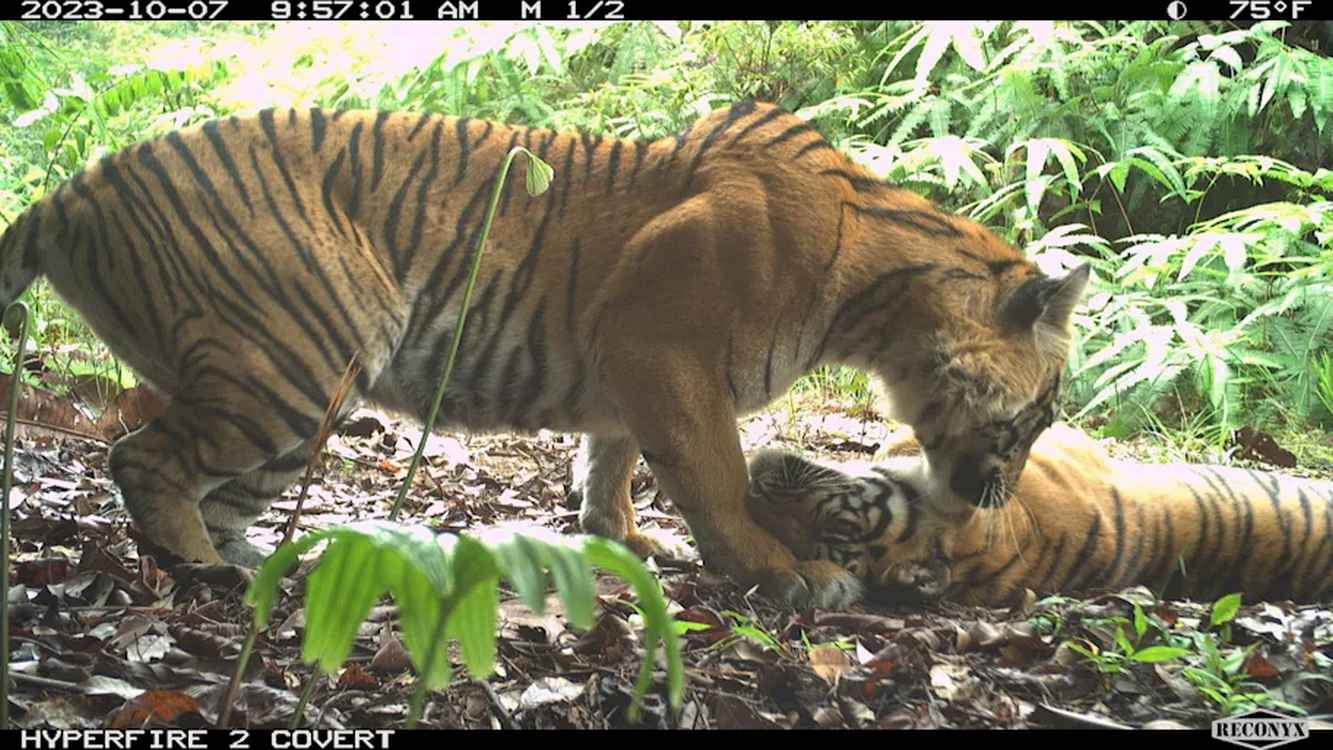
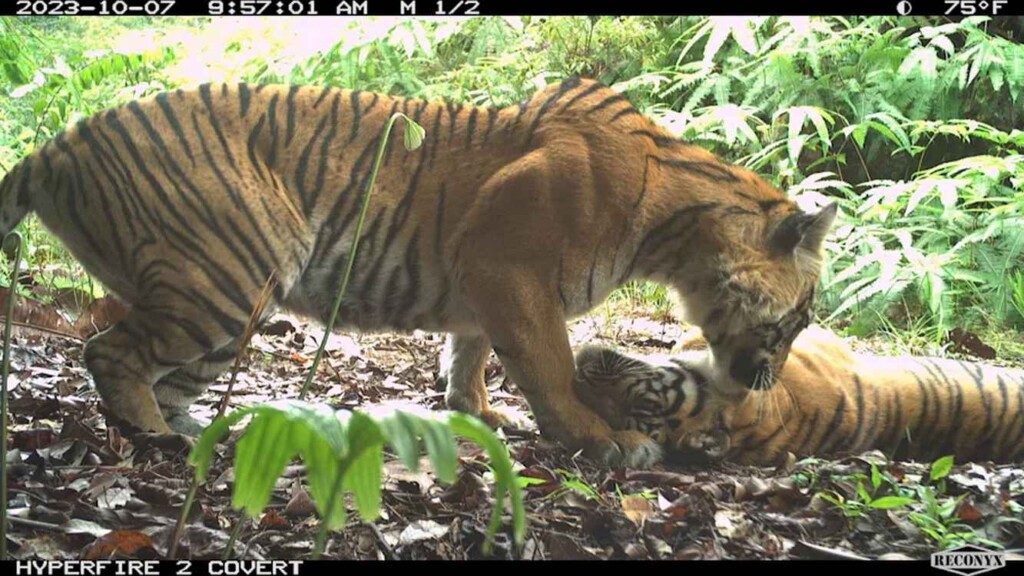
Tigers don’t roam across Asia as they used to, but on one island in Indonesia a population of Critically Endangered Sumatran tigers may have found a habitat that supplies them with enough space, intact forests, and prey to thrive and raise their young.
To examine tiger population densities, researchers working alongside local rangers installed infrared cameras in forests outside the national park system. Their work, in collaboration with the government of Aceh province, resulted in almost three times more images being taken and individual tigers being identified than during previous surveys.
Dedicated protection efforts are the main reason for tigers’ persistence in this ecosystem, which highlights the necessity of such measures, the team said, even though the survey was conducted in provincial forests that reserve less support and smaller budgets than national parks.
Today, tigers occupy just 5 to 10% of their historical habitats. But on the Indonesian island of Sumatra, an important population of critically endangered Sumatran tigers may persevere,
Using infrared cameras, researchers working on the island, have set out to estimate sex-specific population densities and tigers’ movements during three surveys, the results of which were published in a new Frontiers in Conservation Science study.
“We documented a robust tiger population, apparently among the healthiest on the island,” said Dr. Joe Figel, a conservation biologist, who works with Indonesian wildlife and forestry agencies. “For those on the ground, the onus now falls on us to double down and adequately protect them.”
In many ways, the Leuser ecosystem is ideal habitat for Sumatran tigers. Three times the size of Yellowstone National Park, it is the largest contiguous tiger habitat remaining in Sumatra. It’s made up of lowland, hill, and montane forests, of which 44% are classified as intact forest landscape. “It’s also more thoroughly patrolled by rangers than nearly any other place on the island,” Figel said.
Working with local collaborators from communities at the edges of the study area, the team put up cameras in the northern stretches of Leuser, located in Aceh province, and kept them there for three monitoring periods: 34 cameras were installed during March to May 2023, 59 cameras between June and December 2023, and 74 cameras between May and November of 2024.
During the monitoring periods, the team captured a total of 282 sufficiently clear images of Sumatran tigers to allow for the identification of individuals. Analyzing stripe patterns, the team identified 27 individuals from camera-trap images, including 14 females, 12 males, and one tiger of unknown sex.
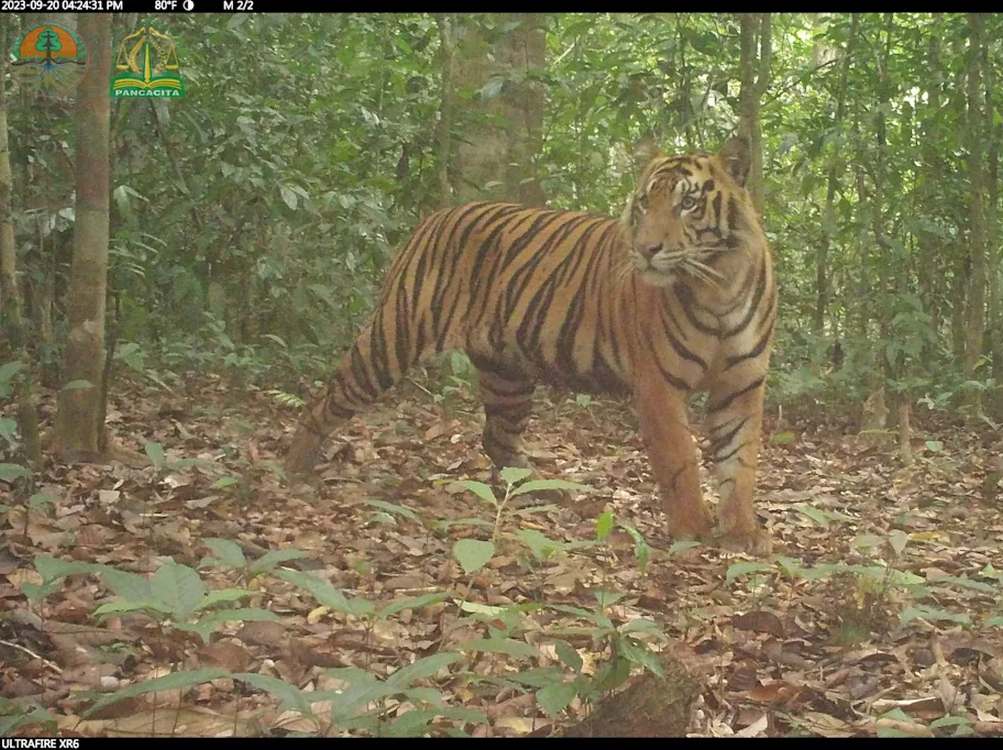
The relatively high number of tigers suggests there is adequate prey in the area to support tiger presence. Over the study period, female and male individuals were photographed an average of 14 and 16 times, respectively. High densities of female tigers indicate a healthy tiger social system and high-quality habitats, where they can raise about three litters of cubs over a decade.
During the six-month session in 2023, three different sets of cubs were documented. Two tiger brothers photographed together as cubs were later spotted individually as adults.
Inside the Leuser ecosystem lies Gunung Leuser Nation Park, however, the present study was conducted in forests provincially protected by the Aceh government. In Indonesia, provincially protected forests receive far fewer resources than national parks, which are supported and managed by the central government.
MORE INDONEWS: Orangutan Released After 9 Years of Intensive Rehabilitation in Nonprofit’s ‘Jungle School’
The camera traps placed by Figel and colleagues snapped nearly three times as many tiger images as during previous 90-day surveys at other sites in Sumatra, and the team was able to identify many more individuals than reported in earlier studies. Only three previous surveys – all carried out in protected national parks – documented more than 10 tigers in a single survey. Higher tiger density estimates than reported in the present study were only documented in an intensive protection zone in southern Sumatra.
The current study also provides valuable insights for future monitoring of tigers, the team said. The data on tiger movement collected here could, for example, inform survey protocols and optimal camera spacing.
TIGER TAKES: Two Tigers Couldn’t Be Apart–A Love Story Born of Restoring Big Cats in Russia After 50 Years
The high numbers of tiger sightings reported here highlights a success story that is due to a multitude of factors, said the team. “The persistence of these habitats and prey populations are the main reasons for our findings.”
“Thanks to the work, activities, and support of government agencies, local Acehnese and Gayo communities, donors, and other researchers, Leuser has maintained important patches of lowland and hill forests where, in Sumatra, tiger prey densities reach their highest levels,” concluded Figel.
*This story originally appeared in Frontiers and was reprinted.
SHARE This Great Story On The Thriving Tigers Of Sumatra’s Forests…