












A senior citizen who suffers from claustrophobia offered a man in the aisle seat on a recent Delta Airlines flight $100 to switch with her.
Though he repeatedly declined, and offered his seat happily, the woman would not let it lie, eventually telling him to give some of the money to his kids as a lesson that being kind brings rewards.
The man, who was not named, shared his story in a recent Reddit room for airline encounters.
“As I approached my seat an elderly lady was having a hard time getting her bag in the overhead so I offered to help. She ended up being in 1D and I was 1C,” the passenger wrote on the sub-Reddit thread r/delta.
“She immediately said she’d pay me $100 to swap seats because she feels claustrophobic in the window seats in this particular seat configuration. Even though I prefer an aisle I told her that I’d gladly switch for free…”
As boarding continued, the man, an engineer by trade, conversed freely with the woman, eventually leading him to believe that the question of payment had been settled: he was not going to willfully take money for a courtesy he hoped anyone would do for free.
Eventually, they landed in Atlanta, and the woman slipped $100 out of her purse and again offered it to the man.
“I tried to refuse again, but she told me to take it and give it to my kids but to explain to them how being nice to others can lead to something nice in return,” he recounted on the social media site.
He concluded his post by questioning the wisdom of offering his kids money, as he foresaw a world in which they’d perform many good deeds but always with a request for a reward.
One of the commentors said they had recently been in the woman’s position, and wished there was some easy way to reward the seat-swapper in their story. As it turned out, the commenter alerted the flight attendant, who was able to add points to the passenger’s frequent flyer account.
What flies there around flies back around.
SHARE This Seat-Saint Story With Your Friends And Brighten Their Days…
Oregon Powerball credit - Multi-State Lottery Association
Oregon Powerball credit – Multi-State Lottery Association
After an Oregon man won the state’s third-highest Powerball lottery prize ever, he has decided to travel, to give to various nonprofits “close to his heart,” and make some investments.
The $328 million prize manifested itself on a ticket bought from a Fred Meyer convenience store in Beaverton, Oregon, a stroke of fortune that saw it receive a $100,000 bonus, which it also says will be used to contribute to nonprofits.
79-year-old winner Abbas Shafii opted to take a lump sum of $146 million rather than the full amount over a 29-year annuity.
“I am overjoyed to have won the Powerball and plan to use my prize to travel, invest and share my good fortune with non-profit organizations that are close to my heart,” Shafii said.
Approximately a third of Powerball game sales in Oregon are returned to the state and supports beneficiaries such as economic development, public education, veteran services, state parks and more, the game’s parent organization, the Multi-State Lottery Association wrote in a statement.
The chance of winning the large total was the same as flipping a coin and having it land head 28 times in a row, mathematicians speaking with the AP estimated.
While Shafii didn’t mention which nonprofits he would be patronizing, Fred Meyer is donating half the $100,000 bonus to the Oregon Food Bank’s Zero Hunger | Zero Waste initiative, showing that generosity is infectious.
Shafii’s winning numbers were 14, 31, 35, 64, 69, and a Powerball of 23.
SHARE This Infectious Generosity With Your Friends…
LeBron James has become the first player in NBA history to score a combined 50,000 points across all games, season and postseason.
He made the record with a three-pointer in the first quarter of the Los Angeles Lakers’ 136-115 win over the New Orleans Pelicans, in which he scored 34.
Talk about longevity.
“I mean, that’s a lot of points,” James said afterward, rubbing his beard in wonder, (we’re right there with you LeBron.)
“Obviously, the first thing that comes to mind is where I’m from. Picking up the game when I was a little kid and having a love for the sport, and hoping that someday I’d be able to play at the highest level. I’ve been able to do that and really enjoy my career. So it’s definitely an honor. It’s pretty cool to see that.”
Across his joint-most-ever seasons in the NBA of 22, LeBron is gradually leaving other greats of the game behind. Kareem Abdul-Jabar is fading into the review mirror with his 44,149 points across 20 seasons.
50,000 points wasn’t a record set by another player—LeBron already was the NBA’s all-time highest scorer across regular season and playoffs—it’s just a nice round number unlikely to be touched for a long time.
During the game, the Lakers’ stadium announcer took the first time-out as an occasion to inform the crowd they had been witness to history, with James acknowledging the standing ovation with several waves from the bench.
The other longevity record left to break would be all-time games played, one he would likely make his own if he returned for another season and stayed fit and available, as he is less than one regular season’s worth of games behind Jabar, and Robert Parish who holds the record with 1,611.
If he were to return for a 23rd season at the age of 41, it wouldn’t be a testimonial either. As his points total against the Pelicans on Tuesday suggests, James keeps up his high-standards. He was named the NBA’s Western Conference player of the month for February, averaging 35 minutes per game, 29.3 points, 10.5 rebounds, 6.9 assists and 1.2 steals. He also holds the NBA’s record for most player of the month awards (41).
AP reports that James has also played in 287 postseason games, the most in NBA history. He became the league’s career playoff scoring leader almost a decade ago, when he surpassed Michael Jordan’s total of 5,987 during his time with Cleveland in 2017.
His performances throughout his career have verged on inevitable, and by far the best piece of LeBron trivia is his scoring streak. Since January of 2007, James has scored at least 10 points in each of the 1,278 consecutive games he has played in since then.
Talk about fine wine.
SHARE This Remarkable Achievement With Your Friends Who Love Basketball…
Quote of the Day: “No one has ever loved anyone too much. We just haven’t learned yet how to love enough.” – Anne Morrow Lindbergh
Photo by: Adrianna Geo
With a new inspirational quote every day, atop the perfect photo—collected and archived on our Quote of the Day page—why not bookmark GNN.org for a daily uplift?
Mural of Mexican priest competing as a wrestler to support an orphanage – Credit: Timothy Neesam (CC BY ND 2.0 / cropped)
If the headline to this story sounds oddly like the plot of the movie Nacho Libre starring Jack Black, well, that’s becaues they are one and the same.
Fray Tormenta was a masked wrestler that delighted crowds in Mexico’s lucho libre circuit for years, but few would have known that underneath the mask there was a man of god—a drug addict turned priest, who wrestled purely to raise money for an orphanage.
The story, though decades old, resurfaced and was retold recently on a Spanish news outlet. Sergio Gutierrez Benitez was born in 1945 the second-youngest of 18 children.
By the tender age of 11, Benitez was addicted to drugs and proceeded down a path of crime, robbery, and odd jobs to fund his various dependencies.
“I started when I was 11 or 12. In this country [Mexico], drugs have always been very present,” recounted Benitez to El Confidencial. “I did everything—marijuana and cocaine every day, even mushrooms from time to time. A little after that, I started heroin.”
At age twenty, Benitez was staring down murder charges after a friend of his in a gang he was in turned up dead. Fortunately, an alibi of drunkenly passing out in a bar elsewhere helped him evade the slammer.
After that, he sought confession, for reasons only he can say, but even though he was turned away for his wickedness, he joined the seminary and became a priest in the Piarist Order, studying in Spain and Italy to cement his faith.
After joining the Diocese of Texcoco, he wanted to build a shelter for the city’s many homeless children and orphans, but the costs were prohibitive. An early life of gang and streetfighting in which he was stabbed, beat up, and shot, left him with a high tolerance for pain, and so he pulled on a lucho libre mask and started wrestling for $15 per hour under the name Fray Tormenta.
He ended up wrestling for 23 years, from 1977 to 2000, traveling from town to town elbow dropping, tombstoning, and double-legging his way to semi-stardom. Relying on his mask to hide his identity, he eventually revealed his double-personality to officiate the wedding of a close wrestling colleague shortly before opening his orphange—the object of his long fight—at the turn of the millennium.
La Casa Hogar de los Cachorros de Fray Tormenta, or Fray Tormenta’s Cubs Children’s Home, has seen over 2,000 children pass through its walls. Many of whom have gone on to become doctors, civil servants, engineers, lawyers, and yes, even wrestlers. One wonders where they got the idea.
WATCH a long explainer video below…
SHARE This Inspiring And Classic Mexican Story With Your Friends Who’ve Never Heard It…
A drone's eye view of the narwhals in the study - credit: O’Corry-Crowe, FAU/Watt, DFO
A drone’s eye view of the narwhals in the study – credit: O’Corry-Crowe, FAU/Watt, DFO
Drone footage has revealed that the narwhal actively wields its long tusk for hunting and play behavior, opening up whole new fields of study over one of the oceans’ most charismatic denizens.
The scientific name of the narwhal (Monodon monoceros) literally translates to “one tooth, one horn,” an incredibly ironic name since the first thing that anyone learns about the narwhal is that what appears to be a horn is actually a tooth, or tusk. At least someone was paying attention, even if someone else wasn’t.
The tusk, which is predominantly found in males and can grow up to 10 feet long, is one of the most fascinating adaptations in nature and the inspiration for myths such as the unicorn. It is believed to play a role in competition for mates, including mating displays.
The tusk may have other uses and its function has long been debated, primarily because few people have observed how these elusive animals use their tusks in the wild.
Limited field observations have long left the creature’s true nature to gut instinct, speculation, and wild fantasy, but researchers from Florida Atlantic University’s Harbor Branch Oceanographic Institute and Canada’s Department of Fisheries and Oceans, in partnership with Inuit communities in Nunavut in Canada’s High Arctic, provide the first evidence of narwhals using their tusks in the wild to investigate, manipulate, and influence the behavior of Arctic char.
These large common and delicious game fish of the northern seas were found to be on the receiving end of the narwhal’s tusk, with the whales delivering sufficient force to stun and possibly kill the fish.
Using drone observations, researchers captured 17 distinct behaviors, which shed light on the dynamics between the narwhal and its prey.
The results of the study, published in the journal Frontiers in Marine Science, also reveal the first evidence of likely play, specifically exploratory-object play, in narwhals as well as other fascinating insights into narwhal behavior in a changing Arctic.
Aspects of the narwhals’ actions, for example, may also have included social learning, and possibly social instruction and personality differences among individual narwhals. These novel findings further enrich our understanding of narwhals’ complex behavior.
“Narwhals are known for their ‘tusking’ behavior, where two or more of them simultaneously raise their tusks almost vertically out of the water, crossing them in what may be a ritualistic behavior to assess a potential opponent’s qualities or to display those qualities to potential mates,” said Greg O’Corry-Crowe, Ph.D., senior author, a research professor at FAU Harbor Branch and a National Geographic Explorer. “But now we know that narwhal tusks have other uses, some quite unexpected, including foraging, exploration and play.”
The narwhals exhibited remarkable dexterity, precision, and speed of movement with their tusks, and regularly made adjustments to track the moving target—in this case the fish. The tusk, especially the tip of the tusk, was used to interrogate and manipulate target fish.
“I have been studying narwhal for over a decade and have always marveled at their tusks,” said Cortney Watt, Ph.D., co-author and research scientist and team lead at Fisheries and Oceans, Canada.
“To observe them using their tusks for foraging and play is remarkable. This unique study where we set up a remote field camp and spent time filming narwhal with drones is yielding many interesting insights and is providing a bird’s eye view of their behavior that we have never seen before.”
“Our observations provide clear evidence of narwhals chasing fish and using their tusks to interact directly with the fish and to influence the fish’s behavior,” said O’Corry-Crowe. “Some of the interactions we saw appeared competitive in nature with one whale blocking or trying to block another whale’s access to the same target fish, while others may have been more subtle, possibly communicative and even affiliative. None appeared overtly aggressive.”
WATCH some of the drone footage below…
SHARE This First Rate Aerial Animal Ethnology With Your Friends…
Tajikistan's Saimumin Yatimov and Kyrgyzstan's Kamchybek Tashiev at a border demarcation deal - credit Kyrgyzstan Ministry of Defense
Tajikistan’s Saimumin Yatimov and Kyrgyzstan’s Kamchybek Tashiev at a border demarcation deal – credit Kyrgyzstan Ministry of Defense
Two of the Central Asian ‘Stans’ have agreed to shift their borders after decades of violent frontier flare-ups, celebrating peace between neighbors.
Not every country can enjoy a border as easily delineated as Colorado and Kansas. Few areas of the world can boast a worse cartographical headache than the Fergana Valley.
Located where the borders of Kyrgyzstan, Tajikistan, and Uzbekistan touch, this fertile region appears like a Jackson Pollock painting, as bits of each nation jut into each other, and drops of sovereign territory are scattered here and there surrounded by foreign land.
To make matters worse, the Fergana Valley, like so much of Central Asia, is home to nomadic pastoralists who for generations never had to think about international borders.
Out of this chaos—courtesy of the Soviet Union—disputes over grazing and water rights and who knows what else have boiled over into outbreaks of extreme violence and unrest along the borders of the Kyrgyzstan region of Batken and northern Sughd region of Tajikistan.
Now however, after successful diplomacy, the two nations have agreed to shift their borders in order to end existing conflict motives.
“Negotiations have reached the final point and can be discussed openly from today,” said the head of Kyrgyzstan’s secret service Kamchybek Tashiev. “After parliamentary consideration, the presidents will sign, then ratification, and finally, the final version will be signed by the heads of two states.”
Both sides announced a new demarcation deal last December, but little to no details have emerged until now. Tashiev said that the agreement has progressed to the point where it can be discussed openly.
Several controversial roads through the rough terrain will be declared ‘neutral’ and available for either nation to use. The authorities will also relocate the inhabitants of the villages exchanged under the agreement, according to the Defense Post, while a vital irrigation canal has had access rights eased for both parties.
After 2022 saw the deadliest fighting in the area since the 1990s, the presidents of the two nations discussed a border agreement openly during a meeting at the UN, a rare moment of warmth and civility that suggested a deal might be possible.
SHARE This Win For Diplomacy And The Common Man On The Frontier…
Tharun Sekar with Yazh behind him - credit: Uru Instruments
Tharun Sekar with Yazh behind him – credit: Uru Instruments
From India comes the incredible story of a young man who reconstructed an ‘extinct’ musical instrument using clues in ancient literature.
Called the Yazh, this gorgeous harp, carved in the form of a peacock and aided by a resonator, was played for Tamil kings 2,000 years ago, but hasn’t been manufactured for years, perhaps even centuries.
His passion for Indian instruments led him to start an instrument company called Uru, which is now selling these harps all over the world.
Profiled in a feature for the Better India, Tharun Sekar picked up instrument making at university while studying for an architecture degree. Born in Chennai, the capital of the Indian state of Tamil Nadu, Sekar was comfortable making guitars and ukuleles, but felt a calling to do something different.
“After finishing college, I was considering instrument-making full-time,” says Sekar. “While Western instruments are popular, I was driven by the question of why our instruments weren’t reaching a global audience.”
He never intended to start making Yazh (Sekar never uses the definite article) but came upon it when a friend asked him if he knew how to make one. Looking into it, Sekar realized there was virtually no information on how Yazh is crafted, played, or even what it sounded like.
The mystery left him entranced, and soon, with the help of some friends, he was consulting the canon of ancient Tamil literature.
“We started to read works of literature like Silapathikaram… where there was a mention about Yazh,” he told the Better India. “We won’t have direct information about the instrument but rather it would be hidden behind uvamai (metaphors in Tamil)—[p]hrases like ‘the sound of Yazh was like honey’, ‘the bend of Yazh was like the belly of an eight-month pregnant woman.’”
Tharun Sekar working on Yazh – credit: Uru InstrumentsMuu
From this he managed to formulate an idea over what the instrument looked like. For sounds, he took references from the canon and compared them with related instruments from other regions like the Greek lyre or an antique harp from Burma.
The literature mentions several components common in stringed instruments such as tuning keys, a resonator, and a bridge (where the strings connect to the body).
It took Sekar a year, with the help of local experts in brasswork, to make his first Yazh, but now he can crank out several in a year. All are handcarved wood and metal, made to order, in different sizes. There are some the size of the harps played by minstrels in the Middle Ages, but other Yazh are very tall and come with a stand to support the weight of the bass-drum-sized resonator.
Its sound lies somewhere between a sitar, western lyre, and a banjo.
Uru Instruments has sold around 80 Yazh to customers from Canada, the US, UK, Germany, India, and other countries.
Along with starting a band that produces music on traditional Tamil instruments, Uru Instruments, led by Shekar, is now pursuing a goal of reviving an antique or lost instrument from each Indian state: a noble goal if ever there were one.
“Right now, we want to work on each state in India and find out an important instrument from that state,” Shekar told the Better India. We are in the search for that.”
LISTEN to the sound of the Yazh from below…
SHARE This Young Man’s Service To Humanity With Your Friends Who Love Music…
Quote of the Day: “A change of feeling is a change of destiny.” – Neville Goddard
Photo by: Clay Banks
With a new inspirational quote every day, atop the perfect photo—collected and archived on our Quote of the Day page—why not bookmark GNN.org for a daily uplift?
The Hudson River Valley and nearby upland is dotted with popular hiking spots, but poor access and limited infrastructure have meant that nearby towns are overwhelmed by visitors during the hiking seasons.
A new comprehensive park and trail will connect these peaks and troughs like never before, and will help spread visiting hikers more evenly along the riverside and keep them off the main road of State Route 9D.
Called the Hudson Highlands Fjord Trail, the design borrows from the landscape palette of the Hudson River School of 19th century painting, by linking marshland, forests, highlands, and riverlands with a 7.5 mile linear trail stretching from Beacon to the town of Cold Spring.
Environmental stewardship has long been valued among the hills of the Hudson River, and the Fjord Trail plans to help regenerate degraded landscapes and protect those which remain.
Powered by a public-private partnership with the state Office of Parks, Recreation and Historic Preservation, the trail will span two counties, engage four local communities, and ensure that as many people as possible can enjoy the area’s scenic bounty while also reducing the impact of overvisitation on man and nature alike.
“The team bringing this to life is second to none,” Lori Moss, a spokeswoman for the project, told GNN.
credit – rendering by SCAPE Designs
“Kate Orff, a TIME 100 honoree and founder of the renowned landscape architecture firm, SCAPE, is designing the project, while Peter Mullan, who led the design and construction of the famous High Line urban trail in New York City, is shepherding the project forward as President & CEO.”
The Fjord Trail will have biking, rail, and wheelchair access for 7.5 miles along the Hudson River, connecting multiple trailheads up into the highlands like Breakneck Ridge, and Sugarloaf, Taurus, and South Beacon mountains.
Balancing visitation with ecological sensitivity, the Fjord Trail will connect communities while weaving in and out of four distinct landscape zones including the river’s edge, highlands, forest, and marsh. The trail’s design and materials will shift to reflect each zone.
Multiple areas along the Breakneck Connector are set for landscape restoration with 436 native trees and 2,000 native shrubs to ensure it regains and retains the natural, native beauty that has captivated so many over the area’s long history of habitation and visitation.
SHARE This Upcoming Revitalization Of A Grand American Landscape…
Thimmamma Marrimanu - credit P. Jeganathan CC 4.0.BY SA
The tree Thimmamma Marrimanu can be seen as everything beyond the fence poles – credit P. Jeganathan CC 4.0.BY SA
North America is graced with the presence of the oldest single tree, the oldest tree colony, the tallest tree, and the largest tree by wood volume.
But it’s India where one must go to stand beneath the world’s largest tree canopy.
At two and a half times the size of the Jefferson Memorial in DC, and four times the size of a football field, looking up at the spreading branches of Thimmamma Marrimanu, or “Thimmamma’s Banyan Tree,” isn’t possible, because they spread farther than the eye can see at any single point.
Looking at this 550-year-old member of the Ficus genus from a distance, one is likely to believe they’re looking at a grove of trees. Walking between the trunks that twist and grab like tentacles, one may actually believe they’re in a grove.
But they’d be wrong. With 4.7 acres of canopy coverage (19,000 square meters) supported by 1,000 individual trunks, Thimmamma Marrimanu is certainly one of the living wonders of the world, and deserves to be counted among the most extraordinary trees on Earth.
Just to be certain the reader has understood the scope of the tree, the sequoia tree General Sherman, the largest tree on Earth by volume, boasts a canopy coverage of just 1,487 square meters—not even one-tenth the banyan’s size.
Located in the Andhra Pradesh state in India’s southeast, its name comes from the Telugu language. Folklore tells of it sprouting from one of the poles that held up a man’s funeral pyre, onto which his wife, a 15th century woman named Thimmamma, threw herself in the act of sati.
Rather than normal trees that grow vertically from one trunk, the banyan tree spreads its limbs horizontally and drops down aerial roots to anchor these branches with new woody columns. Thimmamma Marrimanu has over 1,000 of these secondary trunks.
Banyans are a type of strangler fig tree, which grow parasitically by sprouting from cracks and crevices in other trees, eventually consuming them and leaving a hollowed interior, which is how one can tell which of the many trunks was the original one. It likely makes a good case of being the largest parasitical organism on Earth as well.
Underneath a similar sized banyan tree at A. J. Chandra Bose Indian Botanic Garden, Kolkata, India – CC 4.0. BY SA Aritro Mukherjee IN
It grows between two mountains in an agricultural field where it enjoys government protection and protection from locals who revere it.
Banyan trees anchor local Hindu communities just as sure as they anchor natural ecosystems. The aerial roots prevent soil erosion, and the spreading canopy keeps the understory moist during the dry season. All manner of animals live in and around these trees, which Hindus consider sacred.
BRANCH Out And Share This Tree With Your Friends On Social Media…
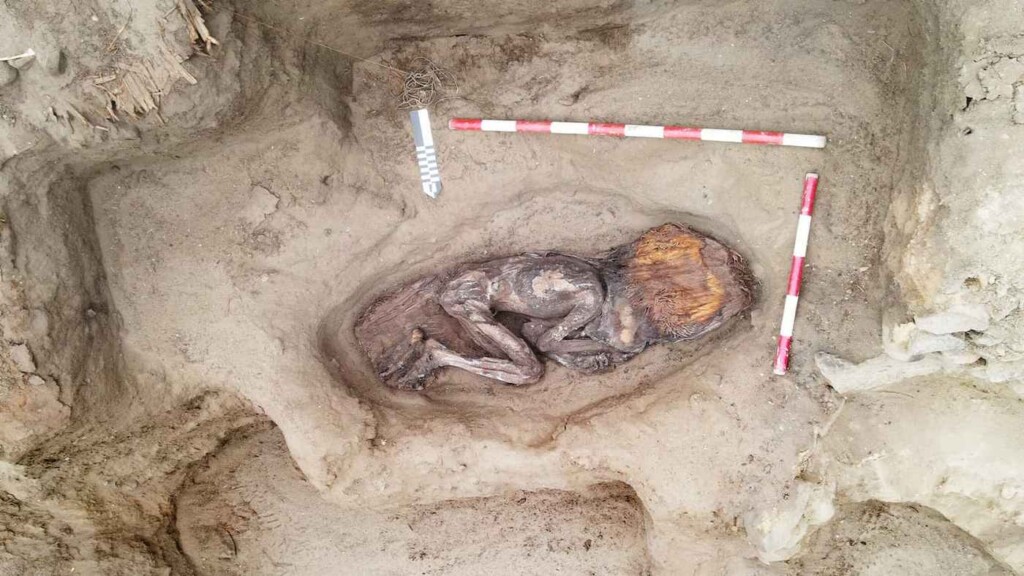
Cross section of the healed fracture point of a mouse’s thigh bone. Each of the circles represents a specific gene, and the color represents that gene’s activity - credit: Mathavan et al., Science Advances 2025 CC 4.0. BY-SA
Cross section of the healed fracture point of a mouse’s thigh bone. Each of the circles represents a specific gene, and the color represents that gene’s activity – credit: Mathavan et al., Science Advances 2025 CC 4.0. BY-SA
A vibrational therapy could be used to replicate a strengthening activity like weightlifting in patients whose bones are broken or brittle, suggests a new study.
It addresses an interesting paradox: bones become denser when subjected to mechanical force and load—which is true even for broken bones—which can’t be subjected to mechanical force or load.
The study looked to see if, by examining genetic expression during a vibrational therapy on bones, it could be possible to replicate these laborious, healing forces in patients who can’t perform activities like weightlifting.
There’s an old saying in medicine which goes “break your hip, die of pneumonia.” While these two diseases might seem to have nothing in common, they’re a duo responsible for a large number of deaths among the elderly in society.
Bone density dramatically declines as we age, and is accelerated among those who don’t perform resistance exercise, strength training, or weightlifting.
“Ideally, we need new therapeutic approaches to delaying the breakdown of bone in old age,” said Neashan Mathavan, a researcher at the Department of Health Sciences at the Technical University of Switzerland (ETH).
Mathavan is a lead author on a new study that looked to see if bones fractured by old age could be thickened with a unique “vibration therapy” by exploiting the genetics of bone growth and repair.
Bone does not just grow in any which way—rather, the bone cells respond to external forces. If bones are subjected to targeted mechanical loading as they heal following a fracture, they can potentially become larger, denser and more stable than they were before the fracture occurred.
While this was demonstrated in mice, the mechanism that drives this effect isn’t understood.
“Only if we understand these mechanisms can we use them as the basis for developing new therapies,” Mathavan told the university press.
Working alongside Ralph Müller, whose trials with the mice set the board for this new research, Mathavan sought to precisely map out gene activity in mice receiving this vibrational therapy for a broken leg.
“For each point in the bone, we now know what mechanical conditions exist there, where bone is being formed and where bone is being broken down,” explains ETH professor Müller.
Among the findings were locations where genes that drive bone mineralization and collagenous bone matrix formation became active, but also, and perhaps more critically, where in the bone were genes that inhibit the growth of bone activated.
This genetic polarity will be key to designing new therapeutic approaches that allow fractures to heal better and bones to remain strong even in old age.
“We will see which direction it takes,” says Müller. “It’s likely that vibration therapy will involve fewer side effects than treatment using drugs.”
SHARE This Critical Research Into How Best To Protect Our Elders…
After 8 months of swerving to avoid an axle-breaker pothole in the road through an English village, a local decided enough was enough.
But rather than get mad, James Coxall decided to highlight the danger and frustration the hole presented with humor.
Instead of leaving a furiously indignant message on the Castle Camp town council’s answering machine, Coxall enlisted the help of his wife and kids to build a pair of wooden legs and feet, clad in jeans and shoes, and fix it down in the hole as if someone had fallen in headfirst.
“We just thought that would be the most amusing way to sort of highlight the pothole,” Coxall told As It Happens host Nil Köksal. “You’ve got to have a laugh and a joke, haven’t you?”
Located on Haverhill Road in the county of Cambridgeshire, Coxall said he measured it himself, and it spanned a yawning 3 feet in length, nearly the same in width, and plunged 3 inches down into the earth.
“The kids helped. We drilled in some wood for the legs. We found an old pair of jeans that were going to the charity shop. We put them on. We stuffed it with some rags. And then we screwed a pair of their old shoes on top,” he said.
Receiving attention from their neighbors, not least at school where the Coxall kids became prankster-celebrities, the hole also attracted the attention of the requisite maintenance crews.
Credit: James Coxall, submitted
Within four days of the legs’ appearance on Haverhill Road, the hole was finally filled after 8 months of neglect.
Unfortunately for the council, Coxall enjoyed the whole experience, and says with a variety of holes to highlight, he wonders which sculpture to erect next—maybe the Titanic sinking, he pondered.
SHARE This Hilarious Bit Of Civic Engagement With Your Friends…
Quote of the Day: “Almost everything will work again if you unplug it for a few minutes, including you.” – Anne Lamott
Photo by: Inspa Makers
With a new inspirational quote every day, atop the perfect photo—collected and archived on our Quote of the Day page—why not bookmark GNN.org for a daily uplift?
The minitouch device - credit EPFL Alain Herzog - CC 4.0. BY-SA
The minitouch device – credit EPFL Alain Herzog – CC 4.0. BY-SA
Phantom limb is one of those enduring medical mysteries: that someone could feel sensations in a hand which had long ago been lost to amputation.
A little like harnessing the placebo effect, scientists have been able to stimulate nerve endings on the skin of an amputated arm which trigger thermal phantom limb sensations, including hot and cold.
Adapting one patient’s existing prosthetic arm and socket with sensors and ‘thermodes’ or small devices which can change temperature, placed at these key nerve endings allowed the man to distinguish a hot water bottle from a cold or room temperature one—not because his prosthetic was detecting it, but because his phantom limb was.
“In a previous study, we have shown the existence of these spots in the majority of amputee patients that we have treated,” says Solaiman Shokur at the Swiss Federal Institute of Technology in Lausanne.
Study participant Fabrizio Fidati was able to tell the temperature of a bottle grasped by his modified prosthetic 100% correctly, falling to just one-third without it.
“Warmth is the most beautiful sensation there is,” Fidati told Shokur. “It’s an interesting technology that would serve to improve prosthetics a lot. The integration of these sensations—hot and cold—in my opinion, we need to shake hands (and improve social interactions) with other people… heat is fundamental.”
Shokur said he imagined when testing patients that after the nerve ending stimulation, each subject would point to a certain area on their stump that Shokur’s team was interacting with; exactly the same as if you put a hot cup of tea against the skin on your forearm.
Instead, patients would point to a place on their prosthetic hand and remark that it was here that they felt the sensation, either hot or cold.
“Of particular importance is that phantom thermal sensations are perceived by the patient as similar to the thermal sensations experienced by their intact hand,” explains Shokur, EPFL senior scientist neuroengineer who co-led the study.
Another patient, Francesca Rossi, described the feeling as “beautiful,” adding that her phantom limb “does not feel phantom anymore.”
“When I touch the stump with my hand, I feel tingling in my missing hand, my phantom hand. But feeling the temperature variation is a different thing, something important… something beautiful,” she said.
“Temperature feedback is a nice sensation because you feel the limb, the phantom limb, entirely. It does not feel phantom anymore because your limb is back.”
WATCH the story below from New Scientist…
SHARE This Story With Your Friends Who Love Futuristic Technology…
Before and After photos in Latur, India – CREDIT: Intl Crops Research Institute for the Semi-Arid Tropics (ICRISAT)
Farms near Matephal village – credit: International Crops Research Institute for the Semi-Arid Tropics
In a degraded and semi-arid farming area in India, simple science-driven changes to the landscape have colored the horizon, and a village’s fortunes, with green.
In the Latur district in the central western state of Maharashtra, 40 years of erratic rainfall, groundwater depletion, soil erosion, and crop failures have impoverished the local people.
In the village of Matephal, the International Crops Research Institute for the Semi-Arid Tropics (ICRISAT) launched a project in 2023 that aimed at addressing these challenges through integrated landscape management and climate-smart farming practices.
Multiple forms of data collection allowed ICRISAT to target precise strategies for each challenge facing the 2,000 or so people in Matephal.
Key interventions focused on three critical areas: water conservation, land enhancement with crop diversification, and soil health improvement. Rainwater harvesting structures recharged groundwater around 1,200 acres, raising water tables by 12 feet and securing reliable irrigation. Farm ponds provided supplemental irrigation, while embanking across 320 acres reduced soil erosion.
Farmers diversified their crops, converting 120 or so acres of previously fallow land into productive farmland with legumes, millets, and vegetables. Horticulture-linked markets for fruits and flowers improved income stability.
Weather monitoring equipment was also installed that actively informed sustainable irrigation practices.
“It is a prime example of how data-driven approaches can address complex agricultural challenges, ensuring interventions are precise and impactful. Matephal village is a model for other semi-arid regions in India and beyond,” said Dr. Stanford Blade, Director General-Interim at ICRISAT.
Farmers actively participated in planning and decision-making, fostering long-term commitment.
“This ICRISAT project improved yields, diversified crops, and boosted incomes. It also spared women from walking over a kilometer for drinking water, now available in the village for people and animals,” said Mr. Govind Hinge of Matephal village.
Looking ahead, ICRISAT writes it wants to use Matephal as a case study to scale these methods across India’s vast and drier average. As Matephal’s fields flourish, the village is a testament to the power of collaboration and science in transforming lives and landscapes.
WATCH the story from ICRISAT below and see the land transform…
SHARE Science’s Ability To Change The Lives oF These Poor Farmers…
A depiction of Leslie's Retreat - credit Salem State University Archives and Special Collections under CC BY 2.0
A depiction of Leslie’s Retreat – credit Salem State University Archives and Special Collections under CC BY 2.0
Without any shots to hear around the world, a little-known and heated standoff marked the opening of America’s Revolutionary War.
On February 26th, 1775, two-hundred and fifty years ago last week, British Lieutenant Colonel Alexander Leslie led a raid into the town of Salem, Massachusetts, to seize what they expected to be cannon stored at a makeshift armory.
Rather than finding artillery, after arriving at the north bridge into town they found an inflamed citizenry, largely unarmed, but indignant in the face of British demands. The colonists flooded Salem’s streets and barred Leslie’s passage until the officer was forced to negotiate and withdraw.
Charles Moses Endicott, a man who fancied himself Salem’s official historian, recorded the event from eyewitness accounts offered by elderly Salemites, and is, as Robert Pushkar writing for the Smithsonian Magazine points out, the only reason we know of it.
“Here … we claim the first blow was struck in the war of independence, by open resistance to both the civil and military power of the mother country; comparatively bloodless, it is true, but not the less firm and decided,” Endicott wrote in his account published by “W. Ives & G. W. Pease, printers.”
According to Pushkar’s references, the British Army commander relied on a network of spies and Loyalist sympathizers to uncover that the colonial militia were converting ship cannon into land-operable pieces, a domineering aspect of war at the time which could be used to control vast acreage of approach terrain.
Launching a raid to confiscate the cannon on a Sunday, Commander-in-Chief Thomas Gage thought, would be convenient since the inhabitants of Salem would be in church or at home resting. This, Pushkar writes, was the wrong deduction. The fact that the Salem townspeople sat in congregation allowed word of the approaching British regiment to spread instantly.
Approaching Salem by ship, the 64th British Regiment of Foot disembarked with muskets, bayonettes, and equipment for searching crates and homes for contraband. They approached, and Major John Pedrick of the local militia raced to town on his horse to alert his commanding officer, Minuiteman Colonel David Mason, who went into church to spread word.
The people raised one portion of the drawbridge that marked the north entrance into the town. Faced with their passage blocked, an angry throng of catcalling, whistling, and fist-waving colonists, and the prospect of fire coming from the local militia on the northern bank of the river, who warned the British that they would be “dead men” if they opened up on the crowd, Leslie, an experienced military officer, was in a bind.
Gage had told him not to open fire unless fired upon, but his goal was an imperative one and it lay on the opposite end of the bridge. Without knowing where the cannon were or who had hidden them in which house, it would require egregious violations of Colonial law, British Common Law, and the general conduct of war to enact a violent raid in which innocents would be killed and private property destroyed.
After an hour and a half consultation though, Leslie insisted that he could not withdraw, telling the colonists he was ready to stay there “until next autumn.”
Pushkar notes that had a British or Colonial soldier gone rogue, the Revolutionary War would have all but certainly started that day. Yet the combination of a young Loyalist minister’s appeals and the understanding that Lieutenant Colonel Leslie needed to save face led to an agreement: the drawbridge would be lowered and the regiment permitted to “march in a peaceable manner” no more than 275 yards into the town, “and then return, without molesting any person or property,” Endicott wrote.
This they did, and jeers followed their retreat, including one from a local nurse who supposedly asked them “Do you think we were born in the woods to be frightened by owls?”
Gage, an officer and a gentleman, issued the same orders during the approach of the British to Concord, where more cannon were believed to be stationed. However, he selected John Pitcairn as commanding officer over Leslie, perhaps changing the course of destiny, as the former was a more resolute type, and bade the redcoats open fire when a shot rang out that is recognized as the start of the war.
History, it is often said, is written by the victors, and the Salemites certainly would have been the greatest of victors America had ever seen if violence had been avoided. As such, they themselves have been responsible for saving the memory of that fateful day, called the Salem Gunpowder Raid, and thank goodness they did.
SHARE This Little-Known Event In Our Founding History With Your Friends…
Laterallus spilonota, or the Galapagos rail - credit: CC 0.0., iNaturalist
Laterallus spilonota, or the Galapagos rail – credit: CC 0.0., iNaturalist
Despite being arguably the most famous island chain in the world in terms of biodiversity, the Galápagos Islands are still surprising scientists today.
A bird seen and recorded by Charles Darwin on his visit to Floreana island in 1835 has been observed in the wild there for the first time in 190 years.
Darwin’s observations from the small, south-central island in the volcanic chain included the presence of a small, secretive bird called the Galápagos rail (Laterallus spilonota).
Just two years ago, several organizations began work on the large-scale Floreana Island Restoration Project. By removing invasive species that devastated native wildlife for generations, the local environment once again became a haven for species to recover and thrive.
The Galápagos rail, a land-bird endemic to the archipelago, has been severely impacted by these invasive species. It dwells on the ground, is extremely vulnerable to predators, and relies on dense, lush vegetation to hide in. But despite these dangers, the rail has proved to be a resilient and resourceful little bird.
The rails, locally known as Pachays, have been quick to return to restored islands. In 2018, six years after the conservation nonprofit Island Conservation successfully removed invasive species from nearby Pinzón Island, the Rails were among the first locally-extinct animals to reappear—along with other species such as the cactus finch.
It hasn’t been long since the Floreana Island Restoration Project began, but the rails have already repopulated it.
During their most recent annual landbird monitoring expedition on the island, teams from the Charles Darwin Foundation and Ecuador’s state agency for managing the archipelago recorded the bird’s presence at three distinct sites.
The birds were present and away from human habitation and agriculture, in a grassland shaded by guava trees. Confirmed findings include six acoustic records, two visual sightings, and one photograph. And it isn’t a coincidence that they’re back now—the site has been monitored for the Galápagos rail consistently since 2015, and this is the first year they’re back.
“The rediscovery of the Galápagos rail confirms what we’ve seen on islands worldwide—remove the invasive threats, and native species can recover in remarkable ways,” said Island Conservation’s Conservation Impact Program Manager Paula Castaño in a statement.
“This is an incredible win for Floreana, and fuels our excitement about what other native species might resurface as the island continues its journey toward ecological recovery.”
Next, scientists must use genetic sampling to determine whether these newly recorded birds are from a self-reintroduced lineage or whether there was a tiny population of rails that survived, undetected, for 190 years.
Island Conservation details how that’s not unheard of: on nearby Rábida, the organization’s restoration efforts led to the rediscovery of a species of gecko that was only known to science through subfossil records dated more than 5000 years old. They’d been living on the island in very low numbers for hundreds of years, but it was only once holistic restoration had taken place that they were able to increase their numbers to detectable levels.
With a local population already establishing itself, chances are good for a successful reintroduction. Soon, it’s hoped, Floreana’s grasslands will be home to a large, thriving colony of rails.
“It gives us hope that there might be even more ‘extinct’ Galápagos species to find,” the statement read.
SHARE This Great Galapagos News With Your Friends On Social Media…

Quote of the Day: “Only as one is willing to give up his present limitations and identity can he become that which he desires to be.” – Neville Goddard
Photo by: Tor Lindstrand (CC License)
With a new inspirational quote every day, atop the perfect photo—collected and archived on our Quote of the Day page—why not bookmark GNN.org for a daily uplift?
Verizon teamed up with ForgiveCo to eliminate $10 million in consumer debt for 6,500 Western North Carolinians who are still recovering in the wake of Hurricane Helene’s sweeping devastation.
The North Carolina families learned that Verizon—the world’s second-largest telecommunications company—cleared their medical, financial, and other debts with the help of ForgiveCo, whose “random acts of kindness” model purchases consumer debt, with no applications required. In fact, no further action was required by the beneficiaries.
Recipients were then notified through surprise letters, emails, and text messages.
But, if a phone call learning that your debt has been cleared isn’t exciting enough, Basketball Hall of Fame coach and Asheville native, Roy Williams, signed on to be the one to share the news with the impacted families.
“These are challenging times, but I’ve seen the strength and resilience of this community. Verizon’s support is a powerful reminder that no one is alone, and together, we’ll rise stronger,” said Mr. Williams.
“It’s a privilege to share this message of hope with the incredible people of North Carolina.”
The hurricane destroyed Shelley Queen’s home in Jackson County but she was one of those touched by Verizon, having medical debt forgiven after she was diagnosed with diabetes, which turned her family’s life upside down.
John Middelkoop
“There were numerous hospital visits, including times I was in a coma and needed a pump to survive. These medical challenges have been difficult, both emotionally and financially. This forgiveness is truly a life-changing gift.”
Craig Antico, Founder and CEO, ForgiveCo confirmed the debt relief, saying, “Through this effort, Verizon will bring transformative change to the lives of North Carolinians in crisis, leaving a lasting mark on future generations.”
Tim Luker, who also lives in Jackson County, has congestive heart disease and was hospitalized the day before the hurricane hit. Since then, he’s been working tirelessly to clean up lots of water damage, floor issues, and yard damage. “When I got out of the hospital, I couldn’t go home because of storm damage.”