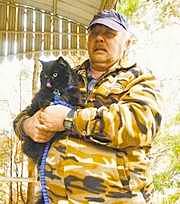










Gary Ribble would not be able to read this story if not for people like you. Ribble, who has chronic lymphocytic leukemia, needed new eyeglasses last spring but couldn’t afford them after losing a job he’d held for more than 40 years.
Then he found out about the Modest Needs Foundation. The grass-roots charity pools thousands of small donations to help people get through short-term financial crises. Donors direct their dollars to the requests they want to fund.
A 92-year-old great-grandma has written more than two thousand letters to troops over the past two years. Each letter is four pages long and unique to each soldier.
Her letter-writing to servicemen began more than one half century ago.
With a sharp decline in inmate population over the past month, Gwinnett County Sheriff Butch Conway plans to devote a portion of the county jail to save dogs’ lives.
The jail will serve as a foster home for the Society of Humane Friends, a pet rescue agency.
The dogs will have access to a fenced grassy area for exercise, Conway said, and trainers will come in to work with the inmates on grooming and training the animals.
“These dogs will be the dogs that would have been put down,” Conway said. “They will be saved at the last minute.”
Here are the Top Ten Innovations from 2009 that will lead us, with chin up, into the next decade. From new technologies that strip pollution from our oceans and air, to household devices that cut carbon emissions; from a possible cure for honeybee colony collapse, to a breakthrough on Alzheimer’s, these bright innovations will ignite hope in even the most cynical. All these stories appeared on the Good News Network in 2009:
A biotech firm in Washington recently announced an overwhelmingly positive response to compounds from a rain forest botanical for treating Alzheimer’s Disease, along with its intention to safeguard the very forests that provide such a remarkable pharmacopeia. In talking with Advana Science CEO Peter Leighton, I realized he just might have the hoped-for promise that millions were seeking — a natural compound that could disrupt the amyloid proteins and prevent them from binding. What’s more, nature was pulling off what drugs could not. The plant compound was so complex in its polysaccharide constituents that it could never be duplicated by any drug. (www.megjordan.com)
An Israeli company has developed a revolutionary new drug that could solve the problem of Colony Collapse Disorder, the disturbing syndrome that has been wiping out bee communities and threatening agricultural production all over the world. The drug, Remembee, which was developed by Beeologics, has completed successful clinical trials on millions of bees in North America. Not only has it proved effective in maintaining bee health, but it also improved the longevity of bees and increased the honey in the hives. Based on Nobel prize-winning RNAI technology, the drug helps bees overcome IAVP virus, which has been associated with colony collapse.
Inventor and water-treatment expert Michael Pritchard was inspired after the devastating Asian tsunami and hurricane Katrina, which left so many without clean drinking water, to develop the Lifesaver bottle. The revolutionary water-filtration method could drastically reduce the suffering worldwide due to the lack of access to clean water.
The Dow Chemical Company today unveiled its line of DOW Powerhouse Solar Shingles, revolutionary photovoltaic solar panels in the form of solar shingles that can be integrated into rooftops with standard asphalt shingle materials. Putting the power of solar electricity generation directly and conveniently in the hands of homeowners, Dow will distribute the shingles in limited quantities by mid-2010, and broaden their availability in 2011.
Sir James Dyson, the inventor who revolutionized the bagless vacuum cleaner, revealed his latest invention: a fan with no blades. The Dyson fan works very differently to conventional fans. With no blades or grill, it’s completely safe, effortless to clean. It uses Air Multiplier™ technology to draw in air and amplify it 15 times, producing an uninterrupted stream of smooth air that doesn’t cause unpleasant buffeting. (Video)
A variety of new technologies are gearing up to grab climate-warming carbon right out of the air. This is different from trapping carbon dioxide as it comes out of pollution sources like factories and power plants. University of Calgary climate change researchers say they are close to figuring out how to commercialize the capture of carbon dioxide directly from the air with a simple system that could be set up anywhere in the world. Chemicals giant BASF and glass and ceramics firm Corning are also working with a team at Columbia University on a company called Global Thermostat to develop a similar device.
An innovative new anti-pollution ship has hit the high seas off western France. The ‘Catamar’ can collect debris and more importantly help clean up oil slicks, straining several hundred cubic meters of oil per hour from the water.
More than 40 smaller boats have already been purchased to help clean up lakes. The company hopes larger boats will soon be mopping up the open seas. (AFP Video)
Trials by companies including Panasonic and Toyota are underway at 3,000 homes throughout Japan, to bring mini hydrogen power plants into backyards that will provide heat and power while emitting a fraction of the carbon dioxide of normal energy sources by using a hydrogen fuel cell to convert natural gas into electricity. It’s called a fuel cell cogeneration system.
A cancer drug that destroys the deadly cells which give birth to tumors has been developed by U.S. scientists. It has already worked against breast cancer and offers hope to those with cancer of the prostate, skin or bowel. The drug selectively kills cancer stem cells which help tumors grow and spread the disease through the body. Unlike other cancer cells, stem ‘mother’ cells are resistant to radiotherapy and chemotherapy, allowing cancer to return after treatment. In laboratory tests, the new drug, salinomycin, was 100 times more effective at destroying stem cells than the powerful chemo treatment Taxol. The U.S. researchers believe dozens of drugs with similar properties could be developed over the next few years. The treatment is around a decade away from the market.
A new solar-powered stadium designed not only to power, cool and water itself, but also to withstand the island’s typhoons and earthquakes. The world’s first completely solar-powered stadium, located in Taiwan, is set to be completed in time for July’s World Games. Every inch of the massive roof is covered in solar panels — enough to power the structure’s 3,300 lights, two huge TV screens, and maybe sell some electricity back to the grid. It even incorporates the ancient art of Feng Shui. (AP Video)
Here are the Top Ten Innovations from 2009 that will lead us, with chin up, into the next decade. From new technologies that strip pollution from our oceans and air, to household devices that cut carbon emissions; from a possible cure for honeybee colony collapse, to a breakthrough on Alzheimer’s, these bright innovations will ignite hope in even the most cynical. All these stories appeared on the Good News Network in 2009:
A biotech firm in Washington recently announced an overwhelmingly positive response to compounds from a rain forest botanical for treating Alzheimer’s Disease, along with its intention to safeguard the very forests that provide such a remarkable pharmacopeia. In talking with Advana Science CEO Peter Leighton, I realized he just might have the hoped-for promise that millions were seeking — a natural compound that could disrupt the amyloid proteins and prevent them from binding. What’s more, nature was pulling off what drugs could not. The plant compound was so complex in its polysaccharide constituents that it could never be duplicated by any drug. (www.megjordan.com)
An Israeli company has developed a revolutionary new drug that could solve the problem of Colony Collapse Disorder, the disturbing syndrome that has been wiping out bee communities and threatening agricultural production all over the world. The drug, Remembee, which was developed by Beeologics, has completed successful clinical trials on millions of bees in North America. Not only has it proved effective in maintaining bee health, but it also improved the longevity of bees and increased the honey in the hives. Based on Nobel prize-winning RNAI technology, the drug helps bees overcome IAVP virus, which has been associated with colony collapse.
Inventor and water-treatment expert Michael Pritchard was inspired after the devastating Asian tsunami and hurricane Katrina, which left so many without clean drinking water, to develop the Lifesaver bottle. The revolutionary water-filtration method could drastically reduce the suffering worldwide due to the lack of access to clean water.
The Dow Chemical Company today unveiled its line of DOW Powerhouse Solar Shingles, revolutionary photovoltaic solar panels in the form of solar shingles that can be integrated into rooftops with standard asphalt shingle materials. Putting the power of solar electricity generation directly and conveniently in the hands of homeowners, Dow will distribute the shingles in limited quantities by mid-2010, and broaden their availability in 2011.
Sir James Dyson, the inventor who revolutionized the bagless vacuum cleaner, revealed his latest invention: a fan with no blades. The Dyson fan works very differently to conventional fans. With no blades or grill, it’s completely safe, effortless to clean. It uses Air Multiplier™ technology to draw in air and amplify it 15 times, producing an uninterrupted stream of smooth air that doesn’t cause unpleasant buffeting. (Video)
A variety of new technologies are gearing up to grab climate-warming carbon right out of the air. This is different from trapping carbon dioxide as it comes out of pollution sources like factories and power plants. University of Calgary climate change researchers say they are close to figuring out how to commercialize the capture of carbon dioxide directly from the air with a simple system that could be set up anywhere in the world. Chemicals giant BASF and glass and ceramics firm Corning are also working with a team at Columbia University on a company called Global Thermostat to develop a similar device.
An innovative new anti-pollution ship has hit the high seas off western France. The ‘Catamar’ can collect debris and more importantly help clean up oil slicks, straining several hundred cubic meters of oil per hour from the water.
More than 40 smaller boats have already been purchased to help clean up lakes. The company hopes larger boats will soon be mopping up the open seas. (AFP Video)
Trials by companies including Panasonic and Toyota are underway at 3,000 homes throughout Japan, to bring mini hydrogen power plants into backyards that will provide heat and power while emitting a fraction of the carbon dioxide of normal energy sources by using a hydrogen fuel cell to convert natural gas into electricity. It’s called a fuel cell cogeneration system.
A cancer drug that destroys the deadly cells which give birth to tumors has been developed by U.S. scientists. It has already worked against breast cancer and offers hope to those with cancer of the prostate, skin or bowel. The drug selectively kills cancer stem cells which help tumors grow and spread the disease through the body. Unlike other cancer cells, stem ‘mother’ cells are resistant to radiotherapy and chemotherapy, allowing cancer to return after treatment. In laboratory tests, the new drug, salinomycin, was 100 times more effective at destroying stem cells than the powerful chemo treatment Taxol. The U.S. researchers believe dozens of drugs with similar properties could be developed over the next few years. The treatment is around a decade away from the market.
A new solar-powered stadium designed not only to power, cool and water itself, but also to withstand the island’s typhoons and earthquakes. The world’s first completely solar-powered stadium, located in Taiwan, is set to be completed in time for July’s World Games. Every inch of the massive roof is covered in solar panels — enough to power the structure’s 3,300 lights, two huge TV screens, and maybe sell some electricity back to the grid. It even incorporates the ancient art of Feng Shui. (AP Video)
Fifty-five percent of U.S. teenagers volunteered during a recent year, led by the nation’s education system where 68 percent of kindergarten through 12th-grade schools now offer or recognize community service opportunities for students.
Want to encourage your own kids to volunteer?
It’s not just people in need who benefit: Experts say helping others can offer young people a host of rewards, from a stronger sense of community to improved self-esteem. Plus, volunteering can help bulk up a college application or a résumé.
So how can you persuade your children to volunteer? Here are some tips from the Huggable Heroes program, via the North American Precis Syndicate.
A Norwegian teenager, Magnus Carlsen, has become the youngest chess grandmaster ever to top the world rankings.
Called the ‘Mozart of Chess,’ the 19-year-old can think 20 moves ahead. He reached the top of the World Chess Federation’s rankings on January 1, under the tutelage of Gary Kasparov, who once earned the same crown at age 20.
Maryland farmer John Helmstetter thought his life was ruined after a fire destroyed his barn and a third of his cattle. But he regained the “American Spirit” when his neighbors and local Amish banded together to help.
Hundreds of Amish men worked for three days to raise the building that provided John with his livlihood.
A 12 year-old girl who had beaten cancer when she was younger, annually designs holiday cards to help raise money for pediatric cancer research.
The card she created this year was given to the two men who haul trash, along with ten dollars.
On that day, the garbage truck pulled over to a stop, while the men inside talked about the girl whose name was listed on the back of the card, along with her picture.
Then, after a few minutes, they returned to the family home. They had something for her.
A man whose boat had capsized in 10-20 foot waves off the North Carolina coast in storm conditions, set about swimming in a last ditch effort to save himself. That’s when he bumped into one of several life boats that had been dropped upwind via parachute by a Coast Guard helicopter in hopes one might reach the man before divers from a Navy ship arrived.
The Missouri man, Dennis Clements, captain of the Gloria A Dios, was finally rescued by sailors from the aircraft carrier USS Dwight D. Eisenhower, who were called in to help when conditions were too severe for the Coast Guard.
Watch the video from WVEC below…
Watch an interview with Clements via the Coast Guard YouTube channel…
A beggar has never been given respect in society, but this one from Bihar has received plaudits and has emerged as a harbinger of hope for his dedication towards social service.
So far, he has conducted marriages of 78 destitute orphans, spending money that he collected during 25 years of begging. His achievement is all the more matchless because he is blind by birth.
His beautiful singing — in buses, trains, village squares and market places — earn alms in return, but unlike others who spend the money on themselves, Yakoub spends most of his alms restoring smiles on the faces of villagers.
A three-part series ends tonight on PBS that explores improving social relationships, learning to cope with depression and anxiety, and becoming more positive, resilient individuals.
Harvard psychologist and best-selling author of Stumbling on Happiness, Professor Daniel Gilbert hosts ‘This Emotional Life’ and talks with experts about the latest science on what makes us “tick” and how to find emotional support for the issues we face.
Each episode weaves together the compelling personal stories of ordinary people and the latest scientific research along with revealing comments from celebrities like Chevy Chase, Larry David, Alanis Morissette, Robert Kennedy, Jr., and Richard Gere. The show’s website also features resources for those interested in learning more: www.pbs.org/thisemotionallife.
Even as a teen while Kenneth lived in a homeless shelter on the destitute streets of Skid Row, he dreamed of attending Harvard to become a neurosurgeon.
When Nnamdi Asomugha, the Oakland Raiders’ All-Pro cornerback worth $45 million, saw Kenneth’s story on CNN, he wanted to help. He runs a foundation, the Asomugha College Tour for Scholars, that takes talented inner-city kids on tours of college campuses they otherwise would never be able to see. He’s helped get 25 teens into college over the last four years.
Kenneth, an honors student and president of his class, will be among the 16 students traveling in the spring to visit schools in Washington, D.C.
Nearly 60,000 books prized by historians, writers and genealogists, many too old and fragile to be safely handled, have been digitally scanned as part of the first-ever mass book-digitization project of the U.S. Library of Congress (LOC), the world’s largest library. Anyone who wants to learn about the early history of the United States, or track the history of their own families, can read and download these books for free.
“The Library chose books that people wanted, but that were too old and fragile to serve to readers. They won’t stand up to handling,” said Michael Handy, who co-managed the project, which is called Digitizing American Imprints.
“Many of these books cover a period of Western settlement of the United States — 1865–1922 — and offer historians a trove of information that’s otherwise tough to locate,” he said. Books published before 1923 are in the public domain in the United States because their U.S. copyrights have expired.
Nearly 60,000 books prized by historians, writers and genealogists, many too old and fragile to be safely handled, have been digitally scanned as part of the first-ever mass book-digitization project of the U.S. Library of Congress (LOC), the world’s largest library. Anyone who wants to learn about the early history of the United States, or track the history of their own families, can read and download these books for free.
“The Library chose books that people wanted, but that were too old and fragile to serve to readers. They won’t stand up to handling,” said Michael Handy, who co-managed the project, which is called Digitizing American Imprints.
“Many of these books cover a period of Western settlement of the United States — 1865–1922 — and offer historians a trove of information that’s otherwise tough to locate,” he said. Books published before 1923 are in the public domain in the United States because their U.S. copyrights have expired.
Americans are helping to keep kids warm in spite of the recent Arctic blast through Operation Warm, a charity that provides brand new coats to children from disadvantaged families. Founded by Pennsylvania Rotary Club member Richard Sanford, Operation Warm has provided more than a half million coats to children in 26 states since 1998.
12 years ago, Sanford read a local newspaper article about children suffering in cold weather while waiting for their school bus because they lacked winter coats. Angered but also inspired, he decided to take action, launching Operation Warm, to work with manufacturers to provide high-quality unused coats to kids in need.
“I couldn’t understand how something like this could happen. It broke my heart to see kids freeze because they didn’t have warm-enough coats,” recalls Sanford, the organization’s CEO and chair.
The Longwood, Pa, man’s first project in 1998 was to purchase 58 coats with his own money from a department store. He and members of his Rotary club distributed the coats to children in a low-income Philadelphia neighborhood.
Since then, Rotary has continued to play a crucial role in expanding fundraising and distribution for more coats, says Sanford. About 60 clubs in the United States have worked directly with Operation Warm, providing more than 25,000 new coats to children.
Kim Fremont Fortunato, president of the organization and a member of the Rotary Club of Wilmington, Delaware, says the quality of the coats is a key difference between Operation Warm and many other coat drives. “Most of the children we help have never owned a new coat,” says Fortunato. “We believe it improves their self-esteem. But most important, the coats we distribute will keep kids warm.”
Sanford says the organization has found many willing partners because people can relate to the children’s plight. “All around us there are poor children in this country who need assistance,” he says. “It’s our responsibility to help those who can’t help themselves. Seeing the kids’ smiles and excitement when they put on their new coats is an incredible experience. This is an enormously powerful project.”
Panasonic and LG Electronics, two of the top television makers, are integrating the free online calling service Skype into their new high-definition televisions.
People who buy the TVs, along with Web camera and microphone accessory designed for the living room, can sit on their couch and talk to their family and friends — and watch them as they chat — from around the world for free.
Chicago’s first lady, Maggie Daley, created an after school program two decades ago that serves 25,000 kids, enrolling them in programs of art, dance, sports, science and video to keep them out of trouble and learning.
The non-profit program, After School Matters, even gives them training and jobs to teach other kids in the after school programs.
Watch the Making a Difference report below, or at MSNBC…
To mark International Human Rights Day last Thursday, a nationally touring photography exhibit was unveiled at the World Bank in Washington DC that depicts a nonprofit organization working to end exploitative child labor in South Asia’s handmade carpet industry.
Faces of Freedom tells the success stories of children who have been helped by organization that launched a certification campaign assuring buyers and importers that no child labor was used in the manufacture of a carpet or rug.
The GoodWeave certification program is a market-based solution for factories that want the advantage of being certified child-labor-free in a marketplace where importers increasingly demand corporate responsibility. RugMark USA, the nonprofit that launched the GoodWeave program also provides rehabilitation and education for former child weavers.
A man sees a 75-year-old man stuck on railroad tracks and pulls him to safety. An off-duty emergency worker pulls a woman from a van after it crashes into an icy pond. An NBA star saves a woman from drowning.
These are examples of everyday people who, when confronted with a life-or-death situation, jumped in to do what they could — and became rescuers and heroes.