Collyweston Historical and Preservation Society – CHAPS
Collyweston Historical and Preservation Society – CHAPS
In a true underdog story, a group of “amateurs” used historical material to locate the buried remains of Collyweston Palace, owned by the grandmother of Henry VIII, Margaret Beaufort.
In the English shire of Northampton, a local historical society had been searching for the palace for 5 years, and located it with the help of ground-penetrating radar.
“We’re just a bunch of amateurs really, with no money, no plans, just a lot of enthusiasm and against all the odds we have unearthed this,” Chris Close, a member of the Collyweston Historical and Preservation Society, or “CHAPS” for short.
Collyweston Manor was listed as a historical site by Historic England back in 1967, but the only evidence anything was there were fish ponds and a barn. The first inkling the CHAPS volunteers had that they discovered something important was the moment their radar scans indicated buried walls and foundations of the palace.
Falling into disrepair by 1650, it was bought by the Dutch Tryon family who built another house on the site. The following excavations done by CHAPS needed the cooperation of several landowners.
CHAPS had raised £14,000 ($17,500) in local grant money for the project, and fortunately their efforts not only succeeded in locating and identifying the foundations and stone moldings of the buildings, but they attracted the attention of better-funded professionals who could help out.
Currently in the second stage of excavations, more radar scans will be employed to ascertain what each building might have been used for while diggers carefully ensure any artifacts present are preserved for a local museum exhibit at Lady Margaret’s Chapel in Collyweston.
“We will also be able to obtain other useful information that will enable us to work out the architectural style along with other important dating evidence,” CHAPS said. “As far as we can tell, the last royal to stay at Collyweston was Elizabeth I who is recorded as holding court here on 3 August 1566.”
SHARE The Efforts Of Collyweston’s Historic And Preservation Society…
Quote of the Day: “The pine stays green in winter—wisdom in hardship.” – Norman Douglas
Photo by: Robert Thiemann
With a new inspirational quote every day, atop the perfect photo—collected and archived on our Quotes page—why not bookmark GNN.org for a daily uplift?
A 49-year-old recently had to live with friends so she could afford to continue her studies when her rent rose.
But she’s just won the keys to a stunning Chelsea townhouse worth a whopping 5 million in West London.
She’s the latest winner of a charity draw organized by Omaze—after buying a ticket for the lottery that raised 2,600,000 in the UK for the NHS (National Health Service).
Oceanne Belle’ won the 4-story home with a $10 ticket. The beautiful townhouse in the sought-after area of Kensington and Chelsea comes mortgage free, with all the tax and legal fees covered.
She studies full-time at the University of Sunderland in London, and will finish her Bachelor of Science degree in Health and Social Care in January—and she’s free to either live in the house, rent it out, or sell it and become a cash multi-millionaire.
When Omaze first tried to contact Oceanne to tell her she’d scooped the prize, she blocked the number because she didn’t recognize it.
She now says winning the house is the “best Christmas present ever”.
“It was a Friday night and I’d been writing a dissertation all day and feeling a bit down in the dumps, as it’s so stressful. I got a few calls from a number I didn’t know so I blocked it, twice!”
Then the Omaze prize team showed up at her address.
“I was greeted by the Omaze team singing funny Christmas carols. Then the next thing I knew I’d won a house and my life had changed forever.”
SWNS / Omaze
“I never win anything and had only ever entered Omaze draws twice before. I guess it’s a case of, third time lucky!
“When they told me I’d won the grand prize I was shaking,” said Oceanne, who’s studying to become a pediatric nurse. “It’s so crazy that last week I was technically ‘sofa surfing’ at a friend’s flat. It’s just unbelievable.
“I can now invite all my family over. I absolutely love cooking and can’t wait to use the kitchen – it’s an amazing feeling.
She still wants to fulfill her dream of becoming a nurse—and this win will help her to achieve that.
“I’m thrilled this Omaze draw has raised so much money for NHS Charities,” she added. “I’ve recently had a long stay in hospital, so I know firsthand how incredible the work the NHS does is. I owe my life to the NHS and wouldn’t be here today without them.”
The Chief Executive at NHS Charities Together, said, “This incredible amount of money will help us provide life-saving equipment, volunteers, and training that will save lives.”
One Brit who spent his life helping the disabled won a 2.5 million country home in a previous drawing. And another home is ready to win (in Somerset) for UK residents only at their website—omaze.co.uk.
SPREAD the $10 Lottery for Homes in the UK By Sharing on Social Media…
Detroit, Michigan celebrated a major milestone in the future of vehicle electrification, as crews finished installing the nation’s first wireless-charging public roadway last month.
Using technology from Electreon, 14th Street is now equipped with inductive-charging coils that will charge electric vehicles (EVs) equipped with receivers as they drive on the road.
The road will be used to test and perfect the Israeli company’s wireless-charging technology in a real-world environment to perfect it ahead of making it available to the public in the next few years.
“We’re excited to spearhead the development and deployment of America’s first wireless charging road,” said Dr. Stefan Tongur, Electreon vice president of business development. “This milestone stands as a testament to our collaborative efforts with the State of Michigan and the Department of Transportation (MDOT).”
The charging road, which runs between Marantette and Dalzelle streets, paves the way for addressing range limitations of EVs,
The move toward electrification was touted by Gov. Gretchen Whitmer, who announced the pilot initiative in September 2021 to develop the nation’s first wireless charging infrastructure on a public road, after MDOT and Electreon entered a five-year commitment to develop the electric road system (ERS).
Electreon’s wireless charging technology is based on inductive coupling between copper coils installed below the road surface and receivers installed on the underside of electric vehicles. The road only transfers its electricity using a magnetic field when a vehicle with a receiver nears the in-road charging segments.
These charging segments can transfer wireless electricity directly to the car battery when the vehicle is parked (static charging) or is driving (dynamic charging). The electric road is safe for drivers, pedestrians and wildlife. Each coil in the road is activated only when a vehicle with an approved receiver passes over the coil. This ensures that energy transfer is controlled and provided only to vehicles that require it.
MDOT and Electreon agreed to install a combined mile of inductive-charging roadway in Detroit’s historic Corktown neighborhood. The charging road runs alongside the Newlab at Michigan Central Building, home to more than 60 tech and mobility startups, allowing for the further testing and advancement of this next-generation technology.
In 2024, MDOT will begin seeking bids to rebuild part of US-12 (Michigan Avenue), which will see additional inductive charging installed. Electreon has also installed two static inductive charging stations in front of Michigan Central Station, which will be able to charge Electreon-equipped vehicles while they are parked.
Extensive testing of the inductive charging technology will continue in early 2024. Using a Ford E-Transit electric commercial van provided by Ford Motor Co. and equipped with the Electreon receiver, staff will test the efficiency and operations of the vehicle and study potential long-term public transportation opportunities.
“Making it easier for EV users to find a reliable charging source without disrupting their commute supports both fleet operations and passenger travel,” said MDOT Director Bradley C. Wieferich.
Electreon operates 18 projects across eight countries, including powering buses in Israel and electrifying roads in France, China, Norway, and Sweden. And, Electreon’s wireless in-road charging technology was named one of the world’s top 100 inventions for 2021 by Time Magazine.
DRIVE This Cool Story to EV Drivers By Sharing on Social Media…
A golf fan has created a stunning portrait of Tiger Woods made out of 25,000 new and broken golf tees.
Aaron Norris finished the artwork last month and has already sold it for an undisclosed amount.
The 43-year-old artist says he got the idea after spotting broken tees strewn across his local course. He started picking them up, so they could become part of a future pallet.
The 6-foot x 6-foot wall art depicts one of the most famous faces in all of sports reading a putt.
“This was an idea I had been thinking about for a long time,” admits the resident of Missouri.
“Every time I played golf I would see all these broken golf tees laying on every tee box. I would always say ‘I could make something out of those’.
Missouri artist Aaron Norris created a stunning mural of Tiger Woods – SWNS
“Over the summer and fall, I started picking them up and saving them. I also had all of my neighbors who played golf saving them for me too.”
Eventually, he decided that he would create a portrait of Tiger Woods, who is tied for most lifetime PGA Tour wins.
Roughly half of the 25,000 golf tees used were collected; he spent $400 buying the other tees.
Previous works by the artist includes a Muhammad Ali oil canvas, an Elon Musk mosaic bead portrait, and a painting of the Kelce brothers, two NFL football stars.
“I’m from the Kansas City area, and when the Royals won the World Series in 2015, I began to get a lot of sports commissions.
“Then a few years later, the Chiefs started winning Super Bowls and the commission work for sports art really started to flood in.
SWNS
But he’s never utilized actual sports equipment to create his artwork before this fascinating work.
Researchers found that twice-daily current stimulation sessions of around 20 minutes improved the memory and overall cognitive performance of elderly people living with Alzheimer’s disease.
The innovative technology, known as transcranial direct current stimulation (tDCS), could also be used as a treatment to improve brain plasticity in Alzheimer’s sufferers through the formation of new neural networks, collections of neurons that fire together.
The tDCS technology is delivered via a device with two electrodes placed over specific areas of a person’s head, which transmits a constant, low-intensity electrical current.
It’s already beginning to be used across many areas of medicine, including for the treatment of depression, and a similar method was even able to zap paralyzed limbs into motion again.
The researchers from China recruited 140 patients with mild to moderate Alzheimer’s and randomly allocated whether they would receive the two daily sessions of the active low-intensity current, or a sham version of the tDCS in a control or placebo group.
Each participant received their respective treatment five days a week, over a maximum period of six weeks.
All participants were over the age of 65 and had had the disease for more than six months, with all also having scored below 26 on the Mini-Mental State Exam (MMSE), in which a score of less than 24 is seen as abnormal and indicative of cognitive impairment.
The currents were applied to the prefrontal cortex—the region of the brain involved in higher-order activities such as planning, decision-making, working memory, moderating social behaviors, and controlling aspects of speech and language.
The researchers then used a different scale called the Alzheimer’s Disease Assessment Scale-Cognitive Test, which focuses on language and memory, to evaluate cognitive performance at the start of the trial, after two weeks, and again after six weeks.
The results of the study showed that after two weeks, tDCS significantly improved the cognitive function of those who received the treatment, particularly their word recall, recall of test instructions, and word recognition.
No such improvements were noticed in the group receiving the sham treatment.
The results also showed that although cortical plasticity is impaired in those with Alzheimer’s, this improved in patients after six weeks of tDCS.
“Taken together, tDCS is a promising method for improving cognitive function with sufficient treatment,” First author Liu Xingxing, from the Zhejiang University in China.
“tDCS can significantly improve the working memory of older patients, and the stimulation changes the resting-state functional connectivity of the frontoparietal brain region,” the authors wrote.
SHARE This With Anyone You Know Who’s Had An Alzheimer’s Diagnosis…
Quote of the Day: “Water is the driving force of all nature.” – Leonardo da Vinci
Photo by: Aaron Burden
With a new inspirational quote every day, atop the perfect photo—collected and archived on our Quotes page—why not bookmark GNN.org for a daily uplift?
Funeral-goers dance in front of wicker casket at service for 65-year-old Irish singer-songwriter Shane MacGowan.
Funeral-goers dance in front of wicker casket at service for 65-year-old Irish singer-songwriter Shane MacGowan.
Thousands of mourners lined the streets of Dublin yesterday to bid farewell to Irish hero Shane MacGowan, the punk rocker who elevated traditional Celtic music to new heights as co-founder of the band The Pogues.
After his death at age 65 from months of complications and pneumonia, his horse-drawn carriage cortege wound through two miles of the city’s streets where musicians gathered and fans joined them in singing songs like Dirty Old Town and A Pair of Brown Eyes as the procession passed by.
As the casket rolled through his hometown of Nenagh draped in the Irish flag, his 1988 hit, If I Should Fall From Grace With God, was pounding from speakers, while the crowd clapped and cheered him on his way.
“Let me go boys, let me go boys… Let me go down in the mud where the rivers all run dry.”
But it was the Irish funeral service, in a nearby church in County Tipperary, that truly demonstrated how to say goodbye to a lively character such as Shane: make it a celebration.
One highlight for the crowd gathered at the public church service was when musicians got up and sang Shane’s unforgettable Christmas song, Fairytale of New York.
Glen Hansard from the band The Frames got a standing ovation on lead vocal and guitar, while John Sheahan from The Dubliners played his tin whistle. The joyful emotions rose to such a height that friends and family escaped the rows of benches to dance in the aisles.
MacGowan singing with The Pogues at a Washington DC St. Patrick’s Day concert in 2011 – by Geri Weis-Corbley
Shane’s friend Johnny Depp, who read a prayer, called the exceptional songwriter “the maestro”, and Bono shared a message via video. Nick Cave also performed MacGowan’s moving ballad A Rainy Night in Sohoat the piano.
You can watch the whole funeral below, but we’ve started the video on Fairytale of New York…
People on the streets of Dublin also rang out spontaneously with the lyrics of the poignant Christmas tale—living proof that the hard-living MacGowan will never be forgotten—especially in December…
After Shane MacGowan’s cortège passes by, hundreds of people remain on Westland Row/Lincoln Place in Dublin for an impromptu rendition of Fairytale of New York. pic.twitter.com/sKq0GoSP5T
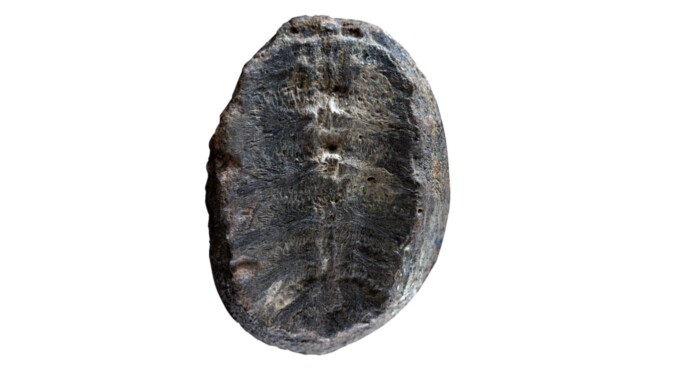
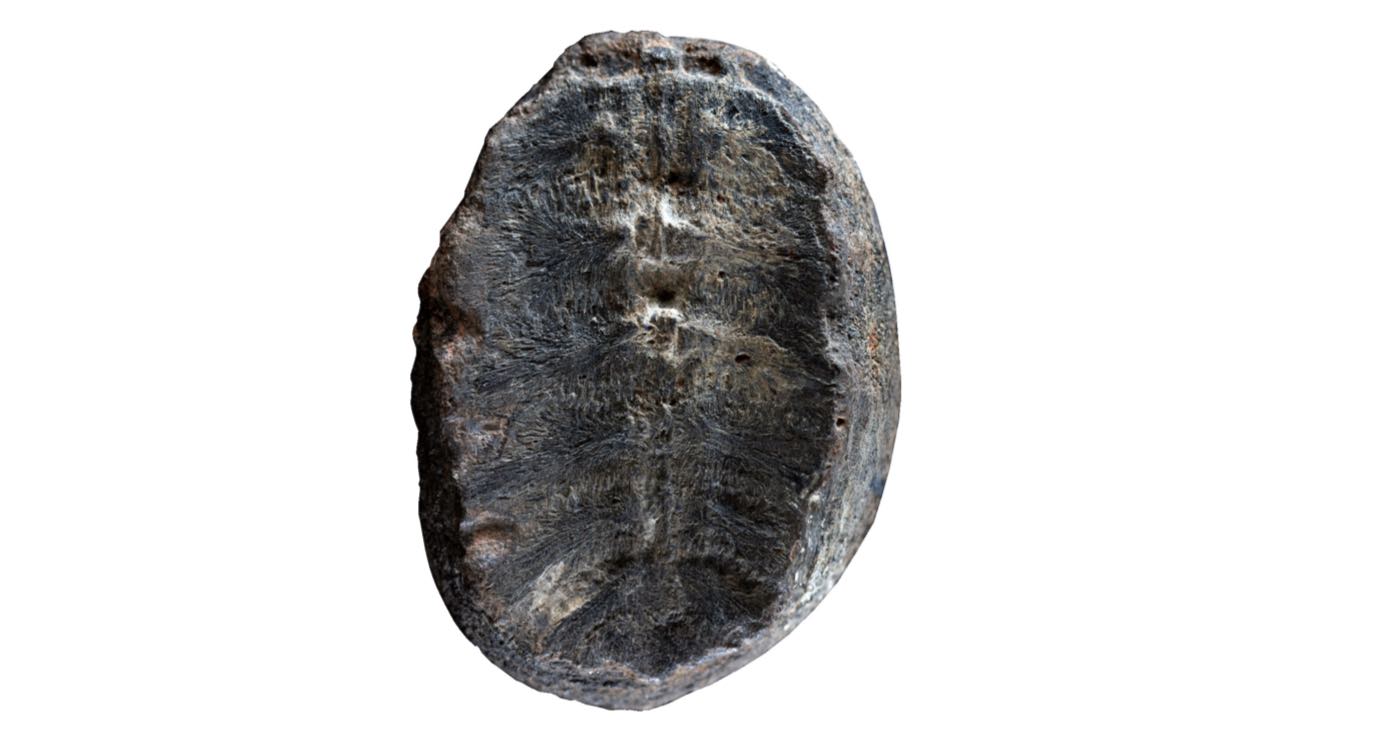
A fossil thought for years to be a plant turns out to be a baby turtle—and surprised researchers have nicknamed it “Turtwig” after a Pokemon character that is half-turtle, half-plant.
From the 1950s to the 1970s, a priest named Padre Gustavo Huertas collected rocks and fossils near a town called Villa de Levya in Colombia.
Two of the specimens he found were small, round rocks patterned with lines that looked like leaves. He classified them as a type of fossilized plant.
But a new study, published in the journal Palaeontologia Electronica, researchers re-examined the “plant” fossils and found that they weren’t plants at all: they were the remains of baby turtles.
“It was truly surprising,” said Héctor Palma-Castro, a paleobotany student at the Universidad Nacional de Colombia.
The plants in question had been described by the priest in 2003 as Sphenophyllum colombianum. The fossils come from Early Cretaceous rocks dating back to between 113 and 132 million years ago, during the dinosaur days.
Fossils of Sphenophyllum colombianum would have been rare at that time, as the other known members of the genus Sphenophyllum died out more than 100 million years prior.
The plants’ age and locality piqued the interest of Colombian-born Dr. Fabiany Herrera, the assistant curator of fossil plants at the Field Museum in the United States, and his student, Mr. Palma-Castro.
Dr. Herrera recalled, “We went to the fossil collection at the Universidad Nacional de Colombia in Bogotá and started looking at the plants, and as soon as we photographed them, we thought, ‘this is weird.’”
At first glance, at two inches in diameter, the fossils looked like rounded nodules containing the preserved leaves of the plant Sphenophyllum. But the pair noticed key features that weren’t quite right.
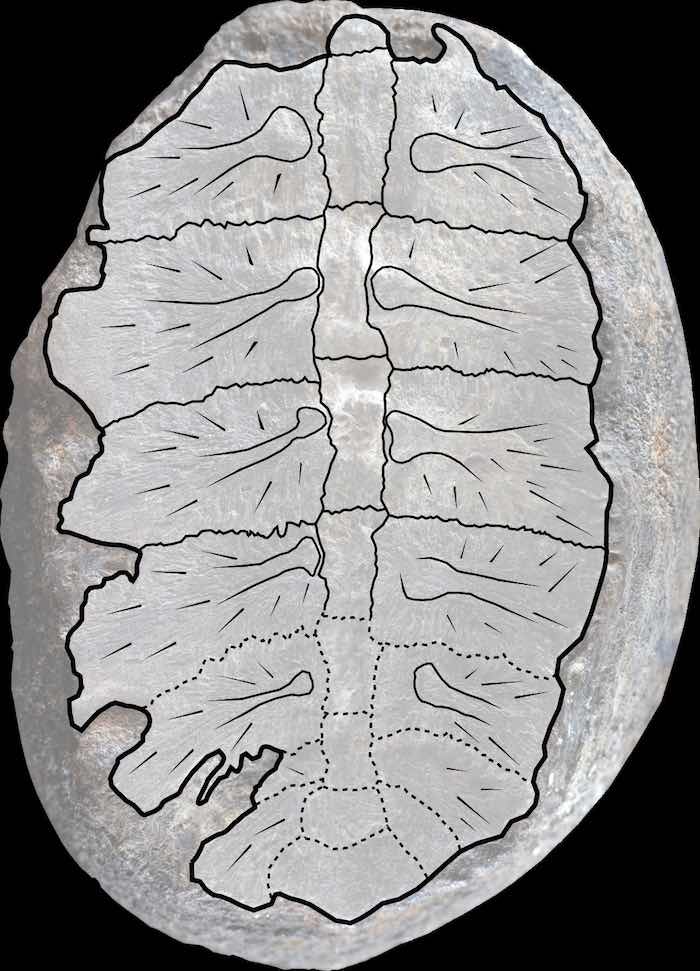
Drawing of the rib and back bones, superimposed onto the fossil – SWNS
“Deciphering the shape and margin of the leaf proved challenging,” said Palma-Castro.
“When you look at it in detail, the lines seen on the fossils don’t look like the veins of a plant, explained Dr. Herrera. “I was positive that it was most likely bone.”
Herrera reached out to an old colleague, Edwin-Alberto Cadena, a paleontologist who focuses on turtles and other vertebrates at the Universidad del Rosario in Bogotá. He confirmed the photos definitely looked like the bony upper shell of a turtle (carapace).
When he saw the scale of the photos, Prof. Cadena said, ‘Well, this is remarkable, because this is not only a turtle, but it’s also a hatchling specimen, it’s very, very small.”
Cadena and his student, Diego Cómbita-Romero, further examined the specimens, comparing them with the shells of both fossil and modern turtles.
“When we saw the specimen for the first time I was astonished, because the fossil was missing the typical marks on the outside of a turtle’s shell,” said Cómbita-Romero. “It was a little bit concave, like a bowl.
“At that moment we realized that the visible part of the fossil was the other side of the carapace, we were looking at the part of the shell that is inside the turtle.”
Details in the turtle’s bones helped the researchers estimate how old it was at death. The juvenile likely died when it was less than one year old.
“This is actually really rare to find hatchlings of fossil turtles in general,” said Cadena. “When the turtles are very young, the bones in their shells are very thin, so they can be easily destroyed.”
The researchers say that the rarity of fossilized baby turtles makes their discovery an important one. “Discoveries like these are truly special.”
The features that Padre Huertas thought were leaves and stems are actually the modified rib bones and vertebrae that make up the shell.
They nicknamed the specimen ‘Turtwig,’ after a Pokémon character that’s half-turtle, half-plant.
“In the Pokémon universe, you encounter the concept of combining two or more elements, such as animals, machines, and plants,” said Palma-Castro. “In this case, Turtwig—the baby turtle with a leaf attached to its head.”
UNEARTH THIS STORY for Pokemon Friends By Sharing on Social Media…
Willy Wonka was immortalized in a life-sized chocolate sculpture by Jen Lindsey-Clark in London's Trafalgar Square – SWNS
Chocolate Sculptor Jen Lindsey-Clark unveils Willy Wonka statue in Trafalgar Square – SWNS
Artists spent 200 hours over two weeks carving a life-sized Willy Wonka using what else but chocolate.
The 6-ft 2-inch sculpture, inspired by the eponymous character in the new movie Wonka, was unveiled this week in London’s Trafalgar Square.
Sculpted into the character’s iconic pose, featuring a hat-tip and cane, the creation was moulded and hand crafted from more than 100 liters of melted chocolate by chocolate sculptor Jen Lindsey-Clark and a small team.
Only the head uses a non-cocoa center.
“As a chocolate sculptor, this was the absolute dream commission,” said Jen, who recently created a bust of King Charles ahead of the coronation.
“Just about everyone in the world of confectionary has been inspired by the magic of Willy Wonka and Dahl’s inventive storytelling one way or another.”
Willy Wonka was immortalized in a life-sized chocolate sculpture by Jen Lindsey-Clark in London’s Trafalgar Square – SWNS
“I grew up on the books and watched the original Wilder Wonka film religiously every Easter and Christmas as a child, so to have had the chance to bring such an enduring character to life in chocolate has been such a labor of love.”
Chocolate Sculptor Jen Lindsey-Clark applies final touches to sweet sculpture inspired by Timothée Chalamet’s Willy Wonka – SWNS
The new film, which features Timothée Chalamet as Wonka and Hugh Grant as the Oompa Loompa, was released on Friday by Warner Bros, and is the latest in a respectable line of films based on Roald Dahl’s literary classic Charlie and the Chocolate Factory.
It follows the life of a younger Willy Wonka, chock-full of ideas and determined to change the world. It depicts the path he took to become the iconic candy maker which several generations have come to know and love.
The sculpture has since been moved so pedestrians wouldn’t begin nibbling on the velvety masterpiece.
WATCH a video about making the sculpture…
And check out the new Wonka film trailer below..
SHARE THIS SWEETNESS With Film Fans on Social Media…
FREE WILL ASTROLOGY – Week of December 9, 2023
Copyright by Rob Brezsny, FreeWillAstrology.com
SAGITTARIUS (Nov. 22-Dec. 21):
Among our most impressive superpowers is the potency to transform ourselves in alignment with our conscious intentions. For example, if you feel awkward because you made an insensitive comment to a friend, you can take action to assuage any hurt feelings you caused and thereby dissolve your awkwardness. Or let’s say you no longer want to be closely connected to people who believe their freedom is more important than everyone else’s freedom. With a clear vision and a bolt of willpower, you can do what it takes to create that shift. These are acts of true magic—as wizardly as any occult ritual. I believe you will have extra access to this superpower in the coming weeks. Homework: Identify three situations or feelings you will use your magic to change.
CAPRICORN (Dec. 22-Jan. 19):
The eminent Capricorn philosopher William James (1842–1910) is referred to as the “Father of American Psychology.” He was a brilliant thinker who excelled in the arts of logic and reason. Yet he had a fundamental understanding that reason and logic were not the only valid kinds of intelligence. He wrote, “Rational consciousness is but one special type of consciousness, whilst all about it, parted from it by the filmiest of screens, there lie potential forms of consciousness entirely different.” This quote appears in his book The Varieties of Religious Experience. In accordance with astrological omens, I invite you to investigate those other types of consciousness in the coming months. You don’t need drugs to do so. Simply state your intention that you want to. Other spurs: dreamwork, dancing, meditation, nature walks, and deep conversations.
AQUARIUS (Jan. 20-Feb. 18):
Are people sometimes jealous or judgmental toward you for being so adept at multi-tasking? Are you weary of dawdlers urging you not to move, talk, and mutate so quickly? Do you fantasize about having more cohorts who could join you in your darting, daring leaps of logic? If you answered yes to these questions, I expect you will soon experience an enjoyable pivot. Your quick-change skills will be appreciated and rewarded more than usual. You will thrive while invoking the spiritual power of unpredictability.
PISCES (Feb. 19-March 20):
Romantic relationships take work if you want them to remain vigorous and authentic. So do friendships. The factors that brought you together in the first place may not be enough to keep you bonded forever. Both of you change and grow, and there’s no guarantee your souls will continue to love being interwoven. If disappointment creeps into your alliance, it’s usually wise to address the issues head-on as you try to reconfigure your connection. It’s not always feasible or desirable, though. I still feel sad about the friend I banished when I discovered he was racist and had hidden it from me. I hope these ruminations inspire you to give your friendships a lot of quality attention in 2024. It will be an excellent time to lift the best ones up to a higher octave.
ARIES (March 21-April 19):
I will cheer you on as you tenderly push yourself to be extra exploratory in the coming weeks. It’s exciting that you are contemplating adventures that might lead you to wild frontiers and half-forbidden zones. The chances are good that you will provoke uncanny inspirations and attract generous lessons. Go higher and deeper and further, dear Aries! Track down secret treasures and lyrical unpredictability! Explore the possible meanings of the term “holy rebellion.”
TAURUS (April 20-May 20):
In January, I will tempt you to be a spirited adventurer who undertakes smart risks. I will invite you to consider exploring unknown territory and expanding the scope of your education. But right now, I advise you to address your needs for stability and security. I encourage you to take extra good care of your comfort zone and even add some cozy new features to it. Here’s a suggestion: Grab a pen and paper, or open a new file on your favorite device, then compose a list of *everything* you can do to feel exceedingly safe and supported.
GEMINI (May 21-June 20): Booker T. Washington (1856–1915) was an American Black leader who advocated a gradual, incremental approach to fighting the effects of racism. Hard work and good education were the cornerstones of his policies. Then there was W. E. B. Dubois (1868–1963). He was an American Black leader who encouraged a more aggressive plan of action. Protest, agitation, pressure, and relentless demands for equal rights were core principles in his philosophy. In the coming months, I recommend a blend of these attitudes for you. You’ve got two big jobs: to improve the world you live in and get all the benefits you need and deserve from it.
CANCER (June 21-July 22):
I periodically get a big jolt of feeling how much I don’t know. I am overwhelmed with the understanding of how meager my understanding of life really is. On the one hand, this is deflating to my ego. On the other hand, it’s wildly refreshing. I feel a liberating rush of relief to acknowledge that I am so far from being perfect and complete that there’s no need for me to worry about trying to be perfect or complete. I heartily recommend this meditation to you, fellow Cancerian. From an astrological perspective, now is a favorable time to thrive on fertile emptiness.
LEO (July 23-Aug. 22):
Have you reached your full height? If there were ever a time during your adult life when you would literally get taller, it might be in the coming weeks. And that’s not the only kind of growth spurt that may occur. Your hair and fingernails may lengthen faster than usual. I wouldn’t be shocked if your breasts or penis got bigger. But even more importantly, I suspect your healthy brain cells will multiply at a brisk pace. Your ability to understand how the world really works will flourish. You will have an increased flair for thinking creatively.
VIRGO (Aug. 23-Sept. 22):
I like Virgo author Cheryl Strayed‘s thoughts about genuine togetherness. She says, “True intimacy isn’t a cluster f*** or a psychodrama. It isn’t the highest highs and lowest lows. It’s a tiny bit of those things on occasion, with a whole lot of everything else in between. It’s communion and mellow compatibility. It’s friendship and mutual respect.” I also like Virgo author Sam Keen’s views on togetherness: “something intrinsically spiritual, the desire for a union so primal it can be called divine.” Let’s make those two perspectives your guideposts in the coming weeks, Virgo.
LIBRA (Sept. 23-Oct. 22):
According to my interpretation of your astrological prospects, you now have the capacity to accelerate quickly and slow down smoothly; to exult in idealistic visions and hunker down in pragmatic action; to balance exuberant generosity with careful discernment—and vice versa. In general, Libra, you have an extraordinary ability to shift moods and modes with graceful effectiveness—as well as a finely honed sense of when each mood and mode is exactly right for the situation you’re in. I won’t be surprised if you accomplish well-balanced miracles.
SCORPIO (Oct. 23-Nov. 21):
Dear God — Thank you a trillion times for never fulfilling those prayers I sent your way all those years ago. Remember? When I begged and pleaded with you to get me into a love relationship with You Know Who? I am so lucky, so glad, that you rejected my prayers. Though I didn’t see it then, I now realize that being in an intimate weave with her would have turned out badly for both her and me. You were so wise to deny me that misguided quest for “pleasure.” Now, I am asking you to perform a similar service for any Scorpio readers who may be beseeching you to provide them with experiences they will ultimately be better off without.
WANT MORE? Listen to Rob’s EXPANDED AUDIO HOROSCOPES, 4-5 minute meditations on the current state of your destiny — or subscribe to his unique daily text message service at: RealAstrology.com
Quote of the Day: “Whenever you do a thing, act as if all the world were watching.” – Thomas Jefferson
Photo by: Robert V. Ruggiero
With a new inspirational quote every day, atop the perfect photo—collected and archived on our Quotes page—why not bookmark GNN.org for a daily uplift?
It’s one thing to power green aviation in Europe where flights take 30 minutes to 3 hours; it’s another thing to send a jetliner across the Atlantic.
But that’s exactly what Virgin Atlantic was able to do for the first time in history, when a Boeing 787 flew from London’s Heathrow to JFK using sustainable aviation fuels (SAF) manufactured from cooking oil, waste crops, and waste food.
This kind of fuel is reckoned as emitting 50% to 70% fewer emissions than jet fuel, and since the whole of world aviation accounts for just 2.8% of global emissions, a 50% to 70% theoretical reduction would eliminate it as a priority in the fight against climate change.
Virgin’s 787 was filled up with 50 tonnes of SAF. Two types were used, with 88% derived from waste fats and the rest from waste products of corn farming in the US.
UK Transport Secretary Mark Harper was one of those on board the flight, and upon landing, declared, “history has been made.” The flight was not open to the paying public, but there were passengers.
Sir Richard Branson, the company’s founder, said he knew it was just a first step.
“But you have to start somewhere,” he told the BBC. “And if we didn’t prove it can be done, you would never, ever get sustainable aviation fuel.”
Heavy machinery has difficulties in becoming green. Planes, trains, and heavy construction equipment need massive doses of portable power; the kind generated through diesel or kerosine. It needs to be not only portable and combustible, but also light enough not to disrupt weight restrictions.
For this reason, passenger jets are at the moment limited to SAF or hydrogen. In the spring of this year, a startup called ZeroAvia flew the largest aircraft (a 19-seater) ever powered by hydrogen which they hope to make available soon to decarbonize short national flights in Europe.
At the moment, SAF is used in just 0.1% of all fueling for passenger flights in the UK, where Virgin is headquartered.
The UK government has set plans to require 10% SAF in all airline fuels by 2030.
Photo released to Smithsonian by William Stein and Christopher Berry
William Stein and Christopher Berry
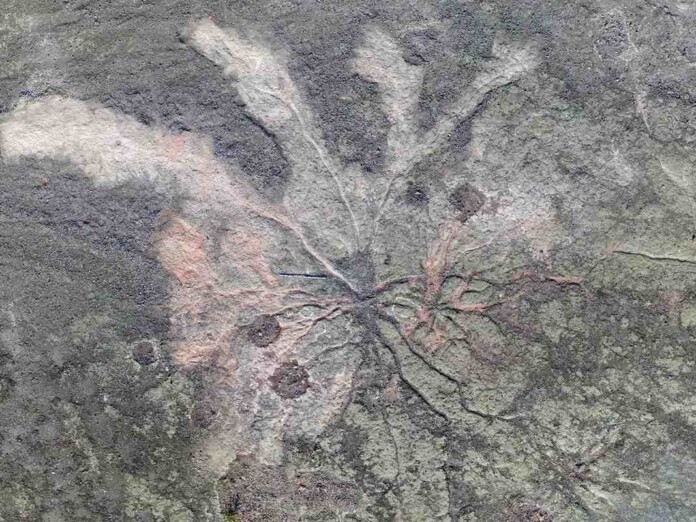
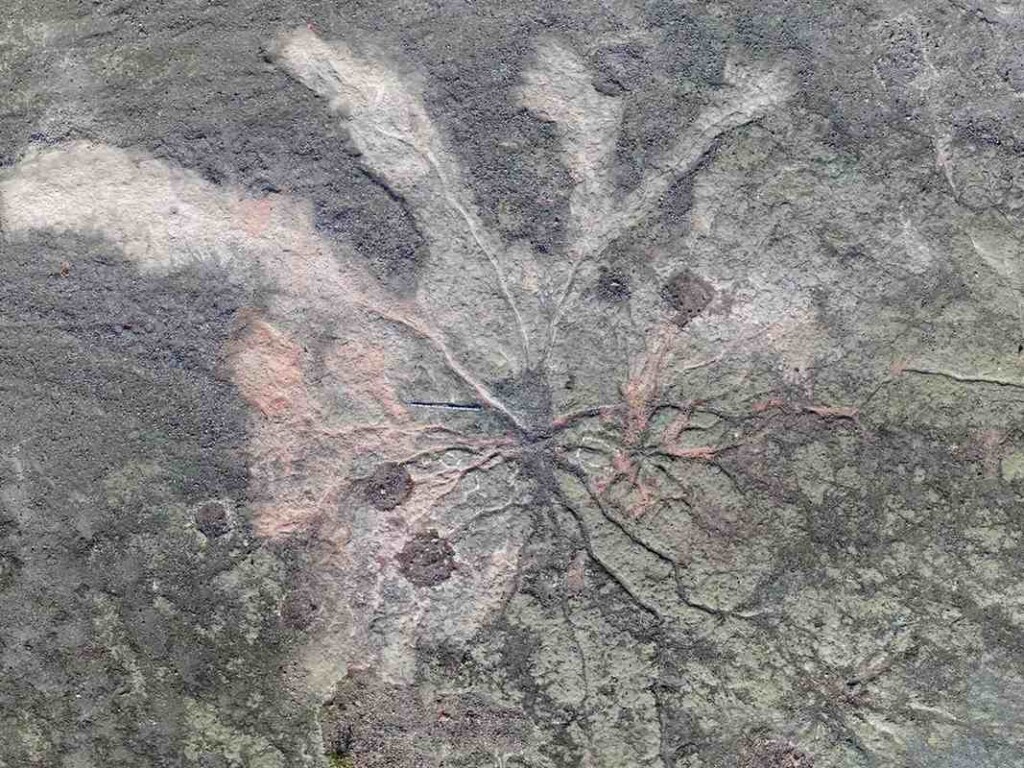
Trees were one of the oldest dominant life forms on Earth, but the most important component of a tree, the roots, are currently shrouded in evolutionary mystery: when they first evolved, how they evolved; these are unanswered questions.
In New York’s Catskill mountain range, a fossilized forest is clueing in paleobotanists as to the origins of woody deciduous trees, and answering, if only partially, some of these questions.
The ancient woodland is 385 million years old. While their trunks have long since turned to dust, their root systems mineralized underground, and the imprints seen today outside Cairo, New York, look remarkably similar to those of our own forests today.
Yet they belong to a different sort of dendron, as they were species that predate the rise of seed disperses. The authors of a study on these Devonian root systems conclude trees came upon the strategy of roots early on, and have stuck with it essentially until our present time.
Belonging to the genus Archaeopteris, the roots branch out in sturdy and intricate patterns, were more able to guzzle up water and nutrients than the roots of other plants at the time, and also offered the support and solidity we associate with trees today.
While seemingly obvious, this was a radical new way for trees to live back in the mid-Devonian when Archaeopteris was evolving. The other dominant genera all had spindly, fast-growing roots that would be replaced over short intervals.
Photo released to Smithsonian by William Stein and Christopher Berry
While Archaeopteris wasn’t a seed-bearing tree, it had a large thick trunk that allowed it to grow both tall and wide, and broad leaves to soak up as much nutrients as possible. Combined with the roots, it shows this Devonian tree ancestor had a serious metabolic engine.
Nearby the forest at Cairo, another fossilized forest called Gilboa has long been thought to be the oldest in the world. But despite being separated by only 25 miles, the two ecosystems had several differences. Gilboa is filled with Eospermatopteris fossils, a genus that resembled tree ferns and which grew fleshy, hollow trunks, fronds instead of leaves, and the spindly roots mentioned above.
Eospermatoperis may have succeeded in colonizing much of the world, but it was Archaeopteris that actually changed the world.
Giant crowns of leaves sopped carbon from the air, storing it in giant woody trunks and in deep woody root systems. The roots burrowed, and died, deep underground, altering the chemical makeup of the world’s soils forever. The leaves shaded the ground, preventing moisture and life from burning up under the sun’s rays. The whole Earth would have been experiencing a reverse of what it’s experiencing today as trees are cut down, carbon is released, and the ground is exposed to UV light.
The Devonian experienced a prolonged period of glaciation resulting from the global cooling of so much carbon leaving the atmosphere, about 9°F or 5°C according to scientists. This resulted in an icebox state called the Late Paleozoic Ice Age which caused the Capitanian mass extinction event.
“What’s happening today is the opposite of what happened in the Devonian,” Paleobotanist William Stein, an author on the paper, told Smithsonian Magazine. “Once again, sweeping change begins and ends with trees.”
WATCH some drone footage of the forest…
SHARE This Heritage Of Our Modern Trees With Your Friends…
De Winton's Golden Mole, photo by team member JP Le Roux
De Winton’s Golden Mole, photo by team member JP Le Roux
A little species of golden mole has been rediscovered in South Africa thanks to an intrepid band of conservationists and a sniffing dog.
De Winton’s golden mole was last scientifically documented in South Africa—in Port Nolloth—in 1936. There were no photographs taken of this tiny blind mammal, and little information existed about its behavior.
Furthermore, without any physical specimen to examine, it was impossible to train a sniffing dog to find these little creatures that burrow under the sand and navigate by detecting vibrations through the tissue in their large noses.
Thinking that maybe De Winton’s mole smells the same as another of the 21 golden mole species, the team led by program manager Cobus Theron from South Africa’s Endangered Wildlife Trust (EWT) trained a border collie named Jessie to lay down on the ground when she smelled one of these other moles.
Another challenge lay in the habitat of De Winton’s golden mole: sand dunes. After a certain number of hours, sand dunes will have moved by some number of meters as winds blow the sand in different directions. Because the moles only burrow 4 inches under the ground, their tracks and dens are easily scrubbed away.
The third challenge was how do you identify De Winton’s Golden Mole without a historical sample, without a detailed description of how the species differs from other golden moles, and without DNA?
Fortune was on the side of Theron and his team, for when they arrived at Port Nolloth for a 2022 expedition, a rainstorm had frozen the tracks of the area’s moles in time in the wet sand. Ironically, Jessie the collie was completely uninterested in the scene, meaning that the tracks were made by a mole whose scent she didn’t recognize.
“The team collected more than 100 samples from the sand to take back to the lab for eDNA—short for environmental DNA—analysis,” writes Re:wild, one of the organizations that supported the effort.
“eDNA focuses specifically on the nuclear or mitochondrial DNA animals leave behind as they move through their environment, including hair cells, skin cells, and scat.”
Re:wild supports the rediscovery of lost species through their innovative and wildly successful “25 Most Wanted” list, which highlights important species that are lost to science, organizes expeditions to find them, and funds conservation based on the publicity of the rediscoveries. So far, De Winton’s golden mole is the 12th the org has crossed off its list.
With the eDNA sequences, the team was able to compare mitochondrial DNA to a specimen of mole held at the Port Nolloth Museum: it was a match.
“It’s been so exciting for me to make this discovery alongside a group of people with a shared interest and vision for golden moles to raise awareness about their presence, about their plight,” says Samantha Mynhardt, a conservation genetics researcher at the Endangered Wildlife Trust.
The only reason journalists and scientists can pronounce a “6th mass extinction” is because many small and seemingly unimportant species like De Winton’s golden mole are going extinct every year. Altogether, they paint a picture of a global biodiversity crisis.
For that very reason, however, the rediscovery of this tiny mammal, which many people will never see, nor make an effort to, nor regret not seeing if it were extinct, is actually tremendous news, because if the loss of dozens of small unknown species like it causes a crisis, the survival of dozens of them causes healthy ecosystems.
“I think it’s just fantastic that in 2023 we can still rediscover species,” said team leader Theron. “All of our stories around conservation are doom and gloom. Here we have an opportunity to say that, actually, there are opportunities to make change.”
SHARE This Sniffing Dog, Tiny Mole, And Hope For The Future With Your Friends…
Quote of the Day: “You’ve been given the gift of 86,400 seconds today. Have you used one to say thank you?” – William Arthur Ward
Photo by: Dhaya Eddine Bentaleb
With a new inspirational quote every day, atop the perfect photo—collected and archived on our Quotes page—why not bookmark GNN.org for a daily uplift?
After a special task force was created to address a criminal case backlog in Detroit, the city is on pace for the lowest homicide rate in 60 years, with violent crime in general falling at combined rates of 56%.
By the end of the government-enforced lockdowns of the criminal justice system in Wayne County which includes Detroit, there were 4,000 felons awaiting trial; the special task force has reduced that number to 1,400.
As a result of their various efforts, which really just amounted to budget increases and allowing judges and others to work from home, three metrics of violent crime from the first 11 months of 2023 compared with 2022 went down dramatically, with the homicide rate down 18%, and carjackings down 36%.
“We know why violent crime soared in America. The criminal courts shut down—you could not put 12 jurors in a room,” Mayor Mike Duggan said about the program and the reasons behind it.
From another city famous for violent crime, Chicago remains on pace for double-digit percentage declines in the number of homicides and shootings, according to a report from WTTW.
Arriving at a pre-pandemic rate, the year-over-year numbers of shootings and homicides have fallen 19%. Overall crime is also falling, as well as violent crime on public transport.
Similar reductions in violent crime are occuring further west as well. While property crime and petty theft are rising in Los Angeles, violent crimes of aggravated assault, homicide, shootings, and rape are all down by double digits; some by quite a lot.
The largest operational nuclear fusion reactor on Earth just produced its first plasma when it came online over the weekend in Japan.
A tokamak-style nuclear fusion reactor, the JT-60SA used superconducting magnets to heat and contain a gas to 200 million Celsius, turning it into a form of matter called plasma.
Nuclear fusion is billed as the Holy Grail of renewable energy, the solution to Earth’s energy needs, and even the last revolution in energy. It mimics the process that powers our Sun, but in a way that produces no emissions, and no radiation.
Originally developed in the Soviet Union in 1958, the tokamak, which is a Russian acronym for “toroidal chamber with magnetic coils,” is a doughnut-shaped reactor made of magnetic coils that can generate the pressure needed to contain the plasma within. When heavy hydrogen isotopes tritium and deuterium are injected into the chamber, their nuclei are fused, which creates energy in the opposite way to nuclear fission, in which an atom is split.
The JT-60SA measures 13.7 meters across and 15.4 meters high, and was assembled by a team representing more than 70 contracted companies and 500 scientists and engineers from Europe and Japan
Work on the device began in 2007 as part of an agreement between the European Union and Japan which aimed to build the JT-60SA as a smaller version of an even larger fusion reactor called ITER which is currently being assembled in France.
EU energy commissioner Kadri Simson said the JT-60SA was “the most advanced tokamak in the world” and called the start of operations “a milestone for fusion history”.
“Fusion has the potential to become a key component for energy mix in the second half of this century,” Simson added.
Governments and a few private firms around the world have been struggling to advance nuclear fusion technology past the point where it generates more energy than it uses, which has been achieved before at the Lawrence Livermore National Laboratory in the US, but not for very long.
Some firms have their own ideas of the best way in which to generate energy with plasma, but the overall industry has a long way to go, even though it has already come on in leaps and bounds.
Data from the JT-60SA will be used to better inform the construction and operation of ITER, if it can come online in time for the originally predicted date of operation in 2025.
SHARE This Next Step In The March Toward Nuclear Fusion Revolution…
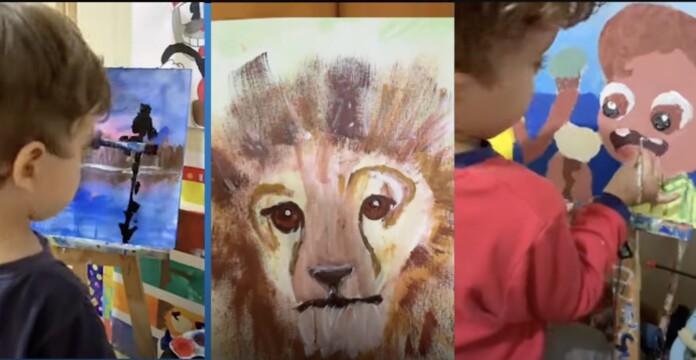
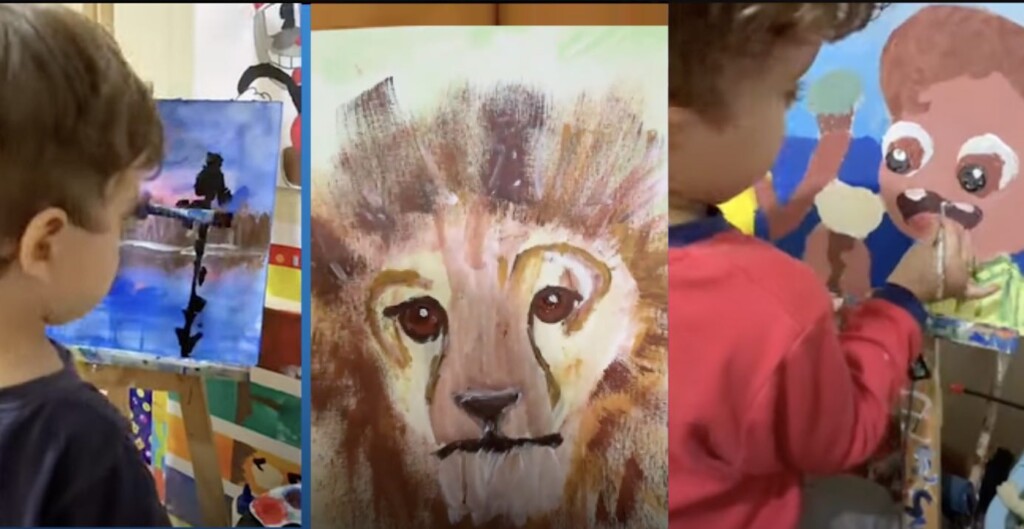
Four-year-old Santiago Daniel Peña García started scribbling on the walls before his first birthday, but rather than fretting about the labor and cost of repainting the wall, his mom focused on what the habit might allow him to become.
Adianée Peña García never stopped him, and now her son paints every day and produces new pieces daily, including a version of Starry Night by Van Gogh.
Adianée said she saw her son was so happy with his crayons and a big white wall as a canvas, and she couldn’t bring herself to stop him.
“I had just bought some colored pencils and I didn’t want him to ruin them, so I got him crayons,” she said, explaining when it took off. “He basically painted every wall in the house. Our bedroom, the hallway, the kitchen, and the living room were covered.”
Santiago Daniel’s drawings were such that the family even had to re-paint the apartment before they moved out, but Adianée thinks it was worth it because she raised an artist.
Santiago Daniel’s scribblings weren’t everybody’s tastes, and Alianée’s brother, who lived with the pair at the time, didn’t like it.
“At the beginning, my brother didn’t like it because it wasn’t our house, but then he saw how much Santiago Daniel enjoyed it,” she said. “The landlord saw it too when we left and he looked so shocked, but we were already painting over it so it was fine.”
Alianée believes that stopping the tot would have stifled his passion for art and says other parents should follow her lead.
“I think if he had done it and I had taken away his crayons it would have killed his passion for creativity,” she said. “I’ve seen parents do that and their kids just don’t enjoy painting like Santiago Daniel does. I would recommend other parents let their children be.”
“They probably won’t all be artists because they scribbled on the walls but they shouldn’t limit something that could help their growth, their creativity.”
Now, as a four-year-old, Santiago Daniel will spend about 40 minutes a day painting, and has moved from scribbles born in his mind to what he sees in a book or on television, such as Micky Mouse or other children’s cartoons.
A passionate artist herself who would often make toys for her son, Adianée moved to Peru from Venezuela in 2017 with no money and had to make do with handicrafts.
The single mom said that she could see him learning from her as she worked.
“I made him books, Teddy bears, I made a chimney for us one Christmas, so we could have a classic Christmas. Santiago Daniel would lie next to me and watch while I painted them, he would grab at my paintbrushes too,” she said.
“He’s been so smart since he was a baby I could see that when he held my paintbrushes he used the same grip as me. Of course sometimes he would hold them in his fist like a normal baby, but he tried to do it correctly.”
WATCH the young Da Vinci in Action in this music-only video below…
SHARE This Brilliant Young Talent With Your Friends…
University of Milano-Biocca - credit University press
University of Milano-Biocca – credit University press
A collaborative study involving experts in Europe and the US found the treatment of stem cells appears to protect the brains of MS patients from further damage.
In the first-ever clinical trials in humans, the researchers found patients injected with the stem cells exhibited no increase in disability or worsening of symptoms.
The promising study, published in the journal Cell Stem Cell, is hoped to lead to further clinical trials that could provide treatment for progressive MS.
More than two million people live with MS across the globe and, whilst some treatments currently available can reduce the severity and frequency of relapses, two-thirds of patients still transition into a debilitating secondary progressive phase of the disease within 25 to 30 years of diagnosis.
An autoimmune disorder like Lupus, ALS, and Crohn’s, MS is characterized by the body’s immune system attacking and damaging myelin—the protective sheath of tissue around nerve fibers, disrupting messages sent around the brain and spinal cord.
An immune cell called a microglial can attack the central nervous system in progressive forms of MS, causing chronic inflammation and damage to nerve cells.
Recent scientific advances involving the transplantation of stem cells have raised expectations that therapies could be developed to help ameliorate this damage.
Previous experiments in mice from the Cambridge University unit of the new study team have shown that skin cells reprogrammed to be brain stem cells and transplanted into the nervous system can help to reduce inflammation, and may even be able to help repair damage caused by MS.
The research team behind the latest study, incorporating experts from the UK, US, Switzerland, and Italy, completed a world-first early-stage clinical trial in which neural stem cells were injected into the brains of 15 patients with secondary MS recruited from two Italian hospitals.
Along with the Cambridge unit, teams performed the trials at the University of Milano-Bicocca, the Casa Sollievo della Sofferenza and Santa Maria Terni hospitals in Italy, the Ente Ospedaliero Cantonale hospital in Lugano, Switzerland, and the University of Colorado in the United States.
The transplant patients were followed for 12 months. No deaths or serious adverse events related to the treatment were observed throughout the year. Side effects were mild, transient, and reversible.
All patients had a high degree of disability at the start of the clinical trial—for example, they were wheelchair-bound—but during the 12-month observation period, they showed no increase in disability or worsening of symptoms. None of the patients showed symptoms that would indicate a relapse or signs of clinical progression, suggesting substantial stability of the pathology.
A subgroup of patients was also assessed for changes in the volume of brain tissue associated with disease progression, which found that the larger the dose of injected stem cells, the smaller the reduction in this brain volume over time.
The researchers speculate that this may be down to the stem cell transplant dampening inflammation.
Professor Stefano Pluchino, a co-leader of the study from the University of Cambridge, admitted that though the research had limitations, the findings were extremely promising.
“We desperately need to develop new treatments for secondary progressive MS, and I am cautiously very excited about our findings, which are a step towards developing a cell therapy for treating MS,” he said.
“We recognize that our study has limitations: it was only a small study and there may have been confounding effects from the immunosuppressant drugs, for example, but the fact that our treatment was safe and that its effects lasted over the 12 months of the trial means that we can proceed to the next stage of clinical trials.”
Professor Angelo Vescovi, another co-leader of the study from the University of Milano-Bicocca, added that it has taken nearly three decades to translate the discovery of brain stem cells into this experiment, which he said will “pave the way” to broader studies “soon to come.”
SHARE This Latest In Stem Cell Science with Your Friends…