













All News - Page 256 of 1715 - Good News Network
Home Blog Page 256

Remarkable Man Averts Oil Tanker Disaster by Crowdfunding to Remove Crumbling Ship From Red Sea

UN Resident and Humanitarian Coordinator for Yemen David Gressly with the FSO Safer

A derelict oil tanker off the coast of Yemen had more than a million barrels of crude sitting around, on the verge of leaching into the Red Sea, until one determined American orchestrated a last-ditch cleanup operation.

Just completed this summer, the salvage operation probably prevented a major environmental catastrophe because the tanker, FSO Safer, was 47 years-old and had serious mechanical and structural risks.

The diplomat working for the United Nations became a true hero after crowdfunding the many millions of dollars needed for the sea-saving work.

David Gressly took advantage of a truce between warring factions in Yemen, where the FSO Safer was abandoned off shore in 2015 when war broke out. The recent truce opened a window of opportunity to do something about this environmental ticking time bomb hanging over the region.

The oil technically belongs to the Yemen state—but who represents that country isn’t yet settled. After a peace agreement was reached in May of 2022, the race was on for Gressly to spearhead a hugely-ambitious fundraiser to find $144 million to buy a new tanker and pay a salvage company to drain the oil and bring the massive bulker to shore.

He knew that the amount of oil was greater—by far—than the barrels spilled in the Exxon Valdez tragedy, so Gressly, the UN Resident Humanitarian Coordinator for Yemen, continued his dogged search for funding over many months.

“If we had a major oil spill there, we would have probably raised a billion dollars in a month—because there are mechanisms for governments to do just that,” Gressly told the Guardian.
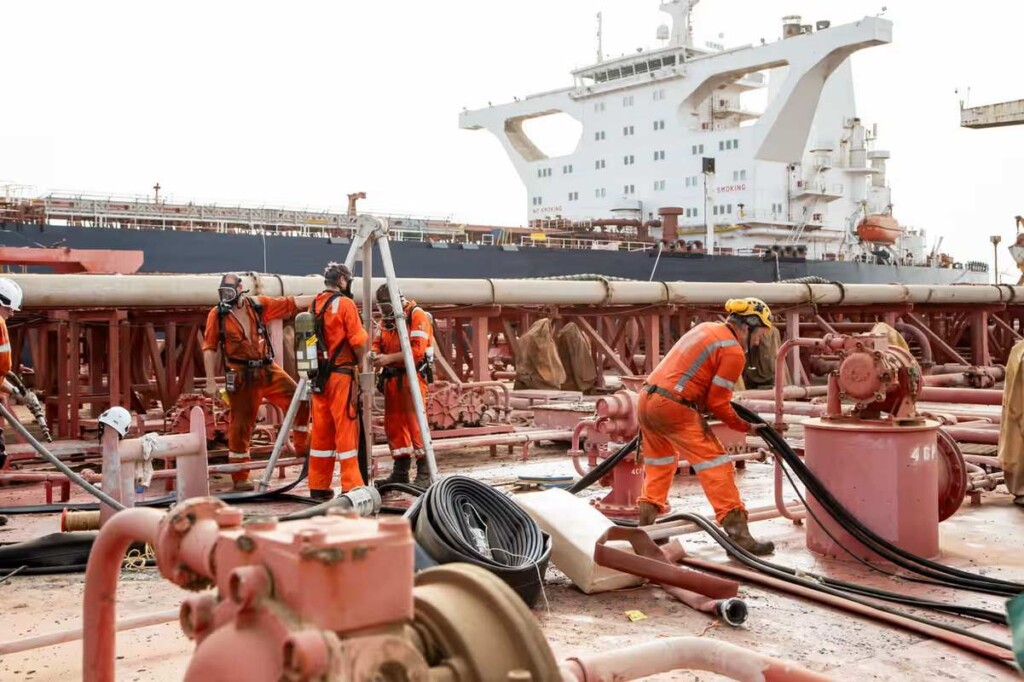
Salvage teams at work on the Safer. credit -Lize Kraan-Smit from Boskalis

After government and private sector donations weren’t adding up, Gressly opened the fundraising to citizens of the world: anyone with a dollar to spare was invited to contribute to this admittedly massive goal.

OTHER AVERTED DISASTERS: NASA Engineer Saves Passenger Jet From Disaster When He Spots Malfunction From Window Seat

But, by September 2022 the campaign had gathered $75 million—more than half of the required amount—an astonishing return driven by individuals, from Yemeni businessmen to schoolchildren in the US. When the campaign reached $121 million in July this year, the emergency humanitarian fund of the UN provided a low-interest loan to cover the rest.

From there, work was turned over to Boskalis, a salvage company that finished the cleanup operation on August 11th after a brand new oil tanker, dubbed the MT Yemen, weighed anchor alongside Safer to siphon off the last of her oil before the old girl was towed to Yemen’s shore for scuppering.

LOOK: Man Helps Repair Washed Out Road After Hurricane, And Discovers It Leads to the Man Who Saved His Life

Because of his lifesaving work in Yemen, Gressly is considering establishing contingency plans for future situations of this sort—especially since it was revealed upon closer examination that Safer had only 12 to 18 months before crumbling into the sea.

WATCH an animation of the whole salvage operation below…

SHARE This Truly Fantastic News Of Averted Disaster On Social Media… 

Digging A Wastewater Pipe Reveals Fossil Treasure Trove of Unknown Species 3-Million-Years-Old

Mangere shell selection - credit Bruce Hayward, released
Mangere shell selection – credit Bruce Hayward, released

Excavations had begun on two huge vertical shafts for a major upgrade of Auckland’s raw sewage pipeline when the groundworks crew came across something astonishing.

Piercing the threshold of an ancient shell bed filled with sea life, New Zealand paleontologist Bruce Hayward likened it to “finding gold right on your doorstep—a once-in-a-lifetime find.”

300,000 individual lifeforms from 266 species, fossilized 3 million years ago are offering the largest single insight into New Zealand native marine fauna in history, and a new paper released on the subsequent research has identified 10 new species.

182 different mollusks were recorded, including the oldest known member of the genera containing the famous New Zealand flax snail. There is the first fossil record entry for ostrocods—five species no less, also known as ‘seed shrimps’ in New Zealand, and the first appearance of a common coral species as well.

Additionally, great white shark teeth, eagle ray dental plates, a sperm whale tooth, and saw shark bones were also part of the haul.

Watercare, the excavation company digging the pipeline, was apparently all too happy to help the paleontologists pull out as many of the ancient shells as could be found: dumping the prehistoric screenshot in a sandy heap in a nearby field.

The company also funded two paleontology graduate students to do the grunt work of sifting through the sand, locating, cleaning, and sorting specimens.

OTHER PALEONTOLOGY NEWS: 500 Million-Year-Old Jellyfish–Oldest Ever Found–May Have Swallowed Prey Whole

Working under the supervision of Auckland Museum curator Dr. Wilma Blom, it took weeks to finish the job.

“Detailed identification of the fossils shows that they were deposited between 3 and 3.7 million years ago in a subtidal channel in an early version of the modern Manukau Harbor,” said Dr. Hayward.

MORE FOSSIL DISCOVERIES: Spectacular Fossils Discovered from Prehistoric Rainforest Reveal Intimate Details From 11 Million Years Ago

“At that time, sea level was slightly higher than it is today as the world was also several degrees warmer than now. As a result, the fossils include a number of subtropical species, whose relatives today live in the warmer waters around the Kermadec and Norfolk islands. At least ten previously unknown species are present and will be described and named in future work.”

Hayward added that this ancient marine channel brought sea creatures and their remains together from both tropical waters and colder climes.

SHARE This Fantastic Collection Of Prehistoric Sea Life With Your Friends… 

Sizzling Clouds, Storms, and Spectres: Witness the Awesome Power of Nature Through UK Weather Photo Contest

Villarrica Volcano, Chile - credit Francisco Negroni via SWSN
Villarrica Volcano, Chile – credit Francisco Negroni via SWNS

From lava illuminating clouds above a volcano to an icy wonderland, these are just some of the over 3,000 photographs submitted to the 2023 Royal Meteorological Society’s weather photo competition.

Just in time for World Photography Day, the competition is now in its eighth year, and acts as an observation deck to the vastly different climates experienced across the world.

Both amateur and professional photographers from 94 countries have shared their pictures and stories for the competition.

The photograph above was captured by Chilean photographer Francisco Negroni, who imaged the clouds above this volcano with a three-minute exposure time to capture the faint light coming from the lava inside. During that period, the turning of the Earth shifted the stars’ positions to make them appear as blurry streaks.

The clouds are what are known as “lenticular clouds” which form when air flowing over the ground encounters an obstacle like a volcano. This causes the air to rise and cool, which can allow moisture to condense and form clouds.

credit – Cristiano Xavier, via SWNS

Cristiano Xavier from Brazil followed a large storm hoping it might give him a chance to get a shot of a tornado. Tornadoes are typically created by large storms known as supercells. Variations in wind speeds can cause a rotation in the air, which the storm can pull into a vertical vortex.

OTHER STUNNING WEATHER EVENTS: Hiker Captures Video of Rare Ice Disk Vortex Spinning in Scottish Winter Weather Phenomenon–WATCH

If this vortex or funnel cloud reaches the ground, then that’s a tornado, and the intense winds can suck up debris and cause serious damage.

“Luckily this tornado stayed over the crops and didn’t destroy any buildings,” Xavier noted.

Fichtelberg Mountain by Christoph Schaarschmidt via SWNS

“It was not easy to photograph this landscape because it was about -14 degrees that evening, with strong winds,” said German photographer Christoph Schaarschmidt, who took this photograph of a mountain landscape turned into ice sculptures on Fichtelberg Mountain in Saxony, Germany.

credit – Matthew Price via SWNS

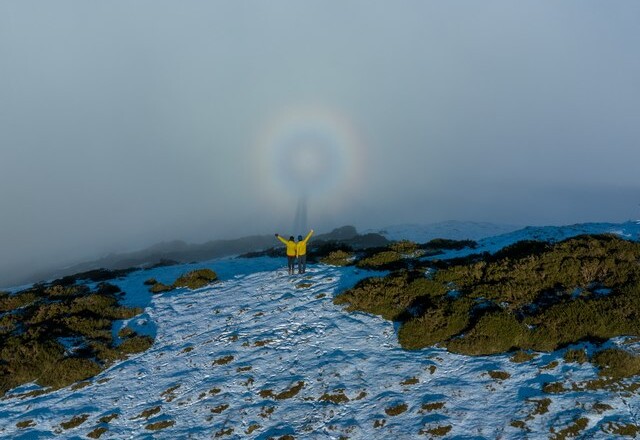
Brocken specters are caused by the shadow of the observer projected onto the mist, often creating the illusion of huge, distant, ghostly figures.

In this photo taken on Hanter Hill in Wales, Matthew Price and his wife spotted the brocken specter that their shadows were creating in the fog.

MORE WEATHER STORIES: Watch An Astrophotographer Capture ‘Giant Red Jellyfish Sprites’ on Colorado Mountain

Using a drone to take a selfie, the specter is surrounded by twinkling rainbow colors as different frequencies of light are reflected back to the camera at different angles by the water droplets in the mist.

Open voting runs until September 24th, and the winner will be selected on October 4th. You can vote for these or any of the other stunning images, like a 6-sided snowflake hanging on the edge of a pine tree branch, or mystical red sprites above a Chinese mountain, here on the contest website.

SHARE These Stunning Snaps With Your Friends… 

“It has long been my axiom that the little things are infinitely the most important.” – Arthur Conan Doyle

Quote of the Day: “It has long been my axiom that the little things are infinitely the most important.” – Arthur Conan Doyle

Photo by: Diana Parkhouse

With a new inspirational quote every day, atop the perfect photo—collected and archived on our Quotes page—why not bookmark GNN.org for a daily uplift?

Montana Youths Sue State Over Climate Change–And WIN–Citing the State’s Constitution

12 of the youth plaintiffs in Held v State of Montana - Our Children's Trust
12 of the youth plaintiffs in Held v State of Montana – Our Children’s Trust

In an historic first, 16 young plaintiffs sued the state of Montana, and won, after asserting that the U.S. state violated their constitutional right to a clean and healthful environment.

In the 103-page decision filed this month in Held v. State of Montana, Judge Kathy Seeley of the First Judicial District Court ruled in their favor based on the state’s own Constitution.

The 50-year-old document declares that citizens have a right to a clean and healthful environment and that each Montanan “shall maintain and improve a clean and healthful environment in Montana for present and future generations.”

With its decree, the court also invalidated as unconstitutional certain Montana laws that promoted fossil fuels without even considering climate change. The court ruled the youth plaintiffs had proven their standing to bring the case by showing significant injuries, the government’s substantial role in causing them, and that a judgment in their favor would change the government’s conduct.

Local news reports say the case was “the first case challenging state and national climate and energy policies to make it to trial in the U.S., and is now the first in which the plaintiffs were victorious.”

INSPIRINGThousands Have Donated $1.6 Million to Innocent Man Freed From Prison After 43-Year Wrongful Conviction

Judge Seeley’s Findings of Fact, Conclusions of Law, and Order set forth critical evidentiary and legal precedent for the right of youth to a safe climate, including these highlights:

● “Every additional ton of GHG emissions exacerbates Plaintiffs’ injuries and risks locking
in irreversible climate injuries.”
● “Plaintiffs’ injuries will grow increasingly severe and irreversible without science-based
actions to address climate change.”
● “Plaintiffs have proven that as children and youth, they are disproportionately harmed by
fossil fuel pollution and climate impacts.”
● “The State authorizes fossil fuel activities without analyzing GHGs or climate impacts”
● “(Montana has) the authority under the statutes by which they operate to protect
Montana’s environment and natural resources, protect the health and safety of
Montana’s youth.”
● “Montana’s contributions to GHG emissions can be measured incrementally and
cumulatively both in terms of immediate local effects and by mixing in the atmosphere
and contributing to global climate change and an already destabilized climate system.”

The youth were represented, in part, by attorneys with Our Children’s Trust, who called it “a sweeping win.”

“As fires rage in the West, today’s ruling in Montana is a game-changer that marks a turning point in this generation’s efforts to save the planet from the devastating effects of human-caused climate chaos,” said Julia Olson, Chief Legal Counsel with Our Children’s Trust. “This is a huge win for Montana, for youth, for democracy, and for our climate. More rulings like this will certainly come.”

“Today we witnessed democracy in action as Montana’s judiciary fulfilled its constitutional duty to hold the political branches accountable for actions exacerbating the climate crisis and causing harm to the state’s youngest and most vulnerable people,” said Nate Bellinger,  a senior staff attorney with the group.

OTHERS ARE SUCCEEDING! India Succeeds in Reducing Emissions Rate by 33% Over 14 Years–On Track to Meet all Targets

“Despite the state’s attempts to avoid any responsibility, the court’s decision affirms that the state has the ‘discretion to deny permits for fossil fuel activities that would result in unconstitutional levels of GHG emissions, unconstitutional degradation and depletion of Montana’s environment and natural resources, or infringement of the constitutional rights of Montanans and Youth Plaintiffs,’” said Barbara Chillcott, senior attorney at the Western Environmental Law Center, who also helped litigate the case.

The trial conducted in June included testimony from 10 expert witnesses as well as 12 of the 16 young Montanans who filed the suit over three years ago. They did not not seek any monetary award in their lawsuit. Instead, the youth sued to protect their right to a clean and healthful environment and to enjoy public lands that are threatened by drought, heat, fires, smoke, and floods.

GREEN SOLUTION: The Magic of Moss: The Tiny Plant Absorbs 6x More CO2 Than Other Plants, Says New Study

The legislative and executive branches will now be responsible for conforming their practices around fossil fuels to the judge’s ruling, including the admonition that “every
additional ton of GHG emissions exacerbates Plaintiffs’ injuries and risks locking in irreversible climate injuries.”

The State has 60 days to decide whether to appeal the decision to the Montana Supreme Court.

“This ruling, this case; it is truly historic. We are heard! Frankly the elation and joy in my heart is overwhelming in the best way. We set the precedent not only for the United States, but for the world,” said Kian, one of the youth plaintiffs.

DO YOU KNOW Who Would Love This? Share it On Social Media And Find Out…

Little Boy Can’t Stop Giggling as Four Puppies Shower Him With Love (WATCH)

SWNS - Kristine Koroleva
SWNS via Kristine Koroleva

Is this what heaven feels like—puppy love?

This adorable video shows a little boy in stitches as four golden retriever puppies shower him with a puppy-bomb of affection.

The four-year-old can’t stop giggling as the pack of nine-week-old puppies jump on him until the laughing toddler is helpless to get up.

The boy’s 28-year-old mom, Kristine Koroleva, gets to see a similar site almost every day in their home in Charlotte, North Carolina.

“It happens almost daily,” she said.

It looks like a fun home to grow up in!

POPULAR: Orphaned Deer Falls Head Over Hooves For Rescuer’s 11-Month-Old Daughter–LOOK

Watch the video below…

SHARE The Contagious Giggles With Dog Lovers on Social Media…

Discovered Enzyme Turns Air into Electricity, a New Clean Way to Make Energy Dreams Come True

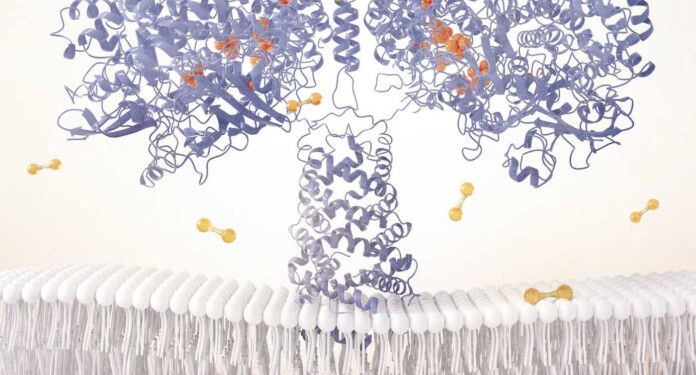
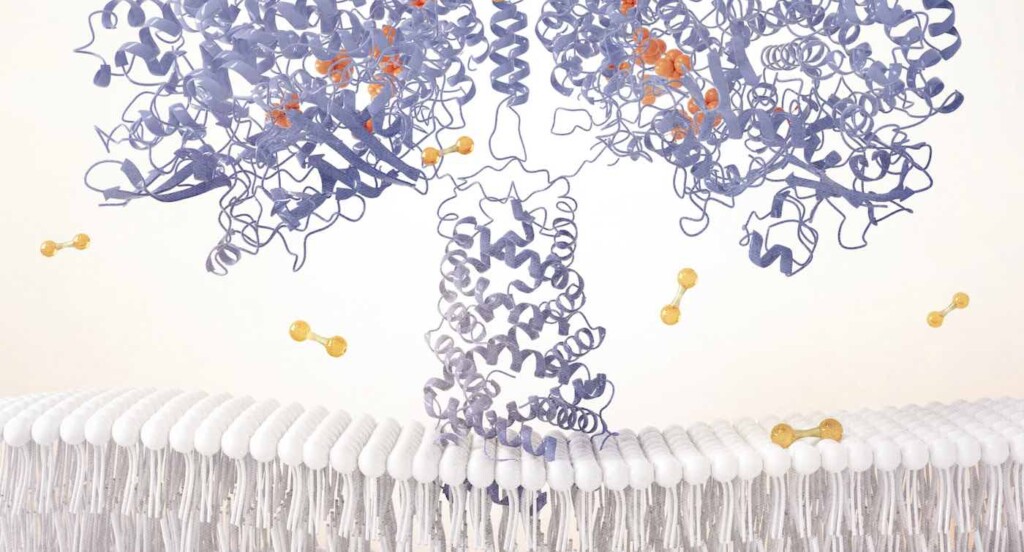
An artist’s rendering of Huc consuming hydrogen from air – By Alina Kurokhtina

Australian scientists have discovered an enzyme that converts air into energy by using the low amounts of hydrogen in the atmosphere to create an electrical current.

The enzyme in question is called Huc (pronounced “Huck”). It’s made by bacteria, and helps them with growth and survival in soil, in the oceans, in volcanic craters, and even Antarctica.

Monash microbiologists have now discovered it can make electricity from thin air.

The important discovery is outlined in the journal Nature. The research team was led by Monash’s Dr Rhys Grinter, PhD student Ashleigh Kropp, and Professor Chris Greening, from the Biomedicine Discovery Institute.

Professor Greening’s lab specializes in how bacteria obtain energy. Dr Grinter’s lab focuses on the molecular machines that make up bacteria, and how they work.

“We’ve known for some time that bacteria can use the trace hydrogen in the air as a source of energy,” Professor Greening said. “But we didn’t know how they did this, until now.”

Huc works as a hydrogen gas scavenger, and unlike all other known enzymes and chemical catalysts, it can consume the gas below atmospheric levels.

In this way it’s like a natural battery, making a small electrical current from air or added hydrogen. Science has been stumped as to how it worked. This finding opens the way to create devices that literally make energy, in the form of electricity, from thin air.

ALSO DISCOVERED: Revolutionary New Clean Fuel Developed that Could See Cars Being Powered by Sunshine

“What we really wanted to do was isolate Huc from a bacterium able to scavenge atmospheric hydrogen,” says Dr Grinter. “That is a challenging thing to do, because often these environmental bacteria are hard to cultivate. So, we developed a series of new methods for, first, growing the bacteria, then breaking them open and then using chemistry to try and isolate this single component.”

The chosen bacterium was Mycobacterium smegmatis, discovered in 1884 in Austria by a doctor, Sigmund Lustgarten, who was looking into skin diseases. Despite being isolated in this context, M. smegmatis generally lives in the soil, doesn’t cause disease, and is relatively well-studied because of its use as a model for organism for its cousin tuberculosis.

“Also,” he says, “one of the things that’s important for studying bacteria or purifying the components is to be able to change their genomes. Add genes, take them away and put in a little bit of extra DNA that allows you to purify the complexes. These tools exist for M. smegmatis.”

Team member Ashleigh Kropp did much of the lab work, including extracting Huc from the bacteria cells.

“We found that Huc has an extra component that we didn’t know existed,” he says.

CARS POWERED BY SUNRevolutionary New Clean Fuel Developed that Could Make Cars Powered by Sunshine

“Using this, Huc forms a large complex, and when we remove it, Huc doesn’t form that large complex anymore. It turns out that this component and the complex is really important for how Huc functions in the cells.”

The lab work showed that purified Huc can be stored for long periods.

“It’s very stable. It’s possible to freeze the enzyme or heat it to 80° Celsius, and it retains its power to generate energy,” Kropp says. “This reflects that this enzyme helps bacteria to survive in the most extreme environments.”

What can it power, and how could it be used?

“While there’s a lot of work to do to make this happen, there’s a number of potential applications,” says Dr Grinter. “The synthesis of fine chemicals requires very specific modifications to a molecule, which can be difficult to perform chemically. Huc could use the electrons from small amounts of hydrogen in air to perform these chemical modifications, in industrial chemical synthesis.”

Huc could also be used as a sensor for hydrogen. Huc produces electrical current when hydrogen is present. When Huc is placed in an electrical circuit, this current can be measured to determine the hydrogen concentration.

Because Huc can oxidize hydrogen to extremely low concentrations, a sensor that incorporates it would be very sensitive.

CHECK OUT: Researchers Can Now Make Clean Hydrogen Fuel By Pulling it Directly From Seawater—No Filtering Required

Possibly the most interesting application of Huc is to power small electronic devices using air or low concentrations of hydrogen.

This would mean these devices are powered by a super-clean and sustainable energy source. Because the amount of hydrogen present in air is so small, only a small amount of electricity could be extracted from it.

“Once we produce Huc in sufficient quantities,” Dr Grinter says, “the sky is quite literally the limit for using it to produce clean energy.

“In addition to the potential applications of the research, this work is really important, because it can help us understand how our planet works.

POPULAR: World’s First CO2 Battery to Offer Long-Duration Energy Storage at Half the Cost

“Between 60% to 80% of bacteria in soils, especially nutrient-deprived soils, have enzymes like Huc, and are constantly absorbing hydrogen.

“They absorb 70 million tonnes of hydrogen every year, and this shapes the composition of our atmosphere, which makes this process important for modulating the climate. Understanding the biochemistry of this process may allow us to harness it to stabilize our climate in the future.”

(Originally published on Monash Lens, CC license)

POWER SOME HOPE On Social Media By Sharing the Discovery…

British Museum Sends Totem Pole Back to its Indigenous Home in Canada–LOOK

Nisga’a Nation totem pole – SWNS / National Museums Scotland

A 36-foot totem pole carved by the House of Ni’isjoohl in British Columbia a century ago is on a sacred journey back home thanks to National Museums Scotland.

The repatriation comes after a year-long discussion with the Nisg̱a’a Lisims Government and marks a historic moment for reconciliation between the museum and the Nisg̱a’a Nation, where the memorial pole was first erected.

“After nearly 100 years, we are finally able to bring our dear relative home to rest on Nisg̱a’a lands,” said Sim’oogit Ni’isjoohl Chief Earl Stephens, who believes the art is “alive with the spirit of (their) ancestors”.

“It means so much for us to have the Ni’isjoohl memorial pole returned to us, so that we can connect our family, nation, and our future generations with our living history.”

The 36-foot-tall (11m) totem pole has remained in Scotland for nearly a century. It was originally sold to the museum by Canadian anthropologist Marius Barbeau.

Weighing one ton, the art will make its way from Scotland to the Nass Valley in Canada in September.

LOOK: Absolutely Epic: Watch the Release of a Wild Bison Herd onto Blackfeet Tribal Land

Following months of preparatory work, a delegation of family members and supporters from the Nisg̱a’a Lisims Government travelled to Edinburgh to hold a spiritual ceremony on Sunday, preparing the memorial pole for its journey home.

Nisga’a Nation totem pole – SWNS / National Museums Scotland

It will be transported to Terrace, and then driven in a family procession to the Nisg̱a’a Village of Lax̱g̱alts’ap, then be housed at the Hli G̱oothl Wilp-Adoḵshl Nisg̱a’a museum after a public arrival ceremony on Sept. 29, with a Nisg̱a’a feast to follow.

NEVER TOO LATE: Rare 170-Year-Old Cree Jacket Turns Up at Vintage Shop in UK–and They’re Reuniting It With Community–LOOK

The pole will be raised in the following days and available for public viewing later in October.

In 1860, House of Ni’isjoohl Matriarch Joanna Moody, from the G̱anada (frog clan), commissioned the pole to be carved by Nisg̱a’a master carver Oyee to honor her family member Ts’awit, who was next in line to be chief.

“The great significance of the Ni’isjoohl memorial pole to the Nisga’a people and their community was made clear to me when I met with their representatives last year,” said Scotland’s Cabinet Secretary Angus Robertson.

CELEBRITY COMPASSION: How Tony Hawk Joined an Apache Pro Skater to Bring New Skate Park to Reservation

“I’m grateful to all parties for the work that has been undertaken to make it happen.”

MULTIPLY THE GOOD By Sharing the Beauty on Social Media…

“To know you have enough is to be rich.” – Lao Tzu

Quote of the Day: “To know you have enough is to be rich.” – Lao-Tzu

Photo by: Indi Samarajiva, CC license

With a new inspirational quote every day, atop the perfect photo—collected and archived on our Quotes page—why not bookmark GNN.org for a daily uplift?

Scientists Create New Material Five Times Lighter and Four Times Stronger Than Steel

anthony mcgee

Materials that are both strong and lightweight can improve everything from cars to airplanes to medical equipment. Now, researchers have created an extraordinarily strong material with very low density–using two unlikely building blocks: DNA and glass.

“For the given density, our material is the strongest known,” according to Seok-Woo Lee of the University of Connecticut, who partnered with colleagues from Columbia University and Brookhaven National Lab.

“I am a big fan of Iron Man movies,” mused nanomaterials scientist Oleg Gang. “I have always wondered how to create a better armor for Iron Man. It must be very light for him to fly faster. It must be very strong to protect him from enemies’ attacks.

“Our new material is five times lighter but four times stronger than steel.”

Some metals, such as titanium, are stronger and lighter than iron. Certain alloys are even stronger—allowing for lightweight body armor, better medical devices, and safer, faster cars and airplanes. Metallurgical techniques have reached a limit in recent years, until nano materials unleashed creative opportunities.

The colleagues reported in Cell Reports Physical Science that by building a structure out of DNA and then coating it with glass, they have created a very strong material with very low density. Glass might seem a surprising choice, as it shatters easily. However, glass usually shatters because of a flaw – such as a crack, scratch, or missing atoms – in its structure. A flawless cubic centimeter of glass can withstand 10 tons of pressure, more than three times the pressure that imploded the Oceangate Titan submersible near the Titanic this summer.

MOST POPULAR: If Replicated, New Physics Discovery Could Grant Levitation to Any Device via Ambient Pressure Magnetics

According to UCONN News, it is very difficult to create a large piece of glass without flaws. But the researchers knew how to make very small flawless pieces. As long as glass is less than a micrometer thick, it’s almost always flawless. And since the density of glass is much lower than metals and ceramics, any structures made of flawless nano-sized glass should be strong and lightweight.

The team created a structure of self-assembling DNA. Almost like Magnatiles, pieces of DNA of specific lengths and chemistry snapped themselves together into a skeleton of the material. Imagine the frame of a house or building, but made of DNA.

Gang and Aaron Mickelson from Columbia and Brookhaven’s Center for Functional Nanomaterials coated the DNA with a very thin layer of glass-like material only a few hundred atoms thick. The glass only just coated the strands of DNA, leaving a large part of the material volume as empty space, much like the rooms within a house or building. The DNA skeleton, like scaffolding, reinforced the thin, flawless coating of glass making the material very strong—with the voids comprising most of the material’s volume, it became lightweight.

ANOTHER BREAKTHROUGH: Stunned Researchers Discover that Metals Can Heal Themselves ‘Without Human Intervention’

As a result, the glass nanolattice structure created a combination of strength and lightness that has never been achieved before.

“The ability to create designed 3D framework nanomaterials using DNA and mineralize them opens enormous opportunities for engineering mechanical properties.” Gang explained in a UConn News release.

But much research work is still needed. The team is currently working with the same DNA structure but substituting even stronger carbide ceramics for glass. They have plans to experiment with different DNA structures to see which makes the material strongest.

UNBELIEVABLE: Scientists Develop New Material to Make Lithium Ion Batteries Self-Healing and Easily Recyclable

Lee believes that DNA origami nanoarchitecture will open a new pathway to create lighter and stronger materials that we have never imagined before.

INSPIRE Scientific Wonder By Sharing This Breakthrough on Social Media….

She Upcycled Her Late Grandpa’s Shirts Into Cute Tops to Keep Him Close to her Heart–See How

SWNS / Issy Spurway
SWNS / Issy Spurway

A young woman who didn’t want to throw away her late grandfather’s shirts has now upcycled them into fashionable tops—and she’s helping others do it, too.

The 21-year-old uses a scissors and sewing machine to transform pieces pulled from a bag of her late grandpa’s clothing—rearranging them into cool designs to be worn by youngsters.

So far, Issy Spurway has upcycled over 100 garments, and she demonstrates the designs on her TikTok social channel.

“When my grandad died I didn’t want to throw his clothes away–but I didn’t want to wear them–so I made them into something I could wear and take a piece of him with me,” said the Loughborough University textile student.

“I actually think it helped with the grieving process as I know he would have loved it.”

She really honed her sewing skills during the pandemic while locked-down in Gloucestershire, England. She started upcycling clothes to practice, but also because it was cheap and shops were closed.

“Over the months I improved and before I knew it had quite a following,” she told SWNS news. “I think (it’s) because a lot of people love their grandparents and keep their clothes as sentimental pieces after they’ve passed.”

LOOK: Mom Alters Her Old Prom Dress for 5-yo to Wear to Daddy-Daughter Dance

“I find that upcycling is all about looking at the already existing features of a garment and working with these to suit a personal style or to make a certain outcome.”

Issy’s videos on @handmade.byIzzy show her cropping, hemming, gathering, and draping techniques.

She said TikTok UK reached out to her and she worked on a few campaigns with them, doing sewing and upcycling tutorials, before she became a college student.

CHECK OUT: She Turns Old Leather Sofas into Chic $200 Handbags to Cut Down on Waste–And They’re Flying Out the Door

Issy has now taken up employment with an upholstery company in Oxford, while finishing her degree.

SHARE The Inspiring Idea With Grandkids Everywhere On Social Media…

New T-Rex Cousins Had Bulldog Snouts and Even Shorter Arms But Still Ruled in North Africa

SWNS license
credit – Andrey Atuchin

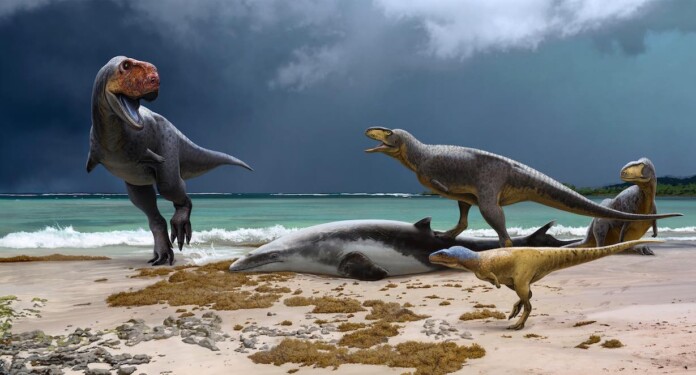
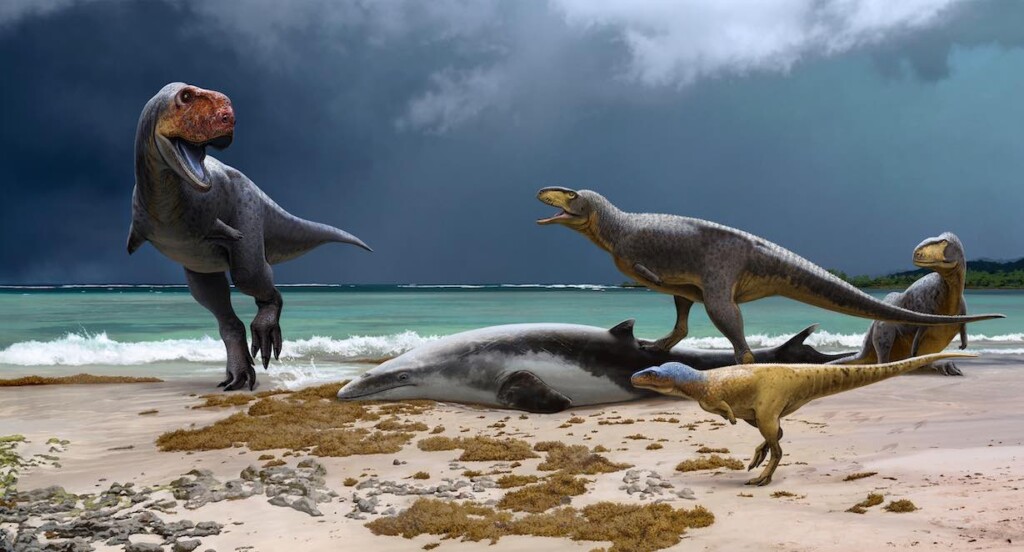
A pair of primitive cousins of T. rex that had short, bulldog-like snouts and even shorter arms have been discovered by scientists in Morocco.

The two new dinosaur species belong to the Abelisauridae, a family of carnivorous dinosaurs that were counterparts to the tyrannosaurs of the Northern Hemisphere.

Living alongside the much larger abelisaur Chenanisaurus barbaricus, the fossils show that Morocco was home to diverse dinosaur species just before a giant asteroid struck the Earth at the end of the Cretaceous, ending the age of dinosaurs 65 million years ago.

The first of the new species was found outside Casablanca near the town of Sidi Daoui. It’s represented by a foot bone from a predator about two and a half meters or eight feet long. The other, from nearby Sidi Chennane, is the shin bone of a carnivore that grew to around twice that length.

“What’s surprising here is that these are marine beds.” said study leader Dr. Nick Longrich, from the Milner Centre for Evolution at the University of Bath. “It’s a shallow, tropical sea full of plesiosaurs, mosasaurs, and sharks. It’s not exactly a place you’d expect to find a lot of dinosaurs. But we’re finding them.”

Morocco as a whole presents an exceptionally clear picture of animal life in the late Cretaceous, and these shallow sea beds host an extremely diverse collection of taxa.

So far, the small number of dinosaur fossils that have been recovered represent five different species—a small duckbill dinosaur named Ajnabia, a long-necked titanosaur, the giant abelisaur Chenanisaurus, and now the two new abelisaurs.

MORE EXCITING DINO NEWS: Fossil Preserves Dinosaur Being Attacked and Eaten by Mammal as Mudslide Entombs them Both

“We have other fossils as well, but they’re currently under study. So we can’t say much about them at the moment,” said Dr. Longrich.

Although it’s been argued that dinosaurs were already in decline before the giant asteroid hit the Yucatan and wiped out about 90% of life on Earth, the Moroccan dinosaurs suggest that they thrived in North Africa up to the very end.

MORE MEMBERS OF THE T-REX CLAN: Frightening Relative of T-Rex is Discovered –And Might be ‘Missing Link’ in Tyrannosaur Evolution

“The end of the Cretaceous in western North America definitely seems to become less diverse at the end,” commented Dr. Longrich. “But that’s just one small part of the world. It’s not clear that you can generalize from the dinosaurs of Wyoming and Montana to the whole world.”

“It also grew colder near the end, so it might not be surprising if dinosaurs at higher latitudes became less diverse. But we don’t know much about dinosaurs from lower latitudes.”

SHARE A Bit Of Science On Social Media With Your Friends…

The Top 20 Things That Make People Feel Good–And a New Positivity Bench in London

Join the Goodness campaign – SWNS
The Goodness Bench inside King’s Cross Station – SWNS

A poll of 2,000 adults revealed the top 20 things that make us feel good—with a good night’s sleep and a sunny blue sky coming in at number one and two.

45 percent said a nice compliment is guaranteed to boost their mood, while laughing until tears flowed also scored high.

The average respondent experiences these uplifting moments three times a day and claims that, in a typical week, they feel good about their day four times out of seven.

But, some are finding it increasingly hard to be happy. In fact, 83% said they proactively avoid negative stories on social media and TV due to it leaving them feeling ‘emotionally drained’.

The survey, commissioned by the cheese company Babybel, also found that nearly half of Londoners would welcome a pick me up.

In response, the brand has created ‘the Goodness Bench’ inside King’s Cross train station in London, as part of its ‘Join the Goodness’ campaign.

It’s designed to spread feel-good vibes by sharing a few positive news stories from the week while donating to its longstanding charity partner, Comic Relief, every time someone sits on the bench.

LOOK: ‘I Celebrated My 90th Birthday by Jumping Out of a Plane at 12,000 Feet’

A spokesperson for the brand said: “We all need a boost from time-to-time and feeling good goes hand in hand with doing good, which is why we wanted to spread positivity through this activation.”

68 percent of the Brits polled believe happiness is infectious, and as a result, over a third say they often or always go out of their way to spread a bit of positivity.

But, oddly, according to the OnePoll results, just 24 percent actively set aside time on a regular basis to do things that make themselves happy.

CHECK OUT: Adults 70 and Older Swear by These Activities to Keep Them Younger Than Their Age

“Doing things to make others happy also has the benefit of making us happy as well, making it a really positive circle of behavior,” the Babybel spokesperson added. “And many of the things on our top 20 list of happiness-makers come at absolutely no cost at all.”

“We all need a boost from time-to-time and feeling good goes hand in hand with doing good, which is why we wanted to spread positivity through this activation.”

TOP 20 THINGS THAT MAKE US FEEL GOOD

1. A good night’s sleep
2. A sunny blue sky
3. Summer
4. Receiving a compliment or praise
5. Booking a holiday
6. Crying with laughter
7. Getting a quiet moment to yourself
8. Eating your favorite snack
9. Pets being happy to see you
10. Looking back at old photographs
11. Finishing a great book
12. Helping an elderly person with something
13. Finishing a workout
14. Hearing children really belly-laughing
15. Finding a parking space when it’s busy
16. A newly-cleaned car
17. When your football or other sports team wins
18. A heart-to-heart with a loved one
19. Volunteering or helping others
20. Finding out your children have done well at school

DID YOU KNOW? How the Mind Can Be ‘Trained Like a Muscle’ to Focus – Try Using These Simple Exercises

SHARE With Londoners Who May Need a Pick-Me-Up on Social Media…
“Those who dwell among the beauties and mysteries of the earth are never alone or weary of life.” – Rachel Carson

Robert Pearce

Quote of the Day: “Those who dwell among the beauties and mysteries of the earth are never alone or weary of life.” – Rachel Carson

Photo by: Robert Pearce

With a new inspirational quote every day, atop the perfect photo—collected and archived on our Quotes page—why not bookmark GNN.org for a daily uplift?

Robert Pearce

Commercial Cargo Ship is Crossing Ocean Using ‘Wind Wings’ Like High-Tech Sails

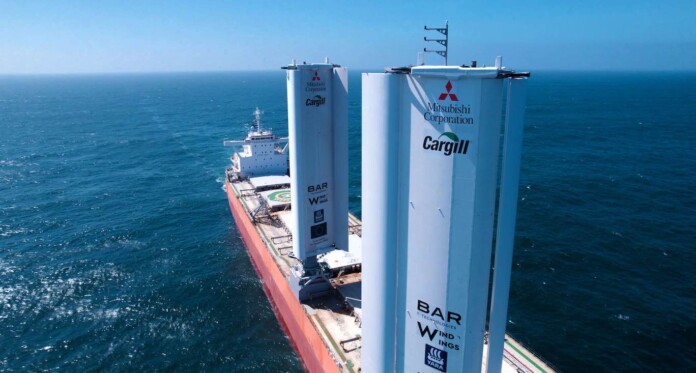
The installation of the wings took place at the COSCO shipyard in China and the Pyxis Ocean is now on the water, conducting her maiden voyage. See SWNS story SWMRsails. It may sound like a step back in time, but shipping has discovered sails. A cargo ship has been fitted with cutting-edge, so-called "wind propulsion" units. Called WindWings, the large wing sails measuring up to 37.5 metres in height and can be added to the deck of commercial vessels. Mitsubishi Corporation’s Pyxis Ocean, chartered by Cargill, is the first vessel to be retrofitted with two WindWings. Produced by industrialisation partner Yara Marine Technologies, they are expected to generate average fuel savings of up to 30 percent on new build vessels, which could be even higher if used in combination with alternative fuels.
credit -Yara Marine Technologies-Pyrix Ocean-Cargill via SWNS

It seems a bit silly, but merchant shipping which long ago ditched its sails for internal combustion is now switching back, but not to any sail you’ve ever seen.

Called WindWings, the large wing sails measure around 100 feet (37 meters) in height and can be added to the deck of commercial vessels.

Pyxis Ocean, chartered by US global food corporation Cargill, is the first vessel to be retrofitted with two WindWings.

Produced by industrialization partner Yara Marine Technologies, they are expected to generate average fuel savings of up to 30% on new vessels, which could be even higher if used in combination with alternative fuels.

Pyxis Ocean is now on the water, conducting her maiden voyage with the WindWings having recently launched in China.

“At Cargill we have a responsibility to pioneer decarbonizing solutions across all our supply chains to meet our customer’s needs and the needs of the planet,” Jan Dieleman, President of Cargill’s Ocean Transportation business, said in a statement.

“A technology like WindWings doesn’t come without risk, and as an industry leader—in partnership with visionary shipowner Mitsubishi Corporation—we are not afraid to invest, take those risks, and be transparent with our learnings to help our partners in maritime [sic] transition to a more sustainable future.”

OTHER TECHNOLOGIES LIKE THIS: Watch This Cargo Ship Fly a Giant Kite to Save Fuel and Cut Emissions

The WindWings project, which is co-funded by the European Union is a retrofit solution that is capable of semi-decarbonizing existing vessels. Over half of the world’s merchant shipping vessels are over 9 years old, so extensive retrofitting is a must.

The International Maritime Organization (IMO) has set ambitious goals for carbon emissions reduction from the use of diesel fuel on vessels. They hope to lower CO2/equivalents by 70% by 2050 compared to a 2008 baseline.

GREEN SHIPPING NEWS: The First Cargo Ship Running on Green Methanol Weighs Anchor Amidst Merchant Shipping Decarbonization

The performance of the WindWings will be closely monitored over the coming months to further improve their design, operation, and performance, with the aim that the Pyxis Ocean will be used to inform the adoption process across not only Cargill’s fleet but the industry.

According to a Cargill release, on an average global route, WindWings can save 1.5 tonnes of fuel per WindWing per day—with the possibility of saving more on trans-ocean routes.

WATCH the WingWings go below… 

SHARE This Return To Tech From The Past With Industry-Minded Friends… 

India Becomes Fourth Nation to Touch Down on the Moon In Mission to Study its South Pole

Chandrayaan-3's rover Pragyan – Image credit: ISRO
Chandrayaan-3’s rover Pragyan – Image credit: ISRO

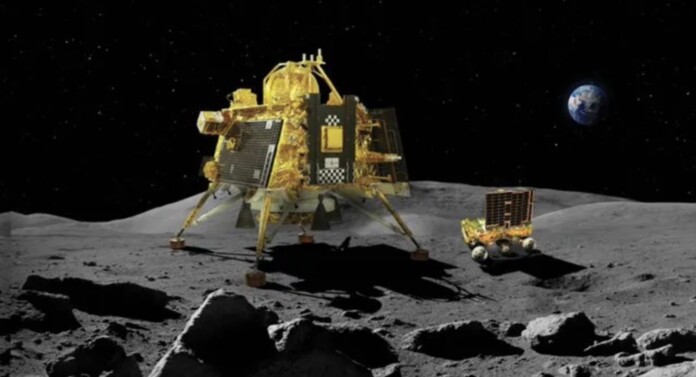
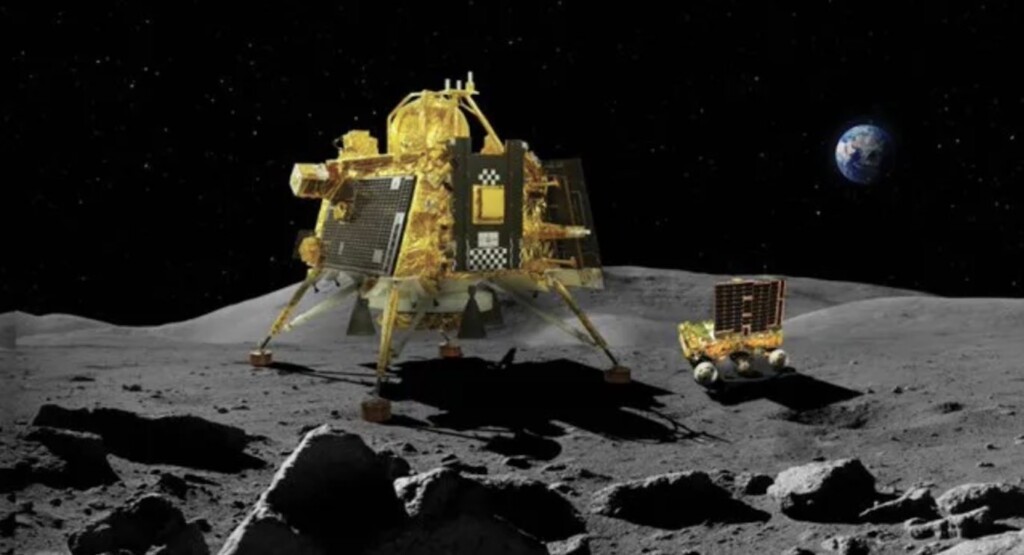
“India is on the Moon,” exclaimed S. Somanath, chief of the Indian Space Research Organisation (ISRO) after their lander/rover combo touched down on the Lunar South Pole on Wednesday, August 23.

In doing so India became the fourth nation to operate on the Moon after the US, Russia, and China, while also beating Japan to our nearest satellite after their attempted mission failed after hitting a crater rim. India is the first-ever nation to visit the South Polar Region.

Nestled between Manzinus C and Simpelius N craters, the Chandrayaan-3 mission is reportedly working well, with both the Vikram lander and the Pragyan rover establishing communications with ISRO command center and deploying solar panels.

The pair comes equipped with a variety of scientific instruments. The Vikram lander has 4 in total, including a seismometer to detect moonquakes, and a passive laser array. Another, a thermophysical probe, is already returning data after having drilled into the Lunar surface to measure temperature differentiations between various depths.

A fourth Vikram instrument, reports Space.com, will study the Moon’s ionosphere, which is filled with electrons and ions formed largely as a result of solar radiation. Indian physicists hope to determine if the ionosphere remains stable over time or changes in density.

The southern pole of the Moon is believed to potentially contain large amounts of frozen water trapped in ice. To that end, the Pragyan rover will spend 2 weeks trundling about examining the messy mixture of small rocks and dust known as regolith.

The ice is believed to be located at the bottom of permanently shadowed craters. Along with water for astronauts, potential harvesting of this water could also mean in situ production of rocket propellant for return journeys. Both uses would dramatically reduce the cost of manned lunar missions.

MORE SPACE MISSIONS: For New Rover, NASA is Swapping Buggy Shape for a Giant Snake in Hopes it Can Explore Icy Moon of Saturn

Another potential use of those craters, because of their permanent umbrage, is the placement of sophisticated space telescopes that would allow scientists to peer farther into the universe.

Nations need to be thrifty in space, and the thrust module that brought the lander and rover to the Moon is also equipped with a science instrument, one that will monitor the orbit of Earth as if it were an exoplanet.

Vikram is Sanskrit for valor, while Pragyan is wisdom.

WATCH the landing video below… 

SHARE India’s Own One Giant Leap With Your Friends… 

City Sparrows Make Better Dads Than Their Country Cousins, Says New Research

A sparrow in Berlin - Svetozar Cenisev
A sparrow in Berlin – Svetozar Cenisev

Despite being more aggressive in defending their territory, sparrows that live in urban areas find more time to visit the nest and feed their young, a surprise to scientists who believed that more aggression would mean less time with their offspring.

Researchers have dubbed them city sparrows, as city life seems to make the males better parents.

There’s something about the big city that can make humans agitated. Scientists were once able to predict the population of a city based solely on the average walking speeds of its citizens.

Scientists observing the sparrows believe that as a result of less predation pressure in the city compared to the country, the birds breed more successfully, and that this potentially increases the habits of the city sparrow sire to visit its nest.

“Male songbirds in temperate zones are thought to reduce parental care when they are more aggressive,” said Dr. Samuel Lane, lead author of the study at Virginia Tech. “Yet in this study, we show that urban male song sparrows provided more care for their young.”

“Against our expectations, we found that they visited nests more frequently and were more successful parents than rural males.”

The study, published in the journal Frontiers in Ecology and Evolution, studied six sites in southwest Virginia characterized by recent urban sprawl over four breeding seasons.

The team already knew that urbanized sparrows were more aggressive in defending their territory despite lower density than those in the countryside.

They thought that this would leave them less time to invest in the care of their offspring.

MORE CITY BIRDS: Falconry Saves Man from Life of Crime, Now he Helps Birds and At-Risk Youth Take flight

The researchers expected that more aggressive urban male sparrows were sacrificing parental care for territorial aggression, which in turn was expected to have a negative impact on the survival of their young.

But not only did they visit their nests significantly more often than their rural fellows, but on top of this they also began feeding nestlings earlier in the day.

And their efforts paid off despite brood parasitism, where other species lay their eggs in the sparrow nest like a cuckoo, which is more common in cities.

MORE GREAT ANIMAL PARENTS: Dolphin Moms Use ‘Baby Talk’ with Their Calves, Research Shows

“It turns out urban males are super males—able to defend their territories and care for their young,” said Dr. Lane.

“Our study adds to growing evidence that certain species of songbirds even benefit from living in urban environments when there is sufficient green space for them to find food and nest locations.”

MORE GREAT ANIMAL PARENTS: The Animal Kingdom’s Top 10 Best Dads for Father’s Day

The scientists hope ongoing research in this field will contribute to designing urban environments that support wildlife better.

However he cautioned that these results, however, should not be generalized to all locations, or other species and animals.

SHARE These Urbanite Sparrow Dads With Your Friends…

Off-Duty Officer Hailed as Hero for Rescuing Woman Who ‘Disappeared’ Under the Waterfall

courtesy of Dave Brosha

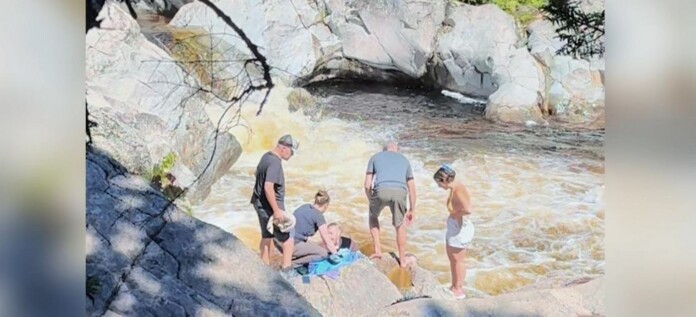
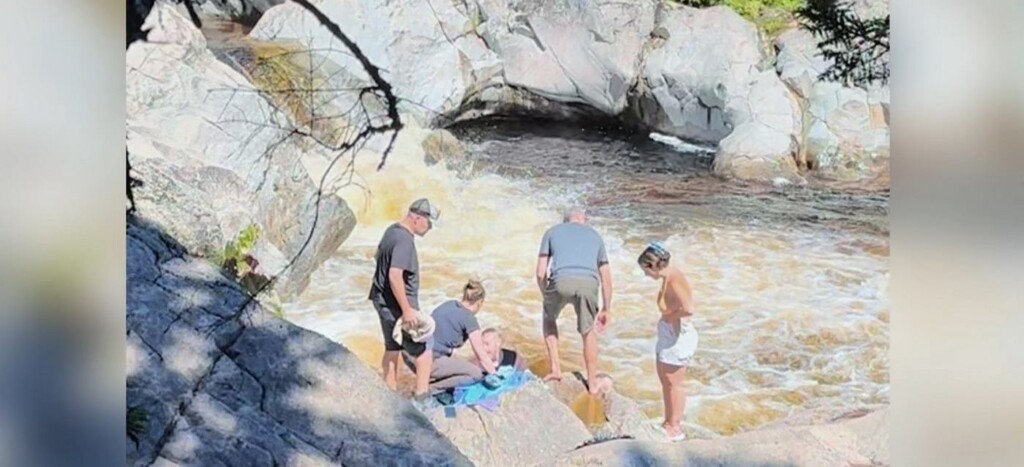
During a hiking trip in Fundy National Park, New Brunswick, a group of swimmers had the good fortune of being found by some hikers that included an off-duty police officer who ended up saving their friend from a raging edy.

The officer, Bruce Lake, was exploring the Laverty Falls area with his wife and friends, and though being hailed as a hero, he was initially told that everything was okay.

Thankfully piercing the veil of the social contract, one of Lake’s friends said that a woman out in the water appeared to be exhausted and might need some help, and that’s when the whole party watched her disappear under the foam after making a short-lived attempt to return to shore.

“She was kind of stuck between these two little waterfalls,” Lake recalled. “She immediately went underneath and then came back up again right near the rock and then grabbed the rock and held on. So she was obviously a little scared.”

Global News quotes Dave Brosha, one of Lake’s friends, who described the events as something “out of a bad movie” after the woman disappeared a second time, but wasn’t remerging, and that’s when the aptly-named Lake made his move, jumping into the water and swimming to the rock to help.

Reaching the rock, the water was deeper than he expected, and the rescue plan devolved to essentially waving his arms and legs about seeing if he could touch her, and as fortune would have it, his hand brushed her arm.

MORE RESCUE STORIES: Pakistani Man is True Hero in Dramatic Cable Car Rescue After Youth Were Stranded 15 Hours–WATCH

Grabbing her and swimming like mad, they approached their friends.

“So I pushed her toward the shore. Her friend got her arm and then I lost touch with her… I was getting sucked back into the exact same spot and only for her to turn around, and she reached her arm and I actually grabbed her arm and we got pulled in together,” he told Global News.

Lake’s wife Bernadette says it’s exactly the sort of man he is to risk his life for a complete stranger.

MORE WATER RESCUES: 7-Year-Old Massiah Is Hero After Rescuing a Drowning 3-Year-Old – All on His Own

Dave Brosha is a professional photographer and snapped a photo post-rescue to honor the savior, but described that after asking the Truro police officer if he could have permission to do so, the response was something like utter disbelief—which Brosha interpreted as a man feeling he did what anyone would have done in that situation.

WATCH the story below from Global News… 

SHARE This Right Place Right Time Rescue With Your Friends From Canada…

“The little things? The little moments?… They aren’t little.” – Jon Kabat-Zinn

Quote of the Day: “The little things? The little moments? They aren’t little.” – Jon Kabat-Zinn

Photo by: Stas Ostrikov

With a new inspirational quote every day, atop the perfect photo—collected and archived on our Quotes page—why not bookmark GNN.org for a daily uplift?

Pakistani Man is True Hero in Dramatic Cable Car Rescue After Youths Were Stranded 15 Hours–WATCH

Sahib Khan and Nasir Khan - released by family.
Sahib Khan and Nasir Khan – released by the family.

A rather unassuming young man with kind brown eyes is being hailed as a hero for his volunteer efforts to rescue 7 teenagers trapped in a cable car in Pakistan.

After two of the three supporting cables snapped, the teenagers were left dangling from an hour before school opened to the darkest watches of the night. A military helicopter originally came to affect a rescue, but fading light and high winds allowed them to save only 1 individual.

Sahib Khan and his older brother Nasir volunteered to rescue the remaining 7, having some experience with such things since they ran a cablecar business themselves. They used a zipline to reach the cable car with enough equipment to help the 5 children and 2 adults back to solid ground at a time.

Footage captured by local news and widely reported shows villager after villager embracing Sahib.

“Today, the way these two young men carried out the rescue operation has made the whole nation proud of them,” said Javed Nasir, a local resident with his arm wrapped around Sahib’s slight shoulders.

The rescue took place in the remote Battagram District of northern Pakistan where building cable cars across ravines can save millions of dollars and months of labor, and it began after the military, who had originally prohibited the villagers from doing anything, acquiesced to the idea that a zipline could be suspended close to the remaining suspension cable.

SIMILAR RESCUE STORIES: All His Training Pays Off: Slackliner Wins Carnegie Medal for Ski Lift Rescue Over Cables

Sahib and Nasir could then use the zipline to come close enough to help the teenagers escape the hanging metal box, but the line and its “dolly,” a byword for a small makeshift gondola, was only big enough for 1 person.

“Our dolly was small, but we were afraid of the load on the zip line. It was a little bit windy and very dark, everything was difficult,” Sahib told Al Jazeera. “But by the grace of God, we were able to bring the second child back down.”

WATCH the rescue happen from SCMP… 

SHARE These Rural Rescuers With Your Friends On Social Media…