FREE WILL ASTROLOGY – Week of April 15, 2023
Copyright by Rob Brezsny, FreeWillAstrology.com
ARIES (March 21-April 19):
I hope that in the coming weeks, you will keep your mind bubbling with zesty mysteries. I hope you’ll exult in the thrill of riddles that are beyond your current power to solve. If you cultivate an appreciation of uncanny uncertainties, life will soon begin bringing you uncanny certainties. Do you understand the connection between open-hearted curiosity and fertile rewards? Don’t merely tolerate the enigmas you are immersed in—love them!
TAURUS (April 20-May 20):
An old sadness is ripening into practical wisdom. A confusing loss is about to yield a clear revelation you can use to improve your life. In mysterious ways, a broken heart you suffered in the past may become a wild card that inspires you to deepen and expand your love. Wow and hallelujah, Taurus! I’m amazed at the turnarounds that are in the works for you. Sometime in the coming weeks, what wounded you once upon a time will lead to a vibrant healing. Wonderful surprise!
GEMINI (May 21-June 20):
What is the true and proper symbol for your sign, Gemini? Twins standing shoulder to shoulder as they gaze out on the world with curiosity? Or two lovers embracing each other with mischievous adoration in their eyes? Both scenarios can accurately represent your energy, depending on your mood and the phase you’re in. In the coming weeks, I advise you to draw on the potency of both. You will be wise to coordinate the different sides of your personality in pursuit of a goal that interests them all. And you will also place yourself in harmonious alignment with cosmic rhythms as you harness your passionate urge to merge in a good cause.
CANCER (June 21-July 22):
Some scientists speculate that more people suffer from allergies than ever before because civilization has over-sanitized the world. The fetish for scouring away germs and dirt means that our immune systems don’t get enough practice in fending off interlopers. In a sense, they are “bored” because they have too little to do. That’s why they fight stuff that’s not a threat, like tree pollens and animal dander. Hence, we develop allergies to harmless substances. I hope you will apply this lesson as a metaphor in the coming weeks, fellow Cancerian. Be sure the psychological component of your immune system isn’t warding off the wrong people and things. It’s healthy for you to be protective, but not hyper-over-protective in ways that shut out useful influences.
LEO (July 23-Aug. 22):
One night in 1989, Leo evolutionary biologist Margie Profet went to sleep and had a dream that revealed to her new information about the nature of menstruation. The dream scene was a cartoon of a woman’s reproductive system. It showed little triangles being carried away by the shed menstrual blood. Eureka! As Profet lay in bed in the dark, she intuited a theory that no scientist had ever guessed: that the sloughed-off uterine lining had the key function of eliminating pathogens, represented by the triangles. In subsequent years, she did research to test her idea, supported by studies with electron microscopes. Now her theory is regarded as fact. I predict that many of you Leos will soon receive comparable benefits. Practical guidance will be available in your dreams and twilight awareness and altered states. Pay close attention!
VIRGO (Aug. 23-Sept. 22):
You don’t know what is invisible to you. The truths that are out of your reach may as well be hiding. The secret agendas you are not aware of are indeed secret. That’s the not-so-good news, Virgo. The excellent news is that you now have the power to uncover the rest of the story, at least some of it. You will be able to penetrate below the surface and find buried riches. You will dig up missing information whose absence has prevented you from understanding what has been transpiring. There may be a surprise or two ahead, but they will ultimately be agents of healing.
LIBRA (Sept. 23-Oct. 22):
Visionary philosopher Buckminster Fuller referred to pollution as a potential resource we have not yet figured out how to harvest. A company called Algae Systems does exactly that. It uses wastewater to grow algae that scrub carbon dioxide from the atmosphere and yield carbon-negative biofuels. Can we invoke this approach as a metaphor that’s useful to you? Let’s dream up examples. Suppose you’re a creative artist. You could be inspired by your difficult emotions to compose a great song, story, painting, or dance. Or if you’re a lover who is in pain, you could harness your suffering to free yourself of a bad old habit or ensure that an unpleasant history doesn’t repeat itself. Your homework, Libra, is to figure out how to take advantage of a “pollutant” or two in your world.
SCORPIO (Oct. 23-Nov. 21):
Soon you will graduate from your bumpy lessons and enter a smoother, silkier phase. You will find refuge from the naysayers as you create a liberated new power spot for yourself. In anticipation of this welcome transition, I offer this motivational exhortation from poet Gwendolyn Brooks: “Say to them, say to the down-keepers, the sun-slappers, the self-soilers, the harmony-hushers, ‘Even if you are not ready for day, it cannot always be night.'” I believe you are finished with your worthwhile but ponderous struggles, Scorpio. Get ready for an excursion toward luminous grace.
SAGITTARIUS (Nov. 22-Dec. 21):
I periodically seek the counsel of a Sagittarian psychic. She’s half-feral and sometimes speaks in riddles. She tells me she occasionally converses by phone with a person she calls “the ex-Prime Minister of Narnia.” I confided in her that lately it has been a challenge for me to keep up with you Sagittarians because you have been expanding beyond the reach of my concepts. She gave me a pronouncement that felt vaguely helpful, though it was also a bit over my head: “The Archer may be quite luxuriously curious and furiously hilarious; studiously lascivious and victoriously delirious; salubriously industrious but never lugubriously laborious.” Here’s how I interpret that: Right now, pretty much anything is possible if you embrace unpredictability.
CAPRICORN (Dec. 22-Jan. 19):
“I’m not insane,” says Capricorn actor Jared Leto. “I’m voluntarily indifferent to conventional rationality.” That attitude might serve you well in the coming weeks. You could wield it to break open opportunities that were previously closed due to excess caution. I suspect you’re beginning a fun phase of self-discovery when you will learn a lot about yourself. As you do, I hope you will experiment with being at least somewhat indifferent to conventional rationality. Be willing to be surprised. Be receptive to changing your mind about yourself.
AQUARIUS (Jan. 20-Feb. 18):
People of all genders feel urges to embellish their native beauty with cosmetic enhancements. I myself haven’t done so, but I cheer on those who use their flesh for artistic experiments. At the same time, I am also a big fan of us loving ourselves exactly as we are. And I’m hoping that in the coming weeks, you will emphasize the latter over the former. I urge you to indulge in an intense period of maximum self-appreciation. Tell yourself daily how gorgeous and brilliant you are. Tell others, too! Cultivate a glowing pride in the gifts you offer the world. If anyone complains, tell them you’re doing the homework your astrologer gave you.
PISCES (Feb. 19-March 20):
I encourage you to amplify the message you have been trying to deliver. If there has been any shyness or timidity in your demeanor, purge it. If you have been less than forthright in speaking the whole truth and nothing but the truth, boost your clarity and frankness. Is there anything you could do to help your audience be more receptive? Any tenderness you could express to stimulate their willingness and ability to see you truly?
WANT MORE? Listen to Rob’s EXPANDED AUDIO HOROSCOPES, 4-5 minute meditations on the current state of your destiny — or subscribe to his unique daily text message service at: RealAstrology.com
Quote of the Day: “The lure of the distant and the difficult is deceptive. The great opportunity is where you are.” – John Burroughs (naturalist and author)
Photo by: Altınay Dinç
With a new inspirational quote every day, atop the perfect photo—collected and archived on our Quotes page—why not bookmark GNN.org for a daily uplift?
The Seine featuring the Saint Alexander III Bridge and the Eifel Tower - CC 2.0. ilirjan rrumbullaku
The Seine featuring the Alexandre III Bridge and the Eifel Tower – CC 2.0. ilirjan rrumbullaku
Parisians are beginning to get excited about the idea of swimming in the Seine again. To say ‘again’ is to really turn back the years, because for decades it’s been unthinkable.
Once the dumping site of so many houseboats and other creators of sewage and pollution, the race to prepare the City of Light for the 2024 Summer Olympics has seen the city “overwhelmingly” improve the quality of the water, making it all set for the triathlon, and plenty of recreation in the decades to come besides.
Despite being called the most romantic river in the world, the Seine was well on its way to being ecologically dead in the mid-2010s. Despite being immortalized in song, poetry, and art, the river had an unappealing green-brown color—typical of the waste it was subjected to.
The $2.3 billion project was started shortly after Paris was awarded the games, and by 2018 they had already passed a law to mandate the Seine’s many houseboats to moor by sewage access—they had been dumping right into the river before.
A graveyard of discarded bikes, shopping trolleys, tires, and god knows what else, a water quality survey in July and August of last year found it was “overwhelmingly good” and ready to host swimmers like French triathlete Thibaut Rigaudeau.
“We will be the ‘testers’ I hope we don’t get sick,” Rigaudeau told ABC News Australia, adding people are already asking him questions like ‘are you scared of swimming in the Seine? It looks disgusting.’
The Seine will feature as the centerpiece of the Olympic Games’ opening ceremony, which for the first time in history will take place along the banks of the river and upon it, rather than in the stadium.
More than half a billion euros will be going to huge storage basins and other public works that will reduce the need to let bacteria-laden water spill out into the Seine when it rains, while other government money is going to improve sewage treatment plants along the banks and at the tributary of the Marne.
One storage facility is located near Paris’ Austerlitz train station, and may save as much as 20 Olympic swimming pools of dirty water from being spat raw into the river.
But the project is looking beyond the games for five ideal bathing spots, promising to reinvigorate the entire Parisian community with a place to go swimming in the summer heat.
Fish have also been seen in greater numbers, and if the Seine is anything like the Thames or the Mersey in England, there are indeed romantic days ahead for the city.
FLOAT This Beautiful News Down To Your Friends On Social Media…
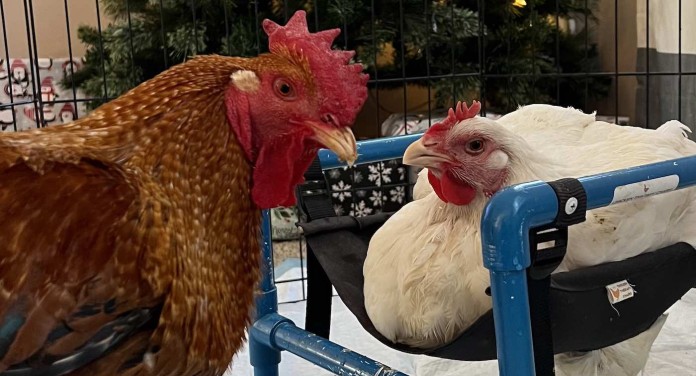
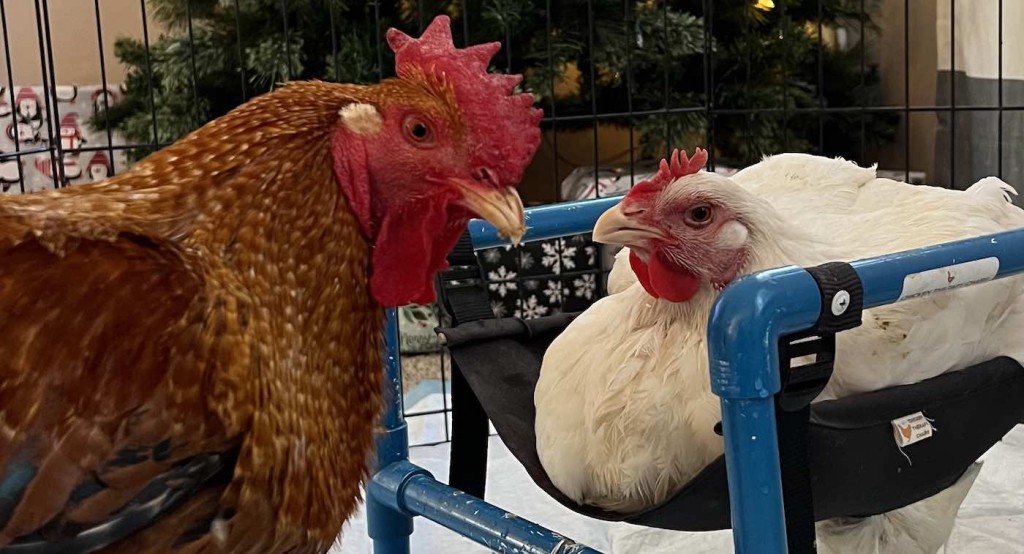
This is Shrimp, the rooster, and he’s fallen madly in love with the disabled hen Basil.
Shrimp and one-legged chicken Basil live together in their own enclosure made of mats and baby gates at the ‘Here With Us Animal Sanctuary’ in Shermans Dale, Pennsylvania, USA.
Basil was taken in as part of a large-scale chicken rescue, and Shrimp was saved just one day before his euthanasia date.
The two have been living in the same sanctuary for 18 months, but it wasn’t until October last year that they met and clicked.
In October 2022, Basil had to have one leg amputated due to an infection and had to be brought inside for her safety.
Around the same time, Shrimp was brought inside because he was being bullied by the other chickens in the coop.
This is when romance blossomed and – although Basil took a little longer to warm up to Shrimp, the pair are now a solid couple. Now they give each other treats, dance for each other, and even refuse to go to the vet separately.
“He was so interested in her through the baby gate, and did a little dance as soon as he saw her,” Amanda Clark, founder of ‘Here With Us.’ “It’s hard to believe their love is real – unless you see it.”
Shrimp is very affectionate toward Basil and gets very excited to see her whenever they are separated.
“It’s the cutest thing ever. Whenever he can, he’ll do a little dance in front of her and plop berries down so she can eat,” said Clark. “They don’t have any spats or anything like that. They really are the perfect couple.”
“Basil is a bit more standoffish, but she just shows her love in a different way. She gets really excited when she is going to see him. We have to send them to the vet together, I think they’d get stressed and nervous if we separated them,” she added.
“They are one hundred percent pets, it’s no different than having a cat or a dog running around the house.”
Cassiopeia A - NASA, ESA, CSA, Danny Milisavljevic (Purdue University), Tea Temim (Princeton University), Ilse De Looze (UGent)
Cassiopeia A – NASA, ESA, CSA, Danny Milisavljevic (Purdue University), Tea Temim (Princeton University), Ilse De Looze (UGent)
In a stunning new picture from NASA’s James Webb Space Telescope, a recently exploded star is lit up in a dozen colors, with each carrying a different explanation.
More than just beauty, the image helps scientists understand one of the most important phenomena in space: the presence of dust.
Scientists have known for decades that galaxies are filled with dust clouds of heavy metals, but they haven’t had conclusive evidence that their chief culprit, supernovae, is in fact the source.
In the new infrared image from James Webb, the supernova Cassiopeia A is dissected 340 years after its fuse first blew. Cas A is the youngest known remnant from an exploding, massive star in our galaxy, and as such offers an excellent opportunity to study one.
The top and left sides of the image are lit up in red and orange from the energy of the explosion impacting the surrounding gas and dust, while the inner, pink-white circle studded with knots is the remains of the star itself.
The inside is the so-called “Green Monster,” an ode to Fenway Park in Boston, which the scientists aren’t sure what to make of. The whole image is 10 light years from side to side.
Cosmic material leftover from exploding star Cassiopeia A (Credit: NASA, ESA, and Hubble Heritage)
The story of the explosion of a star is the story of humanity—and everything else for that matter, since all the heavy metals—the calcium in our bones, the iron in our blood, the gold in our investment accounts—came from the explosions of stars.
“By understanding the process of exploding stars, we’re reading our own origin story,” Danny Milisavljevic of Purdue University, lead investigator for the study of these images, told NASA news.
“I’m going to spend the rest of my career trying to understand what’s in this data set.”
Purdue and NASA released a zoomable version of the photo which you can see on this webpage.
The ingenious and unique feathers of a beloved African bird could provide the inspiration for space-age water bottles which keep liquid still whilst we move.
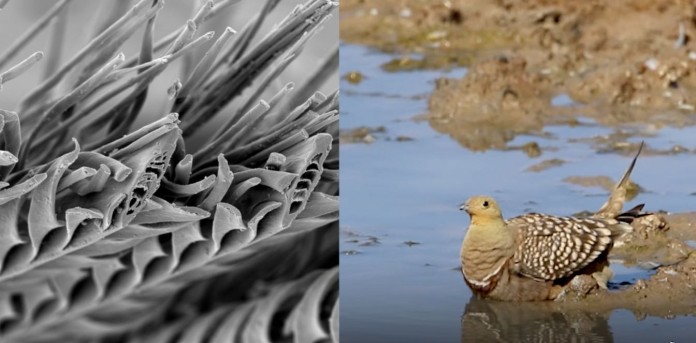
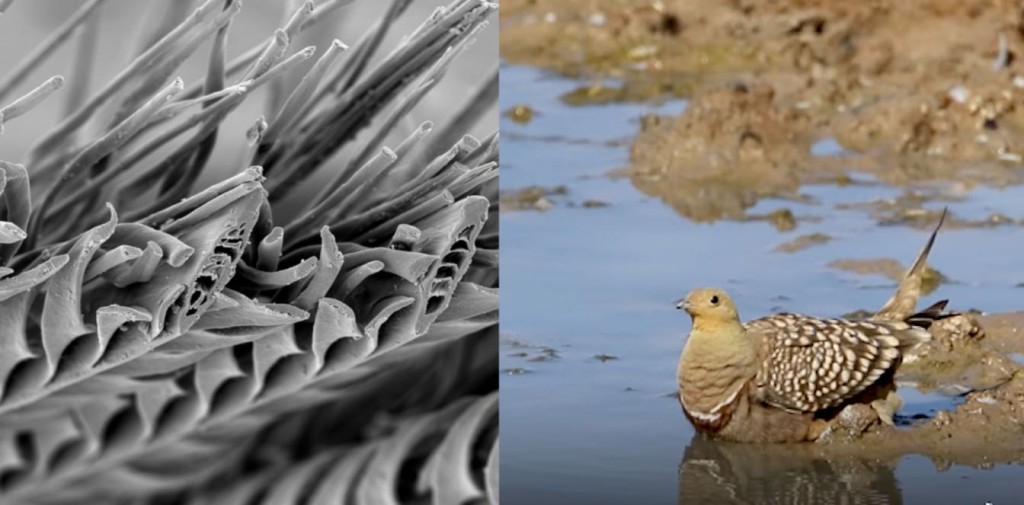
The Namaqua sandgrouse, or “kilkamaine”— an Afrikaans word for the sound they make, is a desert specialist whose breast feathers can soak up water like a sponge and keep it stored even while the bird is flying 40 mph.
This clever adaptation allows it to get water from pools and transport it 20 miles back to the nest for its chicks.
The fascinating bird has long been the subject of scientific interest due to this incredible water-carrying talent, and now a team of American researchers was able to demonstrate how these feathers work.
The study authors hope the new discovery could lead to innovative new products including water bottles that hold water to prevent annoying sloshing around, and netting which can collect and retain water from fog.
The collaborative research team, from both Johns Hopkins University in Baltimore, Maryland, and the Massachusetts Institute of Technology (MIT) teamed up to study how the feathers of the desert-dwelling sandgrouse so successfully store water by using scanning electron microscopes, microcomputed tomography, and 3D videography to see the feathers in the greatest detail.
The team looked at the details of each feather shaft, which measures just a fraction of the width of a human hair—as well as the even more minuscule individual barbules of the feathers.
Then they dunked the dry feathers in water whilst magnified, pulled them out, and submerged them again—emulating a male sandgrouse at a watering hole.
The study, published today in the scientific journal The Royal Society Interface, found that individual feathers held the water through a forest of barbules near the shaft, working together with the curled barbules near the tip acting almost like caps.
The authors write how the components in the feathers were optimized in several ways to hold and retain water, including the way they bend, how the barbules form protective, tent-like clusters when wet, and how tubular structures within each barbule capture water.
“It’s super fascinating to see how nature managed to create structures so perfectly efficient to take in and hold water,” said study co-author Jochen Mueller, an assistant professor at Johns Hopkins’ Department of Civil and Systems Engineering. “From an engineering perspective, we think the findings could lead to new bio-inspired creations.”
The products which could benefit from the research include fog nets to capture moisture from the air in desert regions, or medical swabs that would be better at holding the liquid they absorb.
The team additionally computationally modeled the water intake of the feathers and expects their findings to influence future engineering designs that require controlled absorption, secure retention, and the easy release of liquids.
SHARE This Nature-Inspired Work With Your Friends…
Quote of the Day: “The divine is what has not been envisioned, what cannot be deduced from general rules, nor irreducible to them.” – Mikhail Epstein
Photo by: Kamil Porembiński, CC license
With a new inspirational quote every day, atop the perfect photo—collected and archived on our Quotes page—why not bookmark GNN.org for a daily uplift?
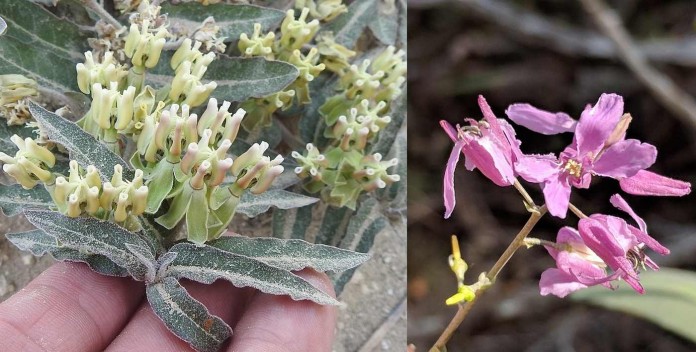
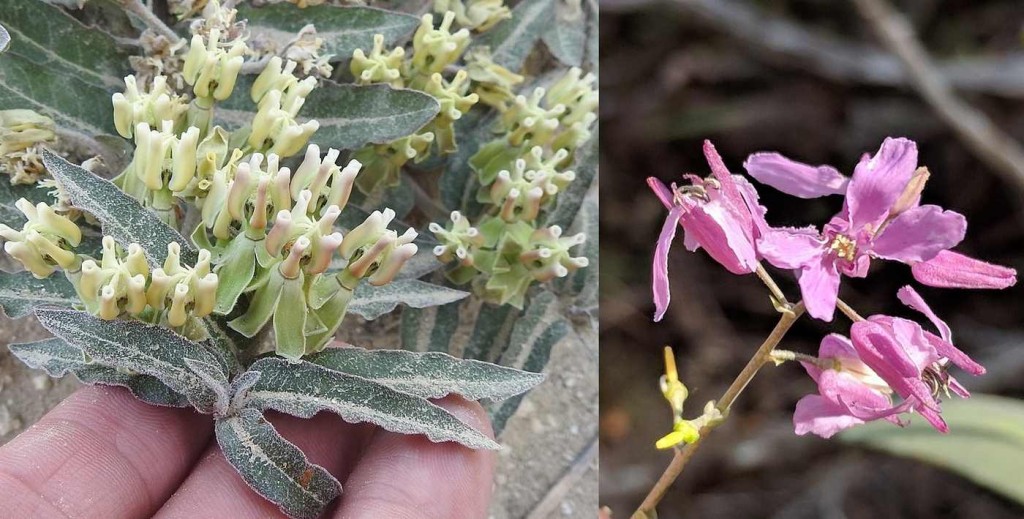
Prostrate milkweed and bracted twistflowers - Sam Kieschnick and Alison Northup CC 4.0. retrieved from iNaturalist
Prostrate milkweed and bracted twistflowers – Sam Kieschnick and Alison Northup CC 4.0. retrieved from iNaturalist
The US Fish and Wildlife Service (FWS) has taken steps to practically guarantee the survival of a beautiful pink wildflower in Texas just a month after it did the same for prostrate milkweed, a key food source for monarch butterflies.
It’s easy enough to tell people they can’t shoot bald eagles, but it takes serious effort to tell people what they can and can’t do on their own land as it relates to plants.
Nevertheless, the FWS has turned to the world’s most successful piece of conservation legislation on Earth, the United States Endangered Species Act, in order to guarantee that hikers and browsing bees alike can enjoy the flowers of these plants for generations to come.
The bracted twistflower has been diminishing due to Texas’ urban sprawl for years, but now 1,600 acres in the four counties of Uvalde, Medina, Bexar, and Travis, have been designated critical habitat and therefore untouchable.
“Very few busy Texans in the world today pause to think about these plants … but they still play an absolutely essential role in our world,” Michael J. Robinson, a senior conservation advocate at the Center for Biological Diversity, told the Texas Tribune.
Found in the hill country, now only in two areas, the twistflower needs a mix of shade and sun provided by the natural mix of trees there such as live oaks and junipers. It is a common food source for Texas bee species.
By being placed on the Endangered Species List, the twistflower is almost guaranteed to survive, since the rate at which species’ declines have been stopped after being placed on the ESL is 99%, the highest of any such national conservation program worldwide.
This protection was also doled out to the prostrate milkweed, which received 661 acres of critical habitat protection. It is illegal to cut, damage, harvest, or transport either flower under federal law.
“Protecting prostrate milkweed is a big deal for the monarch butterflies who lay their eggs on these plants as they fly through Texas after spending the winter in Mexico,” said Tierra Curry, a senior scientist at the Center for Biological Diversity.
Unlike the bracted twistflower, the milkweed is found at the moment exclusively in the terrain surrounding the banks of the Rio Grande, in Starr and Zapata counties.
Monarch populations in Mexico were counted as having increased several years in a row, vaulting the theory that it was simply a single boom year. Now, food resources like the Texas milkweed will be more valuable than ever.
SHARE This Good News For Wildflowers With Your Friends…
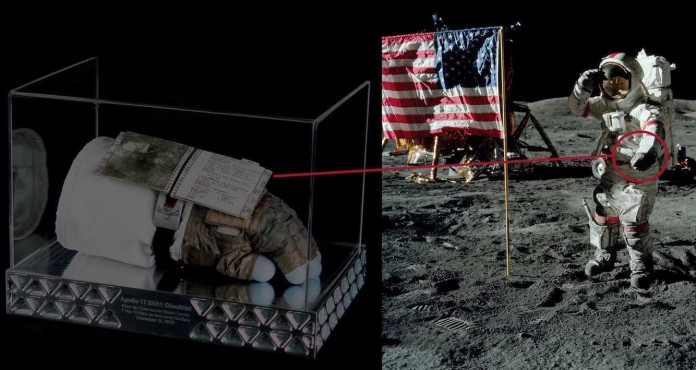
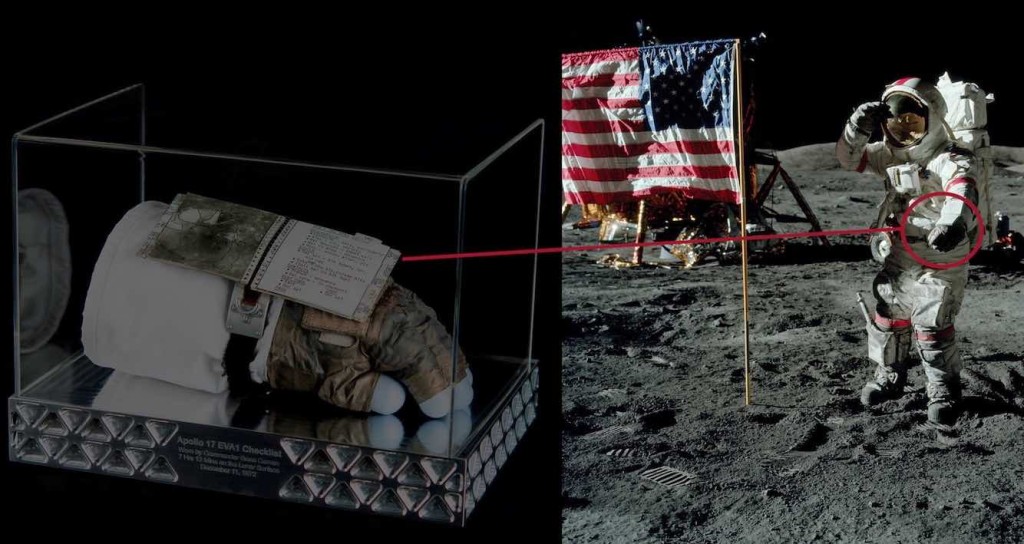
Checklist seen on Gene Cernan's wrist in NASA photograph – SWNS
Checklist seen on Gene Cernan’s wrist in NASA photograph – SWNS
A dusty document used on the Moon is set to go under the auctioneer’s hammer for over $500,000.
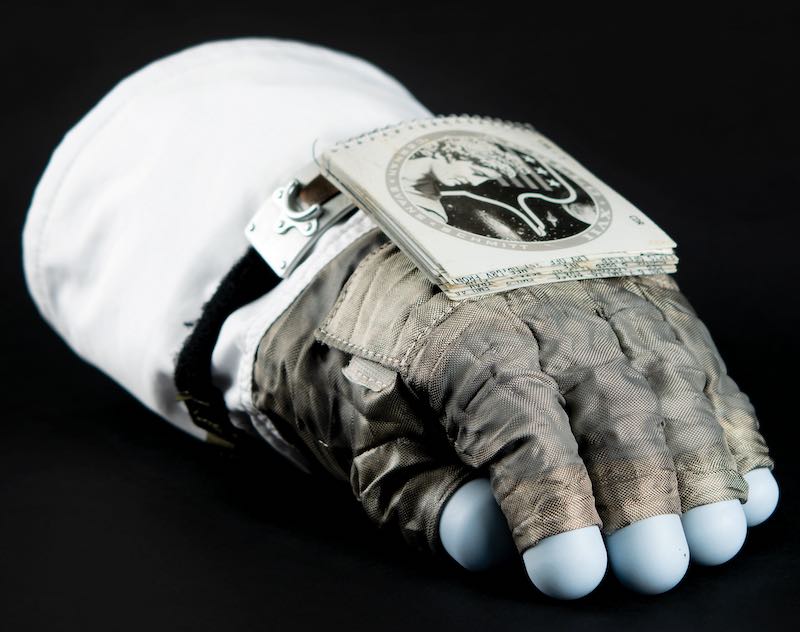
The mission checklist was worn on the lunar surface by NASA astronaut Gene Cernan – and is still covered in moon dust.
Cernan wore a glove and the cuff checklist on his wrist for the duration of the first Extravehicular Activity (EVA) of the Apollo 17 mission.
Taking place in December, 1972, Apollo 17 was the final mission of NASA’s Apollo program; the most recent time humans have set foot on the lunar surface or travelled beyond low Earth orbit.
Boston-based RR Auction says the item was exposed to the lunar environment for 7 hours and 12 minutes and “as such, its pages are still streaked with lunar dust.”
The auction also includes a highly accurate replica of Cernan’s left-handed Apollo A7-LB EVA glove fabricated by renowned artist Ryan Nagata, whose work has appeared in Hollywood movies including the Neil Armstrong biopic First Man.
SWNS
The checklist can be seen on Cernan’s wrist in film footage and photographic stills taken during the EVA, most evidently in images of him saluting the American flag after its deployment.
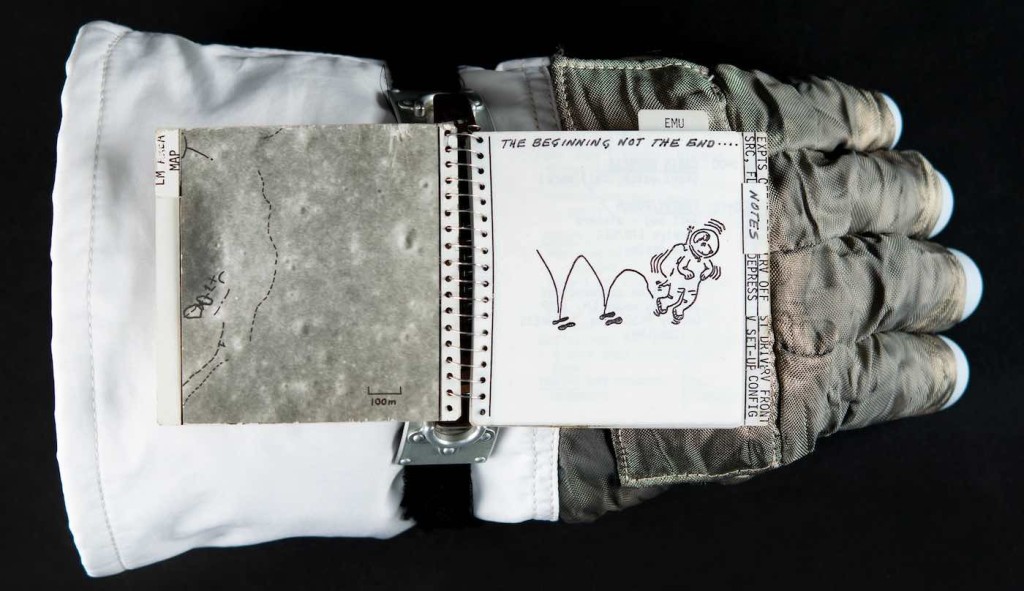
It contains a comprehensive guide for the entire extravehicular activity, offering preparation procedures, simplified maps, and task lists.
Consisting of 25 spiral-bound double-sided pages, attached to an aluminum wrist brace, the document outlines the principal goals of “EVA-1”.
These included offloading the Lunar Roving Vehicle (LRV), deploying the American flag, setting up experiment packages, and collecting samples of moon rocks and lunar soil.
Interspersed are cartoons of astronaut dogs exploring the lunar surface, playfully inserted by the backup crew—an Apollo tradition.
An adopted woman found her mother using a DNA site and Facebook after decades of searching, allowing her to meet her grandmother just days before her death.
Rachel Ruiz always knew she was adopted. On her 18th birthday, she was given a handwritten letter written by her birth mom for her future daughter, saying she hoped they would one day meet. But it contained limited information—not enough for a successful online search.
“I didn’t feel like I needed to find answers to complete myself but I’m so happy I found my birth family.”
Years later, the now-35-year-old turned to ancestory.com last year which led her to her grandfather’s obituary—the key to tracking down her biological mother, Angie Howard.
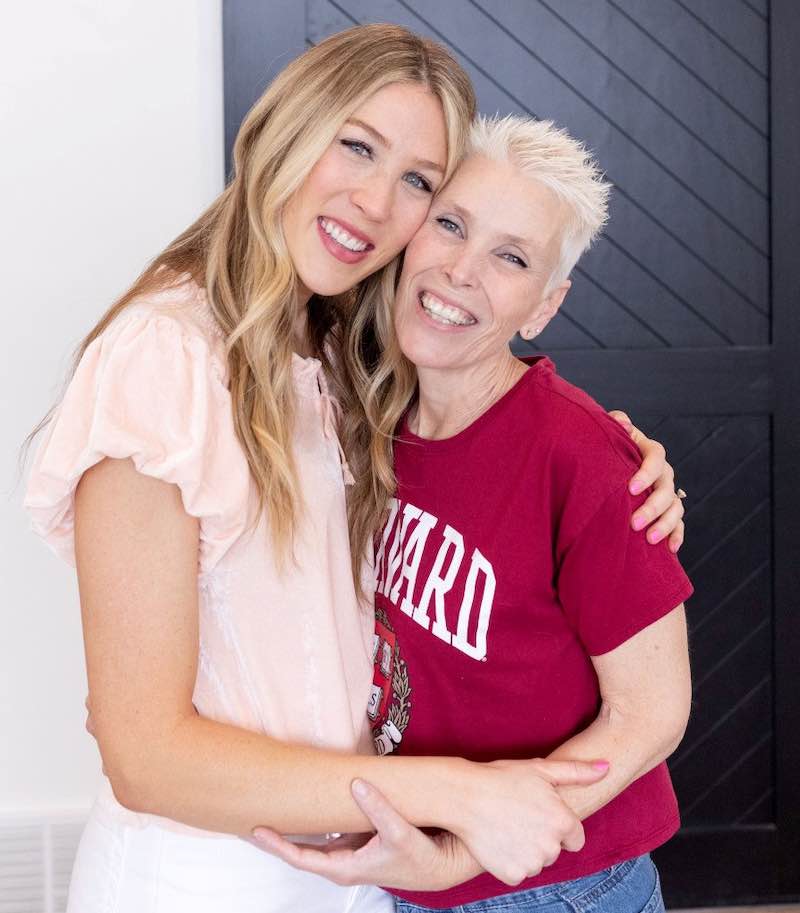
When she finally saw the 52-year-old woman on Facebook, she knew instantly it was a match because they looked so similar.
On Christmas Day she got a reply to a Facebook message from her delighted birth mom.
The pair were reunited—coincidently wearing similar outfits—just in time for Rachel to meet her grandmother, Angie’s 91-year old mom, Mary.
“It’s like a missing piece,” said photographer Rachel.
Since adopting her at two-weeks-old, her parents had prepared to give her the package when she turned 18.
“They had this beautiful crocheted blanket she made me. She had a baby ring when she was born—a beautiful gold ring—and a written letter which said ‘you were with me for nine months. I will never forget you, I hope one day we will meet’.”
Rachel and Angie – SWNS
Rachel also received adoption papers, and while sections were blanked out, it said she was born in Louisiana with the surname Deveraux. Though her search on Facebook turned up no family members, an obituary came up. It included six children, with three daughters.
She reached out to Angie because of her age.
“She didn’t open my message for a long time – I think it got lost in her message requests because we weren’t friends.
“I woke up on Christmas day and she had replied. I immediately started bawling.
“I sent her a picture of the letter she wrote me and she replied ‘I can’t believe it’s you, you’ve found me, what a miracle’.
“I printed out the conversation and showed my parents.
Feeling happy about getting older can reverse a common type of memory loss, according to a new study from Yale.
Older people with mild cognitive impairment (MCI) were 30 percent more likely to regain normal cognition if they were upbeat versus those who were down-and-out about aging.
Moreover, a cheerful approach to the silver years allowed participants to recover their cognition up to two years earlier than the others.
The Yale School of Public Health study is reported to be the first of its kind to link a cultural factor—a positive attitude towards aging—to MCI recovery.
The research was based on 1,716 participants over age 65.
Those who started the study with normal cognition and a happy attitude toward aging were less likely to develop MCI over the next 12 years than those in the negative-thinking group, regardless of physical health or the age they joined the cohort.
Professor Becca Levy, lead author of the study, said: “Most people assume there is no recovery from MCI, but in fact half of those who have it do recover.
“Little is known about why some recover while others don’t.
“That’s why we looked at positive age beliefs, to see if they would help provide an answer.
“Our previous research has demonstrated that age beliefs can be modified; therefore, age-belief interventions at the individual and societal levels could increase the number of people who experience cognitive recovery,” she said in a statement.
Her research published this week in JAMA Network Open was spurred by her previous discovery that older people who felt positive about their age experienced improved cognitive performance.
The latest development was funded by the National Institute on Aging.
SEND Some Positive Aging Vibes By Sharing This on Social Media…
Quote of the Day: “Don’t despise your own place and hour. Every place is the center of the world.” – John Burroughs (naturalist and author)
Photo by: Ryan Hutton
With a new inspirational quote every day, atop the perfect photo—collected and archived on our Quotes page—why not bookmark GNN.org for a daily uplift?
Out in the ultra-rural jungles of eastern Madagascar, something is happening that all climate-conscious philanthropists and investors should take note of.
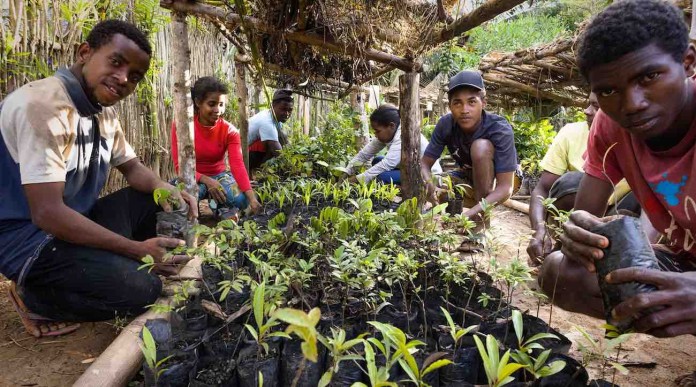
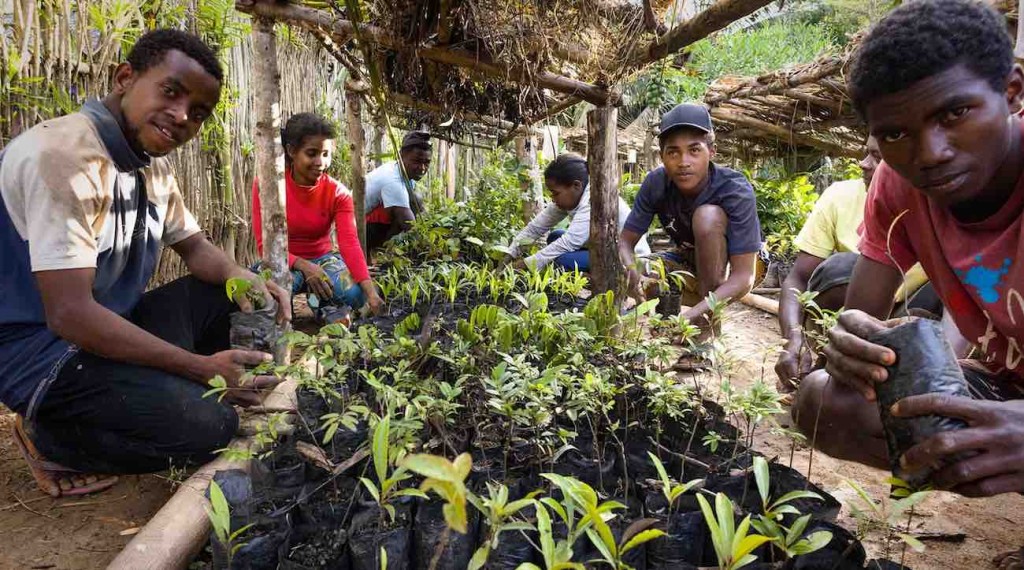
A few intrepid locals have created a 6-year, work-for-knowledge program that’s turning jobless country folk into passionate, skilled, forest management agents and entrepreneurs, ready to show the world that they themselves have the power to restore the glory of Madagascar’s stunning biodiversity.
Organized by a Malagasy woman and her Wall Street ex-pat husband, Green Again Madagascar is unlike any other tree-planting nonprofit around.
“It’s really exemplary of bottom-up restoration,” Leighton Reid, assistant professor in the School of Plant and Environmental Sciences at Virginia Tech, who conducted research for the group, told WaL.
Tree planting has become all the rage as a way for corporations and international aid and development agencies to help alleviate poverty and prevent climate change by offsetting carbon emissions. Huge issues—largely unreported, go along with this activity, however.
Studies have shown that carbon sequestration in the roots of trees planted by hand is often overestimated. Incentives and aid handouts to communities for tree planting have been shown to primarily create monocrop agriculture forests of rubber or other commodities, rather than native forests, that are easily destroyed.
One study in Chile found that landowners simply clear-cut the forests on their land and replanted them just to get the government handout.
If William Easterly’s groundbreaking 2006 book White Man’s Burden is any indication of the lack of success of internationally-imposed development in poor countries, Green Again Madagascar is the cure for such failures—the ultimate bottom-up operation of development and accountability.
Green Again is planting dozens of native tree species to create diverse and complex reforested ecosystems, all while putting faith and function into some of the poorest people on the continent.
Retirement
In 2013, Leighton Reid was working for the University of Missouri’s botany programs in Madagascar when he came to meet Matt Hill, a retiree to Madagascar in 2011 after a 15 year-career on Wall Street.
“That works well for 4 or 5 months then it gets old—drinking and partying,” Hill told WaL, describing his island life.
Between 2011 and 2013, Hill regularly found the motivation for individual projects that interested him, where he could apply his skills in data collection as well as his retirement money to make a difference.
“A way of describing Green Again is not that we plant trees at all, because we don’t—Green Again plant zero trees. What we do is run an eco-school that’s a 6-year training program to take illiterate farmers who want to reforest their own family land,” Hill said. “What we do is we’re a tree-planting entrepreneurial launching”.
Typically, Green Again’s recruits are any rural inhabitants that live around a 60-90 minute walk from the tree nursery. They spend 2 years learning how to work in the nurseries and in the field planting trees, then—and only if they so choose—they can move onto the next level of training where they learn data collection and data entry; crucial to ensuring large companies buying carbon offsets or tree-planting credits like GMO Captial, one of Green Again’s contracted clients, can be accountable to their own aspirations.
“That [tree nursery] crew is paid and owned and managed and officed by another local Malagasy person that has graduated from our eco-school,” said Hill.
In fact, Mr. Hill is not just the only non-Malagasy working at Green Again, but he’s the only person at all that wasn’t born or doesn’t live within that 60-90 minute communal radius.
“So that’s why we get the buy-in from locals; they’re really [skeptical,] like, ‘I don’t know about someone coming on my land, oh wait, it’s Jimmy John? Oh I was there when he was born’”.
Trust is a major issue in developing economies since there’s very little ability for people to seek recourse against those who violate simple business contracts and agreements. Green Again gets around this critical problem in top-down development aid projects by recruiting people who live right in the area where a nursery and tree business is working in.
Growing people growing trees
By the end of 6 years and 12 exams worth of material, the Malagasy leaders at Green Again have learned to produce cash flow projections, manage their own banking, and do their own taxes, some of whom start without the ability to read, or even to properly hold a pencil.
Riding the first wave of graduates was Catherine Sangotra Hill, CFO of Green Again, the first regional office manager for the nonprofit in Tsarasaotra village, as well as owner and operator of the LLC Tamerina Ala Maintso Malagasy, which plants dozens of rainforest acres (slowly over 60 months) in the extremely remote upper Fanandrana river basin.
Green Again has used local knowledge to augment the number of species planted to 64, compared to 5 which is what most reforestation projects can manage.
In addition to her work at her LLC and Green Again, Catherine is a mother of 2 and mentor of many, including Marcellin Velo, another of the graduates from Green Again’s eco-school who runs his own business, became the first person in his family ever to own land, and works as another of the regional office managers for Green Again.
In late December Catherine found herself in the middle of an ecosystem crime trial when a rural man had accidentally burned a large section of village forest after poorly planning a controlled burn on his own land. Mediating on the perpetrator’s behalf, Catherine showed him how to properly restore forests, while working off his debt to the village in Catherine’s crew.
Mr. Hill notes that all kinds of people who enter adulthood with no prospects whatsoever, end up being driven towards Green Again by older folks people with a nostalgia for forests the way they used to be in Madagascar.
“It’s kind of odd, but initially it ends up that their grandmas are pushing them into it,” said Hill. “So grandma and grandpas often see their grandchildren kind of sitting around kind of not working hard, and they say ’well you could do something good for yourself, you could do something good for the family and earn something and chip and, and you could do something good for all our farms, the environment, and Madagascar; why don’t you go sign up at Green Again?”
“I would say, probably 70% of our people who we’ve never seen before who sign up; it’s because one grandma talked to another grandma”.
Workers start off at 120% of the normal daily rate for laborers in that part of the world, and for every level of the course they complete they get what amounts to around a 15% pay raise. By the time the man or woman completes the whole course, they’re making about 50 times more than when they started.
A mandatory 20% savings rate is required of all payroll which is set aside toward whatever goal it is that the individual has chosen for themselves, which could be the purchase of land, the construction of buildings on family property, or collateral as a loan to launch a business.
All this has the added benefit of creating a highly-motivated workforce, who by their own entrepreneurial vision, their sense of responsibility to their community, base greed, or the urging from their family members, are creating the highest-quality native reforestation in a part of the world where nearly three-fourths of all known plant species grow exclusively there.
Part 2 of this story will be released later this month…
SHARE This Amazing, Transformational Program With Your Friends…
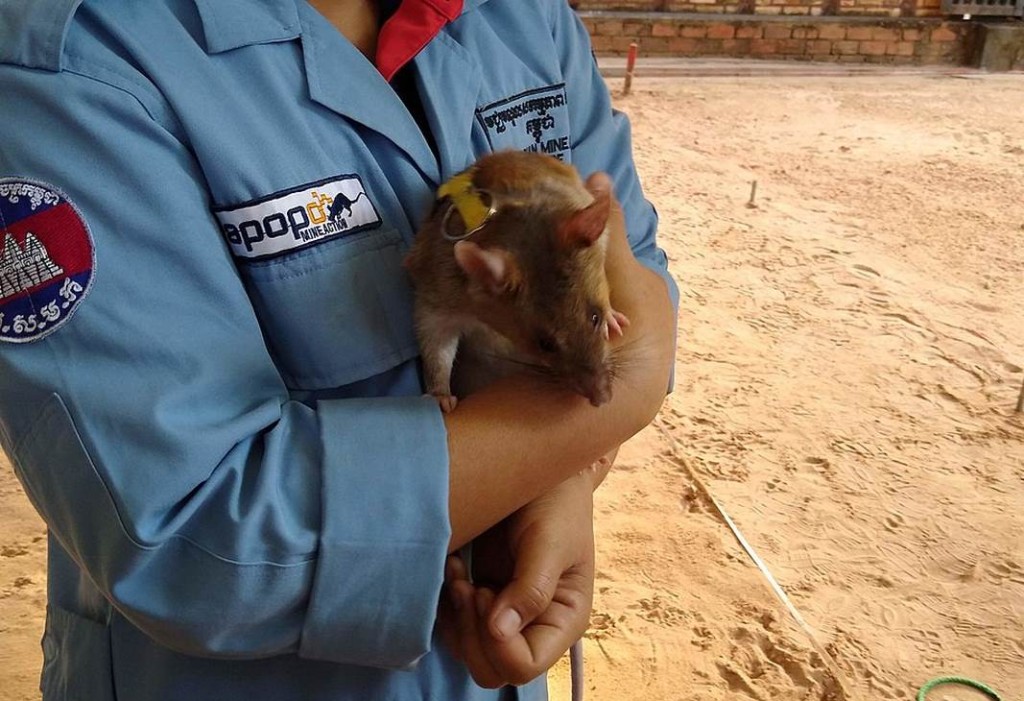
Bosco the "HeroRAT" from the APOPO Program in Siem Reap, Cambodia - Credit Mx Granger - CC 0
Bosco the “HeroRAT” from the APOPO Program in Siem Reap, Cambodia – Credit Mx Granger – CC 0
Let’s face it, rats aren’t the most popular animal. From the Black Death to the Netflix documentary on New York’s rodent problem, they may be the least-liked mammal on Earth.
But down in Kenya and Tanzania, they are utilizing rats to cure disease rather than cause it, and to be a member of society, rather than an outcast.
The APOPO Project has already trained rats to smell landmines—one of the most tragic and long-lasting consequences of warfare, but now scientists are training them to sniff out tuberculosis, and they’re proving more sensitive than microscope testing.
African giant pouched rats, also known as Gambian pouched rats, were also able to detect the olfactory characteristics of TB independent of a person’s HIV status, something which disrupts existing TB testing.
“That is, they can easily identify tuberculosis in people living with HIV, keeping in mind that these people living with HIV, it is very difficult to be diagnosed by the standard test, including Genexpert in microscopes,” Joseph Soka, program manager for TB at APOPO, told Africa News.
Tuberculosis still unfortunately kills millions worldwide, and in the Tanzanian capital of Dar es Salaam, the APOPO rats have now replaced normal testing in 21 different health clinics.
“So, the conventional laboratory techniques can take anywhere from two hours to even 14 days per sample, depending on what technique you use,” said Dhaval Shah, veterinary pathologist at Pathologists Lancet Kenya.
“While the rats will be able to complete testing of fifty samples within two hours and this would be ideal in far places or remote places like Mozambique or places in Mozambique which are rural.”
Bosco the “HeroRAT” from the APOPO Program in Siem Reap, Cambodia – Credit Mx Granger – CC 0
The TB project is going better than the landmine clearance. Provided the ground is free of vegetation and lined with paths for the handlers to walk on safely, each rat is capable of searching up to 400 m2 (4,300 sq ft) per day as part of a team including conventional equipment.
They ignore old screws, nails, coins, and other materials that can make manual mine clearance with metal detectors incredibly slow and tedious.
However it takes around $6,500 to train the rats, and APOPO is the only organization in the world that uses rats, perhaps pointing to the reality of their ability as minesweepers.
WATCH the rats in action on Africa News…
SHARE The Other Side Of This Famous Mammal With Your Friends…
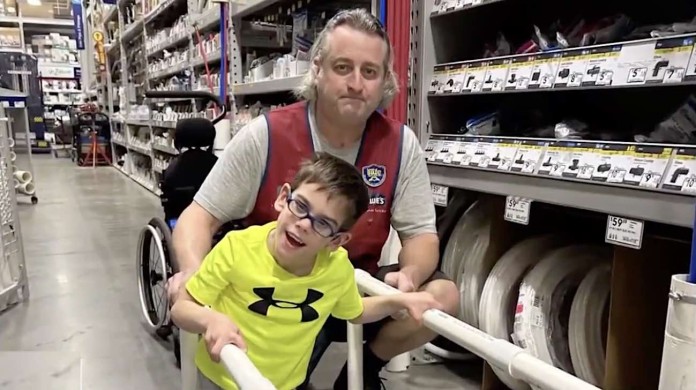
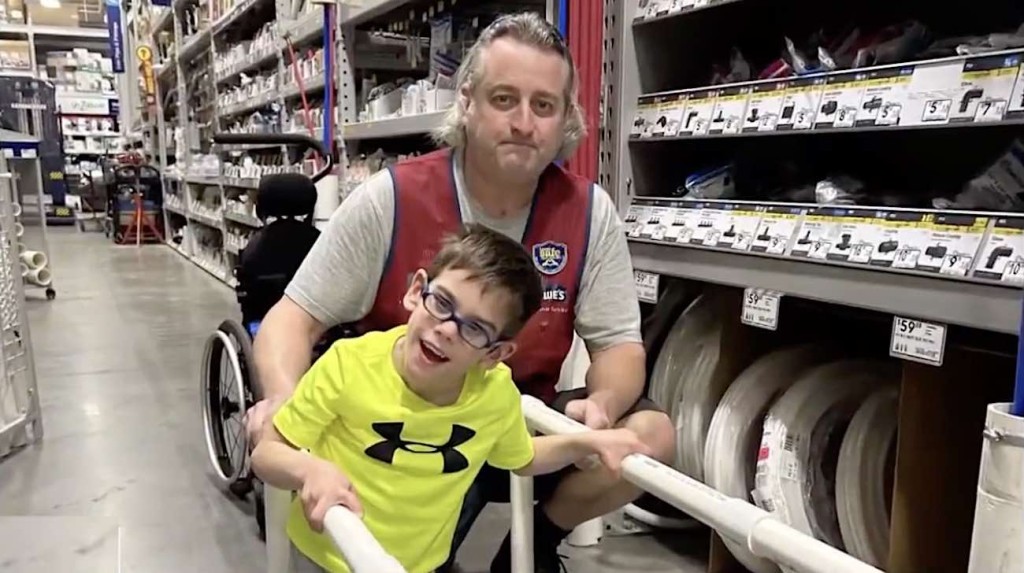
When Lowe’s employee Dave Urban came across the Getty family in the PVC aisle, he thought he would be helping them find the right fittings or something like that.
It was after he heard what was being built, and who it was being built for, that he took the time to do more than just help.
The Getty family was building parallel bars to help their son William practice walking.
“He was born very prematurely, just 23 weeks, so as a result, he has quadriplegic spastic cerebral palsy and one of our goals for William is to get him walking,” mom Jessica Getty told local news.
So inspired by young Will, Dave ended up spending half an hour cutting and fitting the PVC right there in the store, ensuring that everything was perfect to help Will get started finding his feet in the world.
“Then came the test. Will got up, out of his wheelchair and grabbed a hold of those bars. I think you saw that courageous smile of his. Sense of pride, ah, it keeps getting me,” Urban said, holding back tears.
The whole family saw how much it meant to Dave, and quickly made a lasting friend out of the man, who himself said the experience rewarded him “100 times back.”
WATCH the story below from Fox 29…
SHARE This Touching Connection With Your Friends On Social Media…
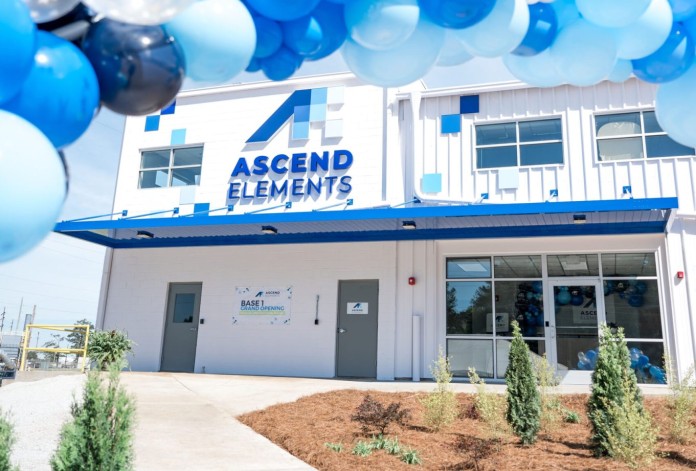
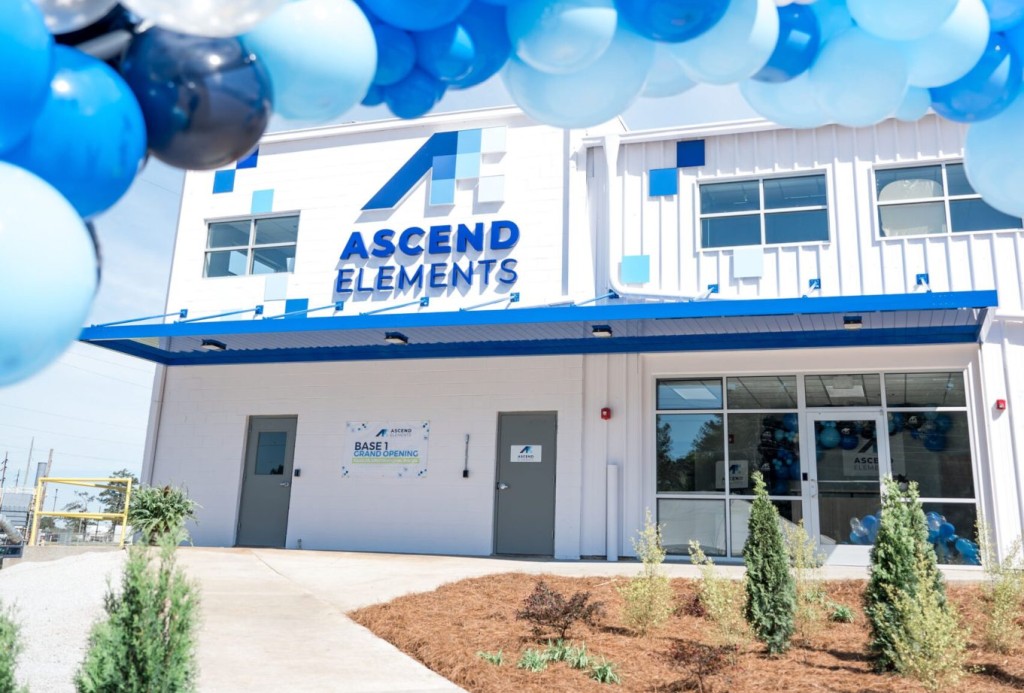
In Covington, Georgia, a 30,000-ton-per-year recycling facility for batteries and battery scrap just switched on the disassembly line for the very first time.
Inside its walls, a Massachusetts-based startup will be harvesting lithium carbonate, cobalt, manganese, and other battery minerals and selling them back to the market, circumventing the huge challenges that come from opening new mines.
Ascend Elements hopes to take advantage of massive government spending on electric vehicle production by dotting the Carolinas, Georgia, Tenessee, and the Midwest with recycling facilities within an hour’s drive from new automotive plants.
The Covington location can take apart around 70,000 electric vehicles worth of batteries, while allegedly providing enough free cash flow to allow Ascend to pay car manufacturers a little for their old batteries to make doubly sure they don’t end up in landfills.
Once they arrive on site, the batteries are shredded and sieved into “black mass” which is sorted by mineral type.
As well as selling raw minerals, Ascend upcycles some of this black mass into cathode precursor and cathode active material at an R&D center in Massachusetts. They are currently building another facility in Kentucky to bring this operation closer to the “Battery Belt” states mentioned above.
“Those two facilities represent the investment that we are making in key infrastructure to recover these batteries, retain these critical elements in the United States and return them into the supply,” said Ascend CEO Mike O’Kronley.
WATCH how they do it in a corporate video below…
LET Your EV Driving Friends Know About This Good Battery Development…
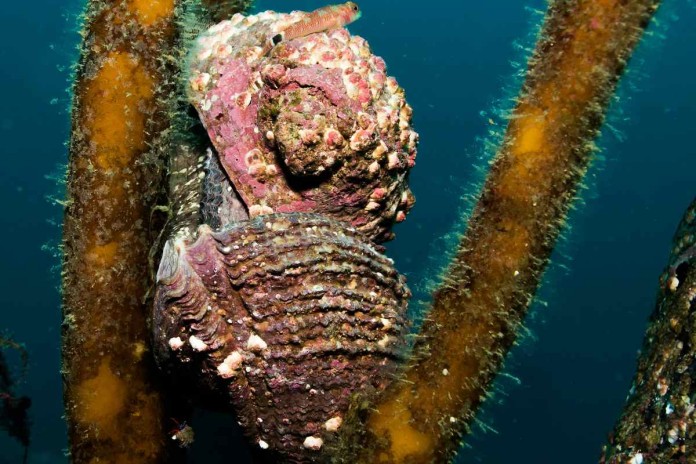
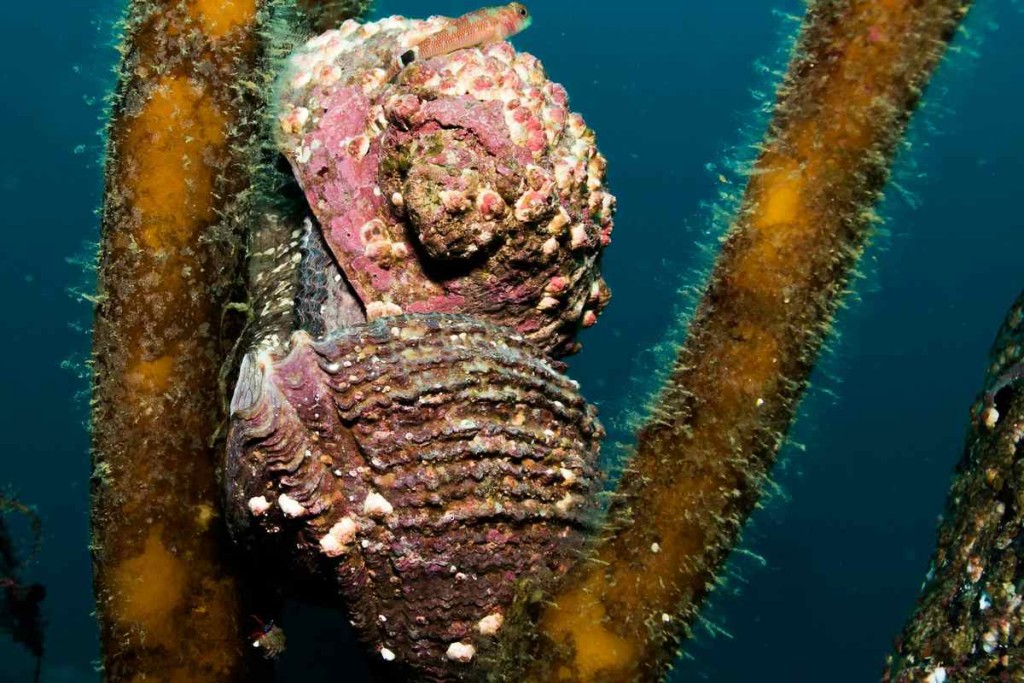
An Endangered abalone whose blood could hold a cure for cancer has been crowned “International Mollusk of the Year.”
Though it’s not much to look at, the Chilean abalone, a large, carnivorous limpet with a heavy shell, got more than 40% of the public vote, conferring them the grand prize—a full genome sequencing.
Chilean abalone Juan Diego Alvarez accepted the prize on his species’ behalf at the Senckenberg Natural History Museum in Frankfurt where voting partially took place, calling the victory “one shell step for man.”
All kidding aside, the cultural, ecological, and potentially medicinal value of the species is hoped to have been amplified by the news of the award. The abalone’s numbers were drastically diminished in the late 20th century due to overfishing.
A component in its blood has been shown recently to be effective against bladder and prostate cancer, and in its natural habitat, it’s a top predator that’s important for keeping its own little food web in balance.
“…A component of its blood, the oxygen transporter haemocyanin, also shows an immunotherapeutic effect against some types of cancer,” said competition judge Dr. Carola Greve, lab manager at the LOEWE Translational Biodiversity Genomics Centre, where the abalone’s genome will be completely mapped out.
“So, the genomic analysis can not only help to explore adaptation strategies and different populations in the large distribution area, but also to discover new molecules with pharmaceutical importance.”
Although mollusks form the second largest animal phylum after arthropods (insects), the genomes of only a few mollusk species have been completely sequenced so far.
Accordingly, little is known about the genomic basis for the diversity of the species, their adaptive abilities, or the natural products they produce.
This abalone, Concholepas concholepas, is actually not an abalone at all, the chief difference being that abalones are herbivores and this one is a carnivore that belongs to the family of Murex snails.
The competition received a total of 4,309 votes from all over the world, the Chilean abalone received the most with 1,798 votes.
It is followed in second place by the wavy bubble snail, Micromelo undatus with 970 votes, the giant deep-sea oyster Neopycnodonte zibrowii, and the thick-horned nudibranch Hermissenda crassicornis.
“Together, we are getting closer to our goal of publicly showing the enormous biodiversity of mollusks and arousing enthusiasm for these often underestimated organisms, many of which perform important tasks in their respective ecosystems,” said Professor Julia Sigwart, Section Head of the Department of Malacology at the Senckenberg Research Institute.
SHARE This Mollusk’s Great Triumph With Your Friends…
Quote of the Day: “To be looking everywhere for miracles is a sure sign of ignorance that everything is miraculous.” – Abraham H. Maslow
Photo by: McKinley Corbley
With a new inspirational quote every day, atop the perfect photo—collected and archived on our Quotes page—why not bookmark GNN.org for a daily uplift?
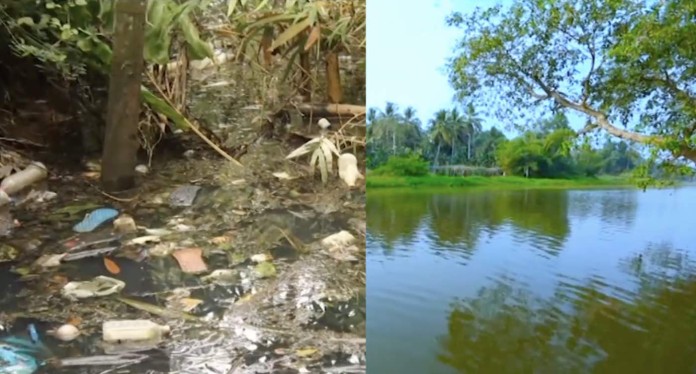
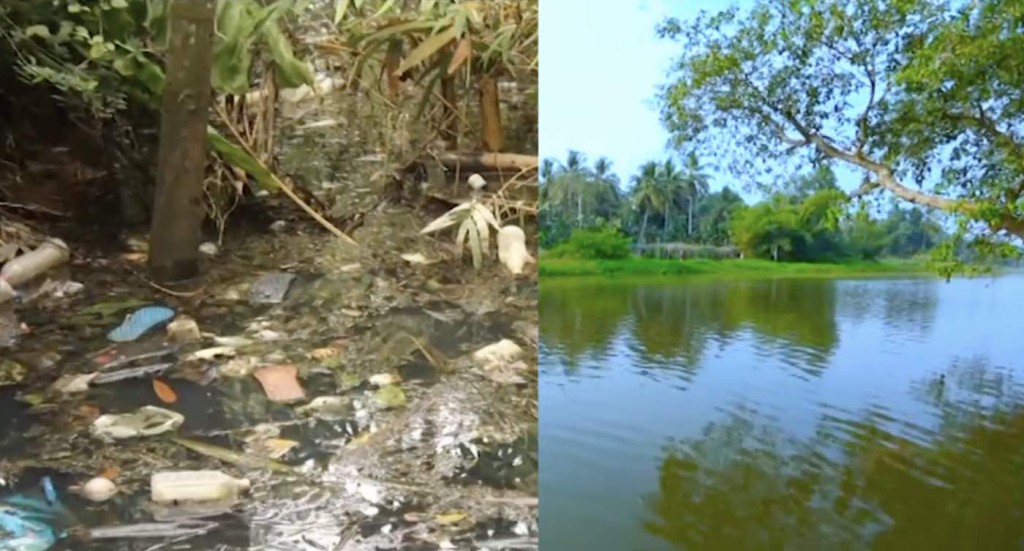
Kuttamperoor River–Before and After (YouTube screenshots) Credit: Budhanoor Grama Panchayat
Kuttamperoor River–Before and After (YouTube screenshots) Credit: Budhanoor Grama Panchayat
A once-biologically dead river in southern India has been revived to the fullest extent thanks to local dedication and government involvement.
A tributary of the Pampa and Achencoil rivers, the 4-mile-long Kuttamperoor River has for centuries been a source of life and drinking water for rural communities in Kerala.
Irrigating more than 2,000 acres of rice paddy, and providing a lifeline for 500 fishermen families, the Kettamperoor River played a huge role in the local community.
However, over three decades of a mixture of misuse and neglect led to the river becoming biologically dead; choked with weeds, and polluted with trash.
Floods, once rare, became a common occurrence, and by 2005 the sorry state of affairs on the Kettampreroor led even to the contamination of groundwater sources.
Those days are gone—thanks to a collaborative effort between the Kerala state government, the Budhanoor village council, and the participation of locals along the banks, the Kettamperoor has been resurrected.
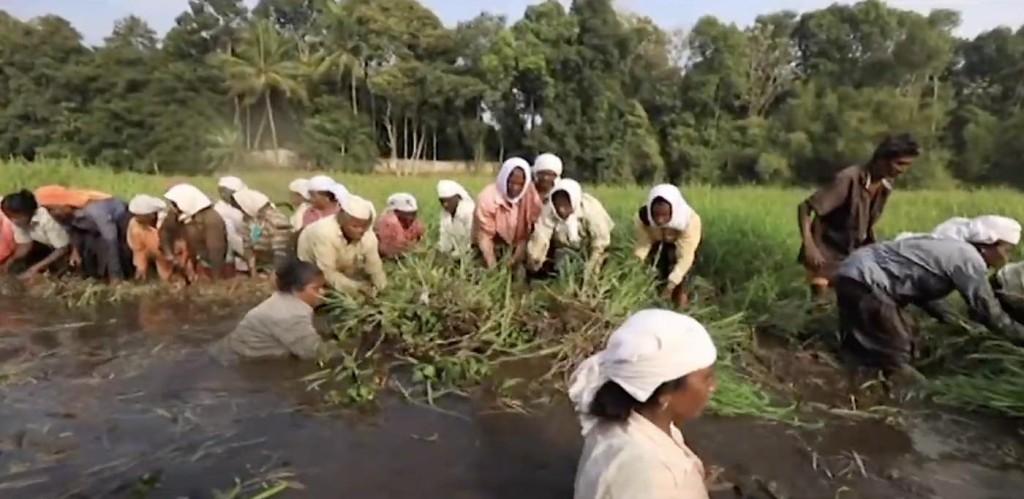
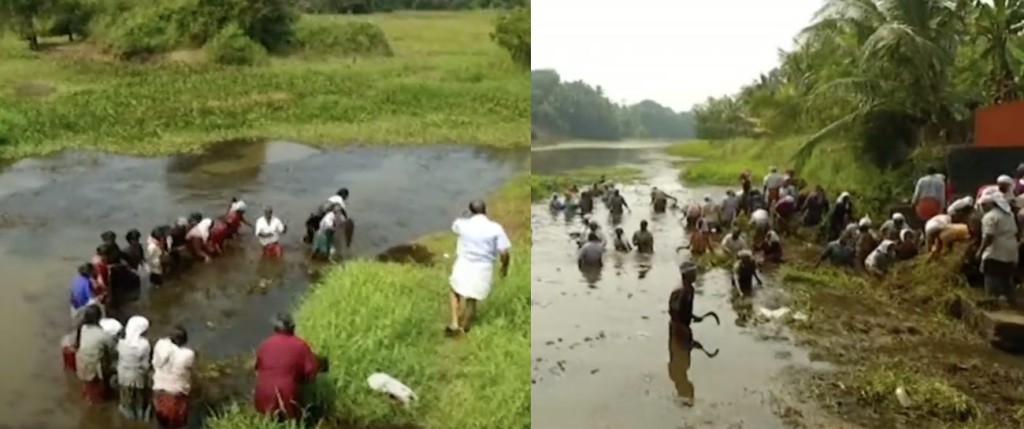
A large number of workers under the Mahatma Gandhi National Rural Employment Guarantee scheme took to the shallows to scoop out the tangled masses of aquatic weeds and trash.
7,000 villagers from the three communities donated around 30,000 man-hours of work to finish the initial clean up in just 2 months.
Volunteers on Kuttamperoor River -(YouTube screenshot) Credit: Budhanoor Grama Panchayat
After that, the state government in Kerala on the southwest tip of India took over and created the conditions for life to return. They worked alongside the denizens of the river, who offered off up some of their land for a planned expansion of the river’s banks.
Kuttamperoor River cleanup (YouTube screenshot) Credit: Budhanoor Grama Panchayat
Five years and around $1.5 million (₹13 crore) later, fish and other animals were back in the river, whose flow width had grown from a few dozen feet to around half a football field in length.
The Hindu reports that the success has become literally a textbook example of restoration, and made national headlines when Prime Minister Narendra Modi mentioned it in a national radio address, known as a Mann Ki Baat.
WATCH the restoration story in full, from Budhanoor Grama Panchayat…
SHARE This Good Earth News From Our Friends In India With The World…