











Centuries after they were made famous by Charles Darwin, and a century after they had become plagued by invasive rats and cats, the Galapagos Islands are well on their way to recovery.
Few events could better capture that recovery than the recent reappearance of the beautiful blue Galapagos rail, a bird which hadn’t been seen on Floreana island for 200 years.
After almost a decade of preparatory work, invasive rats, avian vampire flies, and domesticated cats were eradicated from the island thanks to the close coordination of several conservation groups from around the world working alongside the Galapagos National Park Directorate.
The cleansing of the island has, to the delight of conservationists and scientists working on the project, resulted in a dramatic return for many of the islands persecuted endemic species like lava lizards, Galapagos doves, geckos, and dark-billed cuckoos,
“But the most exciting finding was the re-discovery of the Galápagos Rail,” said Birgit Fessl, principal investigator of landbird conservation at the Charles Darwin Foundation, part of the team restoring Floreana. “This bird had not been recorded on Floreana for centuries—the only historical proof of its presence [was] a specimen collected by Darwin himself.”
The rail is a beauty: boasting a range of blue feathers that begin in midnight blue around the cap to cobalt and powder blue at the wings and wingtips, two vibrant red irises, and a chocolate brown patch on its back.
This ground-dwelling bird was at a high risk of predation by cats, while rats routinely preyed on its eggs. They survived on other islands, but on Floreana, they were believed to have been extirpated.
Being that the fame of the Galapagos stems in no small part from their famous isolation from one another, which led the biologist Charles Darwin to develop the theory of Natural Selection by examining closely-related species island by island, one wonders where the rails even came from.
“[The rails] reappeared and now it’s very common to find these birds just walking around the island. You can hear it, you can see it, it’s unbelievable,” Paola Sangolquí, a marine biologist at the Jocotoco Conservation Foundation, told the BBC.
Whether a tiny number clung to existence in the shadows of the volcanic island, no one can say for certain. It’s as if the restoration of the balance of nature on the island led to its spontaneous resurrection.
Elsewhere on Floreana, the native finches have been documented greatly expanding their songs. Young birds will sing louder and longer. Some are creating new song patterns never-before-documented, and it’s all believed to be a result of shedding the need for secrecy.
A bold young bird, singing loudly on a branch to attract a female, would make himself easy prey for a waiting cat or rat, and with their removal, more than a century of pent up melody seems to have been released upon the island airwaves.
You can learn about the finches in greater detail by reading the BBC piece on the return to normalcy on Floreana.
SHARE The Long-Awaited Return Of Rail And Song On Floreana Island…
Catrina and Charlie as they radioed the school for help - credit, Crestview Local Schools
Catrina and Charlie as they radioed the school for help – credit, Crestview Local Schools
When an Ohio school bus driver began to suffer a medical event, a brother and sister took action that may have saved her life.
Footage taken from a surveillance camera inside the bus shows 8-year-old Catrina sitting in the seat nearest the driver, who began to have trouble breathing. Catrina asked if she was alright, and a shake of the head replied in the negative.
The footage, released by Crestview Local Schools in Ashland, then shows Catrina run to the back of the bus and alert someone she knew she could count on: her 7th-grade brother Charlie.
Charlie rushes to the front and used the radio to call the school and alert them to the emergency, while an 8th grader named Kali also called 911.
The driver, who was hospitalized and later discharged, had allegedly instructed all her regular riders how to use the radio to call the school in case of an emergency, and she said she was glad they remembered her instructions, according to ABC News.
“When I realized that something was going on, [I] went up there and grabbed the radio and then called the school because I knew that that was the quickest way to get help,” Charlie told ABC affiliate WEWS.
“My brother … in the inside when something’s going wrong, he’s scared but on the outside, he’s like calm and concentrated,” said Catrina.
“The actions of these students were truly outstanding,” said Crestview Local Schools Superintendent Jim Grubbs “They remained calm, communicated clearly, and helped one another in a situation that could have been much worse. Their families should be incredibly proud.”
WATCH the kids in action below…
SHARE This Example Of Childhood Heroism With Your Friends…
Quote of the Day: “Winning is a habit. Unfortunately, so is losing.” – Vince Lombardi
Image by: Igor Omilaev
With a new inspirational quote every day, atop the perfect photo—collected and archived on our Quote of the Day page—why not bookmark GNN.org for a daily uplift?
31 years ago today, a strange thing occurred, that isn’t exactly good news, but certainly will make a person think “huh.” On Kiribati, the island nation in the South Pacific, December 31st, 1994, was skipped altogether as part of a reorganization of the oceanic islands according to time zones. The archipelagic republic’s Fenix Islands and Line Islands had their hours shifted forward, inadvertently causing their calendars to read January 1st. READ more about this silly occasion… (1994)
Fiona, Britain's Loneliest Sheep - credit, The Sheep Game
Fiona, Britain’s Loneliest Sheep – credit, The Sheep Game
Having been called “Britain’s Loneliest Sheep,” and later the “World’s Most Famous Sheep,” Fiona is now pregnant with twins 2 years after her harrowing rescue.
GNN reported in 2023 that rural Scotsmen were planning a daring, cliffside extraction of a sheep that had been seen stranded on an isolated beach two years earlier by a kayaker.
The kayaker, Jill Turner, took photos of the sheep, who had grown a truly enormous fleece. How she got there—down the sheer cliffs on the Cromarty Firth—no one knows, but eventually, the Scotsmen raised money for a rescue attempt for their video blog “The Sheep Game.”
Thriving now at Dalscone Farm, where Fiona arrived enormously overweight from a diet rich in salty grass and no space to exercise, the farm recently paired her with a Suffolk ram, and got her “with lamb” after a difficult settling in period.
“She has kind of forgotten how to be a sheep,” said Ben Best, the farm’s manager.
A strict diet and the aid of a few hormones got the ewe in shape and in the mood, and with all the attention Fiona has received over the years, Best estimated that news of her pregnancy will make her the most famous sheep in the world.
Commonwealth media can blow up over sheep stories. When the infamous Australian Merino wether named “Shrek” was caught after 6 years at large, it was one of the most-read stories that week across English-speaking media.
If you don’t believe us, look at how Dalscone Farm presented the news.
WATCH it below…
SHARE This Latest In Sheep Affairs With Your Friends…
The Moosi Rani Sagar - credit, Environmental Foundation of India
The Moosi Rani Sagar – credit, Environmental Foundation of India
Ancient Indian stepwells are being restored to modern water storage facilities to help cure modern water shortages.
Recently, an Indian environmentalist and editor was invited to share his incredible work restoring hundreds of natural and man-made water sources all across India on CNN.
Most recently this has included stepwells, one of the jewels of Indian architectural heritage and civic planning, which have been used for millennia and multiple iterations of empire to supply water in the hot and often dry climate.
“Stepwell restoration is the next big implementation challenge that I would like to add to EFI’s responsibilities because we have a greater responsibility now on protecting these historical assets, which are a testament to human intelligence,” Arun Krishnamurthy tells CNN during an interview in India.
“There’s so much science behind it, the kind of material they use, the kind of artisan skill sets with which they developed and built them, so learning all of it and working on stepwells has been quite a remarkable experience for me.”
EFI has already restored two of these stepwells, and has another 6 slated for 2026. Unlike the 600 natural ponds and lakes Krishnamurthy and his volunteers have worked on, the stepwells demand another sort of expertise.
Their designs and materials often rely on antique methods of construction and landscaping, skillsets Krishnamurthy has had to go seek out as part of his first project in 2022 to restore the Moosi Rani Sagar, a magnificent stepwell in the Rajasthan city of Alwar.
Set amongst the oldest mountains in India, the Moosi Rani Sagar was fed by a hillside collection tank and a 900-meter-long canal equipped with a sedimentation tank. This infrastructure channeled water from the hills down into the magnificent stepwell, having first cleared the water of debris in the canal, and sediment in the secondary tank. It emerged as clean, relatively speaking.
Restoration work required dozens of hands to clear overgrowth of invasive weeds along the canal course, and dredging all of the structures to clear the silt buildups. Over time, lack of civic organization, poverty, and despondency has led to many of these convenient holes in the ground becoming garbage dumps.
With help from the Hinduja Foundation and Prince Albert II de Monaco Foundation, the silt was dredged, the stones cleaned, the fetid water pumped out, and the garbage removed. The holding tank, along with being a must-see local attraction, contributes its cleaned water to the civic water supply, mixing archaic with modern for the benefit of this parched Indian state.
EFI has just begun planning the renovation of a stepwell in Devanahalli, near Bangalore. Here, similar problems exist to those which plagued the Moosi Rani Sagar, but it will also require reinforcements to the stone design, for which Krishnamurthy had to find locals familiar with the stone and the working of it, a process he believes he will have to replicate many times in the future.
Stepwell in Parbhani District Maharashtra – credit, CC license Rohan Kale Explorer
Known as “baolis” or “bwaris,” many of India’s more than 3,000 baolis have fallen into disrepair or outright abandonment, being turned instead into dumps or being buried by foliage.
“When they began clearing what they thought was a garbage dump, they found the structure of a step-well beneath the garbage,” writes Vikramjit Singh Rooprai, a heritage advocate and writer who works with the Aga Khan Trust for Culture—a nonprofit also working toward the restoration of India’s baolis.
“It was one of the deeper stepwells of Delhi. After restoration, the Purana Qila Baoli has so much water that the entire lawns of the [Old Fort in Delhi] are being irrigated by it,” he adds.
For Krishnamurthy and Rooprai, the Moosi Rani Sagar and Purana Qila Baoli are just headline examples of stories that could be repeated many times over to the tune of millions of gallons of water for cities and towns across the subcontinent.
SHARE These Brilliant Part-Tourist Destinations Part Civic Projects…
A slender North American predator not seen in parts of Ohio for 200 years has started returning to its former habitat.
The fisher was extirpated from the state in the 19th century due to fur trapping. Back in 2013, it was spotted again for the first time in northern Ashtabula County, and since then they have become more frequent, with 56 sightings made in the following 12 years.
This relative of the weasel has seemingly spread south from Ashtabula into Trumbull, Portage, Mahoning, and Columbiana counties.
Now, the first sighting has been made in Cuyahoga County, home of the Cleveland Metropolitan Area, and it was Cleveland Metroparks, the city’s parks and wildlife division, that recorded the sighting.
“This is tremendously exciting, as this is yet another extirpated native Ohio mammal species to be documented for the first time in Cleveland Metroparks,” the division said in a statement.
“The return of fishers and other extirpated species like otters, bobcats and trumpeter swans are a result of conservation efforts and emphasize the importance of our healthy forests, wetlands, waterways and natural areas in Cleveland Metroparks.”
A fisher seen in 2024 – credit, Ohio Division of Wildlife
A member of the family Mustelidae which includes martens, stoat, minks, ferrets, badgers, wolverines, otters, and weasels, the fisher is about the size of a housecat. They hunt primarily rabbits, hares, and porcupines, and have no natural predators. In fact, these successful hunters will target prey much larger than themselves, like wild turkey and raccoon. There have been 14 recorded instances of a fisher killing a Canadian lynx.
In Cuyahoga County, Metroparks staff say they aren’t sure if the fisher they saw in the trail camera footage is just passing through or making a home for itself. Mostly solitary recluses, more data will be needed to answer this question.
SHARE This Return To Cleveland For The Fisher With Your Friends…
Graham Walker, CEO of Fibrebond (second from right) - credit, Fibrebond PR
Graham Walker, CEO of Fibrebond (second from right) – credit, Fibrebond PR
From Louisiana comes the story of a corporate dream fulfilled, as a man succeeded his father as CEO of the family business, invested in innovation which paid off, and guided the business through a big sale.
But there was something else that Graham Walker had in his mind to achieve when he prepared to hand over the reins of Fibrebond: the rewarding of his people.
Enclosed in the sale agreement was a clause that 15% of the sale price should be paid out over 5 years as bonuses to his 540 employees—amounting to $240 million. Each employee will receive $443,000, according to the Wall Street Journal.
“I hope I’m 80 years old and get an email about how it’s impacted someone,” Mr. Walker said.
Fibrebond was founded by Graham’s father, Claud, in 1982. It has gone through boom times and the bust times, remaining solvent through a devastating fire, and the dot com bubble. In the mid 2000s, Graham and his brother took charge of the company, and in 2020 began to invest in the materials and know-how to build data centers.
It was a choice that gave the company an early-mover advantage, and today, the company website states, it maintains more than 51,000 modules deployed to projects across the country, making Fibrebond the nation’s leading manufacturer of complex electrical modules used in the data centers.
Following the sale of the company at $1.7 billion to Eaton, a smart power company and client of Fibrebond since 2015, Graham penned an emotional letter.
“Last week, we gathered together and recognized every Fibrebond employee,” he wrote. “We shared the same humbling question, how did we build this? Forty-three years of memories, failures, successes, and opportunities came forth as tears, hugs, and profound joy. Our family fulfilled a commitment that we would all win together, and over two days, we shared details of that commitment.”
Company employees told the journal that news of the bonuses were met with shock and emotion, with people saying they’d use the money to pay off student loans, finance retirement, and go on vacation.
“It was surreal, it was like telling people they won the lottery. There was absolute shock,” said Hector Moreno, a Fibrebond executive who distributed the bonuses, according to the journal.
SHARE This Magnanimous CEO With Your Friends On Social Media…
Quote of the Day: “Love never dies a natural death. It dies because we don’t know how to replenish its source.” – Anaïs Nin
Image by: Paul Cusick
With a new inspirational quote every day, atop the perfect photo—collected and archived on our Quote of the Day page—why not bookmark GNN.org for a daily uplift?
160 years ago today, author and poet Rudyard Kipling, was born. Beloved for his children’s stories, he wrote The Jungle Book at age 29 after settling in Vermont. 8 years later he became the world’s youngest Nobel Prize laureate for literature. Born to British parents in India, his novel Kim is full of vivid narrative about the country where he grew up. READ his poem If… (1865)
He is regarded as a major innovator in the art of short stories, with works like The Man Who Would Be King. His poems include Gunga Din and If. His famous quotes include: ”God could not be everywhere, and therefore he made mothers,” and “Gardens are not made by singing ‘Oh, how beautiful,’ and sitting in the shade.”
If you can keep your head when all about you Are losing theirs and blaming it on you, If you can trust yourself when all men doubt you, But make allowance for their doubting too; If you can wait and not be tired by waiting, Or being lied about, don’t deal in lies, Or being hated, don’t give way to hating, And yet don’t look too good, nor talk too wise: …
(Read the rest of his poem, If, at the Poetry Foundation
MORE Good News on this Date:
A dinner party for 20 was held inside a life-size model of an Iguanodon created by two noted zoologist-sculptors appointed to create life-size concrete models of extinct dinosaurs for a south London exhibit (1853)
The iconic baseball player Sandy Koufax, believed by some to be the greatest pitcher of all time, turns 87 today (1935)
United Auto Workers staged their first sit-down strike (1936)
Wayne Gretzky scored his 50th goal in 39 games, still a National Hockey League record (1981)
Israel and the Vatican established diplomatic relations (1993)
In women’s college basketball, top-ranked University of Connecticut completed a 90-game winning streak (2010)
101 years ago today, American astronomer Edwin Hubble announced the existence of other star systems beyond our own Milky Way Galaxy. Using the powerful new 100-inch telescope in Southern California he studied the spiral nebulae Andromeda, which was a fuzzy patch of light generally thought to be clouds of gas or dust. But Hubble calculated that Andromeda was approximately 860,000 light years away—more than eight times further than the farthest star in the Milky Way—thus proving that the nebulae are separate star systems.
Hubble later went on to discover dozens of other galaxies, and, being revered by astronomers, a famous telescope and scientific law of recessional velocity were named after him. (1924)
115 years ago today, the American author, recordist, and expatriate Paul Bowles, was born. Living in Tangier, Morocco for 47 years, Bowles would publish several books, including the critically acclaimed The Sheltering Skyset in French North Africa through which he traveled extensively. He was just one of so many Europeans or Americans who saw the vast emptiness of the Sahara and the simple day-to-day life of its inhabitants as impossibly romantic and liberating.
Growing up in Queens, Bowles was exposed thanks to his family’s means to the arts: poetry, literature, and music. Buying his first book of poetry at age 11, he had one accepted for publication in the periodical Transition which also published the likes of James Joyce, Gertrude Stein, and others.
In 1947 Bowles received a contract to write his book, the inspiration for which he drew on travels alone through the Algerian Sahara. The publisher rejected it at first, and Bowles even had to send back his advance, until it started selling big elsewhere. In The New York Times, playwright and critic Tennessee Williams commented that the book was like a summer thunderstorm, “pulsing with interior flashes of fire.” The book quickly rose to the New York Times best-seller list, going through three printings in two months.
Another large slice of Bowles’ life was when, under commission by the Library of Congress, he went across all of Morocco recording the traditional music stylings of the various ethnic groups—Berbers, Amaziagh, Arabs, and Jews. He also translated many Moroccan authors into English, such as Mohammed Choukri.
A collection of Bowles’ travel memoirs from Morocco, Algeria, Sri Lanka, India, and other nations, is available on Kindle and is deeply inspiring. It’s entitled Their Heads Are Green and Their Hands Are Blue. (1910–1999)
Also, on this day in 1968, Frank Sinatra first recorded “My Way.”
1999 cover
The iconic song that would become his signature tune was recorded and mixed at Oceanway Recording in Los Angeles. In only a few hours he would travel to Las Vegas to celebrate the New Year. With lyrics written by Paul Anka especially for Sinatra, the triumphant message of recollection at the end of a lifetime, declares without regret, “I did it my way.”
Happy 76th Birthday to Jeff Lynne, the English musician, singer, and record producer, who co-founded the rock band Electric Light Orchestra (ELO). His father bought him his first guitar, an acoustic instrument for £2 that Jeff was still playing in 2012. He co-founded the supergroup Traveling Wilburys in the 80s with George Harrison, Bob Dylan, Roy Orbison, and Tom Petty. With a star on the Hollywood Walk of Fame and a spot in the Rock and Roll Hall of Fame, Lynne still tours with ELO today. His recent Live CD/DVD set features his 2017 sold-out Wembley stadium concerts. (1947)
Happy 78th Birthday to Patti Smith, the Chicago-born singer-songwriter, author, poet, and visual artist. Her debut album Horses became highly influential in the New York City punk rock movement.
Daigo Oliva, CC license
Her cover version of ‘Gloria’ became an instant classic, and she co-wrote ‘Because The Night’, with Bruce Springsteen. Among many honors, she won the National Book Award in 2010 for her memoir, Just Kids.
She still performs at special events–often for liberal political groups who revere her song, People Have the Power.
smial in 2014, Wikipedia
More recent projects include a photography exhibit and another memoir, M Train. WATCH her being presented this year with the key to New York City by the mayor… (1946)
77 years ago today, Davy Jones, the musician, singer, actor, and jockey, best known as a member of The Monkees, was born in Manchester, England.
Still a teen, he won the role of the Artful Dodger in the stage production of Oliver! in London’s West End—and then performed it to great acclaim on Broadway, which earned him a Tony Award nomination.
In 1964, he appeared on The Ed Sullivan Show, the same episode that starred The Beatles, and said: “I watched them from the side of the stage, I saw the girls going crazy, and I said to myself, this is it, I want a piece of that.”
The following year, the 19-year-old singer debuted on the Billboard Hot 100 with the single What Are We Going To Do? The next year, Jones’ dream came true when he became the singer of The Monkees, a pop-rock group formed expressly for a TV show that became insanely popular.
Jones sang lead vocals on The Monkees’ No.1 hit Daydream Believer; and the No.2 hit A Little Bit Me, a Little Bit You; and the No.3 hit Valleri. Also a competent drummer, Jones played mostly tambourine or maracas, and became “the number 1 teen idol of all time,” according to Yahoo! Music.
He guest-starred in many cameo appearances on television shows, including an episode of The Brady Bunch. After performing Girl on the episode, the song became his best-remembered solo hit.
After the Monkees disbanded in 1970, Jones kept himself busy by establishing a New York City-style street market in Los Angeles, called ‘The Street’. He opened his first store, ‘Zilch’, in NYC’s Greenwich Village, selling “hip” clothing and accessories and also allowed customers to design their own clothes.
In 2009, Jones released a collection of classics and standards from the 1940s through the 1970s entitled She. He’s the author of an auto-biography called Made a Monkee Out of Me, in 1988, and the book Daydream Believin.
An amateur jockey, Jones was rushed to the hospital at age 66, after riding one of his horses in Florida and died of a heart attack resulting from arteriosclerosis. WATCH The Monkees’ Daydream Believer… (1945)
Travel teaches many lessons, and for famous American travel writer Rick Steves, one of those is that “Love thy neighbor” need not depend on proximity.
The biblical phrase has been on Steves’ mind of late, following his philanthropic rescue of a community hygiene center where those struggling to provide a basic living for themselves could come and shower or wash their clothes.
Reading in a local news outlet that the owner of the land on which it was built was planning to sell, the wildly successful author and presenter on PBS of “Rick Steves’ Europe” stepped up to buy.
“I vividly remember what it’s like as a kid backpacking around the world to need a shower,” Steves said at an event last week announcing the purchase. “This is a place that gives countless people that are down and out a shower.”
Even though Lynnwood Hygiene Center was two blocks from his own church, Steves never knew it was there. He read about it on the My Edmund News website, and how it went beyond only hygiene to provide heated spaces, meals, and a twice-monthly pop-up medical clinic.
Steves, who told the Washington Post that he’s reached a point of diminishing returns in consuming for his own pleasure, got in touch with the landowner through My Edmund News, and quickly posted an offer of $2.25 million that was quickly accepted.
Meanwhile, the stressed-out executive director of Lynnwood Center, Sandra Mears, had been searching for weeks among local Pacific Northwest donors, non-profits, and philanthropists to try and find some kind of solution.
Her organization had a no-cost, no-commitment lease on the land which was coming up. She had tried to find donors that might help fund a land purchase, or motels and other locations that she could use to transfer the Lynnwood Center to, even briefly.
Then one morning she got an email from Rick Steves, whom she’d never heard of. Having gotten used to ‘nos,’ this faceless name said he had bought the land for her operation.
Mears was able to cancel the goodbye party, and instead hold a “joyful” event with Steves as a keynote speaker, where he announced that a private donor had contributed another quarter-million dollars for expansion and renovation work to add more showers and a community area for residents to socialize.
“This [center] was going to shut down. It would be vacated right now. It would empty for this Christmas,” Steves told the Post. “Love thy neighbor has nothing to do with proximity, that’s a lesson I’ve learned as a traveler.”
SHARE This Local International Philanthropist Stepping Up For His Community…
When family medical troubles seemed to have struck down a top student’s hopes for university, the administrators took action to lift them back up again.
Now the holder of a doctorate and a successful entrepreneur, she has given back to the school that did so much for her by covering the cost of the entire senior year for hundreds of students.
From the Philadelphia Inquirer, the story centers on Sonia Lewis, founder of Student Loan Doctor, and graduate of Bodine International Affairs High School in the northern part of Philadelphia.
Raised by her single mom and grandmother, both of whom were teachers, Lewis always excelled academically. Class president, student government, honor rolls: you name it, she was on it. But she was forced into a caregiving role when her mother was hospitalized with bacterial meningitis just after her grandmother had recovered from cancer.
School suddenly moved to the back bench amid hospital appointments, form-filling, and care for the household which her mother couldn’t do. Set to graduate in the class of ’05, school principal Karen P. Hill noticed that one of the school’s standout students hadn’t applied for federal student loans, and wanted to know why.
“I told the principal, ‘We don’t have any money. We missed the deadline,’” Lewis told the Inquirer, remembering the conservation she had with Hill. “There was no money coming in from my mom. We had my grandmother’s retirement, but that wasn’t enough.”
Her grandmother, she said, considered taking out a second mortgage on her house, but Lewis wouldn’t allow it. She planned to spend a year working and apply for the loans next year.
Hill was having none of it, however, and Lewis got wind of her plans when, at the end of the year award ceremony, each and every one was awarded to her. She ended up collecting $16,200 in academic fund and endowment stipends and prizes that are typically shared among the student body, but which the principal had channeled to a single student down on her luck.
It allowed her to enroll at Bloomsburg University, and pay for her first year of tuition. That set her on the path toward a doctorate in higher education. Once there, she earned scholarships, worked several jobs, and kept grinding. Before long, she was working as an academic coach, and founded the Student Loan Doctor, which provides both consultation and planning for students in debt on how to manage or escape it.
She has helped medical students in particular get hundreds of thousands in loans forgiven. But throughout all her success, Lewis never forgot that night when Bodine sent her off with thousands to her name when she and her family had nothing.
A few days before winter break, 2025, Lewis entered the Bodine auditorium with a massive smile on her face and big surprise on her lips. The students knew only that a successful alumni was visiting for a presentation. She was introduced as one “whose journey began right here in this building,” and she then explained to the students that as they begin to enter the period of applying for scholarships and worrying about tuition for college, there was one thing they’d be able to forget about.
That’s when the Bodine High School mascot—a globe—walked out with a big cardboard check for $16,200, enough to pay for the senior trip, senior brunch, yearbooks, etc. of the whole senior student body.
There have been larger such gifts to schools in America in the past, and there will be many more in the future, but one might imagine there will be fewer that mean as much to a single person as Lewis, whose school gave back to a star student in need.
SHARE This Wonderful, Full Circle Journey With Your Friends In Need Of Inspiration…
A flat-headed cat in southern Thailand’s Princess Sirindhorn Wildlife Sanctuary - credit, Thailand’s Department of National Parks, Wildlife and Plant Conservation
A flat-headed cat in southern Thailand’s Princess Sirindhorn Wildlife Sanctuary – credit, Thailand’s Department of National Parks, Wildlife and Plant Conservation
An endangered small wild cat native to Thailand’s wetlands has been sighted for the first time in 30 years, the country’s wildlife authorities have said.
The flat-headed cat has long been feared extinct in the tropical kingdom, where it inhabits peatlands, mangrove forests, and marshes that are difficult to access.
The last confirmed sighting was in 1995. Now 30 years later, the flat-headed cat has surfaced following a camera trap survey in southern Thailand’s Princess Sirindhorn Wildlife Sanctuary.
Here, night-vision cameras documented 29 sightings of the animal, which included a female with her kitten. The news was released by the country’s Department of National Parks, Wildlife and Plant Conservation, along with the world’s premier wild cat conservation organization, Panthera.
“The rediscovery is exciting, yet concerning at the same time,” veterinarian and researcher Kaset Sutasha of Kasetsart University told the South China Morning Post. “What comes after this is more important—how to enable them to live alongside us sustainably, without being threatened.”
The fear of Sutasha and others is that the habitat of the animal has become too fragmented to provide the hunting range and genetic diversity it needs to thrive. This nocturnal hunter preys on swamp animals, including frogs, fish, and crustaceans. They will also prey on rats, and a domestic chicken if they can get their paws on them.
The animal is well adapted to its aquatic surroundings, and is capable of catching fish by submerging its whole head in water to strike.
Panthera’s small wild cat conservation program had been a back-burner project until 2021, when GNN reported exclusively that the former chairman of a billion-dollar veterinary diagnostics company, Jon Ayers, had taken a position on the conservation NGO’s board, inspired by a personal fascination with small wild cats.
At the time, the organization’s founder Dr. Thomas Kaplan told GNN that the major challenge with small wild cat conservation is a lack of knowledge and that before any long-term conservation program could be implemented, significant camera trap surveys were needed to establish the facts on the ground for animals like the flat-headed cat, of which very little is known.
Panthera is well-regarding for its conservation work around lions, jaguars, and leopards, with its partners in the US government having frequently admitted that if Panthera can’t save a wild cat, nobody can.
In light of that, the good news may not so much be that flat-headed cats were seen in Thailand, but that it was Panthera which saw them.
SHARE This Great News That A Beautiful Mysterious Cat Is Still There To Be Saved…
Ronnie Lockwood, pictured at Christmas on the right - credit, Rob Parsons
Ronnie Lockwood, pictured at Christmas on the right – credit, Rob Parsons
It was the day before Christmas Eve, and recent homemakers Rob and Dianne Parsons were surprised with a knock on the door. Opening it, Rob looked upon a rather strange sight.
A man stood there with a wheeled garbage bin containing his possessions, and a frozen chicken under his left arm. Rob didn’t know it at the time, but he was in the middle of an interaction that wouldn’t just change his life forever, but his community too.
Rob vaguely recognized the man as Ronnie Lockwood, someone whom he’d been told he had to be kind and considerate towards, as he was “a bit different.”
“I said ‘Ronnie, what’s with the chicken?’ He said ‘somebody gave it to me for Christmas’. And then I said two words that changed all of our lives,” Mr. Parsons told the BBC. “And I’m not exactly sure why I said them. I said ‘come in.'”
Lockwood was not a native of the Welsh capital of Cardiff as Parsons was. He had been sent there from 200 miles away at 15-years-old to attend a school for the “subnormal” where he had no friends, no teachers who knew him, and no social worker. The autistic youth then floundered between homelessness and odd jobs, and was already 30 by the time he knocked on Parsons’ door.
That outburst of Christmas empathy did indeed change the family’s life forever, as Ronnie Lockwood became, as the British say, part of the furniture, living there a full 45 years as a member of the family before dying from a stroke aged 75.
Only once in 45 years did Rob and Dianne ever consider asking him to leave, and as strange as their arrangement appeared to others, it never bothered them. Recounting their late and dearest friend to the BBC, the parents of 2 and grandparents of 5 described him as “kind, amazing,” and a “remarkable” help with kids.
The Parsons family with Lockwood (right) – credit, Rob Parsons
“He had a great heart Ronnie. He was kind, he was frustrating,” said Dianne. “Sometimes I was his mother, sometimes I was his social worker and sometimes I was his carer.”
“Somebody said to [our children] one day, ‘how did you cope with Ronnie when your friends came to the house’ and they said ‘well, we don’t think about it really, it’s just Ronnie.'”
On that first Christmas, Parsons had asked his friends and family to get some simple presents for their visitor, who was in turn overwhelmed with emotion from the kindness shown to him by the strangers. And it was a time of the year he always looked forward to, during which he volunteered often at the nearest church, and bought for Rob and Dianne the same Marks and Spencer gift card every year with as much delight in watching them open it as during the last.
It wasn’t long after Lockwood arrived that the Parsons, who were then without children, sought advice as to what they might be able to do to help the man get a leg up. They were advised by a social worker that in order to get a job, a worker must have an address.
Mr. Parsons noted the irony in that statement: that you have to have a job to afford an address—a catch 22 that many homeless people never escape from. They eventually got Lockwood a job as a street cleaner, and bought him his first new set of clothes since he was a teenager.
Every morning, Mr. Parsons, a lawyer by profession, would leave the house an hour early so as to be able to take Lockwood to his job, an arrangement that lasted for years.
– credit, Rob Parsons
Lockwood was described as being an irreplaceable help when their children were born, and meticulous in his attention to volunteer work at the local food bank and parish church. After his death, a new $2 million wellbeing center that included facilities for the unhoused and homeless attached to Glenwood Church in Cardiff was named Lockwood House, after Ronnie, who left it some $52,000 in his will.
The story is a remainder of how much a simple act of kindness can do to change the world, whether your own, those of your family, or your community.
SHARE This Heartwarming Story Of A Family Making Room For A Kind Soul…
Quote of the Day: “Eloquence is a painting of the thoughts.” – Blaise Pascal
Image by: Birmingham Museums Trust
With a new inspirational quote every day, atop the perfect photo—collected and archived on our Quote of the Day page—why not bookmark GNN.org for a daily uplift?
95 years ago today, Fred P. Newton became the first person to swim the length of the mighty Mississippi River. The 1,826-mile swim broke a record for the longest ever. It took him about six months to finish his journey from Ford Dam, near Minneapolis, Minnesota, to New Orleans. The Depression-era salesman from Clinton, Oklahoma, was in the water for 742 hours and protected his body from the cold by a layer of axle grease. READ more from on this day… (1930)
Anti-cancer plant enzyme uncovered by Tuan-Anh Nguyen and Dr Thu-Thuy Dang – UBC Okanagan
Canadian researchers have figured out how plants make a rare natural substance—mitraphylline—with its potential for fighting cancer and becoming a sustainable new medicine.
Mitraphylline is part of a small and unusual family of plant alkaloids, molecules that are defined by their distinctive twisted ring shapes, which help give them powerful anti-tumor and anti-inflammatory effects.
For years, scientists knew these compounds were valuable but had little understanding of how plants actually assembled them at the molecular level.
In solving a long standing biological mystery, progress came in 2023, when a research team led by Dr. Thu-Thuy Dang at the University of British Columbia-Okanagan identified the first known plant enzyme capable of creating the signature ‘spiro’ shape found in these molecules.
Building on that discovery, doctoral student Tuan-Anh Nguyen led new work to pinpoint two key enzymes involved in making mitraphylline—one enzyme that arranges the molecule into the correct three dimensional structure, and another that twists it into its final form.
“This is similar to finding the missing links in an assembly line,” says Dr. Dang, the university’s Research Chair in Natural Products Biotechnology. “It answers a long-standing question about how nature builds these complex molecules and gives us a new way to replicate that process.”
Red vein kratom leaves by Jade at Thehealingeast – CC BY-SA 4.0
Many promising natural compounds exist only in extremely small quantities within plants, making them expensive or impractical to produce using traditional laboratory methods. Mitraphylline is a prime example. It appears only in trace amounts in tropical coffee trees such as Mitragyna (kratom) and Uncaria (cat’s claw).
By identifying the enzymes that construct and shape mitraphylline, scientists now have a clear guide for recreating this process in more sustainable and scalable ways.
Toward Greener Drug Production
“With this discovery, we have a green chemistry approach to accessing compounds with enormous pharmaceutical value,” says Nguyen. “This is a result of UBC Okanagan’s research environment, where students and faculty work closely to solve problems with global reach.”
“Plants are fantastic natural chemists,” Dr. Dang said.
“Our next steps will focus on adapting their molecular tools to create a wider range of therapeutic compounds.”
“Being part of the team that uncovered the enzymes behind spirooxindole compounds has been amazing,” added Nguyen, whose team collaborated with researchers at the University of Florida.
Grey seal surprised fisherman in Norfolk showing up in his net-SWNS
Grey seal surprised Norfolk fisherman showing up in his net – SWNS SQUARE
A surprised fisherman hooked an unlikely catch the day after Christmas when he netted a lost seal 20 miles up river from the coast.
The angler was in a row boat on the River Bure in Norfolk when the grey seal went after his day’s catch of fish.
The hungry seal looked up at the stunned fishermen from inside the net before he called a rescue charity to come help.
Arriving on the scene near Horning, a representative from the wildlife charity called the sea mammal significantly underweight, and then took it to the RSPCA shelter.
The pup, now called Sunshine, likely came from Sea Palling near Horsey Gap which is home to one of the largest colonies of grey seals in the UK.
Around 3,000 pups are born each season but the charity, Friends of Horsey Seals, said this was ‘one of the strangest seal rescue stories’ they’ve seen.
“Horning is 18 kilometers away, over a 5 hour walk, from Sea Palling,” said a Horsey Seals spokesperson. “Chances are that the seal didn’t come over land.”
“Instead it probably swam up the river Bure from Great Yarmouth. The distance from Great Yarmouth to Horning by river is 20 miles.”
Grey seal surprised fisherman in Norfolk showing up in his net-SWNS
Courtesy of Pat DeReamer and Mary Wheaton, whose birthday card exchange earned a Guinness World Record
On her 95th birthday, Pat DeReamer received a greeting card that was already 81 years old.
It all started in 1944, when the Kentucky resident first received the card for her 14th birthday, after her family moved to Indianapolis during World War II.
The “new girl” didn’t have many friends. But one of them, Mary Wheaton, would prove to be the lifelong kind.
“I didn’t know very many people, so, Mary kind of picked me up out of the gutter and, you know, was nice to me,” Pat told a reporter for Kentucky’s WLKY News. “We became really good friends.”
The memorable birthday card featured a cartoon dog on the front with a red bow and the greeting “Here’s Wishing You a Birthday That Really is Colossal.” On the inside, there’s a massive dinosaur skeleton with the message, “‘Cause It’ll Be a Long, Long Time Before You’re an Old Fossil!”
After enjoying the card, Pat saved it. Then she signed it, and sent it back to Mary a month later for her birthday in May.
A tradition was born.
The playful gesture sparked a back-and-forth birthday card custom that has lasted for 81 years and counting.
It survived World War II and went on to earn a Guinness World Record (for the longest greeting card exchange) after 60 years. It has also manufactured a multitude of smiles twice a year for more than three quarters of a century.
“We never said, ‘We’re going to do this’. At least, I don’t remember ever saying that. It just happened,” Pat told WLKY. (Watch the video below…)
“Every year it would give us some reason to call each other and talk.”
The decades passed, the card kept making its rounds, and the world kept changing.
Neil Armstrong walked on the moon. Computers became commonplace. Email was invented—and most people quit sending cards altogether.
But not the two girls from Indiana. Even as the decades passed and adult life sent them to separate states, the childhood friends kept the tradition alive.
Pat knew it would show up in her mailbox this year when she turned 95.
And she’ll sign it, date it, and send it back to Mary in May, just as she’s always done—a tradition of simple joy that brightened her day so many years ago, and will continue to mark a pair of birthdays for another blessed year.
(Watch the local news coverage below…)
START A TRADITION WITH YOUR FRIENDS–Start the Discussion By Sharing This on Social Media…
PFAs self-destruct in this layered double hydroxide material made from copper and aluminum – credit: Rice University
University researchers in Texas and Korea have collaborated to developed an eco-friendly water purifier that captures—and destroys—toxic “forever chemicals” (PFAS) more than 1,000 times better than current methods.
Their study marks a major milestone in addressing one of the world’s most persistent environmental and health threats.
PFAS are synthetic chemicals first created in the 1940s for use in products ranging from Teflon pans to waterproof clothing and food packaging. Their ability to resist heat, grease, and water has made them valuable for industry and consumers, but that same resistance means they do not easily degrade.
Current health studies have suggested their lingering residues in water are linked to possible liver damage, reproductive disorders, immune system disruption, and certain cancers.
Traditional PFAS cleanup methods typically rely on adsorption, where molecules cling to materials like activated carbon or ion-exchange resins. While these methods are widely used, they come with major drawbacks: low efficiency, slow performance, and the creation of additional waste that requires disposal.
“Our new approach offers a sustainable and highly effective alternative,” said Professor Michael Wong at Rice University, who specializes in nanotechnology, chemistry, and biomolecular engineering.
The innovation centers on a layered double hydroxide (LDH) material made from copper and aluminum, first discovered by South Korean Professor Keon-Ham Kim, while he was a grad student at Korea Advanced Institute of Science and Technology in 2021.
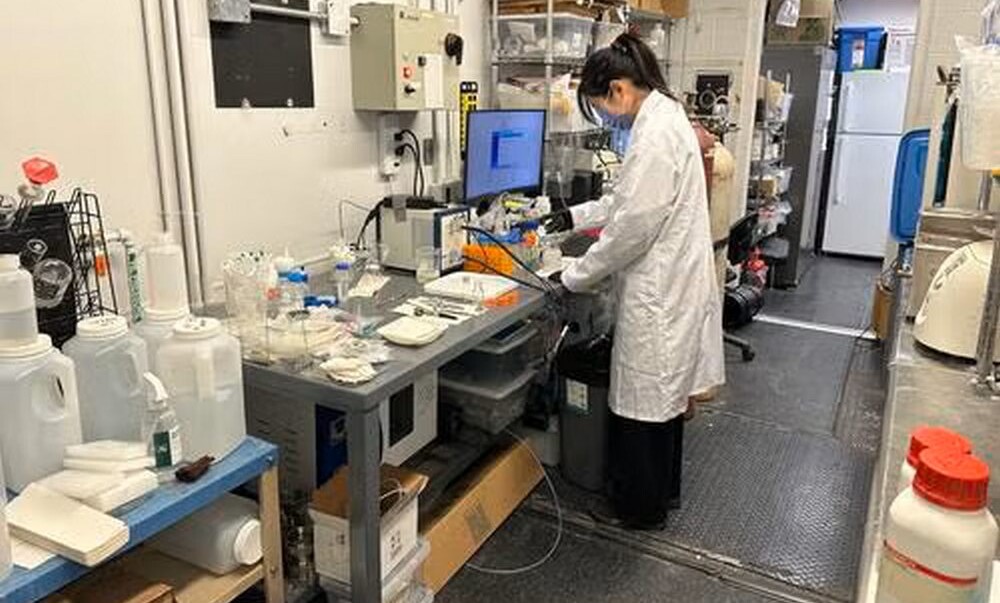
While experimenting with these materials, a student at Rice, Youngkun Chung, discovered that one formulation with nitrate could adsorb PFAS with record-breaking efficiency.
“To my astonishment, this LDH compound captured PFAS more than 1,000 times better than other materials,” said Chung, a lead author of the study.
“It also worked incredibly fast, removing large amounts of PFAS within minutes, about 100 times faster than commercial carbon filters.”
The material’s effectiveness stems from its unique internal structure.
Its organized copper-aluminum layers combined with slight charge imbalances create an ideal environment for PFAS molecules to bind—with both speed and strength.
Works equally well in river water, tap water and wastewater
To test the technology’s practicality, the team evaluated the LDH material in river water, tap water and wastewater. In all cases, it proved highly effective, performing well in both static and continuous-flow systems.
The results, recently published in the journal Advanced Materials, suggest strong potential for large-scale applications in municipal water treatment and industrial cleanup.
Closing the waste loop
Removing PFAS from water is only part of the challenge. Destroying them safely is equally important. The team at Rice developed a method to thermally decompose PFAS captured on the LDH material. By heating the saturated material with calcium carbonate, the team eliminated more than half of the trapped PFAS without releasing toxic by-products.
Remarkably, the process also regenerated the LDH, allowing it to be reused multiple times—refreshing itself for reuse.
“It’s a rare one-two punch against pollution,” wrote Science Daily, “fast cleanup and sustainable destruction.”
Preliminary studies showed the material could complete at least six full cycles of capture, destruction and renewal, making it the first known eco-friendly, sustainable system for PFAS removal.
“We are excited by the potential of this one-of-a-kind LDH-based technology to transform how PFAS-contaminated water sources are treated in the near future,” said Professor Wong said.
“It’s the result of an extraordinary international collaboration and the creativity of young researchers.”