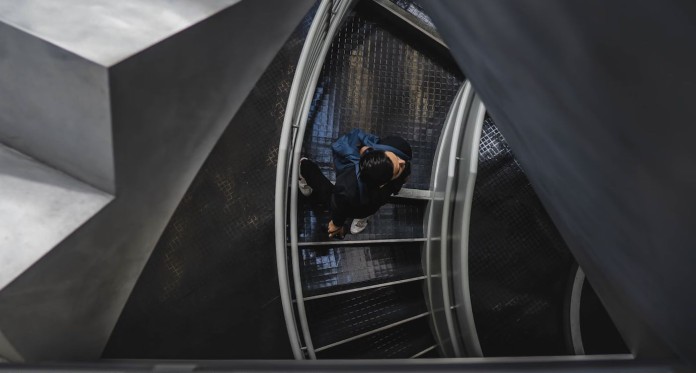
Quote of the Day: “Everything’s got a moral, if only you can find it.” – Lewis Carroll
Photo by: Brannon Naito
With a new inspirational quote every day, atop the perfect photo—collected and archived on our Quotes page—why not bookmark GNN.org for a daily uplift?
In a story that only those who live in the colonial cities of America’s east will understand, a surgeon ran about a mile to and from a hospital to pick up a liver for his patient after a courier’s route was blocked not only by Philadelphia’s strange grid system, but thousands of marathon runners.
66-year-old Charles Rowe was waiting on an operating table with his surgeon Adam Bodzin. He was slated for a liver transplant that day to save his life from complications due to hepatitis C.
Time ticked by until Rowe was surprised to hear that Bodzin was going out the door to get the liver himself.
Meanwhile, an out-of-town van driver for Philly-based Gift of Life Donor Program was having trouble negotiating the one-way streets, half-blocks, and diagonals of Philadelphia’s city center, when it became clear that his route to Thomas Jefferson University Hospital would be blocked by the Dietz & Watson Philadelphia Half Marathon at two separate points.
Event organizers and police have access points for emergencies going towards the hospital, but the courier couldn’t find them even after consulting police.
Clad in sneakers and teal scrubs, Bodzin weaved his way at a full run from the hospital entrance near 11th and Chestnut Streets, through the stream of runners on Lombard Street, then another block to South Street.
Reaching the driver and taking the sealed container with the liver on ice, he zigzagged back the same way, earning what must have been more than a few curious stares, before hitching a ride with the police back to the hospital on the other side of the marathon route.
Thanks to Bodzin’s quick thinking, they managed to transplant the liver successfully, an hour after the time when a liver begins to deteriorate. Rowe made a full recovery and left the hospital 6 days later.
Around the US and UK, dozens of animal hospitals have a catch-all when it comes to grieving pet parents who have lost a furry friend: they give them the poem Rainbow Bridge.
Yet this poem that has touched millions of peoples’ hearts has remained largely authorless for years until the sleuth work of an art historian and cat owner Paul Koudounaris, who managed to turn up the original poet decades after Rainbow Bridge became famous.
Her name is Edna Clyne-Rekhy, an 82-year-old Scottish artist and animal lover who traveled the world, and failed to notice her poem’s popularity.
The story begins with Koudounaris’ work researching pet cemeteries, and the constant references he found to Rainbow Bridge. Looking back over the use cases of what he determined to be the single most important text in animal mourning, Koudounaris pinned it to a 1994 appearance on the advice column Dear Abby, the most syndicated column in American history.
A reader told Abby Van Buren that she had received a copy of Rainbow Bridge from her local Humaine Society chapter in Grand Rapids Michigan. From that debut to her 100 million readers, Rainbow Bridge began appearing on everything to do with the loss of a pet—Hallmark cards, veterinary clinics, etc.
Koudounaris worked out that of the 15 separate authorship filings at the United States Copyright Office, none of them was the legitimate poet. Eventually expanding the list to 25 names in connection to the poem, he determined one, Edna Clyne-Rekny, was the most promising.
This January, Clyne-Rekhy received a strange phone call asking if she were the author of Rainbow Bridge, to which she answered “How on Earth did you find me?”
In 1957, when she was 19 years old, Clyne-Rekhy was grieving the loss of Major, her Labrador retriever, who “died in my arms,” she told Nat Geo. Her mother told her to write down how she was feeling.
“It just came through my head, it was like I was talking to my dog—I was talking to Major,” she says. “I just felt all of this and I had to write it.”
When Koudounaris met her, he found she still had the original handwritten text of the poem. She explained that she had given out handmade copies without her name on them to several of her friends over the years who had lost pets, before moving to live in India, and Spain, all the while the poem’s popularity blossomed across the US and UK.
“Can you imagine?” she says. “Every vet in Britain has it!”
The original text goes like this:
Just this side of heaven is a place called Rainbow Bridge. When an animal dies that has been especially close to someone here, your pet goes to Rainbow Bridge. There are meadows and hills for all of our special friends so they can run and play together. There is plenty of food, water, and sunshine, and friends are warm and comfortable. All the animals who have been ill and old are restored to health and strength, those who were hurt are made better and strong again, like we remember them before they go to heaven. They are happy and content except for one small thing—they each miss someone very special to them who had to be left behind. They all run and play together, but the day comes when one suddenly stops and looks into the distance. His bright eyes are shining, his body shakes. Suddenly he begins to run from the herd, rushing over the grass, his legs carrying him faster and faster, and when you and your special friend finally meet, you cuddle in a happy hug never to be apart again. You and your pet are in tears. Your hands again cuddle his head and you look again into his trusting eyes, so long gone from life, but never absent from your heart, and then you cross the Rainbow Bridge together.
SHARE This Amazing Story Of Internet Sleuthing And Pet Love On Social…
Showing that scientific work so often disproves intuitive rationalization, a recent study found that video games are not damaging children’s brains, but also that games aimed at helping children build healthy brain skills don’t actually work either.
Researchers from the University of Houston claimed that despite parents’ widespread fear, even spending 4.5 hours on a console like the Playstation or Xbox doesn’t impact kids’ brain functions.
The experts warned time spent gaming could take kids away from homework, but even that made very little impact on their brain skills versus their peers.
Professor Jie Zhang, working on curriculum and instruction at the University of Houston’s College of Education, said the study revealed no links between what video games were played, how long they were played for, and how well children performed on cognitive tests.
“Our studies turned up no such links, regardless of how long the children played and what types of games they chose,” said Dr. Zhang. “The study results show parents probably don’t have to worry so much about cognitive setbacks among video game-loving children, up to fifth grade.”
“Reasonable amounts of video gaming should be okay, which will be delightful news for the kids. Just keep an eye out for obsessive behavior. At least now we understand that finding balance in childhood development is the key, and there’s no need for us to over-worry about video gaming.”
The study published in the Journal of Media Psychology examined the gaming habits of 160 diverse urban public-school preteen students, 70% of whom were from lower-income households.
Until now the age group has been understudied.
Participating students reported playing video games an average of 2.5 hours a day, with the heaviest games racking up 4.5 hours.
Researchers looked for a link between gaming and how they performed on standardized Cognitive Ability Test 7 (CogAT), similar to the Canadian CCAT, both of which evaluate verbal, quantitative, and non-verbal or spatial skills.
Neither play duration nor the choice of video game affected the scores, while a slight deficit was found among children who played games instead of doing homework.
Screen time, however, and video gaming are not equal in their ambivalent effects on cognitive ability. Over 9,000 boys and girls in the USA participated in a study GNN reported on last year.
The study found that children who spent an above-average time playing video games increased their intelligence more than the average, while TV watching or social media had neither a positive nor a negative effect.
“We didn’t examine the effects of screen behavior on physical activity, sleep, well-being or school performance, so we can’t say anything about that,” says Torkel Klingberg, professor of cognitive neuroscience at the Department of Neuroscience, Karolinska Institute, who conducted the study.
“But our results support the claim that screen time generally doesn’t impair children’s cognitive abilities, and that playing video games can actually help boost intelligence. This is consistent with several experimental studies of video-game playing.”
SHARE This Research With A Mom You Know Afraid Of Video Gaming…
A minor meteor shower and a few conjunctions offer some great beginner stargazing events this March, but the really exciting opportunity in the heavens is a chance to see all 110 Messier objects, but more on that later.
Tonight, Wednesday the 1st, and tomorrow, there will be the best conjunction of Venus and Jupiter since 2020. At twilight, step outside and look to the southwestern sky. With binoculars or a telescope there’ll be a better view, but the naked eye will do fine.
One will see what appears to be Venus and Jupiter standing a comet’s throw from each other; a great way to introduce kids or friends to stargazing. In reality, the planets are millions of miles from each other, and just appear to be close from our perspective on Earth.
The full moon of March will occur on the 7th and be largest at 7:42 AM US Eastern Time. It’s called the Worm Moon because of earthworms coming out of the thawing soil.
According to Old Farmer’s Almanac, which keeps records of the indigenous names for the moons, the Northern Ojibwe called this Crow Comes Back Moon, and the term Goose Moon was used among Algonquin and Cree peoples.
Further north, Snow Crust Moon was an Anishinaabe term, while to the south, Sore Eyes Moon is a Dakota, Lakota, and Assiniboine term referring to the blinding rays of the sun on snow. Additionally, Sugar Moon (Ojibwe) is the time when maple sap runs, and Wind Strong Moon (Pueblo) refers to the strong windy days that come at this time of year.
Valerie from Space Tourism Guide details that on March 15th the y-Normid meteor shower will pass by at a rate of 6 meteors per hour.
On March 18th, a very unique opportunity arrives for advancing one’s stargazing habit from amateur to expert—the Messier Marathon.
The French astronomer Charles Messier become famous for his Catalogue of Nebulae and Star Clusters. This is principally because Messier was only interested in finding comets, and while he was looking for them he created a list of non-comet objects that interrupted his hunt.
“The “best” night for the Messier Marathon each year typically happens at the new moon between March and early April, due to the Earth’s planetary position in our annual orbit,” Valerie says in her March stargazing guide. “In 2023, there are actually two opportunities, the weekends on either side of the New Moon on the 21st.”
She has made an excellent guide for how to prepare and complete a Messier Marathon.
On March 28th, the Moon and Mars will appear in conjunction in the early morning sky, and offer another great opportunity to introduce kids to seeing the planets when they’re brightest. The moon will be at quarter size which makes seeing Mars much easier.
SHARE This Fun Stargazing Guide With Your Friends…
Quote of the Day: “You should never plan the future by the past.” – Edmund Burke
Photo by: Mojtaba Mohtashami
With a new inspirational quote every day, atop the perfect photo—collected and archived on our Quotes page—why not bookmark GNN.org for a daily uplift?
A 19-month-old girl has become the first person to be cured of a rare and deadly condition, using a new therapy that inserts functional versions of a faulty gene into the patient’s bone marrow.
Teddi Shaw is now predicted to live a long, normal, healthy life thanks to this “cure” for metachromatic leukodystrophy (MLD).
“Teddi is doing absolutely brilliant,” her mother Ally told the Guardian. “She is walking, running, a chatterbox—absolutely no signs so far of MLD. She is an absolute character and has everyone around her laughing all the time.”
The cure happens to be the most expensive drug in the world. Called Libmeldy, it corrects the copies of faulty genes which cause MLD after a patient’s stem cells are removed. The cells are then treated with Libmeldy, and they are replaced in the patient’s bone marrow.
“This is a huge moment of hope for parents and their babies born with this devastating inherited disorder, that can now be treated with a single round of revolutionary treatment,” chief executive of NHS England, Amanda Pritchard said.
Previous data on Libmeldy has shown as far as 8 years post-treatment, it’s corrected the underlying genetic problems entirely.
The drug costs over $3 million, but the NHS came to an agreement with Orchard Therapeutics to substantially mark it down on Teddi’s behalf.
Orchard CEO Bobby Gaspar has said the price represents the costs that were required to develop, test, and get the drug approved when considering there might only be 7-8 diagnoses in England in a year. It’s also a fair bit less than the 10-year cost of the standard of care for MLD patients, who gradually lose motor function and control of the senses.
Rates of MLD vary between North American and European populations, and could potentially be between 1 in 40,000 live births to 1 in 150,000.
MLD is part of a family of illnesses called Lysosomal storage diseases. Similar therapies to Libmeldy are thought to be potential treatments for many LSDs, including Krabbe disease, X-linked adrenoleukodystrophy, Canavan disease, Zellweger disease, and others, all of which are rare, rarely screened for at birth, typically only affect infants, and are fatal over 5-10 years.
In a moment that will bring tears to your eyes and send your jaw to the floor, a packed Istanbul soccer stadium rained teddy bears down onto the field in donation and support for the children affected by the earthquakes.
At exactly the 17th second of the 4th minute of the match, which corresponded to the time of the first earthquake, Beşiktaş JK supporters threw stuffed animals, scarves, and other toys onto the pitch, all of which will be delivered to the children living in the earthquake-hit areas with Beşiktaş club aid trucks.
credit Beşiktaş JK
Often soccer fans will celebrate or memorialize world events, tragedies, or celebrations when a particular minute arrives on the clock which corresponds to it. Some of the stuffed animals had cards or notes attached to the outside.
credit Beşiktaş
The event was organized before the Turkish Super League football match between Beşiktaş and Antalyaspor, and was called “This Toy is my Friend” though other translations have been used, “This Toy is for You,” for example.
Eastern Barred Bandicoot (Perameles gunnii) CC 3.0. JJ Harrison
Eastern Barred Bandicoot (Perameles gunnii) CC 3.0. JJ Harrison
A large research project studying endangered species in Australia has tallied 29 recovered species—all animals that can be safely de-listed from the country’s endangered species list.
Australia’s Protection and Biodiversity Conservation (EPBC) Act currently lists 446 species of animals in genuine need of protection, but 29 of those are no longer in need—15 mammals, 8 birds, 4 frogs, a reptile, and a fish.
Among these critters are the golden, Western barred, and Eastern barred bandicoots, Western quoll, sooty albatross, waterfall frog, Flinder’s Range worm-lizard, yellow-footed rock wallabies, greater bilby, humpback whale, growling grass frog, Murray’s cod, and others.
Australia has been a focus of endangered species conservation for decades because so many of the animal varieties are found nowhere else.
Invasive predators introduced and living here for decades, including foxes and cane toads, have proven highly disruptive to local wildlife like bandicoots and bilbies.
Unlike America’s ESL, the EPBC doesn’t mandate that species be reviewed regularly for recovery. These large scientific papers are rare and represent moments to celebrate for Australia’s conservationists.
The waterfall frog (Litoria nannotis) CC 2.0. Sztaka
The paper, published in Science was conducted by a variety of Australian academic institutions and concluded that conservation managers should aim to measure success at least in part through documentation of recoveries based on stability, ranges, and populations of the current day, even though this represents a smaller fraction of what these were before Australia was colonized.
This they argue will help coordinate conservation efforts and funding for the animals whose populations are decreasing, and address threats that are a danger to multiple animal species at once.
SHARE These Conservation Gains Down Under With Your Friends Worried About Extinctions…
For a limited time only, a Parison opera house box seat typically reserved for visiting dignitaries is being transformed into an Airbnb and priced for the ridiculously reasonable €37 per night.
The Palais Garnier opera house captures all the stunning opulence of La Belle Epoch, and was used as the inspiration for Phantom of the Opera. Opening tomorrow at midday for reservations on July 16th, the Box d’Honeur, or Box of Honor, has been transformed into a lavish suite.
The stunt is part of Airbnb’s partnership with European cities to give a boost to its heritage tourism sectors that have fallen behind over the last few years. Along with renting out the boxes, the Parisian National Operawants to develop a streaming platform.
The Palais Garnier: Credit Thibaut Capotot Airbnb – released
Along with the 1-night stay in the Box of Honor, the ticket includes a tour of hidden areas in the Palais, rarely seen by the public, including the Opera’s incredible private archives and famous underground lake featured in the Phantom of the Opera penny novel.
It also includes a private ballet initiation with one of the Opera de Paris Ballet dancers, an exclusive recital performed by the artists of the Paris Opera Academy, complete with champagne and hors d’oeuvres, dinner in the lavish Foyer de la Danse, a private and historic dancing rehearsal room behind the stage, used by dancers for warming up before a show, and a rooftop tour of the iconic Opera building where guests will enjoy a picturesque moment with one of the best views of Paris.
The Airbnb host is listed as Véronique Leroux, the great-granddaughter of Gaston Leroux, who wrote the Phantom of the Opera penny novel first as a series of installments in the newspaper, based on stories and legends he had heard about the Palais Garnier.
“My great-grandfather’s classic story has inspired so many people through the years,” says Véronique Leroux in a statement from Airbnb. “This is the perfect time to honor him and welcome ‘phans’ to the famous setting of his much-loved novel for a once-in-a-lifetime stay.”
SHARE This Once-In-A-Lifetime Opportunity With Your Friends…
Quote of the Day: “I believe that every human mind feels pleasure in doing good to another.” – Thomas Jefferson
Photo by: Andreea Pop
With a new inspirational quote every day, atop the perfect photo—collected and archived on our Quotes page—why not bookmark GNN.org for a daily uplift?
It seems like a new Silicon Valley startup could change the face of the battery industry forever by utilizing 3D printers to print solid-state batteries.
Solid-state batteries have advantages over lithium-ion because they aren’t flammable, they’re more easily recycled, work in extreme cold, and have greater energy density.
Solid-state batteries have traditionally been difficult to machine manufacture. But by using 3D printing arrays filled with powder, Sakuu systems can make these batteries not only using 40% less material, but in almost any shape the customer might want.
An electric bike could be powered by a battery that hugs a section of the central chassis, or a smartphone’s battery could run all the way around the frame of a circuit board. These unorthodox shapes are just one of the many advantages that Sakuu believe they can offer.
“Many people have built cells in the lab, but they have not been able to scale,” Sakuu CEO and founder Robert Bagheri told Fast Company. “Our vision started with that scalability in mind.”
The array, known as a Kavian, is much smaller than the traditional, “roll to roll” battery manufacturing methods, and because the powder loaded into the 3D printers can be extremely precise, there’s a 40% reduction in materials usage—a huge cost savings over competitors.
The batteries they print can be charged to 80% in just 15 minutes.
Because they can be printed in any shape, all kinds of clever innovations are possible, in all kinds of industries from e-mobility products to wearables and small devices. The company is even working with an aviation company that wants solid-state batteries for their aircraft with holes through the middle of it to help with heat management.
Sakuu plans to sell micro-factories composed of all their technologies in sections of 400 square feet, which can be used to make 100 megawatt hours of batteries in a year. Older equipment takes up 16,000 square feet and can only produce 2.5 megawatt hours per year.
SHARE This Battery Revolution With Your Friends On Social Media…
Madison, Wisconsin capitol by Ryan Wick, CC license; and plow from City of Madison
Madison, Wisconsin capitol by Ryan Wick, CC license; and plow from City of Madison
As part of GNN’s continuing coverage of city snowplow naming competitions, the results of Madison Wisconsin’s contest are in, and they are just hail-arious.
The city’s chief salting truck will be named “Saltimus Prime” after receiving a total of 1,630 votes.
A smaller, agile, bike path-plower will be named “Snowbi Wan Kenobi” after receiving 1,910 votes.
“Seymour Pavement,” is to be the name of the city’s loader/plow, while the Dual Wing Plow Truck will be dubbed “Dolly Plowton.”
It’s a joy and a shame, as some of the other entries were genius. For Game of Thrones fans, it was a pity that the salt truck didn’t receive enough votes for “Brine of Tarth.” Honorable mentions should certainly be given out for “KeaNo Freeze,” “Albert Brinestein,” and to the chemistry students who came up with “Snowdium Clearride.”
In 2021, GNN reported of a similar contest in Scotland, which included winners like, “You’re a Blizzard Harry,” Brinestone Ploughboy, Spreddie Van Halen, Mary Queen of Salt, and On Her Majesty’s Slippery Surface.
Minnesota’s DoT 2022 contest came up with some real zingers, the best of which most certainly must be “Clearopathra,” but “Scoop! There It Is,” ain’t bad either.
SHARE This Bit Of Winter Rime With Your Friends In Need Of A Laugh…
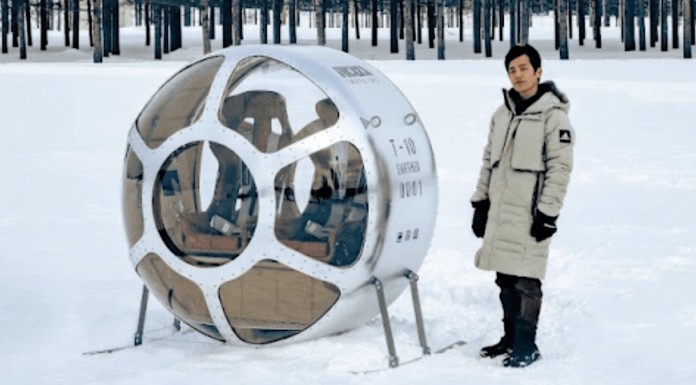
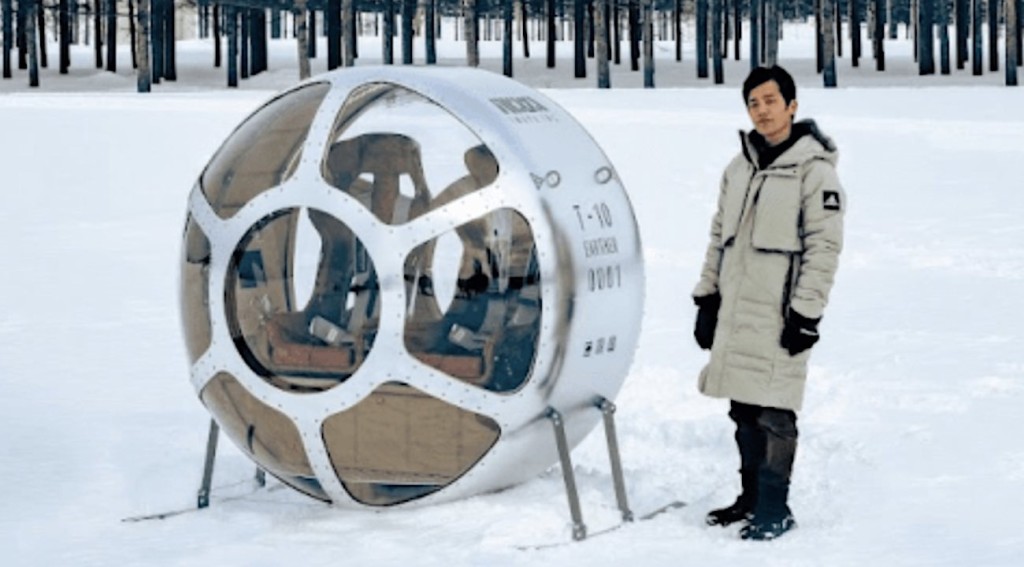
CEO Keisuke Iwaya next to his balloon capsule on the snowy ground of his home island of Hokkaido - Credit: Iwaya Giken
CEO Keisuke Iwaya next to his balloon capsule on the snowy ground of his home island of Hokkaido – Credit: Iwaya Giken
A Japanese aerospace startup is hoping to make space tourism even more accessible with a balloon capsule that hovers up 14 miles above the Earth.
With an unobstructed view of space above, and the curvature of the Earth clearly visible below, the capsule is designed to rival existing space tourism flights that cost millions per ticket by reducing the complexity of the flight, and removing the need for special astronaut training.
Developed by the Sapporo-based Iwaya Giken, the helium-powered balloon is slated for an October launch this year, with tickets available in August at around $175,000. Iawya’s CEO Keisuke Iwaya hopes to bring that cost down to a five-figure, and eventually a four-figure sum as quickly as next year.
Last June, the company successfully launched their balloon up to about 90% total altitude with a hamster on board.
During a two-hour ascent, the capsule, which looks an awful lot like the cockpit of the Millenium Falcon, rises 14 miles above Earth to the stratosphere, higher than jet planes fly, and above the point where space goes from a blue curtain to a twinkling black abyss. After it reaches its target altitude, it remains for 1 hour, before descending over the course of another hour.
“It’s safe, economical, and gentle for people,” CEO Iwaya told reporters. “The idea is to make space tourism for everyone.”
“I hope that balloon space travel will eventually be possible at a price in the ¥1 million ($7,500 USD) range.”
Existing space tourism ventures such as flights by Virgin Galactic, Blue Origin, and SpaceX, cost millions per ticket and require a rocket launch and all the related approval and oversight by NASA or ESA.
Government funding for these space agencies is extremely limited, and tourism has never been even a second-order priority behind robotic exploration and science. This has left the field largely to the new, private commercial space sector.
In contrast to SpaceX’s recent visit to the International Space Station with two guests who each paid $55 million per ticket, and whose launch required months of calculation, preparation, and millions of dollars in resources, Iwaya’s balloon flight can be prepared and launched in about an hour and a half.
“In recent years, there has been an active trend in Japan to fund dreams of space travel, and we are grateful for that,” CEO Iwaya told reporters, according to Japan Forward. “We want to move forward steadily while showing the results of our development.”
Iwaya is currently taking applications for its first flights.
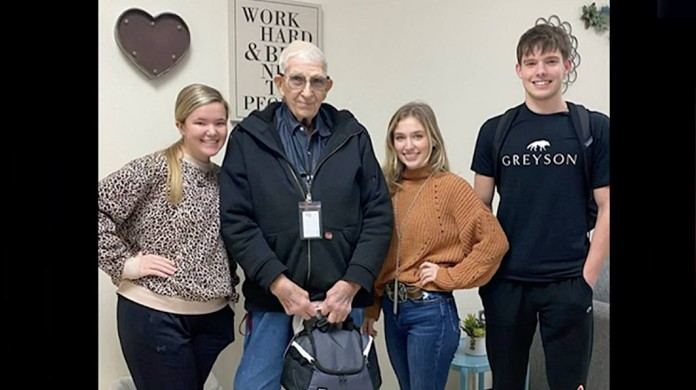
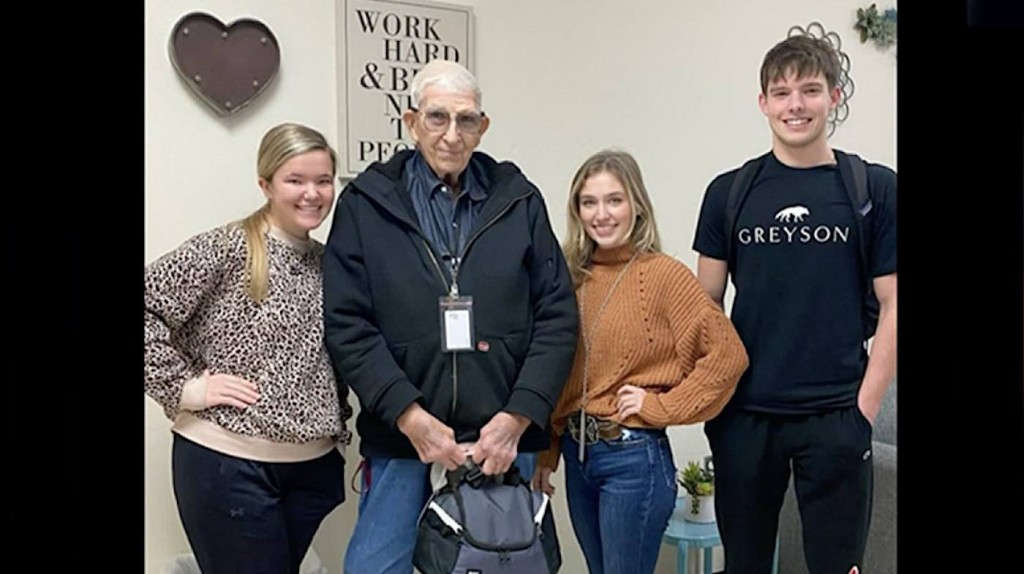
Mr. James and student angels - Greyson Thurman, GoFundMe
Mr. James and student angels – Greyson Thurman, GoFundMe
High school seniors managed to secure a quarter-million dollars for their sweet, 80-year-old janitor who had to come out of retirement after his rent went up.
The money was raised through a GoFundMe, which started out as a simple goal of $10,000, but quickly took on a goal of its own.
Several seniors at Callisburg high school in Texas noticed their school had a new janitor: “Mr. James” an 80-year-old former retiree whose rent had gone up $400 and needed a job to support it.
Believing they could use their whippersnapper knowledge of the internet and social media to help out, they got the idea to open a GoFundMe to help 80-year-old Mr. James get back to doing 80-year-old things.
“It’s crazy to see something that, we knew people would have wanted to help,” said senior Marti Yousko, “But we didn’t know it would blow up.”
A single TikTok video was posted by senior Greyson Thurman showing Mr. James cleaning the halls, along with a GoFundMe aiming to help James continue to live comfortably.
“I have 2,000 followers and that was enough to get the word out,” said Thurman.
Raising $10,000 in 12 hours, most of the donations came from students.
“It’s just amazing,” said Principal Jason Hooper, ”You know of the need that was met because of three kind kids, but of all of our students who have pitched in to help that need.”
Local news reported on the fund drive in mid-February when there was still a 5-digit sum on the table, but it had to be turned off after passing $270,000 in order to get Mr. James the money as soon as possible.
Donations came from all over the country and even beyond, wishing the short-term janitor a happy retirement, and congratulating the students for their brilliant idea.
WATCH the story below from local news…
SHARE This Powerful Example Of Student Organization With Your Friends…
Quote of the Day: “A cloudy day is no match for a sunny disposition.” – William Arthur Ward
Photo by: NOAA
With a new inspirational quote every day, atop the perfect photo—collected and archived on our Quotes page—why not bookmark GNN.org for a daily uplift?
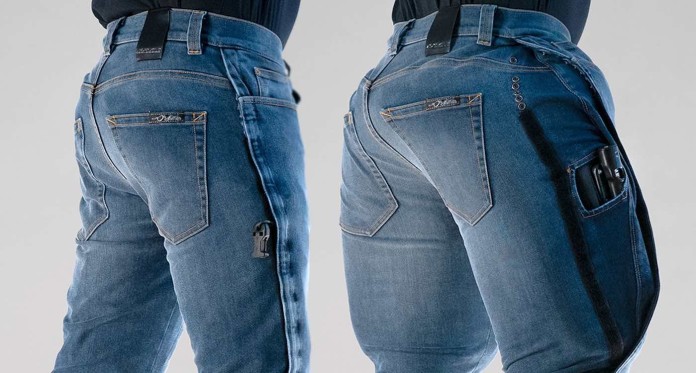
Motorcyclists can soon be safer thanks to a company that produced the world’s first airbag suit.
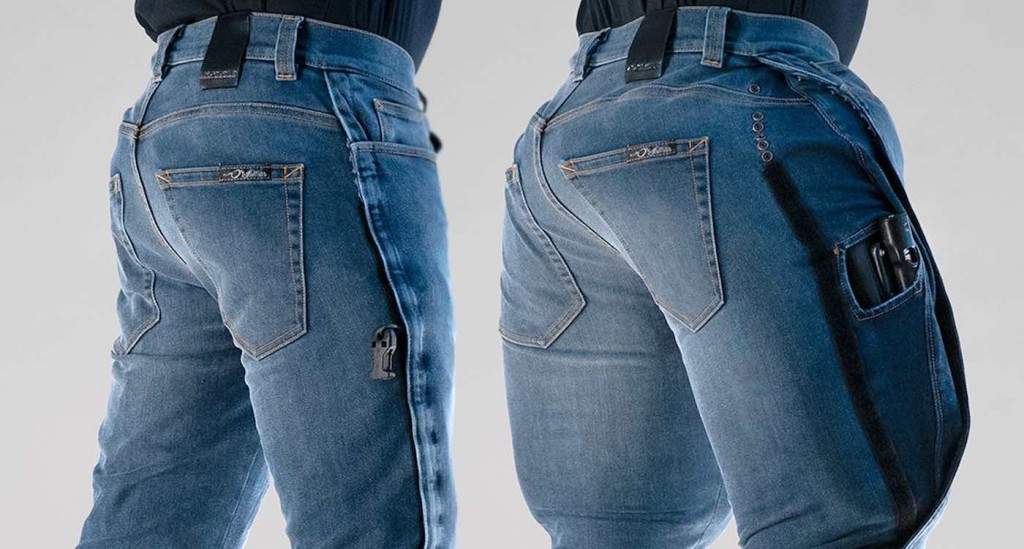
The garment is made from the strongest denim on the planet. Even more unique are the airbags that activate via small CO2 cartridges whenever the rider falls from their bike.
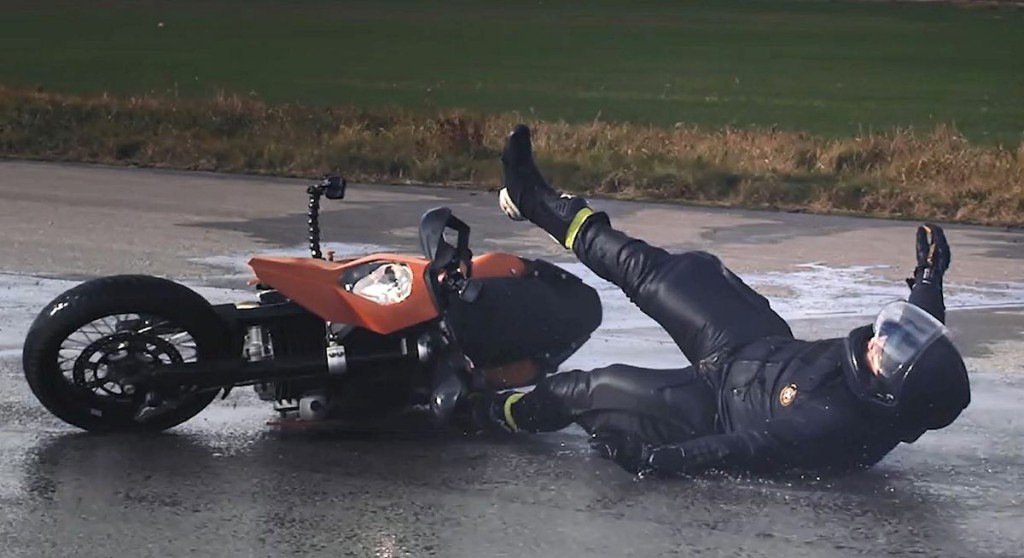
The trigger mechanism is a tether connecting the jeans to the motorcycle. When the equivalent of a road accident occurs, the tether creates a puncture in the cartridges that inflates the airbags.
If the rider is thrown from the bike, a protective air cushion is instantly deployed. Afterward, the CO2 cartridges are replaceable.
While the airbag handles the impact forces, the single-layer denim fabric called ‘Armalith’ handles the abrasion forces, according to officials from the Swedish company Airbag Inside.
They claim they have tested the Mo’cycle brand jeans at speeds of up to 45mph (70kph), with only minimal abrasion to the fabric.
“The airbag covers new areas on the lower body—areas previously unprotected from impact hits, such as the thighs, the rear part of the body, and especially the tailbone.
“To protect the spinal column’s first bone with airbag technology is ground-breaking because spinal column injuries are the ones paralyzing motorcycle riders,” according to the company’s crowdfunding campaign.”
Mo’cycle airbag clothing – SWNS
“The Airbag Jeans reduce the risk of injuries, are as comfortable as any other pants, and are 100% reusable.”
The online sale taking place on the crowdfunding platform indiegogo.com allows everyday motorcycle riders or retailers to order the product now for $528 (€499).
Moses Shahrivar has been developing protective biker clothing for years and is the founder of the fashion tech startup Mo’cycle.
The first prototype designed by Shahrivar in 2005 was a Kevlar and leather-lined jean, but these airbag jeans are breathable, and come in relaxed or regular fit.
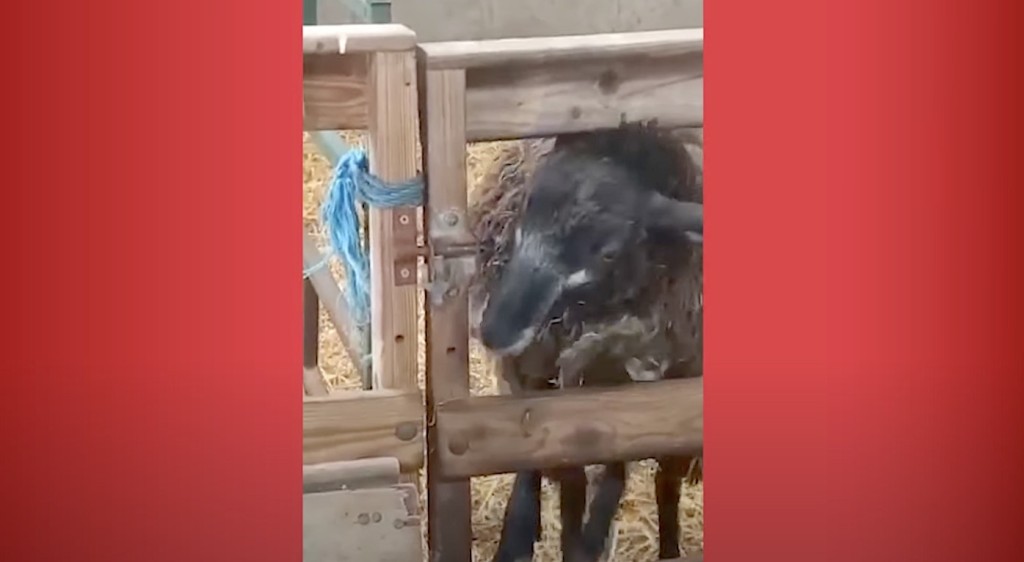
A farm staff was stunned after it learned that one clever sheep had been unlocking a gate to let herself and her pals roam free.
The Whitehouse Farm Centre in Morpeth, England, had no suspects for the rash of break-outs in their barn.
They were left baffled when Lucy the one-year-old Leicester sheep and her two fellow ewes repeatedly escaped.
To solve the mystery, they installed a hidden camera—and got a huge surprise
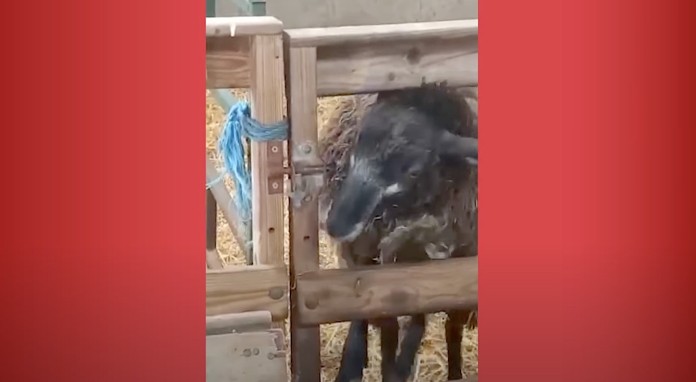
Footage of the gate revealed that Lucy was pulling the wool over everyone’s eyes.
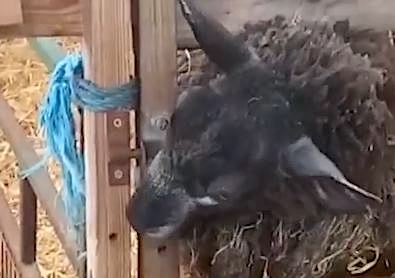
In the video below, she put her head through the wooden fence and then slid the bolt open by using her mouth.
The dextrous black and white sheep then pulls the gate inwards to open it and in a matter of seconds, Lucy and her companions are freed to explore the farm.
Whitehouse Farm Centre / SWNS
The animal even appears to look both ways, checking left and right for oncoming staff, before unlocking the pen and escaping.
Whitehouse Farm posted the video on their Facebook page, which went viral with tens of thousands of views and shares—and comments from viewers who were amazed at how intelligent Lucy’s escape plan was.
“The craziest part was that she knew she needed to open the gate inward,” said one user.
“And they say sheep are stupid,” joked another. “You have definitely shown them.”
In the post, Whitehouse Farm wrote, “OMG, a mystery has been solved today at Whitehouse farm.”
A 28-year-old who helps the elderly to re-home their pets before passing away has celebrated her 100th adoption.
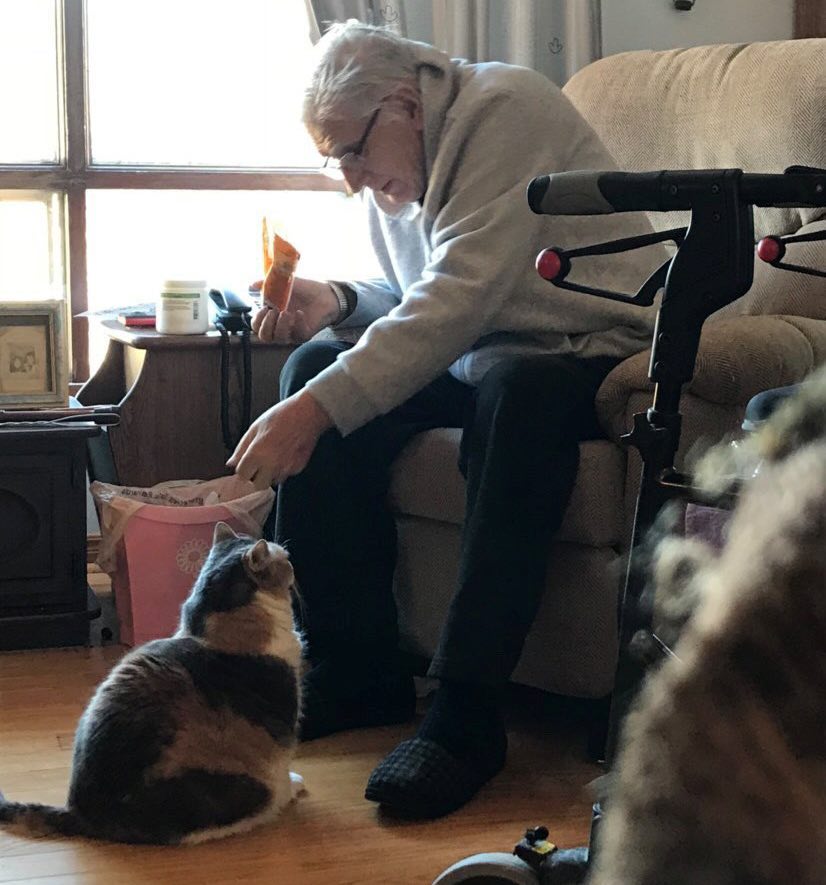
Angela Rafuse was inspired to create her charity after her 85-year-old grandfather died, leaving his cat, Mackenzie, without a home.
None of Angela’s relatives had capacity to take on the responsibility, so she decided to take in the calico cat herself.
After a bad break up, Angela moved home to live with her parents in Halifax, Nova Scotia, and began sharing the basement with the feline.
“I was processing the grief and heartbreak of a breakup and losing my grandfather, but the only options left were taking her to a shelter or me adopting her. I had to take her.”
Although Mackenzie became very grumpy and hissed a lot, Angela soon realized the cat was just scared. It eventually warmed to her new owner after lots of love and attention, inspiring the Canadian woman to start a new venture in 2021.
Angela’s nonprofit, ‘My Grandfather’s Cat’, facilitates adoptions of dogs and cats belonging to seniors who are either terminally ill or wishing to enter a retirement home.
While Angela and the tabby lived in her parent’s basement for 18 months, she started posting videos on TikTok. Soon the duo grew a following of 656,000 people—and many commented about how their grandparent’s pets had to go into shelters after they passed.
“It was like a divine intervention. I knew this is what I should do.”
“We had 30k followers at that point and I thought ‘I can launch it on TikTok, as there were so many people in need’.”
Angela’s launch date was May 18, on her late grandfather’s birthday—and since then it has brought peace of mind to 100 pet owners.
“It gives me so much purpose in life—and I have an amazing team of volunteers.”
Most seniors are referred to My Grandfather’s Cat by care homes or shelters. They submit an application and the team then writes a profile to post on social media.
They then interview people who might be interested, and find out who is a good fit—and the senior has the opportunity to interview the family, too.
“The senior then picks their pet’s second forever home—and the adoptees can stay in touch with the new owner who will share updates.”
One case Angela will never forget is when she helped a woman who had terminal cancer and underwent euthanasia.
“We helped her find a new home for her cats, Koko and Lily, and she chose a lovely multi-generational home with two seniors, their daughter, and grandson.
“She passed away knowing her best friends had the best home.”
It was the last and most important thing on her to-do list.
SPREAD the Great Idea to Fur-Loving Friends on Social Media…
If you are young or old, you can improve your overall health—and probably add years to your life—when you cultivate a full array of good sleep habits.
The new research is being presented at the American College of Cardiology’s Annual Scientific Session next month.
The study found that young people who have more beneficial sleep habits are incrementally less likely to die early.
Moreover, the data suggest that about 8% of deaths from any cause could be attributed to poor sleep patterns.
Life expectancy was 4.7 years greater for men—and 2.4 years greater for women—who reported having all these five quality sleep measures, compared with those who had none or just one of the five favorable elements of low-risk sleep.
“If people have all these ideal sleep behaviors, they are more likely to live longer,” said study co-author Frank Qian, MD at Beth Israel Deaconess Medical Center.
The five key habits are:
seven or eight hours of sleep per night
difficulty falling asleep no more than twice a week
trouble staying asleep no more than twice a week
not using any sleep medication
feeling well rested when waking up at least five days a week.
“I think these findings emphasize that just getting enough hours of sleep isn’t sufficient,” said Dr Qian, a clinical fellow in medicine at Harvard Medical School. “You really have to have restful sleep and not have much trouble falling and staying asleep.”
One limitation of the study is that no information was available about the types of sleep aid or medicine used or how often or long participants used them.
The researchers looked at figures from more than 172,300 American adults, with an average age of 50, who participated in an annual health survey between 2013 and 2018.
Participants were asked questions about sleep habits and were followed for an average of 4.3 years during which time more than 8,600 died. Of the deaths, 30 percent were from cardiovascular disease, 24 percent were from cancer and 46 percent were due to other causes.
Previous studies have shown that getting too little sleep can negatively affect the heart.
Researchers assessed the five different factors of quality sleep using a low-risk sleep score they created based on answers collected as part of the survey. Each factor was assigned zero or one point for each, for a maximum of five points, which indicated the highest quality sleep.
Qian said this is the first study to his knowledge to use a nationally representative population to look at how several sleep behaviors, and not just sleep duration, might influence life expectancy. About two-thirds of study participants self-reported as being White, 14.5% Hispanic, 12.6% Black and 5.5% Asian.
The research team found that, compared to people who had zero to one favorable sleep factors, those who had all five were 30 percent less likely to die for any reason, 21 percent less likely to die from cardiovascular disease, 19 percent less likely to die from cancer, and 40 percent less likely to die of causes other than heart disease or cancer.
He says more research is needed to determine why men with all five low-risk sleep factors had double the increase in life expectancy compared with women who had the same quality sleep.
“Even from a young age, if people can develop these good sleep habits of getting enough sleep, making sure they are sleeping without too many distractions and have good sleep hygiene overall, it can greatly benefit their overall long-term health.”
He explained that for the present analysis the team estimated gains in life expectancy starting at age 30, but the model can be used to predict gains at older ages too.
“It’s important for younger people to understand that a lot of health behaviors are cumulative over time,” Quon said in a press release, ahead of his presentation to the American College of Cardiology’s annual Scientific Session in New Orleans next month.
“Just like we like to say, ‘it’s never too late to exercise or stop smoking,’ it’s also never too early. And we should be talking about and assessing sleep more often.”
The researchers hope patients and physicians will start talking about sleep during doctor visits as part of their overall health assessment and disease management strategies.
DON’T SLEEP on Your Chance to Share These Tips With Loved Ones on Social Media…