Quote of the Day: “Pessimism dries up all the fountains of joy in the world.” – Helen Keller
Photo by: Alvaro Calvo
With a new inspirational quote every day, atop the perfect photo—collected and archived on our Quotes page—why not bookmark GNN.org for a daily uplift?
Originally written by Liz Kimbrough. Reprinted from Mongabay on a CC 4.0. License.
Up in Tanzania’s Ukaguru Mountains, researchers have found a new-to-science frog species with a unique trait: it doesn’t make a sound. The small, silent Ukaguru spiny-throated reed frog (Hyperolius ukaguruensis) doesn’t croak, chirp, sing, or ribbit.
“It’s a very odd group of frogs,” Lucinda Lawson, a conservation biologist and assistant professor at the University of Cincinnati, told the author at Mongabay. The new species, a member of the Hyperolius genus of African reed frogs, was described in the journal PLOS ONE.
Frogs typically use sounds to attract a mate, but the males of this species have tiny spines on their throats, which scientists think females might use to identify the males.
“The male frogs don’t call like most other frogs do. We think they may use the spine as something like Braille for species recognition,” Lawson said. “Without a call, they need some other way to recognize each other.”
Lawson and her team first encountered the frog in 2019 during their search for another species, the elusive Churamiti maridadi tree toad, in the Ukaguru Mountains. Despite at least seven previous surveys in the area, C. maridadi has only been spotted twice in the wild by scientists and is feared to be extinct. Although Lawson’s team didn’t find the tree toad, their expedition led them to the silent Ukaguru spiny-throated reed frog.
According to Lawson, describing a new member of this rare group of frogs, which consists of only a few species found in small populations, is a major victory for conservation efforts.
Photos of the new species: A) male B) female C) mating, and D) habitat. Images courtesy of Christoph Liedtke via Lawson et al. (2023).
“Time spent looking for the beautiful tree toad yielded unexpected results. It was a fantastic finding that made the effort well worth it,” study co-author H. Christoph Liedtke, a postdoctoral researcher with the Spanish National Research Council, said in a press release.
The Ukaguru Mountains in central Tanzania are sometimes referred to as sky islands. Around 30 million years ago, the entire region was covered by a vast rainforest. However, during a drier and cooler period about 10 million years ago, the lowland forests transformed into savannas, leaving the mountainous areas as “islands” of tropical forest.
The persistent humid climate and the seclusion of each peak in the range have led to a high degree of endemism: Nearly 25% of all vertebrate species that occur in the Ukaguru Mountains are found nowhere else on Earth.
“The Ukaguru Mountains are part of the greater Eastern Arc Rift, a fascinating cradle of biodiversity, with many species endemic to single mountain blocks,” Liedtke said. “The fast population growth in Tanzania means that the mountain forest habitats are under growing threats from people.”
Understanding how many of these frogs exist in the wild and where they live is an integral part of their conservation. And the researchers say finding this new-to-science frog highlights how much more there is to learn about this part of the world.
“We still have a long way to go before understanding what species are there and where they can be found,” said Simon Loader, curator of vertebrates at London’s Natural History Museum, who helped describe the new species. “This is particularly the case for the biodiverse-rich submontane forests of Tanzania.”
SHARE This Really Unusual Discovery With Your Friends…
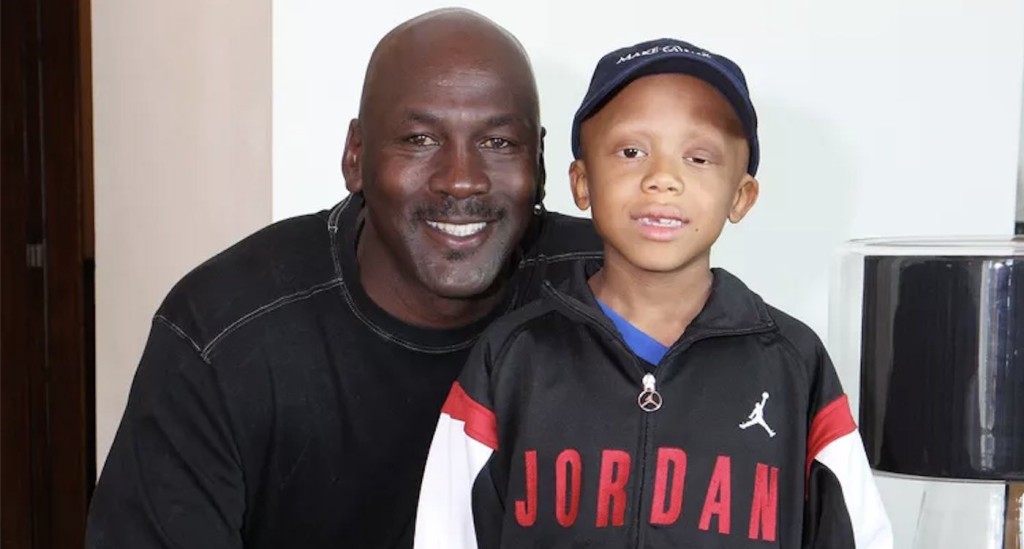
His Royal Airness himself celebrated his 60th birthday today with the largest donation to the Make-a-Wish Foundation in history.
The $10 million fortune will go to “create an endowment to provide the funds needed to make future wishes possible for kids with critical illnesses,” the foundation explained in a release.
Witnessing the strength and resilience of the organization’s kids has been a continuous inspiration, Jordan said, who has been a partner for 34 years.
Jordan noted that he “can’t think of a better birthday gift than seeing others join” him in supporting the foundation and that he hopes the donation will allow “every child” to “experience the magic of having their wish come true.”
The Chicago Bulls legend and greatest basketball player of all time has become increasingly generous with his fortune over the years. In 2021 he donated $10 million to Novant Health for the opening of two new children’s hospitals in his home state of North Carolina, the same company to which he gave $7 million 4 years before that.
President and CEO of Make-A-Wish America Leslie Motter applauded Jordan’s ability to create a legacy both on and off the court.
“Everyone knows about Michael’s legacy on the basketball court, but it’s what he has consistently done off the court when no one’s watching that makes him a true legend for wish families and the wider Make-A-Wish community,” Motter said in a statement.
“Michael using his birthday as a chance to make history for Make-A-Wish speaks to the quality of his character and his loyal dedication to making life better for children with critical illnesses. We hope that the public will be inspired to follow in his footsteps by helping make wishes come true.”
CELEBRATE Jordan’s Generous Birthday Gift On His 60th Anniversary Of Life…
It turns out that Saturn isn’t the only married planet in the solar system. A European telescope has found a new dwarf planet right here at home, and it too has a ring.
The largest object found to orbit our sun since Pluto was discovered in 1930, Quaoar is the third-largest dwarf planet or planetoid of the 3,000 that orbit the sun out beyond Neptune.
A collaboration between the European Space Agency’s ground-based telescopes and the space-based telescope Cheops, began observing Quaoar between 2018 and 2021, during which astronomers discovered it has a ring about 7 times the planet’s 690-mile diameter.
This was found via the common detecting method of occultation—which is the process of measuring the drop in light from a light source that comes when an orbiting exoplanet eclipses it. The astronomers looked at the data and determined that there was something more than just a planet blocking the light behind Quaoar.
“When we put everything together, we saw drops in brightness that were not caused by Quaoar, but that pointed to the presence of material in a circular orbit around it. The moment we saw that we said, ‘Okay, we are seeing a ring around Quaoar,’” stated Bruno Morgado, the leader of the research, who combined the Cheops data with that from large professional observatories around the world and amateur citizen scientists, all of whom had observed Quaoar occult various stars over the last few years.
Quaoar’s ring is awesome without a doubt, but it isn’t the only dwarf planet to be found that has one. The centaur 10199 Chariklo, orbiting between Saturn and Uranus, and Haumea, another dwarf planet beyond Neptune, both have rings.
But Quaoar’s is unique because it breaks a longstanding principle in astronomy that details when disks of dust and debris will inevitably coalesce and form a moon.
Any celestial object with an appreciable gravitational field will have a limit within which an approaching celestial object will be pulled to pieces. This is known as the Roche limit.
“So, what is so intriguing about this discovery around Quaoar is that the ring of material is much farther out than the Roche limit,” says Giovanni Bruno, at the Astrophysical Observatory of Catania, Italy, and member of the research group.
“As a result of our observations, the classical notion that dense rings survive only inside the Roche limit of a planetary body must be thoroughly revised.”
SHARE This Cool Discovery For Your Space Nerd Friends…
Selection of the family photos returned -Courtesy of Carolyn Wieden
Selection of the family photos returned -Courtesy of Carolyn Wieden
With persistence, belief, and the amount of sheer dumb luck normally needed to win the lottery, a Portland senior tracked down an Okinawan family based on the photos left behind in an album her late husband plucked from the shrapnel-strewn beaches of the Japanese Island in 1945.
Strangers, friends of friends, and non-English speakers all pitched in to help Carolyn Wieden fulfill her husband’s wartime dream, and the story, communicated from Carolyn herself to GNN, is one for the history books.
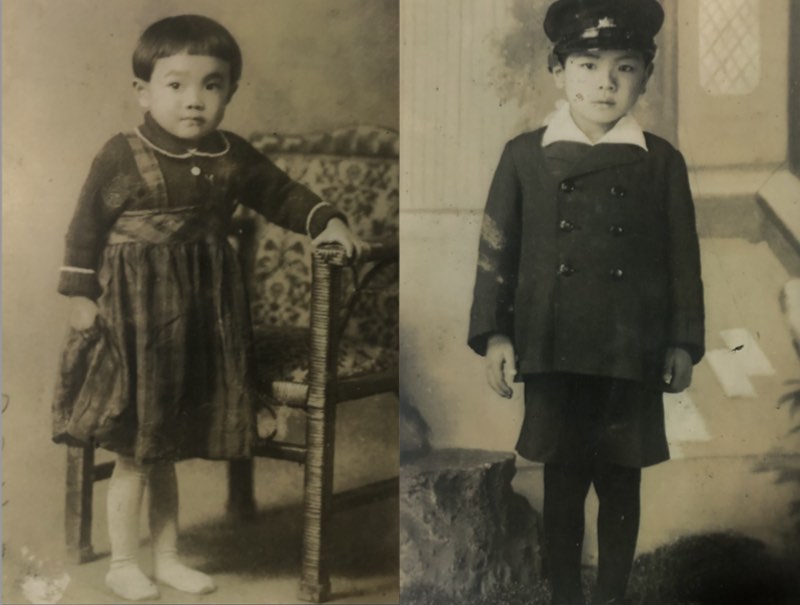
In 1945 the US Navy and Marines landed on the beaches of Okinawa, Japan in the closing stages of the war in the Pacific. Thereupon, Duke Wieden stormed the beaches as part of the third wave and found himself holding a black photo album filled with pictures of family, toddlers, and high schoolers.
It was a relic from a time before the senseless war consumed him and the family in the album, but Duke had enough humanity left to hope one day the album might be returned in a time when waves, and not soldiers, washed up on the Okinawa beaches.
Fast forward to Duke’s passing in 2012, he and Carolyn’s youngest son Ken found the album moldering in his Navy trunk in the family home in Portland, Oregon, which touched off a truly incredible search for its original owner.
“One thing nobody else has noticed about this entire process was the synchronicity involved,” said Carolyn Wieden, Duke’s second wife, and architect of the effort. “Most family members thought it was a lost cause, reminding me how long ago it had happened and how many people had been killed in the war in addition to those who had died of old age.”
“My youngest son and his Chinese friend, however, started the search with enthusiasm,” she told GNN. “Chinese and Japanese are close enough linguistically that she could translate a few things for me and she was also willing to make phone calls, most of which were never returned.”
Child photos spurred the American family’s urgency to return the photos – Wieden family
Among the damp, moldy pages, some leads—however distant—could be gleaned, including some strips of writing. But Carolyn didn’t know how to read Japanese in Okinawan dialect.
“My guitar teacher, Rene’ Berblinger, was our Clark Kent,” said Carolyn. “When I told him about my search, he immediately called his Japanese friends who translated every page of the photo album. While visiting my son in sunny California, I was working on the album outside (because of the mildew) and, for the first time, saw faded Japanese characters scribbled on the last of the black photo pages. Yes, it was a name and address—the first really important clue.”
That wasn’t the end of Berblinger’s contributions, as a truly bizarre coincidence saw the guitar teacher meet a former Marine officer named Erik Lundberg who used to teach English on Okinawa, where he lived with his family. They were visiting Portland, and hearing about Carolyn’s search, offered to be the “boots on the ground,” recruiting an Okinawan friend to break the language barrier completely.
The logos on these shirts were crucial to finding the family to return the photo album – Courtesy of Carolyn Wieden
“I made copies of some of the photographs for them and immediately they recognized a logo on the shirts of a youth group; how amazing was that?” said Carolyn. “Our two volunteer detectives lived in Chatan, the exact neighborhood where members of this youth group had lived, in the same town.”
Before being called Chatan, the town was Irei, but it had been wiped out during the war and replaced by ground for a US military base. Even still, there remained an Irei community association; it was their only lead.
“Back in Okinawa, our volunteers went to the town hall to ask about members of “the Irei Society” and found themselves standing in front of a man who was the elder of that group,” she continued. “He recognized a friend in the photos; he called this friend’s sister to come immediately and she not only recognized her brother but also saw herself in some of these photos.”
“When our two volunteers called to tell me this news, I couldn’t stop crying. Maybe that moment was really my favorite part of the story.”
The photo album belonged to the Sunabe family, who were informed and had the copied photographs brought to them. The oldest of the family was 83-year-old Iha Sunabe, the youngest and only remaining Sunabe child from before the war.
With the connection made in earnest, and the album’s owners identified, the Wieden family, Lundberg, and a reporter for Portland Monthly, boarded a plane to Okinawa, where, in a first-stern, then tearful, then joyful speech and presentation at the new Irei Society headquarters, the album was returned, 7 decades after it had been taken from the beach.
“It’s difficult to describe the relief and happiness I felt when I met Iha, the younger sister of the young woman who had made the photo album, Mitsuku Sunabe [who died during the battle],” Carolyn said. “She thanked us for saving their photo album. All of the Sunabe family, their relatives, and friends were most gracious to us and we felt honored to meet them.”
Dan Wieden looks out over the spot where his father landed during the Battle of Okinawa in 1945.
“My husband’s son Dan died recently. He and his wife Priscilla made our entire trip possible. After our trip to Okinawa, he thanked me and said he felt so close to his dad, seeing one small part of where he had served during World War Two. He was humbled and astonished by his dad’s huge heart, knowing that even the violence of war didn’t change his love of family.”
Before departing, the two families took a new photograph, to commemorate this most extraordinary reunion of family, place, and memory. Separated by 70 years and the whole of the Pacific Ocean, at the site of the Irei Society photo, old bonds of community and family were renewed, whilst new ones were made.
2 families united as WWII photo album is returned – Courtesy of Carolyn Wieden
SHARE This Incredible Story Of Memories, Healing, And Cross-Cultural Connection…
Quote of the Day: “Every optimist moves along with progress and hastens it, while every pessimist would keep the world at a standstill.” – Helen Keller
Photo: Xinjiang, China – by Qingbao Meng
With a new inspirational quote every day, atop the perfect photo—collected and archived on our Quotes page—why not bookmark GNN.org for a daily uplift?
India’s Jal Jeevan Mission of tap water access continues to be one of the great, unsung stories of human development.
Almost 79 million households have been provided with access to a tap water connection since the program’s launch in August 2019, bringing the total to 111 million, or 56% of rural households in the nation.
Governance in India is a strange old dance between legislating on behalf of both economic areas similar in net worth to Western Europe and rural areas that are among the poorest in Asia.
The Jal Jeevan Mission hopes to connect every household in the country to public water systems by 2024. The initiative faced disruptions during the pandemic, but from a starting point of just 32.2 million rural households out of a registered 192 million, the program has seen remarkable success.
11 crore tap connections!
The vision of our PM Sh. @narendramodi ji, the relentless pursuit of the goals set out for #JalJeevanMission by the ministry and the effort of our team on ground has made this mega milestone possible. #11CrHarGharJal
That was the union minister of the merged ministries of sanitation and drinking water celebrating the accomplishment after Indian Prime Minister Narendra Modi announced the ‘mega milestone.’
In 2018, before Jal Jeevan began, just 49.5% of the country had access to safely managed drinking water, lower even than neighboring Bangladesh. The accomplishment becomes all the more remarkable when considering that during the course of Jal Jeevan, India surpassed China as the most populous nation on Earth.
SHARE This Important Step On The Road To Eradicating Poverty…
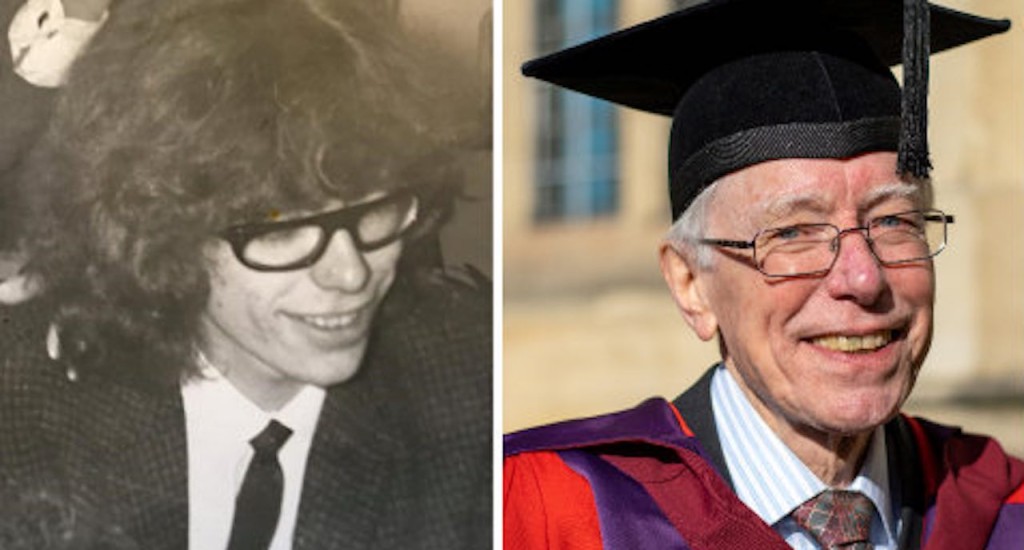
Newly-graduated ‘Doctor’ Nick Axten said it took him “a long hard think” to get his doctoral dissertation in order, which is probably what most Ph.D. candidates would say.
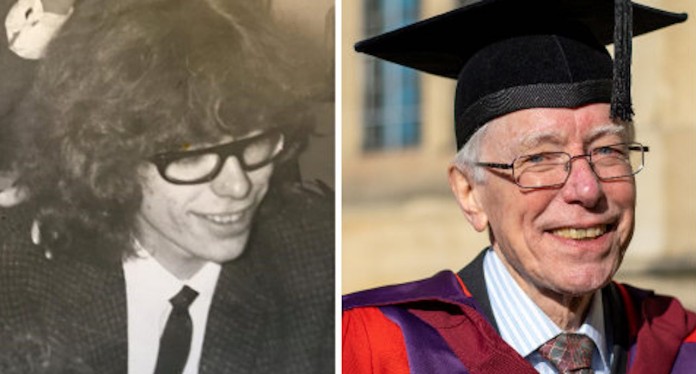
Unlike most candidates however, it took Dr. Axten 5 decades before the 76-year-old student finally graduated with a Ph.D. in mathematical sociology at the University of Bristol.
He started all the way back in 1970, the year he received a prestigious Fulbright scholarship at the University of Pittsburgh. But after five years he returned to the UK with the Ph.D. unfinished.
“What I was trying to do in the early 70s was exceptionally difficult,” said Dr. Axten. “Some problems are so great it takes the best part of a lifetime to get your head around them.”
He restarted the process at Bristol 7 years ago with the aim of finishing a Masters in the Arts, before carrying on to a Ph.D. in Philosophy, finishing in 2022 aged 75. This year, he received his Doctorate in front of his wife Claire and 11-year-old granddaughter Freya.
Dr. Axten’s research, which he hopes to publish, builds on the ideas he was working on in America five decades ago.
It’s a new theory for understanding human behavior based on the values each person holds. Dr. Axten says it has the potential to change our view of behavioral psychology.
During a varied career, Dr. Axten married, fathered 2 children, lived all over the UK, and was the creator and principal author of the school teaching program ‘Oxford Primary Science.’
Back in 1967 when he started his undergraduate degree in Leeds, UK, men had long hair and women were wearing miniskirts. Smoking inside university buildings was the norm and personal computers were still sci-fi.
“It was still flower power and there was a revolutionary feel. It was the time of the Vietnam War, Paris, Prague, and student sit-ins,” he reminisced. “Sociology and psychology were suddenly boom subjects. I went to study them because I wanted to understand people.”
“I have loved being a student again at Bristol University. All of the other philosophy graduate students were around 23 but they accepted me as one of their own.”
“Nick was an incredibly enthusiastic, energetic, and committed student during his time here,” said his University of Bristol supervisor, Professor Samir Okasha. “It’s fantastic to see him graduate half a century after he started his original Ph.D.”
SHARE This Inspiring Story With Anyone Struggling Through University…
A young Eurasian Eagle Owl from Central Park Zoo CC SA-4.0. Rhododendrites
A young Eurasian Eagle Owl (not Flaco) from Central Park Zoo CC SA-4.0. Rhododendrites
On February 3rd, a jailbreak occurred in Manhattan—it was a Eurasian eagle owl named Flaco. Investigators don’t know the identity of his vandal accomplice who shredded the netting of his enclosure, and the search for witnesses is ongoing.
In all seriousness, Central Park Zoo’s Flaco had lived his whole adult life in captivity, and the zoo workers were “stressed, and frustrated [sic], and tired” trying to capture him.
But as continued observation of the bird noted his increasing confidence in traversing Central Park’s vast acreage.
“Several days ago, we observed him successfully hunting, catching, and consuming prey,” a statement from Central Park Zoo read on February 12th. “We have seen a rapid improvement in his flight skills and ability to confidently maneuver around the park.”
“Birders have been out in force and there are a lot of eyes on Flaco,” the statement continued. “We are confident that we will be able to track his movements as he continues to explore and expand his range. We thank everyone who is pulling for the eagle owl’s safe recovery and understand the importance of good birding etiquette while observing and photographing him.”
One such birding group, Manhattan Bird Alert, has been tweeting updates on his position.
After a spirited hooting performance before flyout, Flaco went on a sequence of long flights to explore and hunt new territory, eventually landing on the lawn on the north side of Central Park's Sheep Meadow on a dark, moonless Monday night. ❤️🦉 pic.twitter.com/6MFQ03sGAA
The New York Times wrote that “by Sunday, his survival instincts had kicked in enough for the Wildlife Conservation Society, which operates the zoo, to say it would ease the intensity of its effort to retrieve him. He had earned the chance to live without 24-hour scrutiny.”
Flaco, the escaped Eurasian eagle-owl, spent a lot of time inside the grounds of @centralparkzoo last night. Zoo staff tried to retrieve him but he was uncooperative. Pictured here looking cheeky in the crane exhibit. (Long exposure taken from outside the zoo).#birds#birdcpppic.twitter.com/djYWx4eJ3s
If they were given the opportunity, they would likely retrieve him, perhaps for reintroduction in the wild thanks to his newfound survival skills. Manhattan is no place for a rodent eater; too much rat poison is used in the city for Flaco to remain safe for long.
An atomic resolution 3D model of a Bacteriophage - CC SA 4.0. Dr. Victor Padilla-Sanchez
An atomic resolution 3D model of a Bacteriophage – CC SA 4.0. Dr. Victor Padilla-Sanchez
If it still holds that the enemy of my enemy is my friend, then a virus that kills bacteria might be a good place to start developing medicines.
Antimicrobial resistance (AMR) creating “superbugs” is the largest threat to individual health on Earth. As many as 60% of the strains of common bacteria that live in our society are now resistant to antibiotics in some way.
The Eliava Institute of Bacteriophages, Microbiology, and Virology in Tbilisi, Georgia has been studying the effects of “phage therapy” on the treatment of AMR for decades, back when it was part of the Soviet Union.
Phage therapy uses bacteriophages, a kind of virus that infects, replicates in, and kills bacterial microbes, as a tool to clear AMR infections, and studies done at the institute between 2014 and 2018 had a more than 95% improvement and recovery rate, with no cases of complications or side effects after phage application.
However, these tiny lifeforms are difficult to find.
National Geographic reported on Kenyan virologists digging through Nairobi’s sewage where quadrillions of microbes work hard to break down sewage matter. This high concentration of bacteria inevitably attracts predators—bacteriophages.
At the Kenyan Medical Research Institute’s Department of Emerging Infectious Diseases,the virologists test isolated phages caught from the sewage plant on two AMR strains of Klebsiella pneumonia and Pseudomonas aeruginosa—two of the most common AMR superbugs in Kenya.
The virologists won’t know what it was that killed the bacteria—phages are microscopic in relation to bacteria, which are microscopic to our eyes. Instead, evidence of the bacterias’ deaths is found, and the sample is stored in deep freeze for later investigation.
This research is much more cost-effective and fast than producing new antibiotics, which based on the significant financial risks imposed by government agencies like the FDA of putting a drug through trials (a pharma company can lose upwards of $10 billion if a drug makes it to phase 3 trials and fails) no new antibiotics have been developed since 1980.
Another advantage, particularly for phage therapy in African and Asian countries that lack a domestic pharmaceutical industry, is that bacteriophages tend to be more effective when they live in the same environment as AMR bacteria. Kenya’s research institute found that phages from Georgia weren’t as effective as killing superbugs that evolved in Kenya for example.
Additionally, phages evolve to prey on one species of bacteria, meaning in potential human use, they won’t harm the plethora of non-harmful, friendly microbes that are so vital to human health and wellbeing.
The Kenyan team has so far identified 150 different phages, and in the US, 60 clinical trials are currently registered to test phages for safety and efficacy in treating AMR superbug infections.
SHARE This Surprising Group Of Allies With Your Friends On Social Media…
Quote of the Day: “You see things; and you say ‘Why?’ But I dream things that never were; and I say ‘Why not?’” – George Bernard Shaw
Photo by: Some Tale
With a new inspirational quote every day, atop the perfect photo—collected and archived on our Quotes page—why not bookmark GNN.org for a daily uplift?
Former Head of Marketing at Yahoo Finance Adam Taggart always thought it was bizarre and unacceptable that financial literacy wasn’t compulsive in high school and college, but the years 2019 through 2021 made him realize that America needed help understanding how to protect their livelihoods from financial dangers.
He created Wealthion, the fastest growing, totally-free, online financial literacy network centered around the Wealthion podcast for which Taggart cranks out 5 episodes a week—all interviews with experts in protecting wealth, but accumulating it.
It’s safe to say there has never been a larger collection of expert insight, evaluation, and strategy on all things investment and finance, that simultaneously addresses the concerns and interests of everyone from rank beginners to veteran marketeers.
In just a little over 2 years, Wealthion’s YouTube views for the past 20 days beat out those of a number of big financial brands like Forbes, The Economist, Fortune & The Financial Times.
That’s because, as the history of podcasting has shown us, there is an authenticity that breeds trust when people record hours of conversation together, and Taggart’s mission of helping people protect their families and fortunes big or small, rather than making a buck off of portfolio management fees, shines through.
Back to basics
What do you think about when you hear the words “stock market”? Too many Americans long ago began associating the stock market as a place where rich men go to become richer.
Hundreds of years ago, stock markets were envisioned as the best way to grow the wealth of a nation and everyone in it, and there’s nothing holding anyone back from taking some of their wealth, protecting it, and increasing it, provided they understand a little first.
“The new era of higher inflation & interest rates plus trillions in annual deficits has changed the rules of investing,” Taggart explains on Wealthion. “Those unaware of this, who don’t understand the implications are at unacceptable risk of remaining trapped in financial insecurity for the rest of their lives.
“The cost of living increases much faster than most folks’ wages. Banks offer no yield on your life’s savings. The pandemic has made the job market a lot more precarious, as has the accelerating trend towards automation and outsourcing.”
To help folks combat this, Taggart interviews experts from various fields of investing, including those on the bull side and those on the bear side. He talks about “macro,” the analysis which looks at the overall health of the economy, and “micro,” the technical analysis that makes some stocks or funds a good buy and others bad ones.
He speaks to experts in natural resources, the automotive industry, housing and real estate, precious metals, energy, telecommunications and technologies, and foreign markets all to ensure that any investment strategy is well-informed.
Of course, there are also those who don’t feel confident enough to manage their own portfolio, and that’s why Taggart only brings on guests whose portfolio management strategies are tailored to the current epoch, and who do it for the sake of helping others.
Wealthion refers viewers to a team of investment experts who review portfolios for free in order to help provide maximum protection to fellow Americans, and many of Taggart’s guests share insights that they typically sell.
GNN staff editor Andy Corbley submitted his portfolio of natural resource and precious metals stocks to famed investor Rick Rule, who appeared on the podcast as a guest recently. Rule evaluated them for free, ranking them on a scale of company profitability and solidity before connecting Andy to a second analyst for further discussion, again, for free.
SHARE This Resource With Someone You Know Who Wants To Start Investing…
Editor’s note: This story has been modified to reflect Taggart’s position as Head of Marketing, as well as the correct financial media that Wealthion is outpacing.
A California start-up has saved thousands of used electric vehicle battery packs from landfills by diverting them into an energy storage facility.
BWU Storage Solutions made a million bucks last year selling stored renewable energy to the CA power grid, thanks to 1,300 used battery packs from Toyota and Honda EVs.
Worn out over long years of powering cars, the batteries nevertheless have continued use as a way to store excess solar and wind energy for times when the sun isn’t shining and the wind isn’t blowing.
Over the next decade, millions of battery packs will need to be dismantled and recycled or will need a second use at a facility like B2U to prevent them from being sent to landfills.
Grid storage in large-demand states like California is a useful destination for these battery packs, and could potentially lower storage costs by 40% estimates the San Diego Times.
B2U’s Sierra facility has 25 megawatts of storage capacity capable of fitting any EV into their system. They are seeking to use Japanese investment capital to expand their operations to Texas and California.
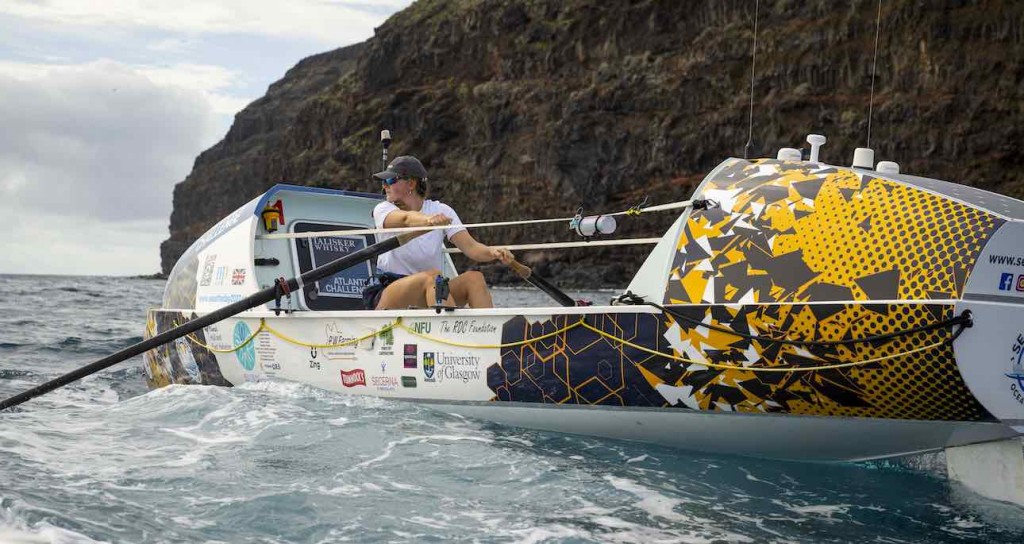
A 23-year-old woman just set the Talisker Challenge record for the fastest solo row across the Atlantic.
Departing from the Canary Islands on the 10th of December, Mariam Payne rowed 59 days, 16 hours, and 36 minutes, before arriving in Antigua last Friday.
The extraordinary feat was accomplished to raise money for the east Yorkshire charity Wellbeing of Women and Mind, Hull and East Yorkshire for which more than €13,000 ($14,200) was raised.
“The last eight to 10 miles were actually really hard,” Payne told the BBC. “It’s that point where you know you’re there and you’ve done it, but you just have to finish it off. So eight miles is nothing in the grand scheme of 3,000 or whatever, but it felt like some of the longest.”
The event was the Talisker Whiskey Atlantic Challenge, described as the toughest endurance event on Earth. No support is allowed—all food, water, and other necessities must be brought along. Talisker describes the Atlantic Challenge thusly.
“Sleep deprivation, hallucinations, hunger and the ultimate test of body and mind will be balanced by sighting incredible marine life, witnessing the breaking of a new day and sun sets that cannot be viewed by land.”
Rower Miriam Payne – Atlantic Challenge / SWNS
Payne rowed 15 hours per day alone in the vast Atlantic Ocean during 86°F days with strong winds. She spent Christmas Day rowing, and during parts of the journey was closer to crew on the International Space Station than to anyone else.
“The week before last, I thought I wasn’t going to get the record anymore because the wind dropped and I was going nowhere,” she told The Guardian. “There was one day where I rowed for 18 hours and I got less than 10 miles, so that was pretty demoralizing. I could just feel the race record slipping away.”
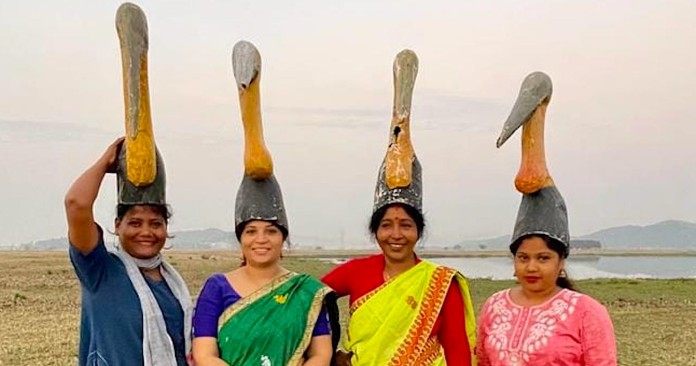
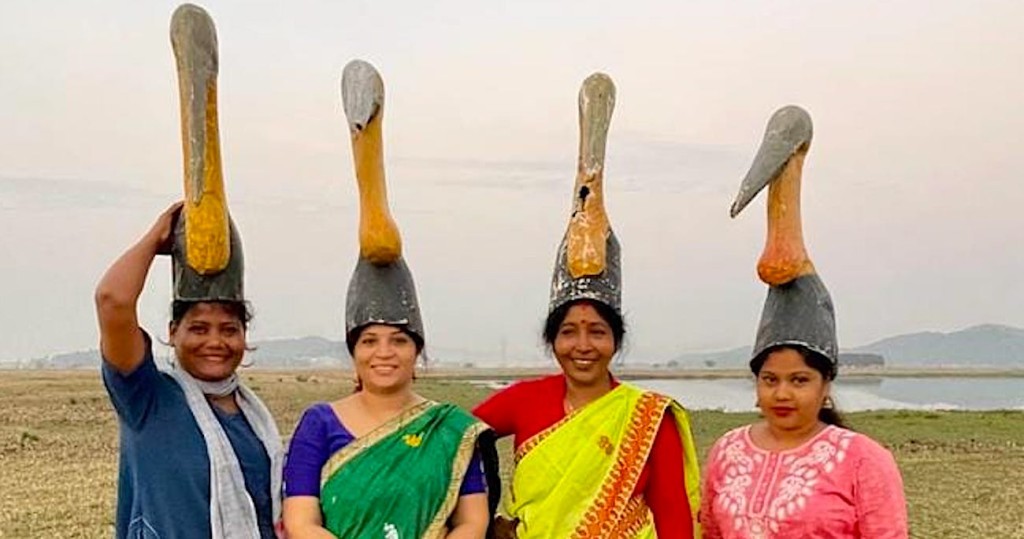
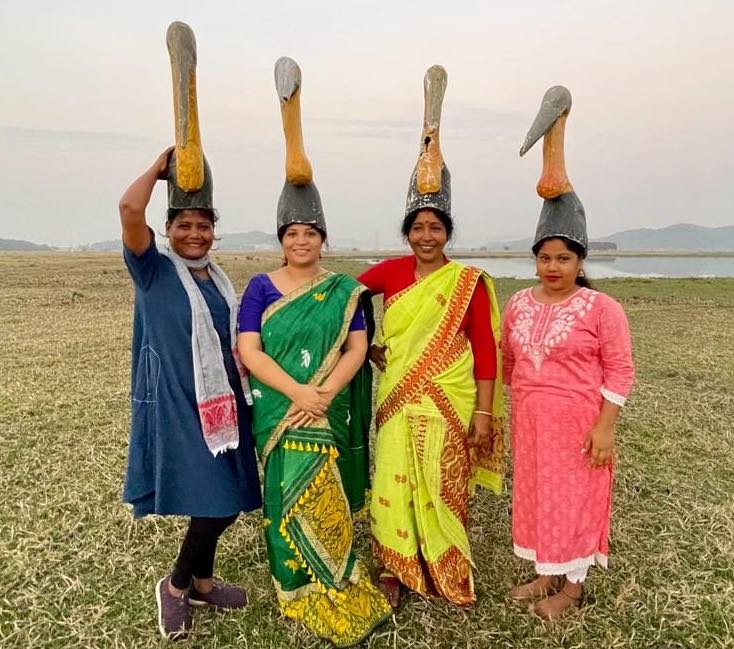
Changing attitudes towards conservation in the Indian state of Assam have these women wearing paper-mache hats to support one of the world’s most endangered storks.
Once reviled for their foul smell, carrion-filled diet, and unhandsome appearance, the greater adjutant has become a welcomed member of communities where it was once killed as a pest thanks to the pioneering work of a conservation hero.
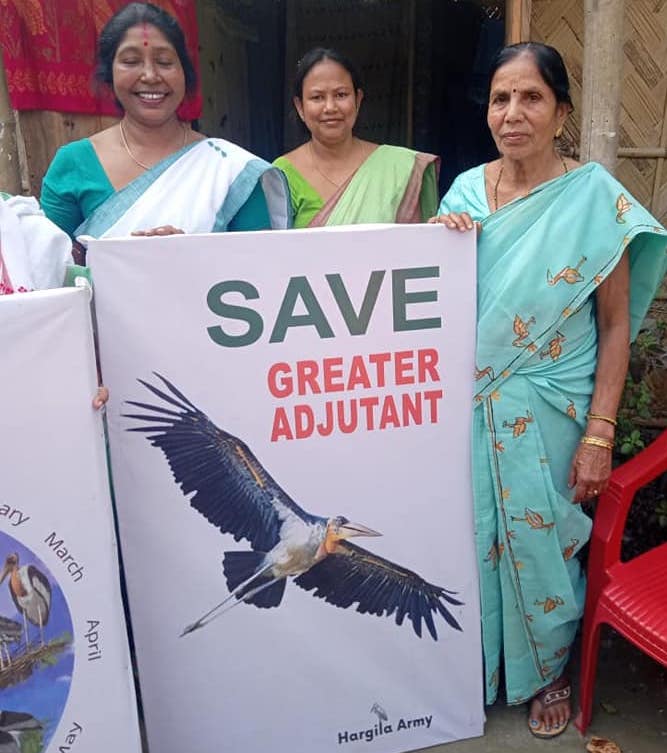
Dr. Purnima Devi Barman credits her “mothering instinct” for her interest in the protection of the greater adjutant (Leptoptilos dubius) – or hargila (meaning “bone swallower” in Assamese).
The bird has been persecuted for its traits mentioned above, as well as a belief that they were bringers of bad omens, and can now only be found in two Indian states and Cambodia. It was during her pursuit of a Ph.D. in stork biology that Dr. Barman rushed to the scene of a village where residents had cut down a nest tree, resulting in several injured and dead chicks.
Seeing the prejudice with which the villagers treated the nesting stork made her realize she needed to change opinions in Assam or the greater adjutant would go extinct.
She began to hold festivals to celebrate people in the villages along India’s Brahmaputra River who had kadam or burflower trees in their yards, honoring them as protectors and guardians of a rare bird. Everyone likes to be appreciated, and the tactic quickly began to work and ensure that the adjutants had safe places to nest.
During these occasions Dr. Barman would use the opportunity to explain that, with a diet exclusively of carrion, the greater adjutants played a crucial role in keeping the ecosystem free from the disease vectors like dead animals.
Courtesy of The Hargila Army
She became renowned among global conservationists for mobilizing 10,000 women into the “Hargila Army” whose job it is to advocate for and protect the storks.
“Conservation is all about uniting people and building ownership,” Barman told The Guardian. “I’ve always believed that, if given a chance, women can make a big difference in conservation.”
Courtesy of The Hargila Army
From just a few nests in 2008, Barman’s unique, all-hands-on-deck approach to the bird’s security has increased the number to 200 in 2018, and the number of individual storks has climbed back above 1,000 in Assam.
In 2021, Barman established the Hargila Learning and Conservation Centre in a government school in Pacharia village, where volunteer women use songs and games to encourage children to protect the birds when they grow up.
This year Dr. Barman picked up the recent UN Environment Programme’s Champions of the Earth award, while last year she was named World Female Ranger, and received the highest female civilian honor from the Indian central government: the Nari Shakti Puraskar.
SHARE This Exceptional Woman And Her Important Missions On Social Media…
Quote of the Day: “Study the dynamics of disobedience, the spark behind all knowledge. To disobey in order to take action is the byword of all creative spirits.” – Gaston Bachelard
Image: BAILEY MAHON
With a new inspirational quote every day, atop the perfect photo—collected and archived on our Quotes page—why not bookmark GNN.org for a daily uplift?
Jammu and Kashmir mountains - By UnpetitproleX, CC-BY-SA 4.0
Jammu and Kashmir mountains – By UnpetitproleX, CC-BY-SA 4.0
In a stunning development for the future of technology, India, one of the world’s fastest-growing economies, just uncovered vast reserves of lithium in the Reasi district of the northern union territory of Jammu and Kashmir (J&K).
The Geological Survey of India (GSI) estimated that around 5.9 million metric tons of lithium could be found there. From having no known sources of lithium, the discovery would suddenly place India’s reserves as the second-largest on Earth, as much as Australia, China, Portugal, Zimbabwe, the USA, and Argentina added together.
Lithium is one of the world’s most critical scarce resources. It’s used to make rechargeable batteries found in the world’s smartphones, tablets, computers, and electric vehicles.
Talking to a Jammu-based paper, the Daily Excelsior, J&K Mining Secretary Amit Sharma said that going forward teams would be working around the clock to set up an online auction for the various lithium blocks, and was excited for the investment injection into a poor region where horticulture, handicrafts, and tourism make up most of the livelihoods.
“Lithium blocks which are a rare thing and a much demanded global mineral for electric batteries which is the future, [sic] shall be explored and e-auctioned so that J&K figures on the global map so far as availability of lithium reserves in the world are concerned,” Sharma asserted.
Many countries, including India which suffers from some of the world’s worst air pollution, are looking to convert much of their internal combustion auto market into an electric one for the sake of emissions.
Lithium is key to this project. Chile and Argentina are two of essentially 4 nations that have historically had mineable reserves of lithium, and along with Australia, most of the world’s lithium comes from these three nations.
Many critics of electric vehicles point to the world’s limited lithium contents as a future obstacle to mass EV production, especially if extensive battery recycling to recover existing lithium isn’t taking place.
If Indian miners can bring the supply online soon enough, the chance for the kind of rapid acceleration in battery production needed to fulfill many nations’ electrification goals can be possible; not least because more supply means lower prices, allowing more consumers to afford electric vehicles.
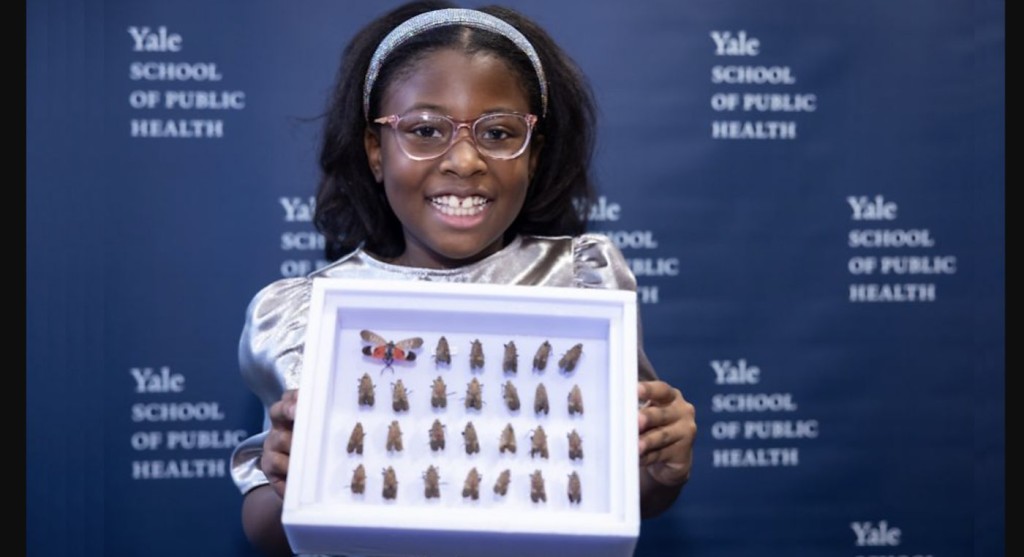
When 9-year-old Bobbi Wilson heard about the Hoboken campaign to eradicate the spotted lanternfly, she took the message to heart, whipped up some homemade, non-toxic, spotted lanternfly poison out of vinegar, and headed out to do her part.
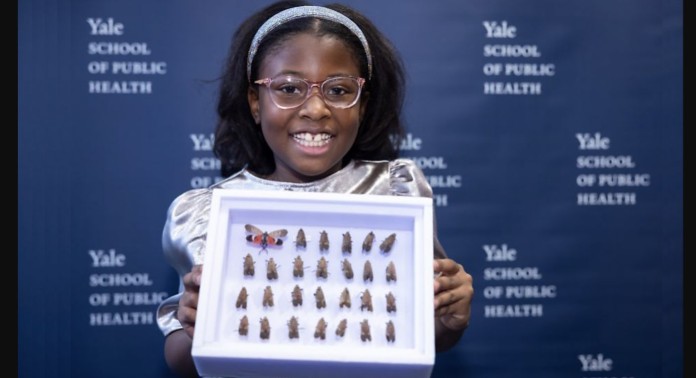
Yale decided to highlight this citizen scientist, as she donated her collection of 27 laternflies to the Peabody Museum of Natural History database, and received the title “donor scientist.”
“We wanted to show… how inspiring she is, and we just want to make sure she continues to feel honored and loved by the Yale community,” Ijeoma Opara, an assistant professor at the school, said in a statement.
The invasive spotted lanternfly can cause huge damage to ecosystems, and currently New Jersey is suffering from a bit of an infestation.
It’s an unfortunate thing as the lanternfly is quite beautiful, but its piercing-sucking talons can damage over 70 species of native and ornamental plants but have a preference for high-value ag commodities like grapes and stonefruit.
Native to China, they are typically kept in check via parasitic wasps and were accidentally introduced to the United States in 2014. Feeding on plant sap, their bodies create a sugary excretion called honeydew which collects on or around trees and cultivates sooty molds which can lead to tree death.
Spotted Lanternfly – NJ Dept. of Agriculture
Wilson was joining in New Jersey’s “Stomp it Out” campaign to help clear out the winged devils from the state. The campaign recommends three things: killing any individuals seen on one’s property, scraping off the “egg masses” which are greyish slimes that contain between 30 and 50 eggs that they lay in wintertime, and cutting down about 90% of all theAilanthus altissima trees, also known as the “tree of heaven,” which belies its presence as an invasive pest species.
NJ believes that if 90% of all the trees are cleared, the remaining 10% can be used as “trap trees.” The tree of heaven is a critical symbiotic species for the lanternflies, and they’ll inevitably be drawn there, and if the tree were say, poisoned, exterminated.
They are currently found in Virginia, Pennsylvania, New York, and Massachusetts as well as New Jersey.
SHARE This Awesome Young Woman And Her Important Mission…
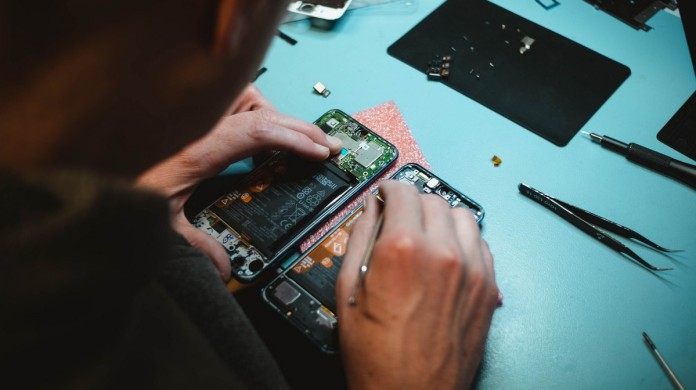
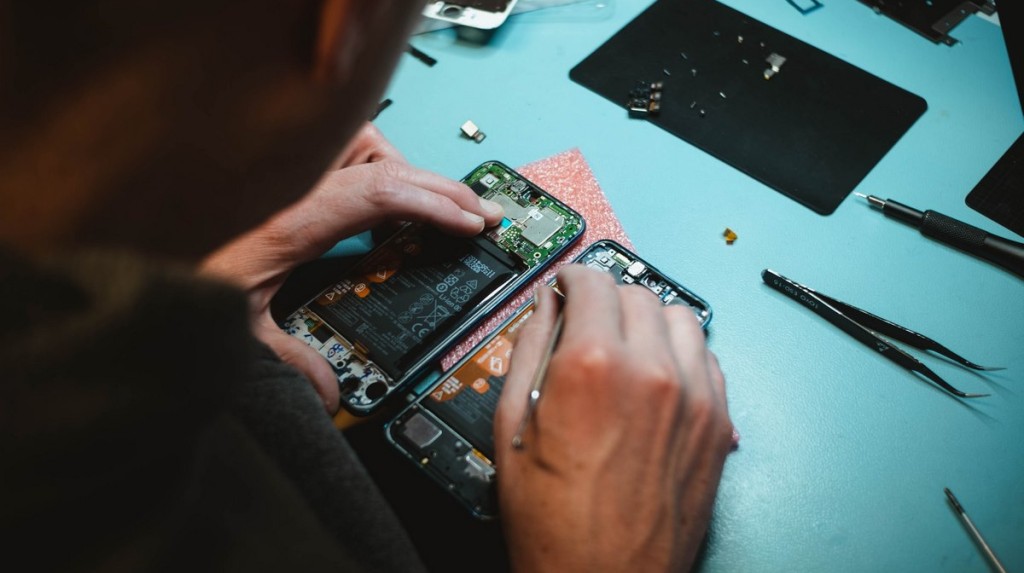
Across America, more than 20 state legislatures are looking over proposed laws that would help guarantee citizens’ access to parts, instructions, and diagnoses to help them repair products—from smartphones to tractors—in their own homes.
Called the “Right to Repair” movement, it’s been growing in urgency and size since the turn of the millennium, and 2023 could be the first year in many where the DIY capability of the American consumer grew, rather than diminished.
In Colorado, a bill was passed along party lines in the State House 9-4, mandating that tractor and other farm equipment manufacturers provide enough parts and instructions to allow farmers to repair their own tractors.
“The manufacturers and the dealers have a monopoly on that repair market because it’s lucrative,” said Rep. Brianna Titone, a Democrat and one of the bill’s sponsors. “(Farmers) just want to get their machine going again.”
Certain dealers like John Deere (previously) and Steiger don’t allow, as part of the buying agreement, fixes at home, but as an article in the Miami Herald points out, repairmen aren’t on call 24-7 in the high plains of Colorado. One farmer had to wait 5 days for a service on his tractor that stopped during a crucial period in the growing season, where he could have been losing as much as $83,000 a day.
Right to Repair farming legislation is on the table or has already passed in 10 states in the Union, including Colorado, but also Florida, Maryland, Missouri, New Jersey, Texas, and Vermont.
Just this January, the American Farm Bureau Federation and John Deere signed a memorandum of understanding, described as a “powerful middle ground” that ensures farmers’ and ranchers’ right to repair their own farm equipment but without the government involving force and violence to enforce it
John Deere will now allow farmers the parts and kit needed to repair their tractors themselves.
“We look forward to working alongside the American Farm Bureau and our customers in the months and years ahead to ensure farmers continue to have the tools and resources to diagnose, maintain and repair their equipment,” David Gilmore, John Deere’s Senior Vice President for sales and marketing, said in a statement.
It’s not just tractors that are potentially becoming easier to fix at home, but automobiles as well.
This January, the Right to Equitable and Professional Auto Industry Repair Act was introduced into the House.
“The legislation would require all tools and equipment, wireless transmission of repair and diagnostic data, and telematics systems needed for vehicle repairs to be made available to the independent repair industry,” writes Automotive News.
The bill has come to the House after similar legislation was passed in Massachusetts and Maine, where lawmakers wanted to beef up the right-to-repair and aftermarket auto parts industry, especially regarding telematic data and other information from onboard computers.
Just as it wasn’t only tractors and farmers who felt their right to DIY repairs needed protecting, it isn’t only mechanical engineering where right-to-repair is flourishing.
The New York state Senate signed the Digital Fair Repair Act into law in the dying days of December, ensuring original equipment manufacturers make parts, instructions, and diagnostics data available to anyone looking to repair a device, such as a smartphone or tablet.
“As technology and smart devices become increasingly essential to our daily lives, consumers should be able to easily fix the devices they rely on in a timely fashion,” Governor Kathy Hochul said. “This legislation will empower consumers with better options to repair their devices, thereby maximizing the lifespan of their devices, saving money, and reducing electronic waste.”
One of the major reasons that companies want to make repairing devices as impossible as possible is that if things like schematics and software become freely available, it places intellectual property and trade secrets at risk, and allows bad actors to back-engineer patented products.
There are several holes in that argument, namely that patent law is still enforceable and companies could sue those attempting to make knock-offs. Secondly, rigid intellectual property and trade secrets protection stifles innovation.
“After a decade of trying, we get two [state laws] in a very short period of time,” Kyle Wiens, CEO of iFixit, told Axios.
“Every single day, I’m seeing a couple more states file a new bill. And I think we’re going to be over 20 states very soon and those bills are moving.”
There’s also something to be said for the ultimate end which consumers of many of these irreparable items are forced to make for them; they end up in landfills. E-waste is a potentially-catastrophic oncoming environmental problem since it doesn’t really biodegrade in any meaningful sense, and recycling it requires technical dismantling.
The right-to-repair is also equally about keeping easily-fixable devices out of the landfills.
Know Someone Who Loves Fixing Things? SHARE This Good Nationwide News…
Quote of the Day: “The emotion of love is not self-sustaining; it endures only when lovers love many things together, and not merely each other.” – Walter Lippman (Happy Valentine’s Day!)
Image: Oziel Gómez
With a new inspirational quote every day, atop the perfect photo—collected and archived on our Quotes page—why not bookmark GNN.org for a daily uplift?