














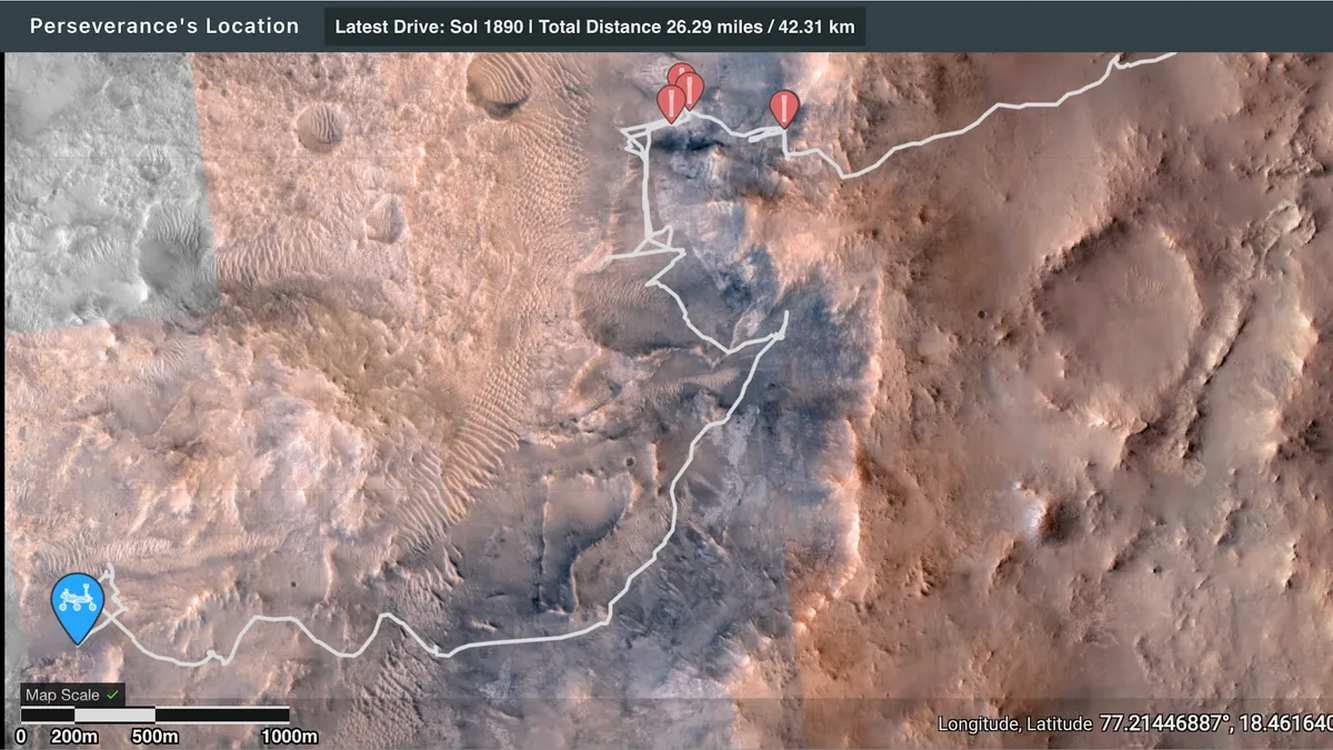
NASA’s Perseverance Mars rover just completed a special milestone as it recently marked 5 years on the Red Planet.
The robotic science lab has put 26.2 miles under its wheels: in other words, a marathon.
Having conducted hundreds of experiments so far, the rover’s data has already helped refine our understanding of the Martian surface, and in celebration of its marathon achievement, a summary of success is in order.
Through its drilling efforts at the bottom of Jezero Crater, where it landed, Perseverance has helped scientists confirm that the crater at some point was filled with water, leaving lake sediments at its base.
In 2022, the rover drove up from the crater floor onto the delta, a vast expanse of 3-billion-year-old sediments that, from orbit, resembles river deltas on Earth.
As the rover drove onto the delta, its Radar Imager for Mars’ Subsurface Experiment instrument (RIMFAX) fired radar waves downward at 10-centimeter intervals and measured pulses reflected from depths of about 65-feet below the surface (20 meters). With the radar, scientists can see down to the base of the sediments to reveal the top surface of the buried crater floor.
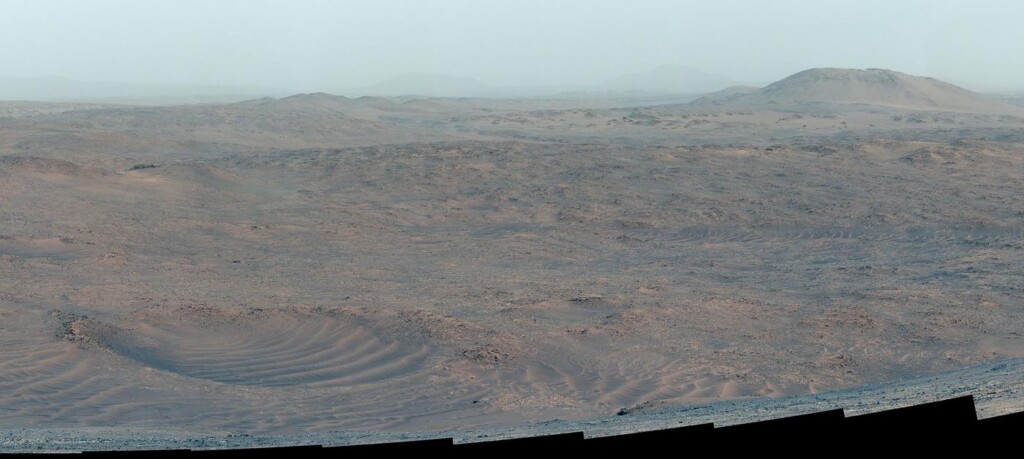
The images showed that the sediments are regular and horizontal—just like sediments deposited in lakes on Earth.
That same year, the rover captured video footage of a Martian solar eclipse with the tiny moon Phobos. The potato-shaped sphere doesn’t block out the sun, but was still cool to watch.
Perseverance’s Mastcam-Z has a solar filter that acts like sunglasses to reduce light intensity. This allowed for unrivaled color and detail to appear in the eclipse video.
By the end of 2023, Perseverance had finished exploring Jezero crater, and began exploring the furthest reaches of the canyon where the river would have flown into the lake. Rich carbonate deposits had been spotted along the margin which stood out in orbital images.
“We picked Jezero Crater as a landing site because orbital imagery showed a delta—clear evidence that a large lake once filled the crater. A lake is a potentially habitable environment, and delta rocks are a great environment for entombing signs of ancient life as fossils in the geologic record,” said Perseverance’s project scientist, Ken Farley of Caltech.
In April 2025, Perseverance was back with its head down, studying the Martian geology at the fastest rate since the early sample gathering in Jezero.
By then it had summited the crater rim, and conducted almost 100 sampling efforts.
This included some of the earliest molten rock to form on Mars, and formerly underground boulders juxtaposed with well-preserved layered rocks and other masses that seem to have been sculpted by running water; a veritable rock bonanza that may have also included the oldest sample yet.

As the rover passed the Marathon mark, there is still no concrete plan for how to get Perseverance’s cached samples back from Mars. The sample return mission seen as feasible when the rover launched saw its costs rise to $11 billion, prompting NASA to begin a complete overhaul of the plan and solicit new proposals from industry and academia to find a more affordable and faster way to return the samples to Earth.
NASA Administrator Jared Isaacman has floated the idea out of sending a manned mission to Mars and simply having astronauts pick them up by hand. Such a mission is an eventual goal of NASA and its sole rocket supplier SpaceX, which would like the costs of a robotic sample return mission rather redundant.
The samples were deposited in tubes of sterilized sapphire dubbed the “cleanest surfaces in the universe,” and so are therefore presumably durable enough to last a few decades provided a meteor doesn’t smash them to pieces.
WATCH the rover’s progress sped up below…
SHARE This Story With Your Friends Who Love Space…