












Insects play a critical role in ecosystems but, because they are so rarely preserved as fossils, it’s hard to study their roles from habitats millions of years old.
But fossilized tree resin can occasionally preserve an insect within its amber, freezing a moment in time.
Most rare of all is when the moment in amber contains multiple insects that were living in close proximity to each other–providing a priceless opportunity to learn more about their ecosystems in bygone geological eras.
The biggest question is: Were they pollinators, parasites, predators, or prey—or were they just ‘in the wrong place at the wrong time’?
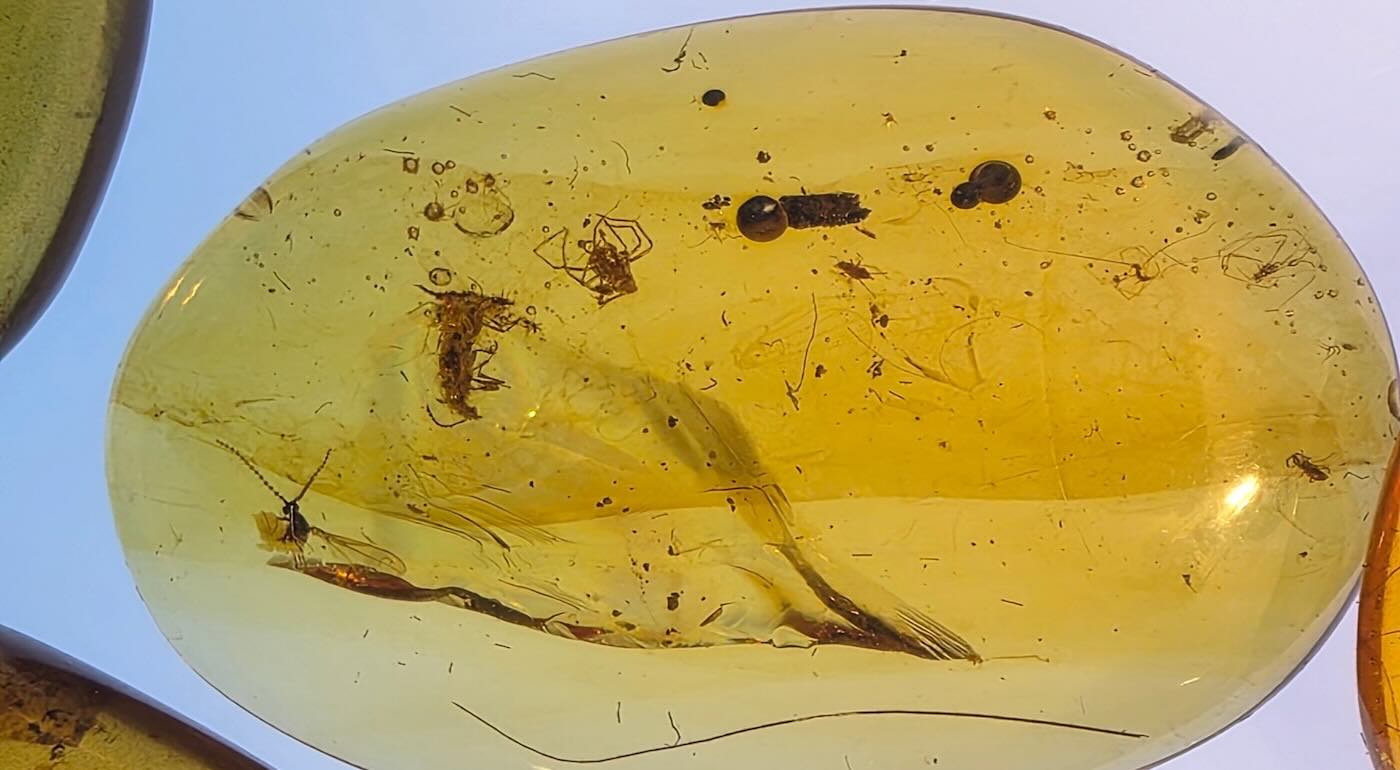
In a new study, researchers in Spain analyzed six pieces of amber containing fossilized ants that lived alongside dinosaurs during the Cretaceous period.
The samples include several different organisms of different species, a rare phenomenon called ‘syninclusion’.
“Amber inclusions are representative of possible interactions between different organisms shaping the environment,” said study lead author Dr. Jose de la Fuente, of the Institute for Game and Wildlife Research in the city of Ciudad Real. “(They) provide a snapshot of life on Earth millions of years ago.”
Ants are considered particularly important to ecosystems. The earliest ants, which were first found in the Upper Cretaceous period 66 to 100 million years ago, are known as Stem ants and didn’t leave modern descendants. All ants alive today evolved from Crown ants.
Both species are found in the amber samples studied by the scientists, as well as Hell ants, which evolved from Stem ants.
The study, published in the journal Frontiers in Ecology and Evolution, included four pieces of Cretaceous amber around 99 million years old, one piece of Eocene amber from around 34 to 56 million years ago, and one piece of Oligocene amber from around 23 to 34 million years ago.
The scientists used powerful microscopes to examine the amber, and found three of the six pieces of amber contained ants in close proximity to mites.
In one piece of amber the scientists found a Crown ant, wasp, and two mites, so close to the ant that they may have been traveling on it. Another (known as Case 4) contained a Stem ant and a mite, about four millimeters apart (around 1/10 inch).
AMAZING AMBER:
• World’s Largest Prehistoric Flower Preserved in Amber is Stunning Reminder of Nature’s Wonder–LOOK
• 112-Million-Year-Old Amber Samples Preserve a Snapshot of an Ancient Forest
A further piece also contained three different species of ant close to a mite and some termites, as well as mosquitoes and a winged insect.
In another piece of amber, known as Case 6, the research team found a Stem ant, which seems to have been feeding on something, alongside a probable parasitic wasp and a spider. Another piece contains a Stem ant and a spider, while the other contained a Hell ant, a snail, a millipede, and some unidentifiable insects.
Dr. de la Fuente said the ant-mite interactions in Case 4 may reflect two possible scenarios: First, a relationship where mites attach to ants for free rides to new habitats, or second, one where mites feed on the ant host during transport.
But some evidence points to their relationship being mutually beneficial.
WHAT’S UNDER A MICROSCOPE? ‘Once-in-a generation’ Fossil Discovery Reveals New Species in 16-Million-Year-old Amber
Future research could help clarify that by using micro-CT scanning to look for attachment structures on mites which would have allowed them to clamber onboard ants to travel.
He said the spider in Case 6 could camouflage itself as an ant and may have benefited from proximity to real ants.
It makes a person wonder what Charles Darwin would have perceived—and conceived of—had he been included in this fascinating research project.