














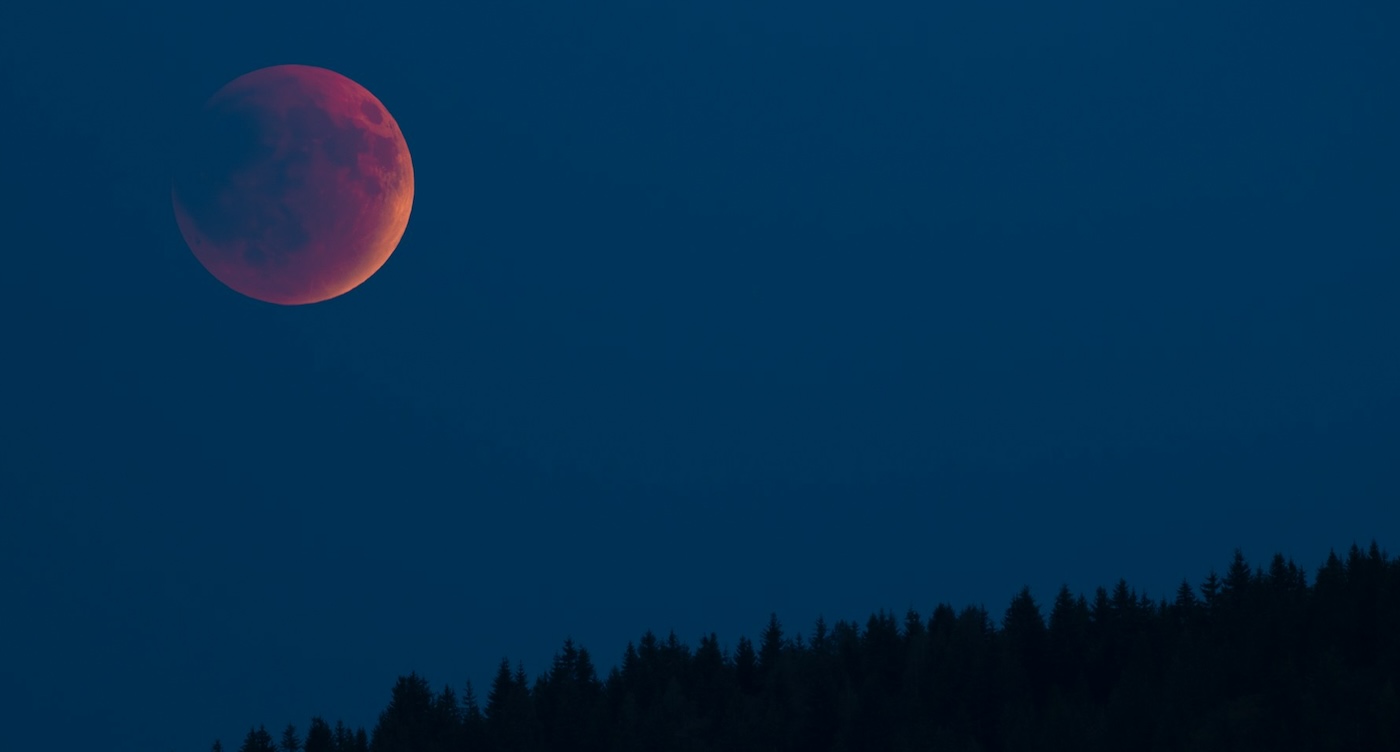
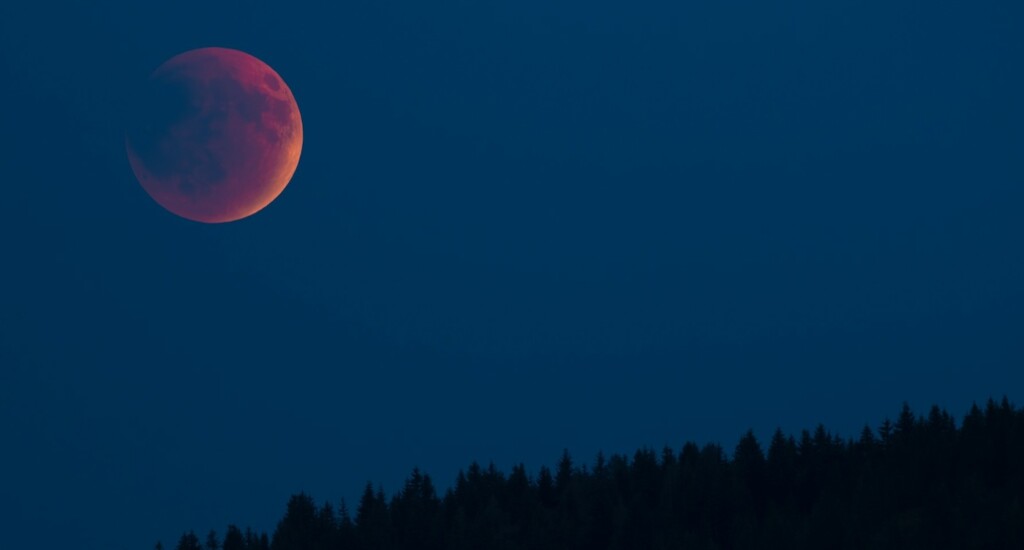
The full Moon in March will appear orange-red in the early morning sky as a result of a total Lunar eclipse, and North Americans are positioned almost perfectly to see it.
Sometimes called a Blood Moon in the media for the coloration, it should probably be called a coral or a jasper moon, because it doesn’t look like any blood you’ve ever seen.
The eclipse peaks in the early morning hours on Tuesday, March 3rd, with totality occurring around 6:04–7:02 a.m. US Eastern Time (3:04–4:02 a.m. Pacific Time).
The explanation for why the Moon turns orange-red comes from how the light from the Sun breaches the atmosphere. Sunlight contains a full color spectrum, and different wavelengths possess not only different colors, but different properties. Blue light scatters easily, NASA writes, when it comes in contact with the atmosphere, which is why the sky appears blue during the daytime.
As the Earth passes between the Sun and Moon, red light from our star, which moves at a more direct and lower velocity, penetrates Earth’s atmosphere at a shallow angle and is cast on the Moon in red.
The difference between a ‘total’ and ‘partial’ Lunar eclipse is that in the former case, the Moon will pass into the deepest part of Earth’s shadow, known in eclipse jargon as the umbra, and the moment of totality. The Sun, Earth, and Moon will be in perfect alignment, with the shadow from the light of the former falling over the latter.
32 minutes either side of totality, the Moon will still be in Earth’s shadow, but not perfectly centered, and while still appearing orange-red the deepest red coloration won’t be seen. Sometimes that’s as close as the Moon will get to the umbra, and in this case it’s known as a partial Lunar eclipse.
This eclipse will be best viewed across western North America, Central America, and the western part of South America. Australia, New Zealand, and eastern Asia, can see it too.
SHARE This Great Moment To Get Out And Enjoy Nature With Your Friends…