














[By David Sylvester]
My friend Kevin died at his desk on September 11, 2001, on the 99th floor of the North Tower of the World Trade Center.
I was in Philadelphia watching the Twin Towers fall on TV like everyone else, except I knew someone inside.
A lifelong positive presence, Kevin was someone who made me want to be better, and his loss left me adrift.
So nine months after the towers fell, I got on a bike and honored his life by pedaling 4,200 miles across a grieving country from Astoria, Oregon, to Kevin’s childhood home in Philadelphia.
Because the tragedy of that September day touched all of our lives in some way, something surprising occurred on that journey.
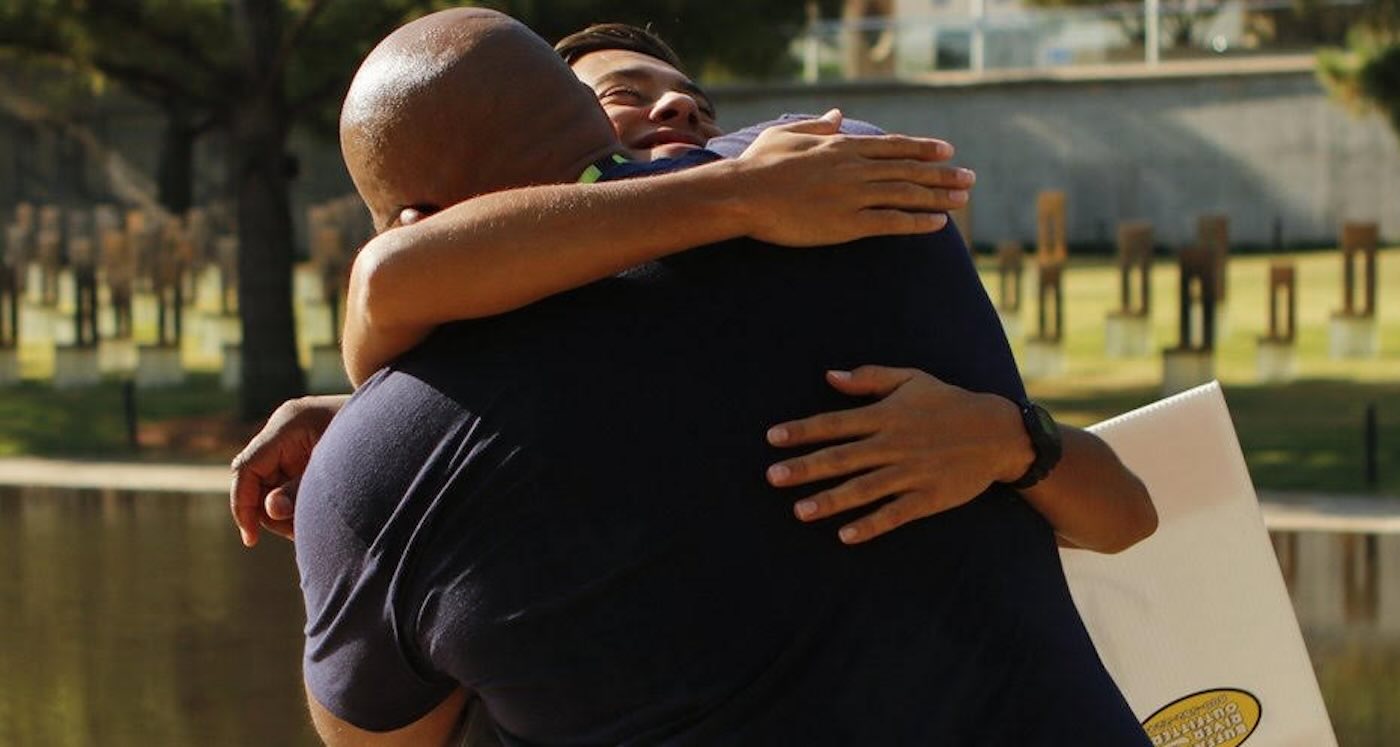
Everywhere I stopped, everyone wanted to talk, to connect, to feel safe, and above all, to hug.
Every citizen felt vulnerable, and I was biking right into their wounded hearts—and the nation’s conversations, connections, and hugs were revitalizing.
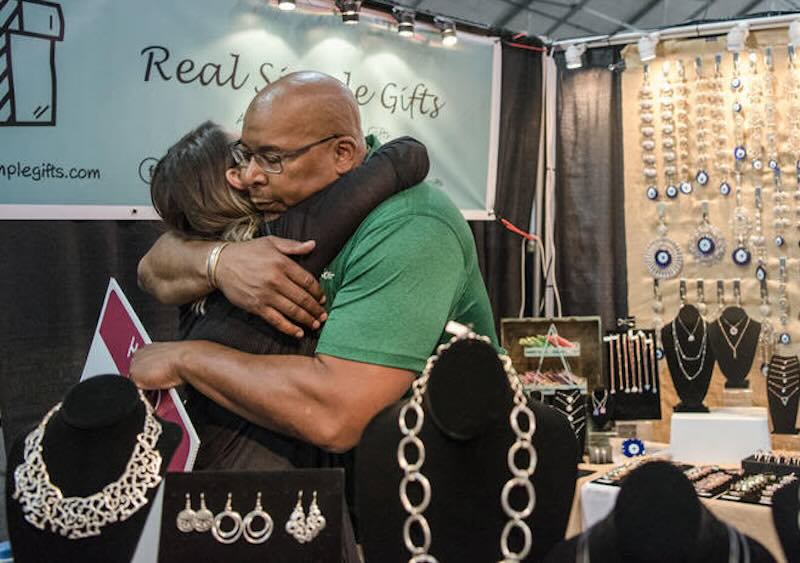
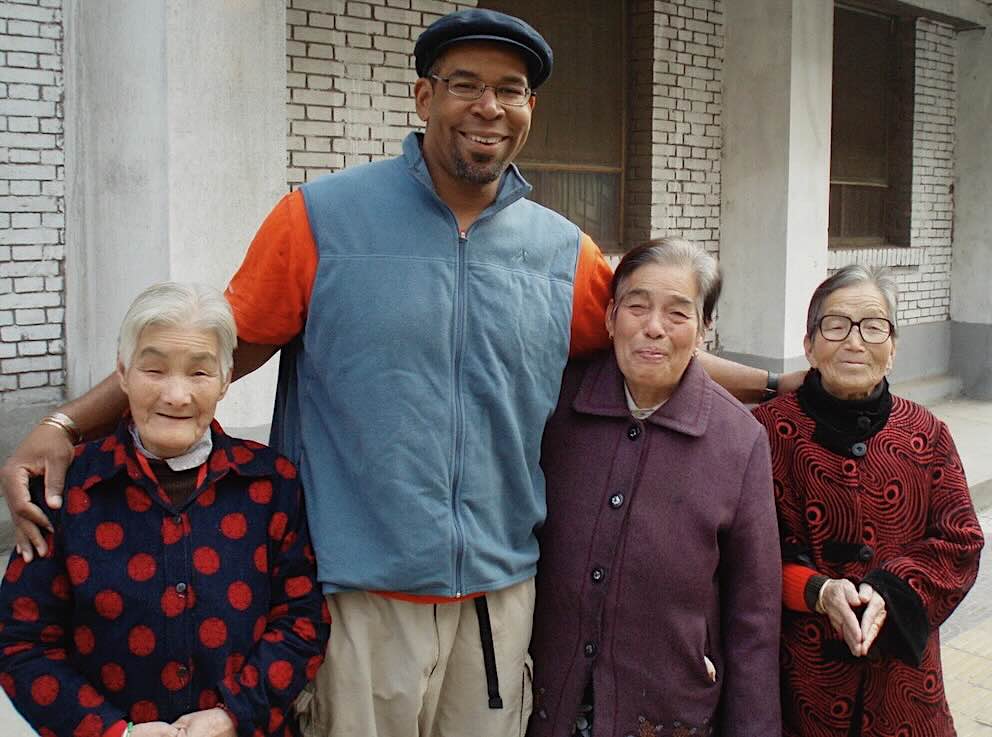
So that first ride in 2002 became a second in 2004—Cairo to Cape Town—and then a third in 2007—Istanbul to Beijing—and then more trips across Australia, Europe, and Israel, hugging all the while.
When I began this 25-year journey, I initially measured my accomplishments by distance, noting how many thousands of miles I biked or drove. Then I spoke about the number of people I hugged, noting that my record was 1,330 on July 31, 2017, in Las Vegas.
What began as an honor ride had evolved into legitimate research—a longitudinal study examining human connection across 42 countries and 50 states, where physical touch served as both methodology and measure—from Tajikistan to Turkey, Malawi to Mexico, Namibia to Northern Ireland.
LETTER FINALLY DELIVERED AFTER 9/11: Son Receives 24-Year-old Letter Written by his ‘Hero’ Flight Attendant Mom who Crashed on 9/11
How far can an embrace take you?
The circumstance of my presence opened the door for people to become more forthcoming, open, honest, understanding, and communicative, and created a hugging and healing space for myself and others.
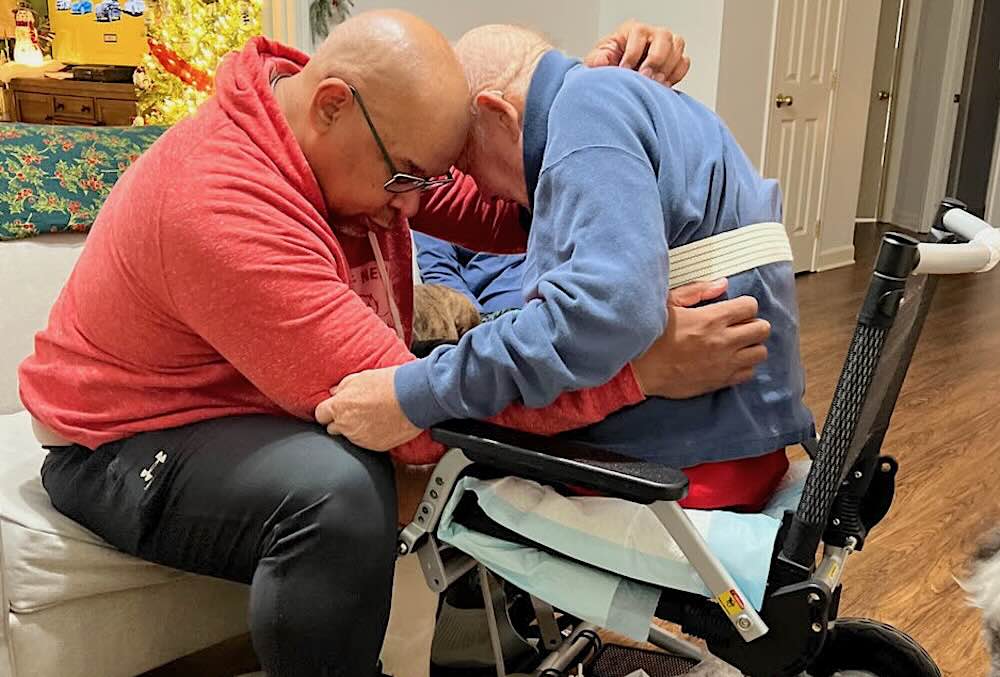
Their stories touched me, like in 2018 when I was flying to Anchorage and happened to be seated next to a man born in Alaska, but now living in Delaware. Returning to settle his father’s affairs, he was clearly hurting. So during our flight, 30,000 feet above our lives, I opened up about the wide range of emotions I went through after my father died.
Soon we were swapping dad stories, laughing, crying, and even holding hands. At baggage claim I gave him one of my hug coupon cards. We only met that one time, but ever since, he messages me a few times a year when he cleans out his wallet to say that my card is the only thing he keeps, along with his license and credit cards.
“It’s the purest thing I have,” he told me.
Then there was the South Dakota high school student I met in 2017, whose parents were struggling with addiction and, now, joblessness. She emailed me that her friend said, ‘We sure could use that guy who hugged people regardless of who they were right now,’ and ended her note with, “So years later I want to thank you for the love that you give.”
Then there’s the woman in Orlando I met in June 2016, just days after the Pulse Nightclub massacre. She saw me on a local morning show, offering hugs to anyone who needed them, and drove straight to the memorial where I would be.
She’d been following me since reading a 2008 piece I wrote for ESPN, and told me she’d always wanted a hug from me, but knew it would take something “extraordinary” for our paths to cross. She collapsed in my arms, and I can still feel her tears on my cheek.
I remember being in a mosque in Belfast, Northern Ireland, and meeting a Muslim woman who loved my story and personal mission but couldn’t hug me. She wondered if her smile went toward my ‘hug tally’.
With a big smile, I clicked my clicker and said, “It does now!”
She lit up and told me to wait there. A few minutes later, she returned with five women and said, “Tell them your story.”
As I shared my story, the women began to smile, and she yelled, “Click it! Click it!! Click it!”
I now have thousands of these stories, not because I am anything special; I am just a regular dude who discovered that the only measurement that counts and enriches the quality of our lives is depth: the depth of commitment, connection, love, devotion, and respect.
I also learned that hugs aren’t one-sided acts; they are highly communal and communicative. As I looked deeper into the action that made all of this possible, I developed a seven-principle framework—EMBRACE:
- E—Engage others with open hearts. Authenticity isn’t optional. People know when you’re being performative versus being present.
- M—Make meaningful connections. There’s a difference between casual, polite contact and purposeful interaction. One potentially empowers and energizes, while the other falls short.
- B—Bridge our differences. I focus on hugs, but it could be high-5s or handshakes. Physical touch transcends language, culture, race, and class. I’ve seen it a million times.
- R—Respect for all people. You must be willing to meet people where they are and respect their boundaries. Connection isn’t about what you need—it’s about what they’re ready for.
- A—Accept without judgment. When in crisis contexts—trauma, addiction, failure—people need grace, not evaluation. Your job isn’t to like them or fix them. Your job is to see them.
- C—Create confidence in our shared worth. Everyone needs to know they matter, so being recognized, if only for a moment, can be the foundational spark of healing.
- E—Engender hope through human touch. A hug isn’t just comfort. It’s proof that someone cares enough to stay. Hope isn’t just a feeling. It’s a force that moves us.
These principles aren’t theories from a textbook—they’re tried, tested, and proven lessons earned on the ground by engaging over one million people. And now they’re yours too.
It’s now 2026, twenty-five years after my friend’s death, along with 2,976 others—and so much of who we are and how we live has changed.
Here’s what I have learned during my experiment. We all have a larger capacity for everything than we believe, but, you can’t outrun grief or fill life’s painful voids with distance, quantity, substances, or geography.
GRIEVING RESEARCH: A Scientific Observation of Love and Loss on the Cellular Level
I’ve pedaled over 25,000 miles across Africa, Asia, Australia, and North America, and spent over 3 years of my life on the road, but my friend is still gone, and his loss still hurts.
The only thing that heals is depth—stopping long enough to listen and being present long enough to be heard and connect.
With the EMBRACE principles, you’ll see that a hug is more than an extension of a handshake, and vulnerability isn’t a weakness but a gateway to something curative.
SELF-HELP COURAGE: Woman With Fear of Rejection Cures Herself With Self-Esteem by Asking Odd Requests of Strangers
Kevin was my brother—not by blood, but by choice—and when you lose a brother like that, you either shut down and let the world harden you, or you open up.
The EMBRACE principles—and all the hugs—helped me reshape myself into a better man.
So, how far can an embrace take you? If you’re willing to stop running and go deep, a simple hug can take you pretty damn far.
David “Big Dave” Sylvester is the author of a new book, Brothers in Arms: Real Men Hug (December 2025). Learn more on his website: davidhalesylvester.com
Thank you! Thank you! Thank you! I want to give you a BIG hug!