














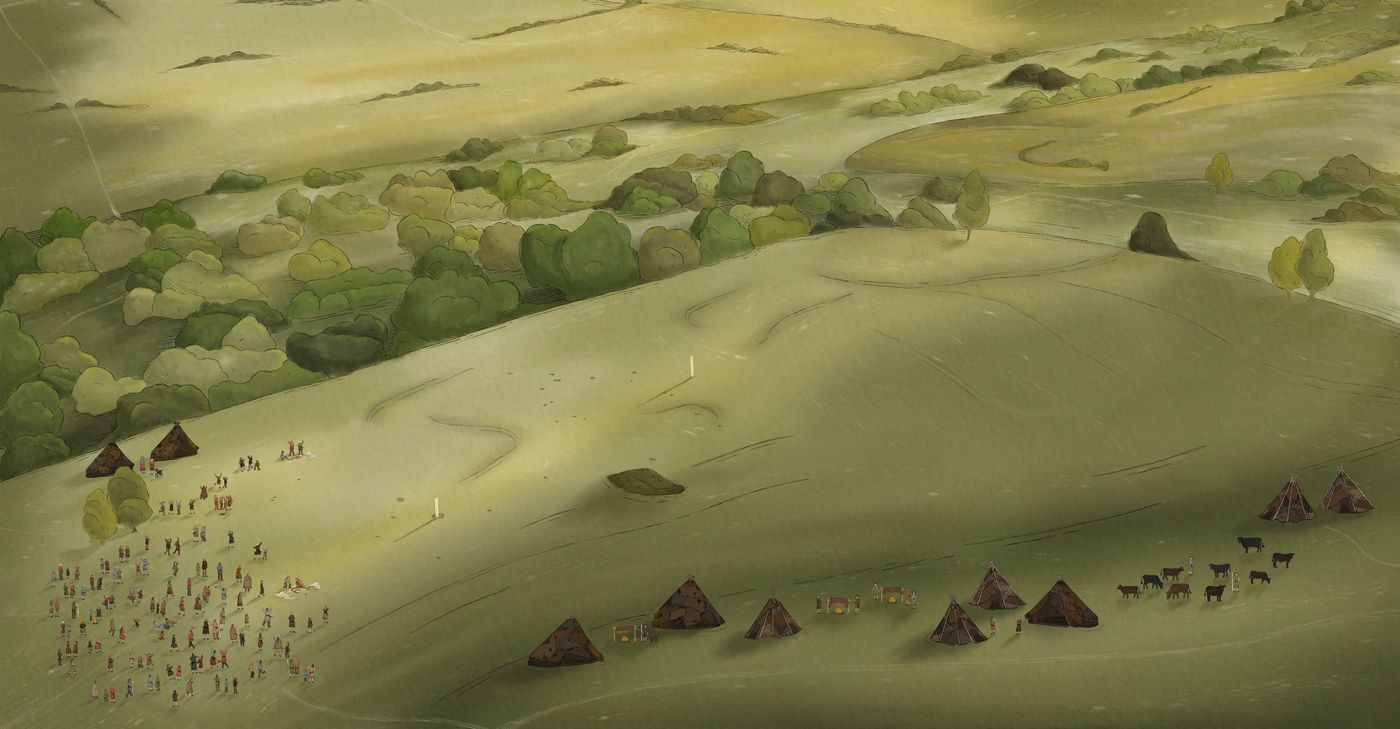
It was essentially two post holes in the ground and a couple of trash dumps: but it’s still one of the greatest finds of archeologist Phil Harding’s career.
Found near Wiltshire just 3 miles from Stonehenge, and dated to 2,950 BCE, Harding’s big find is a Stone Age monument that aligns to the summer and winter solstices as Stonehenge so famously does.
Harding was doing preservation archaeology work in advance of a Ministry of Defense building project in Bulford, and the evidence was so scant he almost passed it over. It was only when, examining his survey maps, he drew a line between the two post holes with a ruler and pencil and noticed it was about 50 degrees off true north, “which was pretty much the line of the midsummer sunrise,” Harding told the Guardian.
“And so I got really, really excited about that.”
Carbon dating of remains in the rubbish dumps and post holes strongly suggest the 2,950 BCE date, and based on the depths of the holes, it’s likely the wooden poles they supported were around 3-4 meters tall. They were placed 120 meters apart.
One hypothesis is that the poles were a prototype or trial run in advance of building the real thing, as the building date comes 500 years before the large trilithon stones the solstice Sun shines through were erected at Stonehenge.
Another is that it was a campsite of the same people who built the first stage of Stonehenge, but whatever it is, it has the defining feature of archaic life on the Wiltshire plain—alignment with the rising of the Sun on the summer and winter solstices.
MORE HENGY NEWS: A Circular Wooden ‘Stonehenge’ Discovered in Denmark Is 4,000 Years Old
Matt Leivers, the senior research manager at Wessex Archaeology, the organization that was contracted to do the work by the Defense Ministry, spoke extensively to the Guardian about the discovery and what it means for research into Stonehenge and its builders.
“What we’re seeing here is the religion of the Stone Age made manifest in the ground. Obviously we have no understanding of precisely what any of it meant, but the fact that time and again, over thousands of years, people are coming back to [the Stonehenge landscape] to build and rebuild and mark and remark this set of substantial events—it gives us an indication that this is religion. This is how they are understanding their place in the cosmos, how the universe works, what their deities are.”
ANCIENT ASTRONOMY: Ancient Chinese Astronomer’s Star Log is Found to Be World’s Oldest–Predating Greeks by 200 Years
“We don’t know what the sun meant to them. We don’t know whether they personified it as a deity. But the amount of effort that’s directed toward marking it and its movements leaves us in no doubt at all that this is a major religious event that’s inscribed over the whole landscape over millennia.”
SHARE This Great Expansion In Our Understanding Of Stonehenge And Its Builders…