









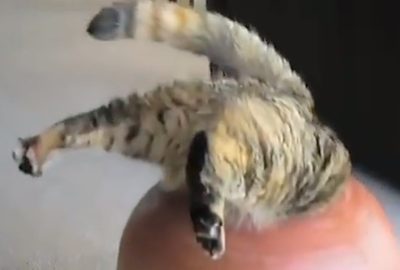
 If you took all the hilarious moments that cats jumped into tiny boxes and and bags and placed them end to end, you would get a laugh fest of epic proportions, like the one below.
Even the dogs are funny in this music video by HuffPost Comedy.


If you took all the hilarious moments that cats jumped into tiny boxes and and bags and placed them end to end, you would get a laugh fest of epic proportions, like the one below.
Even the dogs are funny in this music video by HuffPost Comedy.

A U.S. based group called Wello has reinvented the wheel to help families in the developing world who don’t have easy access to water.
Many people, including children, are spending a quarter to half of every day, hauling water on their heads. But, instead of carrying the heavy load, the Wello water wheel provides a way for anyone to easily transport 50 liters by rolling it.

Federal health authorities on Tuesday reported a 43 percent drop in the obesity rate among 2- to 5-year-old children over the past decade, the first broad decline in an epidemic that often leads to lifelong struggles with weight and higher risks for cancer, heart disease and stroke.
The New York Times called it the first clear evidence that America’s youngest children have turned a corner in the obesity epidemic.
One big reason is the decline in sugary beverages from the daily diets of children.
(READ the story in the New York Times)
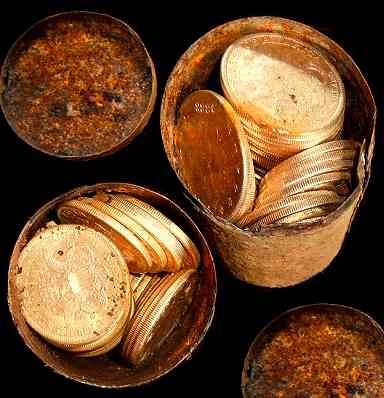
During the California gold rush of the 1800’s, what did people do with their treasure when banks were rare, and sometimes untrustworthy? They buried it.
Now a middle-aged couple has staked a claim to part of the state’s legendary gold treasure after walking the dog on their rural property in Northern California and noticing a buried can jutting out of the ground near a tree.
Using a stick, they were able to dislodge the can and decided to carry it back to their house. The can was unusually heavy, but nothing could have prepared them for what they would find when they pried the lid open: mixed in with dirt and stones, they found a stash of $20 gold pieces—a literal pot of gold.
Despite being buried for over a hundred years, many of the coins were preserved in pristine condition; some being finer than anything seen to date.
Kagin’s, Inc. has expertly cleaned, filed, and numbered the coins, calling the collection the “Saddle Ridge Hoard”. Highlights of the cache include at least fourteen of the finest known specimens, including an 1866-S No Motto Double Eagle valued at close to $1 million.
The Saddle Ridge Treasure of U.S. gold coins will soon be available for sale at Kaginsinc.com and on Amazon.


Thanks to a surfing dog named Ricochet, a sick boy was able to feel like a normal kid again. Caleb lost the feeling in his lower body last July just weeks after he was diagnosed with stage 4 brain cancer.
The certified therapy dog famous for her surfing skills, joined the Make-A-Wish Foundation to fulfill Caleb Acosta’s request for a day in the waves with the four-legged star.
“It was life-changing,” Caleb’s mom, Cathy Acosta, told Good Morning America.
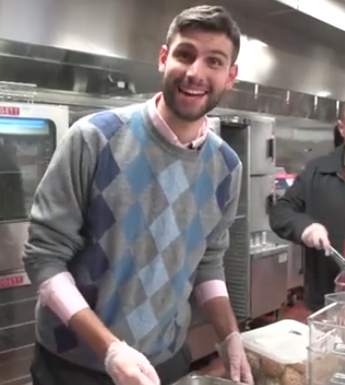
Ben Simon, a senior at the University of Maryland happened to be in the cafeteria around closing time and saw the amount of food being dumped in the trash. He asked if he and his friends could donate the leftovers, and they said, “Sure.” That was his first food delivery, in September 2011.
“And ever since then, it was like, ‘What if this was at every college?'” Simon recalls.
Thus began the Food Recovery Network, which has diverted 271,000 meals to churches and shelters that feed hungry people.
Today college students across the nation have signed up and mobilized to address hunger issues in “the most commonsense way possible” — saving leftover food that would otherwise be thrown away.
(WATCH the video below)
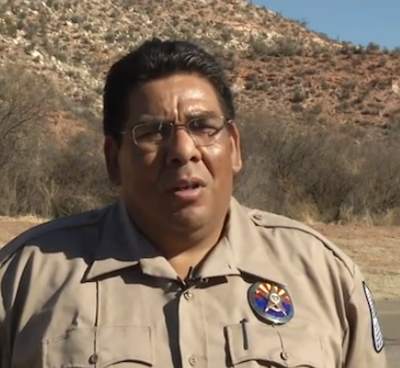
Working as an Arizona State Park Ranger isn’t just a job for Army veteran Carlos Garcia, it’s a second chance.
Under a program the state launched in partnership with a host of public and private agencies to put homeless veterans to work, he is earning $12 an hour and living in a FEMA trailer. He is taking part in the Arizona Action Plan to End Homelessness Among Veterans, and he said it has changed his life.
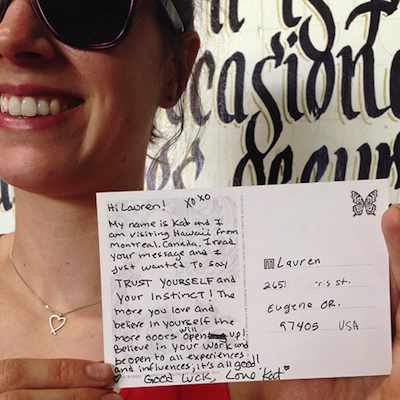
Everyone can use a little encouragement. How about getting an uplifting postcard from a stranger in Hawaii?
That is the beautiful premise of an art project out of Canada called, Love From Hawaii.
Artist Jeff Hamada offered “free encouragement” to the viewers of his popular art blog, Booooooom.com. All they had to do was to post in the comments section why they needed to be encouraged and Jeff took the requests — along with a package of beautiful postcards — to an annual retreat for fellow artists in the Aloha State.
Hamada then shot photos of each of the postcard authors as they held up their cards destined to cheer up a stranger half a world away.
Originally he brought 100 postcards and promised to fulfill as many comments, but more than 200 people posted their mailing address and were eager to receive some love from Hawaii, so Hamada was going to try to get each one all sent.
The project grew out of a Twitter experiment a couple years ago where the artist asked his followers who needed free encouragement. After he saw the tweets, he picked one and asked his followers to sent uplifting messages.
Visit Booooooom.com to see a full gallery of postcard portraits.


Thanks to extraordinary measures by the Santa Ana police, a local man has been reunited with his stolen camera and the priceless photos of his young wife who passed away at age 30.
The detectives found items that were stolen by the same man who stole a computer with a tracking device. Among the pawn shop receipts was one for a camera. When Detective Jerry Verdugo looked closely at the photos, he recognized a picture of a wall and a tree that jogged a memory from the location of a home where another break-in occurred — where Dave Lacey lives and the camera was taken.
(WATCH the video below, or READ the story from ABC)

At Hinkley High School in Aurora, Colorado, when students create problems or experience conflict, instead of getting suspended, they get together to talk, using a “talking circle”, or as they refer to it at Hinkley, a restorative circle.
The results are promising.

It all started with an innocent comment by writer Alexander Chee, when he said in an interview that he likes to work while riding on trains. “I wish Amtrak had residencies for writers.”
Afterward, a New York City-based writer, Jessica Gross, tweeted to Amtrak asking when such a residency could become real.
According to TheWire.com, “Though such lofty fantasies often die unrealized, by the grace of some transportation-and-prose-loving god, Amtrak actually responded to Gross on Twitter, and liked the idea.”

A baby elephant in India became trapped after slipping on a muddy railway embankment, but thanks to a passing train, the animal was pulled out of the hole and got a snack while waiting to be rescued.
Passengers on a moving train saw the young calf in distress and convinced the train’s engineer to stop. They gave it food before a rescue ensued.
(READ the story, w/ more photos, in the Metro.co.uk)

In the Netherlands, a radical idea is being tested: Self-contained “villages” where people with dementia shop, cook, and live together—safely.
In the small town of Weesp, in Holland a dementia-focused living center called De Hogeweyk, aka Dementiavillage, is serving as a model for the rest of the world.
The secure compound contains apartments and buildings, closed to the outside world with gates and security fences. But, inside, it is its own self-contained village: Restaurants, cafes, a supermarket, gardens, a pedestrian boulevard, and more.
(READ the story, w/ photos, at Gizmodo)
Photo credit: Hans Erkelens/CC

Eight-year-old Marissa Alterio’s appeal in front of the congregation of the Fairfield Presbyterian Church affected one parishioner so much that he walked up to her and emptied his wallet, handing the young girl $85.
“It was all the money in his wallet,” said Marissa, who has since gone on to collect close to $1,000 to help buy school supplies later this month for the students of two schools in her grandmother’s native land of Guatemala.
(READ the story in the Daily Republic)

The owner of Fox’s Pizza, Tom Wynkoop, who earned media attention in early January after he volunteered to deliver their medicines to any homebound residents during an extreme snow storm in Pennsylvania, received many donations in the mail from strangers who heard about the gesture.
One man called from Nebraska, saying he wanted to buy a local stranger dinner. A minister from New Mexico sent a letter saying he used the story to begin his sermon. A thumbs-up came from Denmark.
Wynkoop thought about positive avenues in which to distribute the money, and he chose the local Meals on Wheels program, which delivers hot meals to shut-ins. He then matched the donations, doubling the amount of the check to $2,000.
(READ the story in the Daily Republic)

Youth around the world have managed to turn a dangerous and deadly viral drinking game into random acts of kindness that have most recently turned infectious on university campuses in Canada.
It started when a man in South African decided to give away a sandwich to a homeless guy, rather than continue the drinking-dare game for which his friends had nominated him publicly, called NekNominations.
This one alternative act inspired European youth to begin nominating each other to do good deeds while recording videos of themselves being kind. Random Act of Kindness RAK Nominations were born.
The Canadian version currently captivating students on campuses like McGill University is called Feed the Deed.
University of Ottawa medical student Josh Stern saw someone abroad use their nomination for a good deed and he decided to do the same. Feed the Deed has spread exponentially and into other countries, like the US and Mexico, with Stern estimating that more than 1,000 good deeds were recorded in only a couple of weeks.
#FeedTheDeed videos are being tagged and posted on a Facebook Page run by Kindness Counts, a foundation run by Russell Citron and other university students along with high school leaders since 2012.
(WATCH a Feed the Deed moment by a random Canadian)

An Australian group, Clowns Without Borders, travels the world on a mission bringing smiles to the faces of children in refugee camps and natural disaster zones.
They recently returned to the Philippines after performing for thousands who were recovering from Typhoon Haiyan.

Thirty people braved the Minnesota cold to ask the local Home Depot Hardware store to “show bees some love” on Valentine’s Day.
Babies in bee suits, beekeepers on bicycles, and a slew of other Minnesotans were eager to urge home garden stores to stop selling bee-harming neonicotinoid pesticides — and plants pre-treated with “neonics.” Retailers like Home Depot have a unique opportunity to act as industry leaders by taking these products, known to endanger bees, off their shelves.
The Minnesota Department of Agriculture is currently reviewing neonics. After 50,000 bumblebees died in Wilsonville, Oregon last year, a bill to restrict neonics made significant progress through the Oregon legislature. And in Congress, new co-sponsors continue to sign on to the Save America’s Pollinator Act.
(READ the story from Pesticide Action Network, Panna.org)
RELATED Stories: EPA Debuts Bee-Protective Pesticide Warning Labels

Vancouver is rated first among North American cities for quality of life, in a closely watched annual survey, followed by Ottawa, Toronto and Montreal in second, third and fourth places. San Francisco won the fifth spot.
On a global basis, once again, the top city in the world for quality of life is Vienna. Zurich is second, followed by the New Zealand city of Auckland and then Munich. Vancouver clinches fifth place.
(READ more from the Toronto Globe and Mail)

Independent bookstores, with their paper-thin profit margins and competition from Amazon, have found a sugar daddy in the person of famous author, James Patterson.
The best-selling author has started a program to give away $1 million of his personal fortune to dozens of bookstores, allowing them to invest in improvements, dole out bonuses to employees and expand programs, especially for children.
More than 50 stores across the country will begin receiving cash grants this week.
(READ the story from the New York Times)
Creative Commons Photo by Susan Solie-Patterson