The funniest and most popular photography competition in the world—The Nikon Comedy Wildlife Photography Awards—announced the winners of the 2024 competition this week, with the top honor going to a red squirrel stuck in a tree.
Over 9000 images were entered, the highest number in the contest’s ten-year history, from professional and amateur photographers vying for the top accolade.
The competition was tight among the 45 finalists, with judges selecting their favorites, with only a few points between the top 5 entries. But Milko Marchetti’s image called, ‘Stuck Squirrel’ was popular across the board.
The moment was over in a flash, Milko recalled.
“I have taken many photographs of squirrels, in many situations over the years in Italy, but this one struck me as really funny and such a strange position, because it is that exact moment when the squirrel is detaching its back legs from the trunk to enter its hide.”
“Whenever I show this image at the nature seminars at my local photography club, the audience always explodes with laughter, so I had to enter it!”
The competition was founded in 2015 by Paul Joynson-Hicks and Tom Sullam, both professional photographers and passionate conservationists to create a refreshing, fun, and free photography competition unlike any other, showcasing funny images of the earth’s most amazing wildlife and raising awareness about conservation.
There were special mentions for the younger generation of emerging photographers including the winning shot of a frog that won the Nikon Young Photographer Award (for those under 25), with a close up of a frog smiling at the camera. Kingston Tam from Australia received a Z8 + 24-120mm kit from Nikon for their entry.
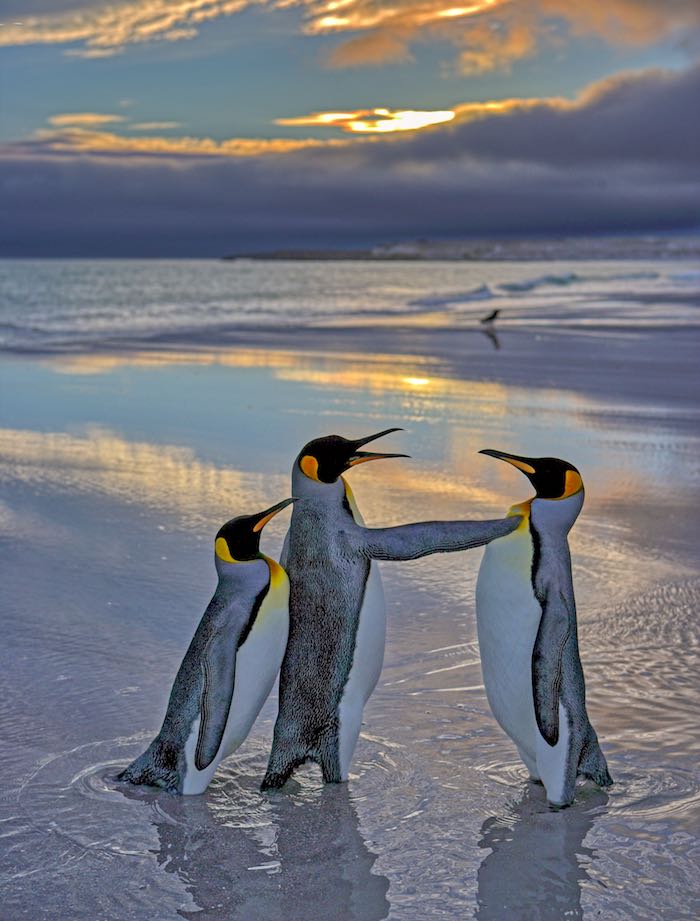
Another Highly Commended Winner features King Penguins in the Falkland Islands. The image shows a male trying to make a move on a female who has already paired up with another male. The body position and wing posture make the message clear, ‘back off!’
When Larry Stewart was growing up in his grandparents’ home in a small Mississippi town, he didn’t know they were impoverished. It wasn’t until he started school that he learned what he “lacked”—the bathrooms, telephones, hot water and gas stoves to be found in other kids’ homes.
As a young adult, Larry confronted poverty again. Living paycheck to paycheck, he became homeless when his employer went out of business owing Larry more than one check. So Larry resorted to living in his car, covering himself in his laundry in an effort to stay warm and hoping to forget his hunger. By the time he’d gone two days without a regular meal, he was so desperate that he went to the Dixie Diner and ordered breakfast without knowing how he’d pay for it.
When he finished eating, he started looking around on the floor, pretending he’d lost his wallet. The cook even came out from behind the counter and helped him look.
Then, suddenly, the search was over.
“You must have dropped this,” the cook said. He was holding a twenty-dollar bill.
Larry was so grateful that he made a vow to himself: as soon as he was able, he’d do something for others like what the cook had done for him. Over time, he became financially stable, and he set out to keep his vow. Although he wasn’t well off by any means, he knew he couldn’t put off getting started.
One evening, he stopped at a drive-in restaurant and noticed that the waitress was wearing a tattered coat that couldn’t have been keeping her warm. When he handed her money to pay for his food, he knew it was the moment.
“Keep the change,” he said.
Tears welled in the waitress’s eyes, and her hands shook as she held the money. “You have no idea what this means to me,” she said, her voice shaking, too.
But Larry did have an idea what it meant to her.
Afterward, he was so inspired by what had happened that he started driving around looking for people who needed help. They weren’t hard to find, and he gave away $200 in fives and tens.
The more successful Larry became, the more money he gave away. By the time he’d earned considerable wealth in cable and phone services in Kansas City, Missouri, he was anonymously giving away substantial amounts as a “Secret Santa.” He consulted with local social workers, firefighters, and police officers to find needy and deserving recipients. He also found some of them on his own, at laundromats, social service agencies, government housing facilities, and businesses that paid minimum wage. At thrift stores, he often found people who were raising their grandchildren. When he would give them anywhere from $100 to $300, it would change the whole complexion of their Christmas as well as their outlook. For many of them, this money made it possible to buy presents and cover necessities like utility bills.
Larry didn’t want people to have to beg, get in line or apply for money. “I was giving in a way that allowed them to keep their dignity,” he said in an interview with a local news station years later. Just like the cook at the Dixie Diner had done for him.
All told, Larry gave away more than $1.4 million over the years. There are many stories from people whose homes he saved. People who told their families there wasn’t going to be a Christmas but wound up being able to buy gifts because of the money Secret Santa gave them. People who were able to pay their bills and get their gas turned back on, thanks to Larry.
In 2006, after serving as an anonymous Santa for more than twenty years, Larry was diagnosed with terminal cancer. At that point, he decided to go public because a tabloid newspaper was about to reveal his identity. Larry thought he should be the one to tell his story, hoping it would recruit more Santas to take his place. He’d seen that every time a Secret Santa was written about in the media, the coverage was followed by a wave of new Secret Santa appearances. He hoped making his identity public would continue to add to the ranks.
Larry got his wish. Thousands of people visited his website and signed up to become Secret Santas. And based on the number of people who emailed the site about their experiences that Christmas season, the new Secret Santas did more than sign up; they also turned out in force.
When Larry died in 2007, his handpicked successor—an anonymous Kansas City businessman—took over for him and continues to lead the Society of Secret Santas today. Its members follow in Larry’s footsteps around the world. The postings on the society’s website tell of giving money to victims of fires, people who had been evicted from their homes, and veterans and military families in need. They tell of former NFL player Dick Butkus handing out hundred-dollar bills in San Diego and former Major League Baseball player Luis Gonzalez doing the same in Phoenix.
A foundation was also formed in Larry’s honor to accept donations to be used by the Santas. The first donation was from former Kansas City parking attendant Sam Williams, who wanted to make a small gift in memory of the man who’d given him a hundred-dollar bill a few years before. “He gave me the biggest gift I ever got in my life,” Williams told KMBC News.
Larry gave Secret Santas everywhere a gift, too. As the society’s website says, “The compassion shared from one spontaneous random act of kindness is elevating, priceless and not easily explained. It is an instant connection between souls that can change a life forever. Being a Secret Santa has blessings beyond words.”
What’s more, it’s a gift anybody can give. “It’s not about the man, it’s not about the money—it’s about the message,” says a Secret Santa. “Anyone can be a Secret Santa with a kind word, a gesture, a helping hand.
And what impact that gesture may have is anybody’s guess. “You never know what one little act of kindness will do for somebody,” as Larry told Ted Horn, chef-owner of the Dixie Diner, when he tracked him down twenty-eight years after their first meeting. “It can change their whole life…It changed mine.”
Quote of the Day: “All nature is but art unknown to thee.” – Alexander Pope
Photo by: Mae Mu (a star anise)
With a new inspirational quote every day, atop the perfect photo—collected and archived on our Quote of the Day page—why not bookmark GNN.org for a daily uplift?
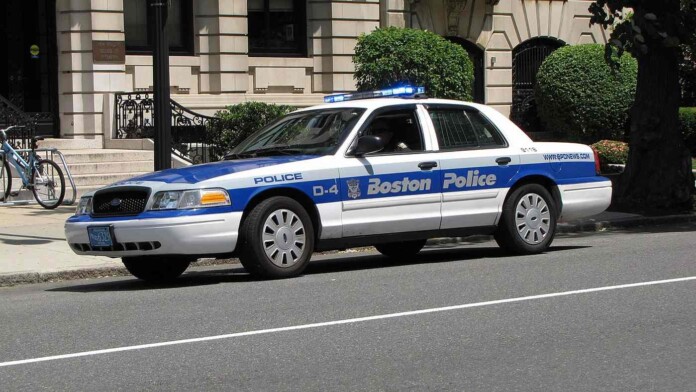
Boston Police Department cruiser - credit Ben Schumin, CC 3.0. By-SA
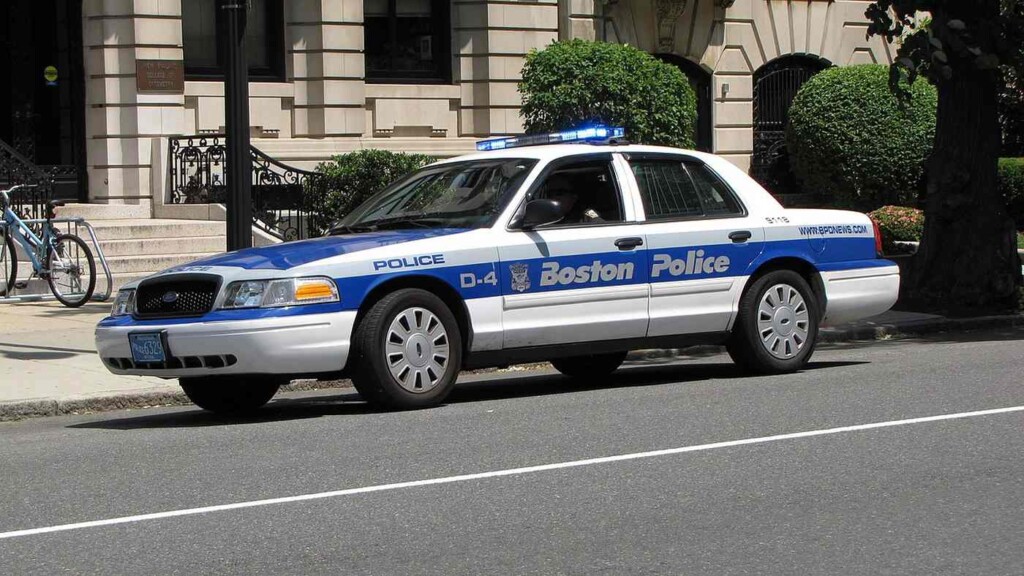
Boston Police Department cruiser – credit Ben Schumin, CC 3.0. By-SA
Though rarely mentioned among the most homicidal cities in the country, Boston has seen her fair share of mean times. But according to a new report, there have never been fewer murders in the city than now.
That’s because 2023 saw the fewest on record, and barring an explosion of violence in the last 17 days of 2024, this year will contain even fewer than that.
The city of Boston saw 37 homicides in 2023, which according to Christian Science Monitor, was the lowest number recorded since the Boston Regional Intelligence Center began counting.
At the time, the murder rate of 5.29 per 100,000 residents was the city’s lowest in the 21st century. For perspective, the decade spanning 2000 to 2010 saw only three years where homicides fell below 60 per year.
By September 2024, the homicide rate had fallen 60% year-over-year, and as of December 10th, the city of 654,000 residents had witnessed just 22 homicides.
Shootings have also reached a record low despite being the leading cause of homicide in the city in 2024, signaling broader declines in violent crime in general.
“While it’s difficult to pinpoint a specific cause for the steep decline, public safety experts point to the tight-knit network of neighborhood associations and community-based organizations focusing on young people at risk for violence,” writes Troy Aidan Sambajon for the CSM.
This time last year GNN was reporting on the homicide rates in Detroit and Chicago falling precipitously: 18% and 19% respectively, while Los Angeles also recorded a 25% drop compared to 2022.
SHARE This Positive End-Of-Year Statistic With Your Friends From Mass…
Synhelion’s industrial-scale solar fuel plant DAWN - Credit: Synhelion
Synhelion’s industrial-scale solar fuel plant DAWN – Credit: Synhelion
From Switzerland comes a new technology that aims to decarbonize the transportation methods we use right now.
Through a thermochemical process driven 100% by solar power, the energy startup Synhelion can synthesize gasoline, diesel, kerosene, or any other fossil fuel currently in use.
Their colloquially termed ‘solar fuels’ are carbon neutral, as they emit only as much CO2 as was used in their production, compared to fossil fuels that come from deep underground and add to the global carbon cycle.
The technology that powers the DAWN solar fuel plant pictured above relies on concentrated solar radiation reflected from a bank of mirrors into a receiver that creates temperatures as high as 1,500C°. This not only powers the production of fuels through synthesizing H20 and CO2, but also is fed into a storage system that powers the production after dark.
Launched in 2016, Synhelion has needed some time to get its feet under itself, but with its first industrial-scale plant in operation, transportation services are starting to take notice.
In September, Swiss aircraft manufacturer Pilatus Aircraft signed a five-year agreement with Synhelion that includes a commitment to purchase solar kerosene for their aircraft starting in 2027. Under the agreement, Pilatus will acquire 200 tons of solar fuel per year.
Just 8 days later, Lake Lucerne Navigation Company (SVG) and Synhelion announced an identical five-year agreement for 100 tons per year. The company’s iconic steamboats, integral to Lake Lucerne’s landscape for over a century, were originally powered by coal and later by heating oil.
With Synhelion’s solar fuels, neither these ferries, nor Pilatus’ aircraft, nor anyone else for that matter, need to retrofit or replace their existing vehicles. The solar fuels combust exactly the same as their fossil fuel equivalents, offering the chance for these firms to save tens of millions in the process of getting to net zero.
“We believe that solar fuels are, as of today, the best way to rapidly defossilize aviation,” Markus Bucher, CEO of Pilatus, said in a statement.
“Synhelion’s renewable solar fuels offer the ideal solution to defossilize our historic steamboats,” said Stefan Schulthess, Managing Director of SGV. “We’re excited to support this disruptive technology.”
The 2027 date for both agreements reflects when RISE, the first commercial-scale production facility for solar fuels is slated to be ready for operations, with the capacity to produce 1,000 tons of fuel per year from its location in sunny Spain.
Studies show that even at the current pace of electrification, there will be many remaining internal combustion engine vehicles around the world that will also need to be powered sustainably to meet net-zero emission targets by 2050.
While they still emit CO2, solar fuels also consume CO2 from the air during manufacture, and because the process is synthetic, nitrous oxide and other emissions harmful to human health are absent.
WATCH an explainer video below…
SHARE This Remarkable Future Of Fuels With Your Friends On Social Media…
In a US study of 192,000 participants, five servings of dark chocolate a week was associated with a lower risk of developing type-2 diabetes.
This was in direct contrast to milk chocolate consumption, which was not associated with any protective effect, and rather was linked to higher weight gain.
The study included 34 years of data and over 18,000 incidents of type-2 diabetes, pointing to how dark chocolate, particularly the kind with 70% cacao or more, can be part of a healthy diet.
Everyone should first understand that the study is the most fertile soil for a phenomenon in science literature known as the ‘healthy user bias.’ Put simply, people who care about looking after themselves are more likely to select dark chocolate, because of its lower sugar content, than milk chocolate, just as those people who are less bothered about monitoring their overall sugar intake won’t be bothered about which chocolate is available.
Furthermore, the 192,000 participants were nurses and health practitioners, and are therefore those most likely to be aware of the risks of added sugar in food.
Even though the authors of the study, published in the British Medical Journal, report to have adjusted the results for diet, personal, and lifestyle factors, the healthy user bias can manifest in other ways; and the diets of the individuals were gathered from food frequency questionnaires which are notorious for participants entering what they imagine or want to perceive themselves as eating, rather than what they actually ate.
These are not only challenges related to this study on chocolate, but almost all dietary literature because people don’t have the time or desire to lock themselves in a metabolic ward to perform a randomized controlled trial that would yield the gold standard of medical data.
With these caveats printed, there was still a 21% associated risk reduction in developing type-2 diabetes, the most rampant metabolic disorder in the US and around the world, when consuming dark chocolate rather than milk chocolate.
One potential strength of the study was that 5 or more servings of dark chocolate per week was actually associated with a 10% lower risk of developing type-2 diabetes when compared with those who ate no chocolate at all.
It could be because they are selecting other options such as vanilla ice cream, but it’s a possible indication that the finding is something more than corollary.
Another potential strength of the study was that it identified a dose-dependent response to dark chocolate’s protective effect. In the study, every additional weekly serving was associated with a 3% greater risk reduction in developing type-2 diabetes.
While this could again be down to the healthy user bias, in the sense that every additional day of the week consuming dark chocolate means one less consuming a more sugary dessert, it may also point to the influence of an organic compound present in chocolate that isn’t found in processed deserts: flavanols.
Flavanols are a plant chemical that acts as an antioxidant. Readers who frequent the supplement aisle at the pharmacy may have seen a bottle marked ‘Quercetin’. Derived from the Latin word for oak, quercetin is a flavanol, and is sometimes taken to ease inflammation of the prostate, reduce blood pressure, and tame upper respiratory tract infections.
Some studies have suggested it may have a potential for improving heart health, though more research would be needed to know for sure. Going off of first principles, quercetin is found in vibrantly-colored fruits and vegetables, like bell peppers, onions, tomatoes, and dark leafy greens like kale and cabbage, and probably contributes in many small ways to proper physiological functioning, or we wouldn’t have evolved palates to enjoy these foods.
More research is definitely needed to explore this association, but consumers and individuals can use it regardless as a good guide for selecting foods, particularly deserts: more dark chocolate, less milk chocolate.
INDULGE In This Chocolately News with Your Friends…
FREE WILL ASTROLOGY – Week of December 14, 2024
Copyright by Rob Brezsny, FreeWillAstrology.com
SAGITTARIUS (Nov. 22-Dec. 21):
If you burn wood to heat your home, I prefer burning ash and beech wood rather than, say, pine and cedar. The former two trees yield far more heat than the latter two, so you need less of them. Let’s apply this principle as we meditate on your quest for new metaphorical fuel, Sagittarius. In the coming months, you will be wise to search for resources that provide you with the most efficient and potent energy.
CAPRICORN (Dec. 22-Jan. 19):
The world’s longest tunnel is over 35 miles long. It’s the Gotthard Base Tunnel in the Swiss Alps. I’m guessing the metaphorical tunnel you’ve been crawling your way through lately, Capricorn, may feel that extensive. But it’s really not. And here’s even better news: Your plodding travels will be finished sooner than you imagine. I expect that the light at the end of the tunnel will be visible any day now. Now here’s the best news: Your slow journey through the semi-darkness will ultimately yield rich benefits no later than your birthday.
AQUARIUS (Jan. 20-Feb. 18):
Would you like to avoid wilting and fading away in January, Aquarius? If so, I recommend that during the coming weeks, you give your best and brightest gifts and express your wildest and most beautiful truths. In the new year, you will need some downtime to recharge and revitalize. But it will be a pleasantly relaxing interlude—not a wan, withered detour—if in the immediate future you unleash your unique genius in its full splendor.
PISCES (Feb. 19-March 20):
My treasured Piscean advisor, Letisha, believes it’s a shame so many of us try to motivate ourselves through abusive self-criticism. Are you guilty of that sin? I have done it myself on many occasions. Sadly, it rarely works as a motivational ploy. More often, it demoralizes and deflates. The good news, Pisces, is that you now have extra power and savvy to diminish your reliance on this ineffectual tactic. To launch the transformation, I hope you will engage in a focused campaign of inspiring yourself through self-praise and self-love.
ARIES (March 21-April 19):
If you were walking down the street and spied a coin lying on the sidewalk, would you bend down to pick it up? If you’re like most people, you wouldn’t. It’s too much trouble to exert yourself for an object of such little value. But I advise you to adopt a different attitude during the coming weeks. Just for now, that stray coin might be something like an Umayyad gold dinar minted in the year 723 and worth over $7 million. Please also apply this counsel metaphorically, Aries. In other words, be alert for things of unexpected worth that would require you to expand your expectations or stretch your capacities.
TAURUS (April 20-May 20):
The Taurus writer Randall Jarrell compared poets to people who regularly stand in a meadow during a thunderstorm. If they are struck by the lightning of inspiration five or six times in the course of their careers, they are good poets. If they are hit a dozen times, they are great poets. A similar principle applies in many fields of endeavor. To be excellent at what you do, you must regularly go to where the energy is most electric. You’ve also got to keep working diligently on your skills so that when inspiration comes calling, you have a highly developed ability to capture it in a useful form. I’m bringing this up now, Taurus, because I suspect the coming weeks will bring you a slew of lightning bolts.
GEMINI (May 21-June 20):
My upcoming novels epitomize the literary genre known as magical realism. In many ways, the stories exhibit reverence for the details of our gritty destinies in the material world. But they are also replete with wondrous events like talking animals, helpful spirits, and nightly dreams that provide radical healing. The characters are both practical and dreamy, earthy and wildly imaginative, well-grounded and alert for miracles. In accordance with your astrological potentials, I invite you to be like those characters in the coming months. You are primed to be both robustly pragmatic and primed for fairy-tale-style adventures.
CANCER (June 21-July 22):
In December 1903, the Wright Brothers flew a motorized vehicle through the sky for the first time in human history. It was a very modest achievement, really. On the first try, Orville Wright was in the air for just 12 seconds and traveled 120 feet. On the fourth attempt that day, Wilbur was aloft for 59 seconds and 852 feet. I believe you’re at a comparable stage in the evolution of your own innovation. Don’t minimize your incipient accomplishment. Keep the faith. It may take a while, but your efforts will ultimately lead to a meaningful advancement. (PS: Nine months later, the Wrights flew their vehicle for over five minutes and traveled 2.75 miles.)
LEO (July 23-Aug. 22):
During the rest of 2024, life’s generosity will stream your way more than usual. You will be on the receiving end of extra magnanimity from people, too. Even the spiritual realms might have extra goodies to bestow on you. How should you respond? My suggestion is to share the inflowing wealth with cheerful creativity. Boost your own generosity and magnanimity. Just assume that the more you give, the more you will get and the more you will have. (PS: Do you know that Emily Dickinson poem with the line “Why Floods be served to us — in Bowls”? I suggest you obtain some big bowls.)
VIRGO (Aug. 23-Sept. 22):
The term “cognitive dissonance” refers to the agitation we feel while trying to hold conflicting ideas or values in our minds. For example, let’s say you love the music of a particular singer-songwriter, but they have opinions that offend you or they engage in behavior that repels you. Or maybe you share many positions with a certain political candidate, but they also have a few policies you dislike. Cognitive dissonance doesn’t have to be a bad or debilitating thing. In fact, the ability to harbor conflicting ideas with poise and equanimity is a sign of high intelligence. I suspect this will be one of your superpowers in the coming weeks.
LIBRA (Sept. 23-Oct. 22):
“Amazing Grace” is a popular hymn recorded by many pop stars, including Aretha Franklin, Elvis Presley, and Willie Nelson. Created in 1773, it tells the story of a person who concludes that he has lived an awful life and now wants to repent for his sins and be a better human. The composer, John Newton, was a slave trader who had a religious epiphany during a storm that threatened to sink his ship in the Atlantic Ocean. God told him to reform his evil ways, and he did. I presume that none of you reading this horoscope has ever been as horrible a person as Newton. And yet you and I, like most people, are in regular need of conversion experiences that awaken us to higher truths and more expansive perspectives. I predict you will have at least three of those transformative illuminations in the coming months. One is available now, if you want it.
SCORPIO (Oct. 23-Nov. 21):
“Thinking outside the box” is an American idiom. It means escaping habitual parameters and traditional formulas so as to imagine fresh perspectives and novel approaches. While it’s an excellent practice, there is also a good alternative. We can sometimes accomplish marvels by staying inside the box and reshaping it from the inside. Another way to imagine this is to work within the system to transform the system—to accept some of the standard perspectives but play and experiment with others. For example, in my horoscope column, I partially adhere to the customs of the well-established genre, but also take radical liberties with it. I recommend this approach for you in 2025.
WANT MORE? Listen to Rob’s EXPANDED AUDIO HOROSCOPES, 4-5 minute meditations on the current state of your destiny — or subscribe to his unique daily text message service at: RealAstrology.com
Quote of the Day: “It is Christmas in the heart that puts Christmas in the air.” – W.T. Ellis
Photo by: Getty Images for Unsplash+ (cropped)
With a new inspirational quote every day, atop the perfect photo—collected and archived on our Quote of the Day page—why not bookmark GNN.org for a daily uplift?
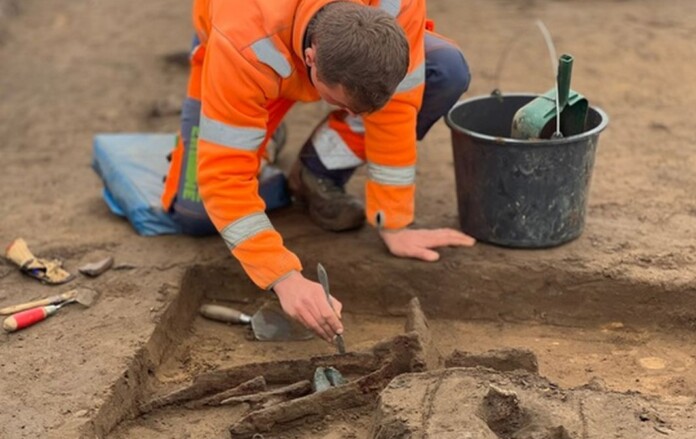
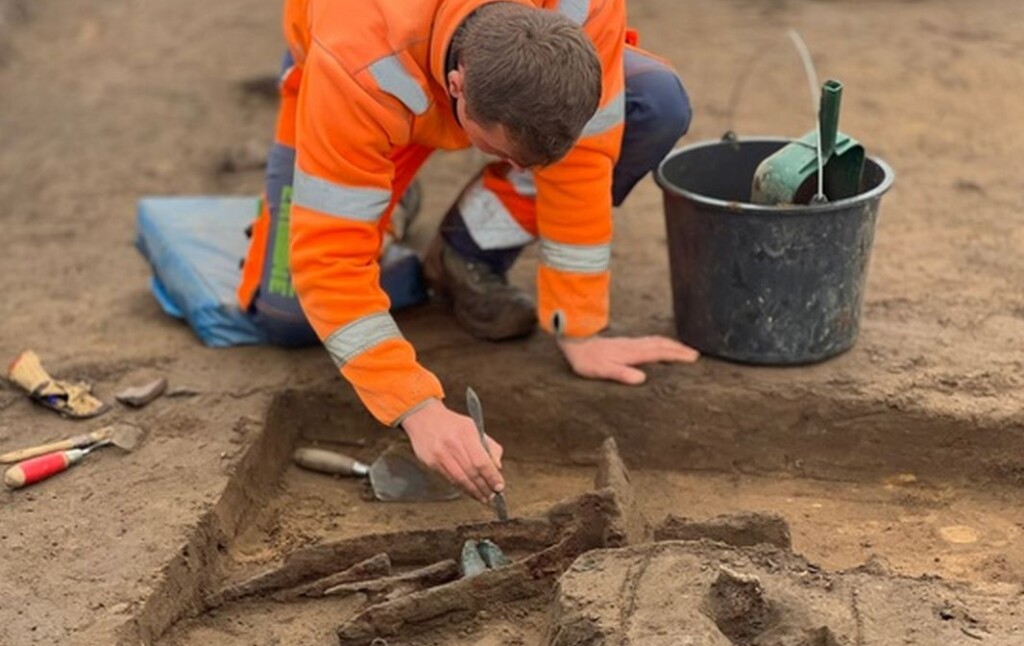
Excavation leader Elias Witte Thomasen uncovering the massive weapon sacrifice - Credit Vejle Museums
Excavation leader Elias Witte Thomasen uncovering the massive weapon sacrifice – Credit: Vejle Museums
During work on the E45 motorway in Denmark, archaeologists uncovered a large ‘weapon sacrifice’ consisting of hundreds of bladed weapons from the late Iron Age.
Alongside the iron armaments, an incredibly valuable chainmail cuirass and other artifacts were also interred, indicating that the site was once inhabited by a prominent leader.
The manner in which the war equipment was buried suggests it was an offering to higher powers, a strange yet well-documented custom that’s believed to have taken place after battles or the death of an important individual.
“From the very first surveys, we knew this was going to be extraordinary, but the excavation has exceeded all our expectations,” said Elias Witte Thomasen, an archaeologist at the Vejle Museums and leader of the excavation, in a museum press release.
“The sheer number of weapons is astonishing, but what fascinates me most is the glimpse they provide into the societal structure and daily life of the Iron Age. We suddenly feel very close to the people who lived here 1,500 years ago.”
The haul includes 119 lance and spearheads, 8 swords, 5 knives, 3 arrowheads, an axe head, and a chainmail cuirass—an object of immense value at the time, which would have taken months to craft. Also found were two ‘oath rings,’ a bugle of sorts, and a horse bridle, alongside other unidentified iron objects and hundreds of flint and pottery fragments.
The rings, worn around the neck, bore the depictions of a ‘ring bearer,’ an artistic motif borrowed from the Romans meant to denote power and loyalty, and who in this case seems to be wearing chainmail similar to the kind found there.
The weapons were found in the remains of two separate buildings in Løsning Søndermark, in the municipality of Hedensted, and were often bent in dramatic angles.
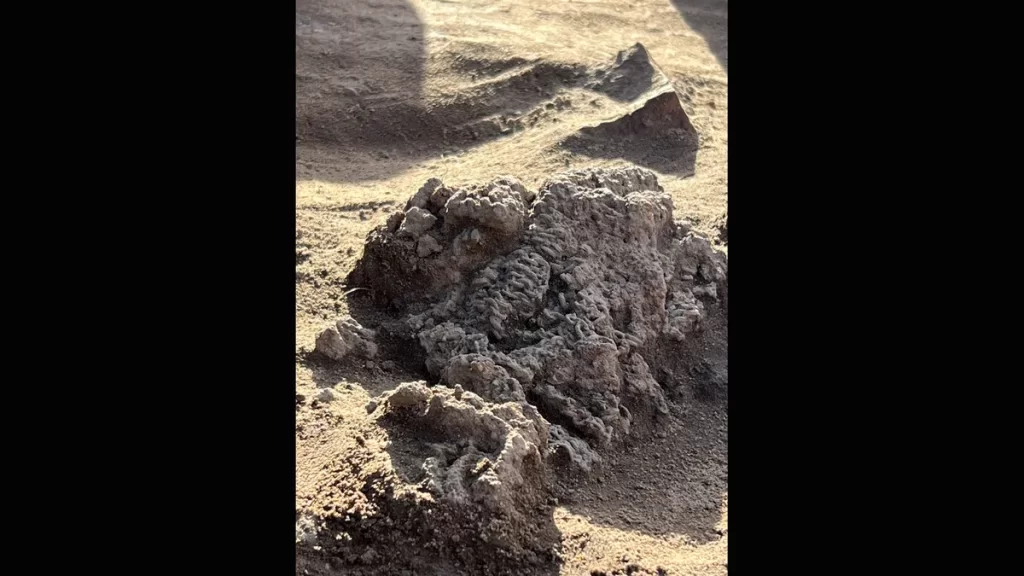
The chainmail shirt -Credit: Vejlemuseere.
In one, the deposits were made during the dismantling of the house. The large, roof-bearing posts were removed, and the weapons were buried in the empty hole. In the second, the offerings were made during the construction of the house, with the weapons and other equipment being tightly packed around the roof-bearing posts prior to backfilling.
This gave the archaeologists the assurance that the building wasn’t a barracks or smithy, where one may expect to find piles of weapons, and that they were all set together for ceremonial purposes.
“Considering how expensive and time-consuming forging weapons was back then, this is like sacrificing a bunch of sedans,” one reader commented on Gizmodo’s report of the museum’s discovery.
The ceramics and flints indicate how the settlement at Hedensted had long been inhabited, and that by the time of the burial—perhaps 400 CE—it had grown into a significant center of community which may have attracted the kind of individual who could afford a chainmail shirt.
Producing chainmail required significant expertise, and would remain part of the battle regalia of Scandinavia’s warrior elite for the next 600 years at least.
Very few chainmails from the Iron Age have been found in southern Scandinavia. The chainmail from Hedensted is the first discovered in relation to a settlement rather than in burials.
Efforts are underway to display parts of the massive find at the Vejle Cultural Museum in early 2025.
SHARE This Unique Discovery With Your Friends Who Love Archaeology…
An energy sector think tank has reported that for the first time ever, the UK has used more renewable energy than fossil fuels across an entire calendar year.
Fossil fuels only produced 97 TWh of electricity, amounting to 35% of the UK’s total grid usage, a steep fall of 11% since 2021.
Wind, solar, and hydropower reached a record high in 2024, generating 37% of UK electricity (103 TWh) with wind power nearly overtaking natural gas, and in fact did so during the first three quarters of 2024.
UK wind power is currently forecast to generate 29% of UK electricity in 2024, totaling 82 TWh.
The numbers were published recently by Ember, which produces analysis on energy around the world.
“The renewables future is here,” said Ember senior energy and climate analyst Frankie Mayo.
“This long-awaited milestone is a testament to how much progress the UK has made. It’s time to seize the moment, to cut reliance on expensive gas with new renewables, storage, and grid upgrades.”
“With the phase-out of coal power completed this year, reducing gas use is the next big opportunity for the country,” he concluded.
According to EDGAR, the Emissions Database for Global Atmospheric Research, the UK was Europe’s third-largest emitter of CO2 emissions and equivalents (0.8% of the global total), behind Germany and Italy (Russia and Turkey excluded) but had experienced the most dramatic reduction (45%) when measured against national emissions in the year 2,000.
“Renewables producing more of the UK’s electricity than fossil fuels for the first time ever is a real landmark moment in Britain’s transition to being a clean energy superpower,” Greenpeace UK policy director Doug Parr said in a statement.
SHARE This Good Green Energy News With Your Friends From The UK…
Henna tattooing has been inscribed as Intangible Cultural Heritage - Credit: Aditya Saxena for Unsplash
Henna tattooing has been inscribed as Intangible Cultural Heritage – Credit: Aditya Saxena for Unsplash
Most people know that Rome, Machu Picchu, and the Great Pyramids are enshrined as “World Heritage Sites” by the UN’s cultural and educational organ, UNESCO.
Far fewer will know that UNESCO maintains another ‘World Heritage’ list, one that’s far more important, arguably, than the task of ensuring the most famous monuments of the world survive through the centuries.
It’s called ‘Intangible Cultural Heritage’ and was first organized in 2008. It strives to recognize, honor, and therefore protect, all traditional activities that tell the story of the human experience: from Parisian baguette baking to Indian henna tattooing.
UNESCO’s 19th annual session of the Intergovernmental Committee for the Safeguarding of Intangible Cultural Heritage has recently concluded in Paraguay, adding 58 different forms of cultural traditions to its list of Intangible Cultural Heritage. It includes all manner of traditions, rare and common, threatened and thriving, enjoyed by humans around the globe.
The musical genre of Guarania in Paraguay; the Korean tradition of fermenting soybeans to make jang; Aleppo soap making, where giant ‘floors’ of soap are cut into bars by men wearing bladed sandals; Pysanka, the Ukrainian art of decorating easter eggs; K’cimi dancing of Tropojë, in Albania; the Festival of Bà Chúa Xứ Goddess at Sam Mountain,
Vietnam; and Ngondo, the worship of water oracles in the marshlands of Cameroon are just a few of this year’s inscriptions on the list of ways in which humans enrich their lives, cultures, and the world as a result, and which UNESCO strives to protect.
If you’ve never heard of these, maybe the concept of the list is better expressed with three of the most famous inscriptions from this year’s additions.
Henna tattooing has been going on since the Old Kingdom of Egypt, as traces of the henna plant have been identified on mummies’ skin. Practiced right the way across the belt of the world, from Morocco to Bangladesh, it is the most common non-permanent form of body decoration on Earth, and is used during holidays and family celebrations, or just for fun.
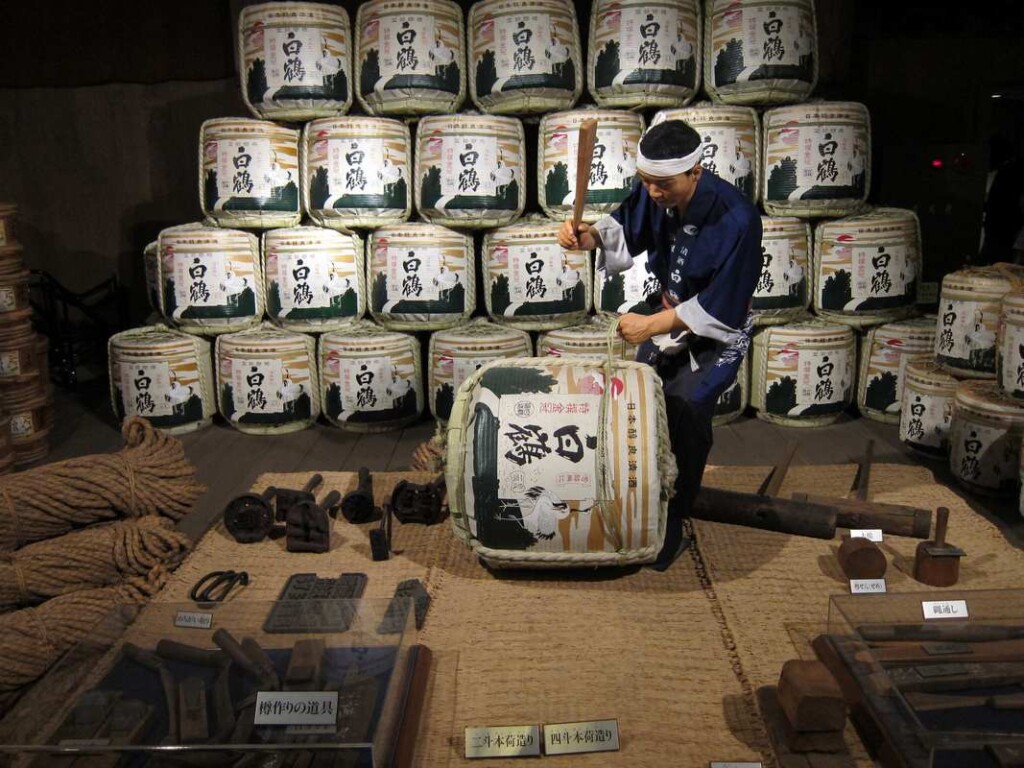
The Sake Brewing Museum in Kobe – Credit hslo CC 2.0., via Flickr
Sake is an alcoholic beverage made from grains and water that is deeply rooted in Japanese culture. Craftspeople use koji mold to convert the starch in the ingredients into sugar. They oversee the process to make sure the mold grows in optimal conditions, adjusting the temperature and humidity as needed. Their work determines the quality of the sake. Viewed as a sacred gift from deities, sake is indispensable in festivals and other occasions.
The art of dry stone construction refers to the practice of building with stone without using binding material. Traditionally practiced in 14 countries across Europe, it is achieved through the careful selection and arrangement of stones to ensure the long-term stability of the structure and its adaptation to the local terrain and climate. Structures include houses, bridges, and fortifications.
It’s extremely common for travelers to plan routes around visits to World Heritage Sites, but the Intangible Cultural Heritage list offers an alternative and fascinating way to organize a trip to a faraway country, as most travelers will tell you it’s always the human element of a trip that stands out the most in one’s memories.
UNESCO Director-General Audrey Azoulay said it best in a statement upon the conclusion of the session; that World Heritage Sites may be the famous part of UNESCO’s work, but Intangible World Heritage is probably a much more important role for the organization.
“With more than 700 inscriptions to date, this Convention has reinvented the very notion of heritage—to the extent that we can no longer separate the tangible from the intangible, the sites from the practices,” Azoulay, from Algeria, wrote.
“It is our great responsibility to promote this heritage, which—far from being mere folklore, far from being frozen in time and distanced from today’s reality—is very much alive and needed.”
SHARE This Celebration Of Humanity’s Cultural Heritage With Your Friends…
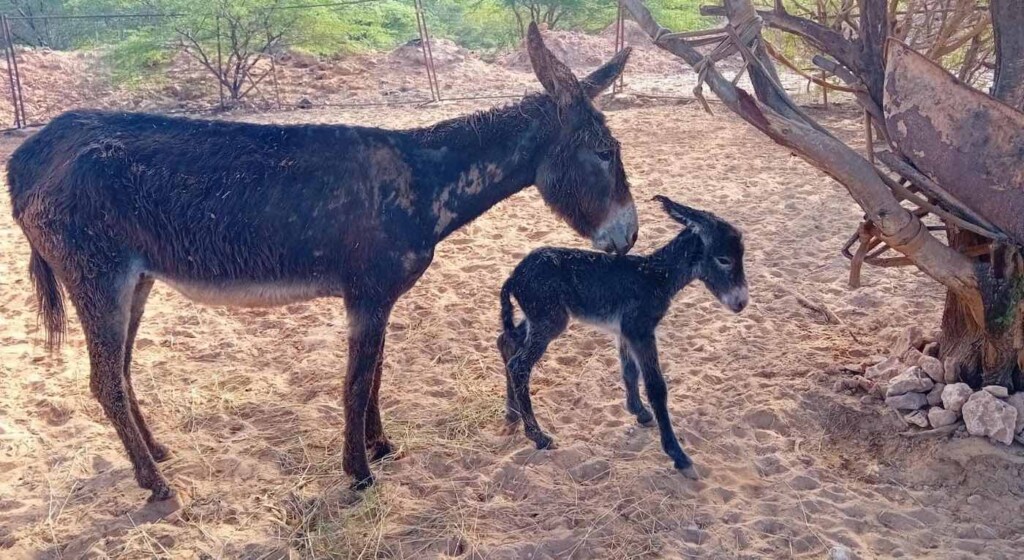
Rescued mule gave birth to surprise Christmas miracle –by Sue Toach / SWNS
Rescued donkey gave birth to surprise Christmas miracle – by Sue Toach / SWNS
In a delightful and kind Christmas story, a pair of British travelers found ‘room at the inn’ for a dying donkey who then gave birth to a foal after receiving treatment.
Sue and Andy Toach were due to escape the cold of England with a winter vacation out in Boa Vista, Cape Verde. As it happened, Sue spotted a post on their hotel’s Facebook page about a dying donkey found stranded on the beach.
Animal lovers both, the Toachs purchased some supplies to take in a bid to save the skeletal and sick donkey—named Bella-Riu—from death.
On arrival, Sue teamed up with other hotel guests and local tour guides to find a veterinarian who might be able to treat Bella. They then managed to find a home for her at a local riding center and, just days later, Bella gave birth in the stable when nobody had even known she was pregnant.
“When Bella was found, she was very skinny, her hips and ribs were visible, her coat was matted and she was covered in parasites,” Sue told the British media outlet SWNS. “When I got there I was grooming her twice a day, and would sit and talk to her after I gave her twice-daily medicine.”
“The local tour guides came back to us the next day and said they had found a man, Sidnei, who could take Bella,” she said. Arrangements were made, and once in the stable it didn’t take long for Bella to get settled in her new, temporary home; she even made friends with one of his horses—who had been a fellow rescue.
Sue and Andy were due to fly home when she got a call from the tour guide Lindsay saying Bella had given birth overnight.
Sue had suspected Bella might be pregnant but vets weren’t able to bring her in to be scanned, so nobody knew for sure.
Now fast-recovering Bella and her surprise son named Spaghetti live happily in their new home.
“I left before I got to meet Spaghetti, but we’ve promised to go back—we want Bella and Spaghetti to have a fantastic life there,” said the inspired Sue, who, along with the other guests, have started a GoFundMe to raise money for the rest of Bella’s treatment.
And Sue has vowed to return next year so she can see Bella again and meet Spaghetti for the first time.
“Now we’re hoping to raise money to help Sidnei with their care and veterinary bills, so we can still help from back at home. Sidnei said he might be able to take more rescues on too, so we’re hoping the money can go towards that as well.”
SHARE This Christmas-Themed Vacation Story From Sunny Cape Verde…
Quote of the Day: “When one teaches, two learn.” – Robert Half
Photo by: fran innocenti
With a new inspirational quote every day, atop the perfect photo—collected and archived on our Quote of the Day page—why not bookmark GNN.org for a daily uplift?
In rural Indiana, a couple are selling around 1,000 stately fir and pine trees for Christmas to help fund the education of their 8 grandchildren.
Shawn and Bruce Carpenter planted around 5,000 tiny trees a decade ago, reasoning that by the time they reach between 6 and 10 feet tall, their grandchildren will begin shipping off to colleges and universities across the country and will need a helping hand.
Time passed, and the Carpenters let nature take its course on the plantation; keeping a lookout for bagworms and mowing the grass between the trees, but doing little else besides.
Many died, but around a thousand, beautiful trees remain ready for the holiday season, meaning that Bittersweet Farms is finally ready for business.
“It was an investment to help our grandkids for college,” Shawn Carpenter told the Herald Times. “One that’s taken awhile.”
“Bittersweet Farms Cut & Carry Christmas Trees for Sale,” reads a sign the Carpenters put out by their rural mailbox on Bittersweet Road in Bean Blossom, Indiana, located in the state’s south-central Brown County.
Pick Your Own Christmas Tree estimates that this year, after inflation, trees will likely cost around $13 per foot, with rural prices trending down towards about $75 for an average tree, but going for as much as $100 in the cities. Bittersweet Farms charges $10 per foot.
If the Carpenters were to ship 60% of their total stock at a median price of $83, they’d pocket just shy of $50,000. Presuming expenses and taxes of 20% of the take-home, they’d close the season at around $39,000.
If all 8 of the grandchildren attended university, they would receive $4,875 from their grandparents; a pretty helpful way to start the next chapter of their lives.
On November 30th—their first day of business—they sold 6 trees, including two of their largest to a Columbus Regional Hospital executive who bought the hospital building a tree for 2024 and 2025.
Up until now, the family has been harvesting trees from the land for years, but this is the first time the public has been able to buy from there. Buyers can saw one down themselves, or they can get help from Bruce and Shawn.
Bittersweet Farms is open Monday through Saturday 10 a.m. until 5:30 p.m. and is closed on Sundays.
TELL Your Friends To Get Down To Bean Blossom And Buy Themselves A Tree…
LEGO is celebrating 5 years of success for its flagship sustainability initiative Replay which allows consumers to ship used and unwanted LEGO bricks back to the company for redistribution to others.
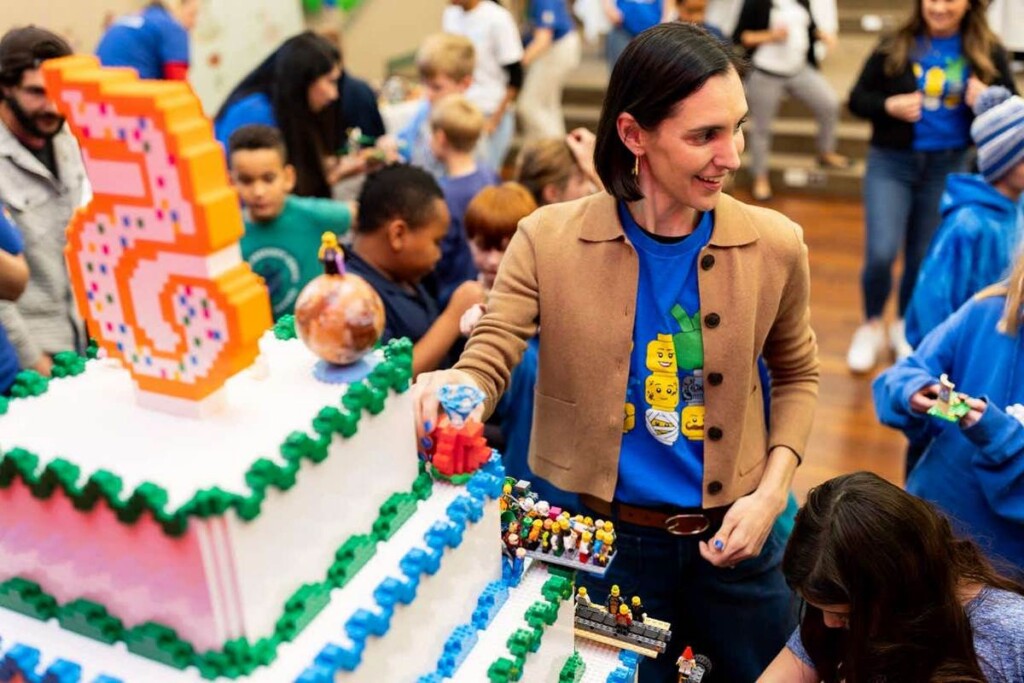
In a pair of lovely celebrations in Boston and Richmond, giant LEGO birthday cakes bearing the number ‘5’ were decorated by children who then got to take sets made of donated LEGO bricks home with them.
GNN first reported on Replay’s launch in 2019, and five years on there have been 1,229,072 lbs. of LEGO bricks donated to the program which has distributed them to almost 400,000 children over the last five years.
Sara Rossley, Replay Program Manager in Boston, enjoys the festivities – Credit: LEGO, released
That’s over 300 million individual bricks filling 190,000 distributed Replay sets, all being reused and re-loved rather than thrown in a landfill.
Most people don’t want to give away, or certainly throw out, their LEGO collection, according to Tim Brooks, the Environmental Responsibility Vice President at the LEGO Group.
“The vast majority hand them down to their children or grandchildren. But others have asked us for a safe way to dispose of or to donate their bricks. With Replay, they have an easy option that’s both sustainable and socially impactful,” he said in 2019 when Replay first launched.
That option has been routinely availed of, and coupled with existing initiatives to use recycled plastic to manufacture bricks—with the increase in cost coming out of company profits, LEGO is becoming one of the most sustainable toy companies on Earth.
“The LEGO® Replay program highlights the lasting power and durability of the LEGO brick and ensures it stays ‘in play’ through donations across the country,” said Skip Kodak, Americas Regional President at the LEGO Group.
“This free and easy-to-use program gives LEGO bricks renewed life, and we’re proud that over the past five years, Replay has reached nearly 400,000 kids, increasing their access to learning through play. It’s been a delight to engage more kids and educators with Replay through this anniversary celebration.”
The donation process is simple: collect any loose LEGO bricks, sets, or elements, place them in a cardboard box, and visit lego.com/replay to print out a free UPS shipping label. The package will be sent to the LEGO Replay facility, where each brick will be sorted, inspected by hand, and given a rigorous cleaning. Donated bricks will then be distributed to kids throughout the U.S. by nonprofit partners.
SHARE This Great Alternative To Throwing Away This Classic Toy…
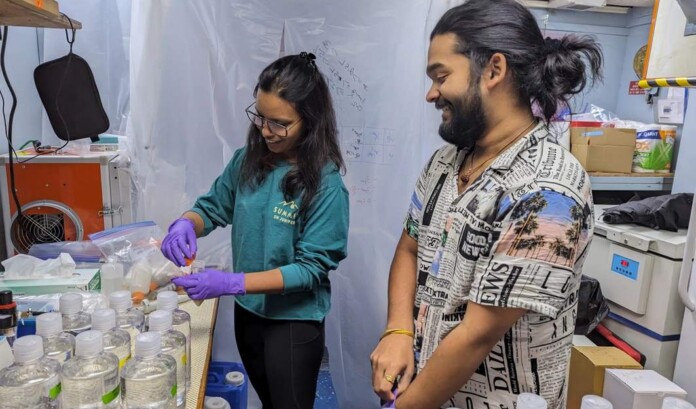
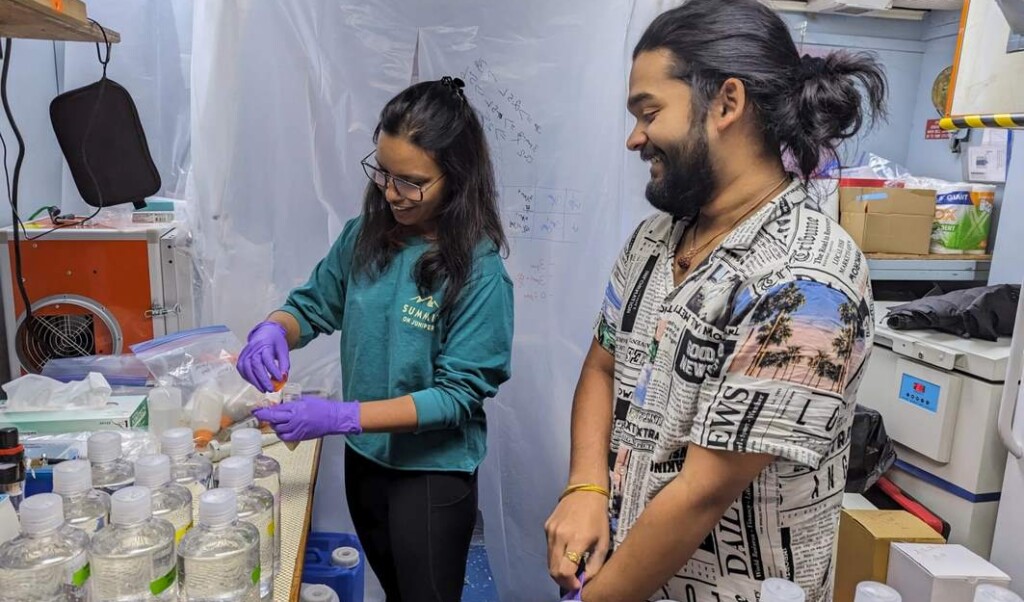
First authors Diksha Sharma, left, and Vignesh Menon lead experiments on seawater collected from the Gulf of Maine - Credit: Annie Kandel, released
First authors Diksha Sharma, left, and Vignesh Menon lead experiments on seawater collected from the Gulf of Maine – Credit: Annie Kandel, released
American scientists have proposed a new method for recruiting trillions of microscopic sea creatures and their insatiable appetites for the fight against climate change.
The technique harnesses the animals’ daily habits to essentially accelerate the ocean’s natural cycle for removing carbon from the atmosphere, which is known as the biological pump, according to the paper in Nature Scientific Reports.
The study, published by researchers at Dartmouth College, reported that spraying clay dust on the surface of the ocean converts carbon into food the animals would eat, digest, and send deep into the ocean as carbon-filled feces.
They explain that the process would begin with spraying the clay dust at the end of algae blooms. These blooms can grow to cover hundreds of square miles and remove about 150 billion tons of carbon dioxide from the atmosphere each year, converting it into organic carbon particulates. But once the bloom dies, marine bacteria devour the particulates, releasing most of the captured carbon back into the atmosphere.
The researchers found that the clay dust attaches to carbon particulates before they re-enter the atmosphere, redirecting them into the marine food chain as tiny sticky pellets the ravenous zooplankton consume and later excrete at lower depths.
“Normally, only a small fraction of the carbon captured at the surface makes it into the deep ocean for long-term storage,” says Mukul Sharma, the study’s corresponding author and a professor of earth sciences. Sharma presented the findings on December 10th at the American Geophysical Union annual conference in Washington D.C.
“The novelty of our method is using clay to make the biological pump more efficient—the zooplankton generate clay-laden poops that sink faster,” says Sharma, who received a Guggenheim Award in 2020 to pursue the project.
A mixed zooplankton sample including common species – Credit Adriana Zingone, Domenico D’Alelio, Maria Grazia Mazzocchi, Marina Montresor, Diana Sarno, LTER-MC team CC 4.0. BY-SA
“This particulate material is what these little guys are designed to eat. Our experiments showed they cannot tell if it’s clay and phytoplankton or only phytoplankton—they just eat it,” he says. “And when they poop it out, they are hundreds of meters below the surface and all that carbon is, too.”
The team conducted laboratory experiments on water collected from the Gulf of Maine during a 2023 algae bloom. They found that when clay attaches to the organic carbon released when a bloom dies, it prompts marine bacteria to produce a kind of glue that causes the clay and organic carbon to form little balls called flocs.
The flocs become part of the daily smorgasbord of particulates that zooplankton gorge on, the researchers report. Once digested, the flocs embedded in the animals’ feces sink, potentially burying the carbon at depths where it can be stored for millennia. The uneaten clay-carbon balls also sink, increasing in size as more organic carbon, as well as dead and dying phytoplankton, stick to them on the way down, the study found.
In the team’s experiments, clay dust captured as much as 50% of the carbon released by dead phytoplankton before it could become airborne. They also found that adding clay increased the concentration of sticky organic particles—which would collect more carbon as they sink—by 10 times. At the same time, the populations of bacteria that instigate the release of carbon back into the atmosphere fell sharply in seawater treated with clay, the researchers report.
In the ocean, the flocs become an essential part of the biological pump called marine snow, Sharma says. Marine snow is the constant shower of corpses, minerals, and other organic matter that falls from the surface, bringing food and nutrients to the deeper ocean.
“We’re creating marine snow that can bury carbon at a much greater speed by specifically attaching to a mixture of clay minerals,” Sharma says.
Zooplankton accelerate that process with their voracious appetites and incredible daily sojourn known as the diel vertical migration. Under cover of darkness, the animals—each measuring about three-hundredths of an inch—rise hundreds, and even thousands, of feet from the deep in one immense motion to feed in the nutrient-rich water near the surface.
When day breaks, the animals return to deeper water, where they deposit the flocs as feces. This expedited process, known as active transport, is another key aspect of the ocean’s biological pump that shaves days off the time it takes carbon to reach lower depths by sinking.
Sharma plans to field-test the method by spraying clay on phytoplankton blooms off the coast of Southern California using a crop-dusting airplane. He hopes that sensors placed at various depths offshore will capture how different species of zooplankton consume the clay-carbon flocs so that the research team can better gauge the optimal timing and locations to deploy this method—and exactly how much carbon it’s confining to the deep.
“It is very important to find the right oceanographic setting to do this work. You cannot go around willy-nilly dumping clay everywhere,” Sharma told Dartmouth press. “We need to understand the efficiency first at different depths so we can understand the best places to initiate this process before we put it to work. We are not there yet—we are at the beginning.”
SHARE How These Scientists Working Towards A Better Tomorrow…
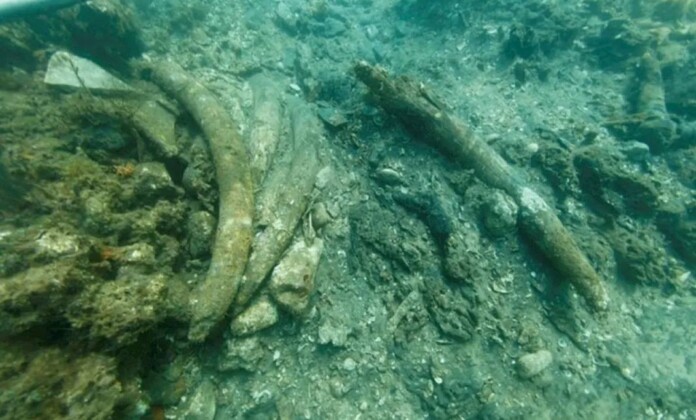
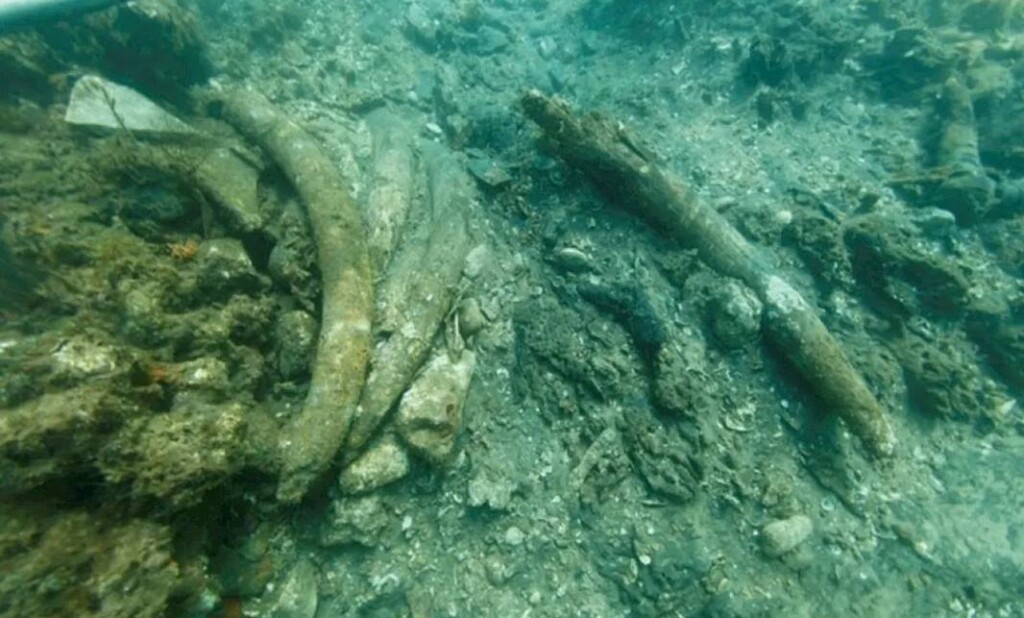
Elephant ivory was found among the wreckage - Credit: Caesar Bita, National Museums of Kenya
Elephant ivory was found among the wreckage – Credit: Caesar Bita, National Museums of Kenya
Not far off the Kenyan coast, maritime archaeologists believe they have found the wreckage of a galleon belonging to Vasco da Gama, the Portuguese navigator who found the route to India around Africa.
While the true provenance of the vessel is unclear, the discovery would be of monumental importance to the study of maritime archaeology, and the history of European exploration.
It was originally identified near the city of Malindi in 2013 by Caesar Bita, an underwater archaeologist at the National Museums of Kenya who received a tip from a local fisherman.
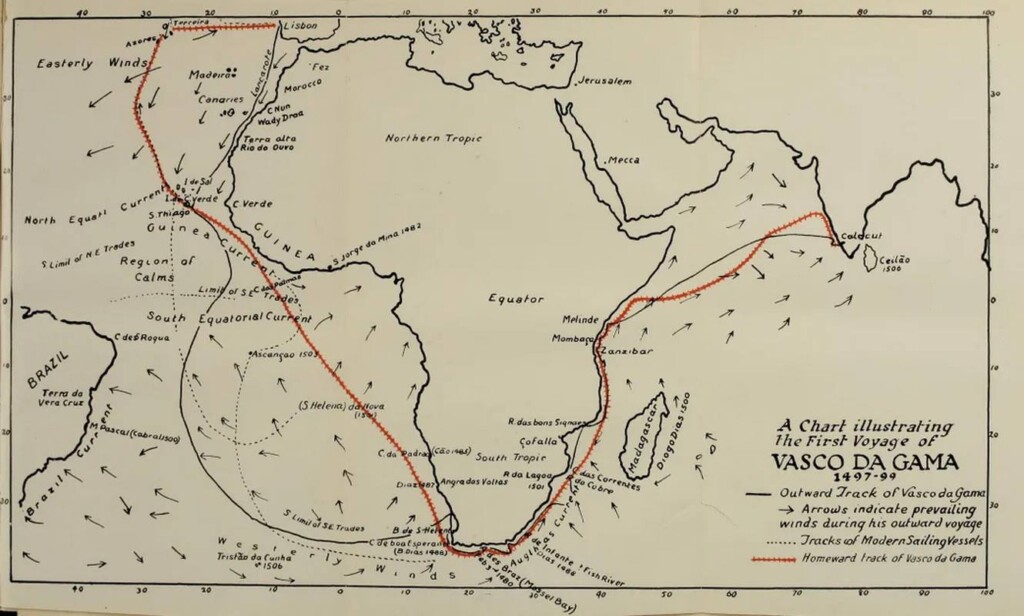
Commissioned in 1497 to find a route to “the Indies,” da Gama was the first European to round the Cape of Good Hope, before proceeding to sail north along the coast of Zanzibar to reach India. It was the first route to India by sea, and it changed European and world civilization forever.
On his third, multi-ship voyage in 1524, one of the Portuguese galleons, the São Jorge, sank somewhere off East Africa, but da Gama died of an illness en route, and a precise location for the ship was never provided.
After years of documentation, Bita invited the Portuguese nautical archaeologist Filipe Castro from the Center for Functional Ecology at the University of Coimbra to investigate the wreck. Together, they believe the ship is the São Jorge, which would make it the oldest European wreck in the whole of the Indian Ocean.
“I think this is a unique shipwreck,” Castro tells Live Science’ “It is a treasure.”
A map of Vasco da Gama’s first voyage to India.
Lying at shallow depths of just 20 feet, this ship is protected by the local population, who are part of a community archaeology project and who the team intends to train so that they can monitor the finds and participate in their recording and analysis.
Elephant ivory and copper ingots have been excavated from the wreck, where few timbers from the ship remain. The divers have uncovered pieces of the hull after digging some trenches on the seafloor, but other features remain covered in coral.
“It is larger than what we imagined for an early 16th-century ship,” Castro tells Artnet. “It is enormous. The first feeling you get when you look at it is that it is going to take time to dig it. Carefully, minding the details.”
Although there is a list of eight Portuguese shipwrecks in Malindi waters, the provisional dates of the artifacts point to the first quarter of the 16th century, and a ship that was on the outward journey to India rather than the return journey.
This means it could also be the Nossa Senhora da Graça, another Portuguese vessel that sank in 1544, but that wasn’t a part of the famous navigator’s fleet.
Quote of the Day: “We shall never know all the good that a simple smile can do.” – Mother Teresa
Photo by: public domain
With a new inspirational quote every day, atop the perfect photo—collected and archived on our Quote of the Day page—why not bookmark GNN.org for a daily uplift?
The Milwaukee Art Museum's Art:Forward Gala in 2024 - Credit: Front Room Studios and courtesy of the Milwaukee Art Museum.
The Milwaukee Art Museum’s Art:Forward Gala in 2024 – Credit: Front Room Studios and courtesy of the Milwaukee Art Museum.
Thanks to the kindness of a generous donor, children 12 and under will now be able to visit the Milwaukee Art Museum (MAM) for free.
The gift of $3.5 million was given anonymously but with instructions to establish an endowment supporting child attendance at the museum.
The donor “shared fond memories of visiting the museum with their family throughout their life” and “expressed their wish for the endowment to foster similar experiences for future generations of families,” according to the museum’s Tuesday announcement.
“This wonderful gift is a celebration of the way that philanthropy can have a significant and lasting impact for generations,” MAM chief development officer André Allaire said in the news release.
“Every day, our youngest museum visitors will be able to access, engage with, and learn from world-class exhibitions and programs free of charge thanks to the generosity of an individual who believes in the power of art to strengthen our community.”
Children ages 12 and under will have free access not only to the museum’s collections, but also its exhibitions and youth and family programs.
At the moment, MAM’s exhibitions include a collection of photography, images, and videos from American image artist Robert Longo, entitledAcceleration of History, and a collection of woodblock prints from the Baltimore-based artist, wife, mother, and educator LaToya M. Hobbs.
“Since our earliest days as an institution, the Milwaukee Art Museum has provided free educational experiences for children,” said Marcelle Polednik, the MAM director. “The endowment established from this inspirational donation will keep that tradition alive for future generations of the communities we serve.”
KNOW Anyone In Milwaukee? SHARE This Great News For Those With Kids…
Last year GNN reported on two Louisiana high schoolers who used trigonometry to properly demonstrate Pythagoras’ Theorum, a mathematical concept that remained unsolved for more than 2,000 years.
Ne’Kiya Jackson and Calcea Johnson made national headlines, won their school a large grant, and were invited to publish papers on their discovery after making it.
On October 28th, in a paper published by the teens in the journal American Mathematical Monthly, they’ve used their skills in trigonometry to demonstrate 9 other ways to prove the theory.
To understand the scope of their accomplishment, it’s necessary first to understand the theory.
Pythagoras’ Theorem deals with triangles that are not perfectly symmetrical, and it goes like this.
The area of the square whose side is the hypotenuse (the side opposite the right angle) is equal to the sum of the areas of the squares on the other two sides. It is written as a2+b2=c2.
Pythagoras’ Theorem CC 3.0. Wapcaplet
One of the interesting things about this equation is that for 2,000 years, no mathematician has been able to demonstrate the truth of it without simply using the equation itself as proof; what is called circular logic, and not accepted as true evidence of proof.
It was this sticky problem that the teens solved, and in doing so won their academy a large grant from NBA legend and all-around great guy, Charles Barkley.
“To have a paper published at such a young age — it’s really mind-blowing,” Johnson, who is now studying environmental engineering at Louisiana State University, said in a statement emailed to Live Science. “I am very proud that we are both able to be such a positive influence in showing that young women and women of color can do these things.”
According to Johnson and Jackson, they proved the theory correct without using it as proof like this. Trigonometry is the study of triangles, and presenting equations through it can be done through the principles of sine and cosine. Sine and cosine are ratios that are defined in the context of a triangle’s right angle.
However, according to the young women, over time these two principles have merged in an unhelpful way.
“Students may not realize that two competing versions of trigonometry have been stamped onto the same terminology,” the pair write in their introduction. “In that case, trying to make sense of trigonometry can be like trying to make sense of a picture where two different images have been printed on top of each other.”
Beyond this explanation, readers can take a look at the presentation in the study and see for themselves whether they can make sense of the concepts. In any case, by teasing sine and cosine apart, one can find “a large collection of new proofs of the Pythagorean theorem.”
SHARE These Amazing Teen Minds And Their Continued Success…