











All News - Page 215 of 1715 - Good News Network
Home Blog Page 215

This Tiny Moon of Saturn Is the Smallest Case of a Subsurface Ocean Ever Found in the Solar System

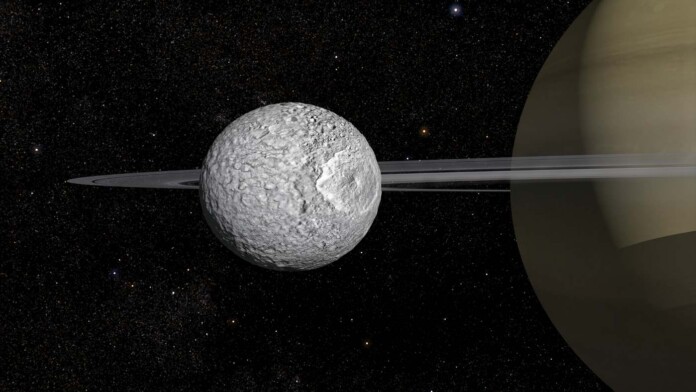
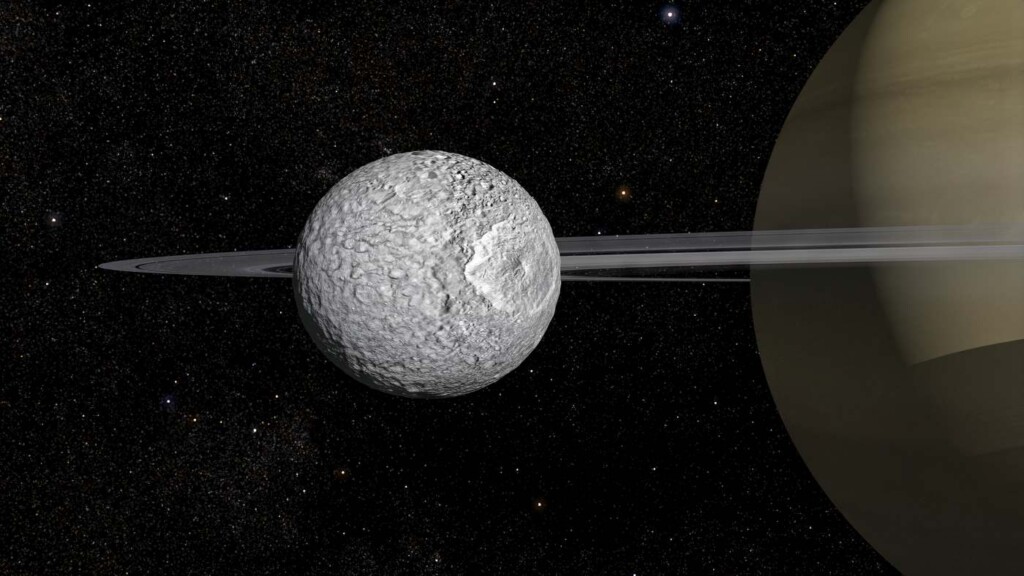
PICTURED ABOVE: An artist’s impression of the small moon of Mimas which may very well hold a subsurface ocean. PC: Frédéric Durillon, Animea Studio Observatoire de Paris – PSL, IMCCE

Reprinted with permission and alterations from World at Large, an independent news outlet covering world news, conflicts, travel stories, conservation, and science news.

It’s been known for a decade that Saturn’s icy moon of Enceladus almost certainly hides a subsurface ocean beneath its northern pole. But as scientists writing in Nature recently challenged, the same is true for a much smaller and unlikely moon called Mimas.

Think of a glacier shaped like a ball the size of California or Spain and you have some idea of what Mimas looks like. Imagining this compact snowball becomes a bit more difficult if you think that between 12 and 18 miles down lies a contained ocean containing a little less water than the whole Mediterranean Sea.

These subsurface oceans on icy moons are extremely exciting targets for astrobiologists since it’s believed that life first evolved on Earth in its shallow seas. These cryo-geologic features are present on Enceladus and the Jovian moon of Europa, but until now, no one was looking at bodies as small as Mimas, which is many times smaller than the other two.

“Mimas is a small body whose most distinctive feature is a crater so large that it gives the moon the appearance of the Death Star space station from the Star Wars franchise,” writes Matija Ćuk from the SETI Institute in California, and Alyssa Rose Rhoden from the Southwest Research Institute, who together wrote a comment on the paper.

Previous research has suggested two possibilities for Mimas’ interior: either an elongated rocky core or a global ocean. The latest analyses by Valery Lainey and her colleagues at the Observatoire de Paris, reveal that changes to the rotational motion and orbit of the small moon are affected by its interior in such a way as to suggest that beneath its cratered, pock-marked exterior, there lies an ocean and not a rocky core.

To do this, Lainey et al. took careful measurements of the moon’s moments of inertia, or its resistance to rotational acceleration. The inertia allowed the team to understand the moon’s gravitational field.

The team used data from the Cassini spacecraft, which has been exploring the Saturnine environment for many years and led to some of the largest advances in the understanding of the famous ringed planet and its moons.

Moving backwards to go forwards

Time for a science lesson: Saturn and Earth are slightly flattened planets. Among other things, this causes the orbit path of moons to shift in a flat circular motion. Take a ball in one hand and a ring in the other, then move the ring in a flat motion without touching the ball within, and you have a visual picture of this phenomenon.

For the sake of the example, if the ball (or planet) is rotating clockwise, and the ring (or orbit) is moving clockwise as well, this is the effect that flattened planets have on the precession, or shifting of the orbital path, of their moons. If the moon’s shape and/or gravitational field are elongated like an egg, this phenomenon is reversed, i.e. the planet and moon rotate clockwise, but the orbital path is rotating counterclockwise.

PICTURED: Mimas’ large crater called Herschel. PC: NASA/JPL-Caltech – SSI/CICLOPS Kevin M. Gill. CC 2.0.

What Lainey and her colleagues discovered is that Mimas’ orbital precession is the latter case, but if so, the movements of a frozen body of ice and rock do not match the patterns of inertia recorded. Instead, the measurements of Mimas’ position suggest that the evolution of its orbit is better explained as being influenced by an internal ocean.

MORE FROM WORLD AT LARGE: Locked in a 4 Billion-Year-old Dance, Six New Exoplanets Demonstrate the Cosmic Beauty of ‘Resonant Orbits’

The authors calculate that the ocean lies beneath an icy shell approximately 12 to 18 miles (20–30 km) deep. Simulations suggest that it appeared between 25 and 2 million years ago. As such, signs of such an ocean would not have had time to make a mark on the surface, such as heavy fracturing on the surface of Europa, or the cryo-volcanoes that spew out ice, gas, and sloshy material present on Enceladus.

“The idea that Mimas’ ocean could have formed relatively recently also has implications for other features of the Saturnian system that remain mysteries, in spite of clues retrieved by the Cassini mission,” explain Ćuk and Rhoden.

“Saturn’s bright icy rings are apparently young in geological terms, but not all scientists agree. The heavily cratered icy moons seem ancient, but the source of the bodies that made the craters is disputed, and there are suggestions that the moons themselves are also geologically young”.

MORE SCIENCE NEWS: Webb Telescope Detects Water Vapor Just Hanging Out in Space Inside Fascinating Goldilocks Zone

“The clues provided by Mimas and its ocean could help to resolve some of these conundrums. Finally, adding Mimas to the catalogue of ocean worlds changes the general picture of what these moons can look like. The idea that relatively small, icy moons can harbor young oceans is inspiring, as is the possibility that transformational processes have occurred even in the most recent history of these moons,” they add.

Lainey and colleagues’ findings will no doubt motivate a thorough examination of mid-sized icy moons throughout the solar system, of which there may be dozens. Most notably, there is a suite of mid-sized icy moons orbiting Uranus, which was selected as the highest-priority target of a NASA flagship mission by the Planetary Science and Astrobiology Decadal Survey. WaL

SHARE This Amazing Discovery Of Oceans On Tiny Moons…

Recycling Crew Didn’t Stop Searching for Woman’s Lost Wedding Ring Until They Found a ‘Needle in a Haystack’

credit - City of Greenville, South Carolina Government / Facebook
credit – City of Greenville, South Carolina Government / Facebook

Finding a needle in a haystack is always easier when the needle isn’t worth thousands of dollars, but the stress of it all was borne by the trash collectors from the city of Greenville, and reunited a woman with her lost wedding band.

It was a routine stop at the local recycling center for Melanie Harper, but as she was separating plastics and paper, she accidentally separated white gold and diamonds as well.

Her wedding band slipped off into the bins and she was sure the chances of finding it were slim. Harper emailed the city’s public works department and asked them if they could keep an eye out for a glittery band amid the trash, and while she went home unoptimistic, the litter pickers and public works employees upended the whole container in a parking lot and went to work.

Sifting meticulously through the refuse, the workers epitomized the ideas of public service, and perhaps it was destiny that the man who found it was named “Golden.”

“After hours of searching, Travis Golden struck gold. White gold. They called a very grateful Melanie, who came out to PW to reunite with her ring,” read a post from the Greenville South Carolina Facebook page, which gave a shout-out to Golden and the other staff members who pitched in to find the ring. “We are so grateful for your commitment to our community.”

credit – City of Greenville, South Carolina Government / Facebook

“Finding a needle in a haystack = hard. Finding a ring in a recycling bin = nearly impossible. Unless you’re City of Greenville Public Works, where employees truly dive into their work!” the post added.

It’s not the first time this has happened in the country recently. Last August, GNN reported that parks supervisor Lauren Perez from Corpus Christi organized the complete disruption of Monday morning trash collection in order to locate a 40-yard dumpster where she knew a 17-year-old had lost a ring containing her father’s ashes.

MORE STORIES LIKE THIS: Ring Lost Down Toilet 13 Years Ago is Discovered at Wastewater Treatment Facility 1,000 Feet From Her Home

Trash collection workers Jesse Martinez and Robert Trevinco joined Perez in combing through the trash left baking over the weekend’s nearly 100°F heat. They searched for hours until they came upon a big with the Subway boxes—where the girl’s mom had told them they would be—and methodically began opening them one by one until, at last, a purple jewel shined in the morning light.

“It was in the last bag we went through,” Perez told the Washington Post. “I was so excited to let her know.”

SHARE These Dedicated And Considerate Individuals Of South Carolina… 

New Spiral-Shaped Lens is Massive Improvement for Eyewear: ‘Potentially Revolutionizing Ophthalmology’

The new spiral diopter lens could be used on contact lenses and implants for cataracts Credit: Laurent Galinier / SWNS
The new spiral diopter lens could be used on contact lenses and implants for cataracts Credit: Laurent Galinier
/ SWNS

Ophthalmologists have developed a spiral-shaped contact lens that maintains clear focus at different distances and in varying light conditions.

The new lens works much like progressive lenses used for vision correction but without the distortions typically seen with those lenses. It could help advance contact lens technologies, intraocular implants for cataracts, and miniaturized imaging systems.

The inspiration for the design came when the paper’s first author, Laurent Galinier, was analyzing the optical properties of severe corneal deformations in patients. This led him to conceptualize a lens with a unique spiral design that causes light to spin, like water going down a drain.

This phenomenon, known as an ‘optical vortex,’ creates multiple clear focus points, which allow the lens to provide clear focus at different distances.

“Creating an optical vortex usually requires multiple optical components,” Galinier told Optica. “Our lens, however, incorporates the elements necessary to make an optical vortex directly into its surface. Creating optical vortices is a thriving field of research, but our method simplifies the process, marking a significant advancement in the field of optics.”

In Optica, Optica Publishing Group’s journal for high-impact research, the researchers describe the new lens, which they call the spiral diopter, and Bertrand Simon from another optics laboratory said their invention could revolutionize ophthalmology.

“Unlike existing multifocal lenses, our lens performs well under a wide range of light conditions and maintains multifocality regardless of the size of the pupil,” said Simon from the Photonics, Numerical and Nanosciences Laboratory in France. “For potential implant users or people with age-related farsightedness, it could provide consistently clear vision, potentially revolutionizing ophthalmology.”

MORE RESEARCH NEWS LIKE THIS: Red Light Therapy Could Improve Your Eyesight After it Declines Due to Age

“In addition to ophthalmology applications, the simple design of this lens could greatly benefit compact imaging systems,” said Simon. “It would streamline the design and function of these systems while also offering a way to accomplish imaging at various depths without additional optical elements. These capabilities, coupled with the lens’s multifocal properties, offer a powerful tool for depth perception in advanced imaging applications.”

The researchers created the lens by using advanced digital machining to mold the unique spiral design with high precision. They then validated the lens by using it to image a digital ‘E,’ much like those used on an optometrist’s light-up board. The authors observed that the image quality remained satisfactory regardless of the aperture size used.

THE GIFT OF SIGHT: Billionaire MacKenzie Scott Donates $15m to Provide Glasses to Farmers With Blurry Vision in Developing Nations

They also discovered that the optical vortices could be modified by adjusting the topological charge, which is essentially the number of windings around the optical axis. Volunteers using the lenses also reported noticeable improvements in visual acuity at a variety of distances and lighting conditions.

“This new lens could significantly improve people’s depth of vision under changing lighting conditions,” said Simon. “Future developments with this technology might also lead to advancements in compact imaging technologies, wearable devices, and remote sensing systems for drones or self-driving cars, which could make them more reliable and efficient.”

Exciting stuff.

SHARE This Wow Moment In Optics Research With Your Friends… 

“Listening well is a superpower. Keep asking someone you love ‘Is there more?‘ until there is no more.” – Kevin Kelly

Quote of the Day: “Listening well is a superpower. Keep asking someone you love ‘Is there more?’ until there is no more.” – Kevin Kelly

Photo by: Ed Yourdon

With a new inspirational quote every day, atop the perfect photo—collected and archived on our Quotes page—why not bookmark GNN.org for a daily uplift?

What Makes the Perfect Valentine’s Day Date for American Singles? (Poll)

A survey of 2,000 single Millennials and those from Gen Z currently seeking partners sought to uncover the anatomy of the perfect Valentine’s Day date.

Valentine’s Day may be the sweetest day of the year because almost three in five (58%) dating Americans say dessert is the number one highlight of the date.

Ideally, according to four in ten, Valentine’s Day dates should begin with flowers or a gift. 33% want to be picked up from their home by their date.

The date should then continue with going out to dinner (59%) or to a movie (33%) and end with some form of togetherness — whether it be alone time with their date (48%) or a goodnight kiss (43%).

Conducted by OnePoll on behalf of HI-CHEW candy, results of the random double-opt-in survey showed that 80% of respondents plan to celebrate on February 14th this year.

Of those respondents, 63% plan to step out, while 20% plan to stay home.

BIG GAME DATE: Most Americans Say the BEST Part of the Super Bowl is Not the Actual Game

A third of Millennials, however, are looking to go all in with an overnight getaway, compared to one quarter (24%) of Gen Z.

For those who are planning to stay put, the top plans are to watch TV or a movie (61%), cook a nice dinner (59%), become intimate (51%) and eat desserts or candy (38%).

LOVE SHACK: Top Romantic-Comedy Films For a Broken Heart Revealed by New Poll

“While many respondents may stick with old favorites, it’s always great to look to try something new to make this Valentine’s Day special,” said a company representative.

Slow Moving Tai Chi is ‘More Effective Than Aerobic Exercise’ For Reducing High Blood Pressure

Photo by The Other Dan (CC license)

A new study found the ancient Chinese martial art of Tai Chi was more effective in reducing high blood pressure than other forms of exercise such as brisk walking or stair climbing.

Chinese scientists compared two groups of participants with high blood pressure over one year—one practicing Tai Chi and the other performing aerobic exercise.

The authors of the study, published in the JAMA Network Open journal, say their results should encourage health advisors to promote the gentle martial art in preventing heart disease in those with hypertension.

Researchers from the China Academy of Chinese Medical Sciences took 342 participants with prehypertension–blood pressure that’s slightly higher than normal–and split them into two groups.

Half the participants (average age 49) performed Tai Chi, the Chinese martial art practiced for self-defense and health, during four supervised sessions every week for one year.

The traditional mind-body exercise guides individuals to concentrate on very slow and fluid movements that can benefit an individual’s balance, breathing, and heart function. (Watch a beginning lesson below…) Previous studies have also shown its benefits in reducing blood pressure.

The other half of participants performed aerobic exercise including climbing stairs, jogging, brisk walking, and cycling four times a week during the same time frame.

Researchers measured the systolic blood pressure (SBP) of participants at six months and at the end of the study. At both stages, they found significant differences in the blood pressure of the two groups.

MORE BENEFITS: Tai Chi Can Curb Parkinson’s Disease Symptoms for Years and Lower Needed Drug Doses–Study

Each participant had blood pressure readings of between 120 and 139 at the beginning of the study.

At 12 months, the average blood pressure of the Tai Chi group fell by 7.1 points, whereas the aerobic groups’ fell by just 4.61. Similar results were also observed after six months.

Both the blood pressure readings taken during the day and those taken while sleeping at night were each found to be significantly reduced in the Tai Chi group compared with their aerobic exercising counterparts.

Dr. Yanwei Xing, a lead author of the study, said the results showed definite benefits of practicing Tai Chi for reducing blood pressure.

INSPIRE ME: 90-Year-old Earns Judo Belt Level Reached By Only 6 People in the Nation

“Twelve months of Tai Chi are superior to aerobic exercise for reducing blood pressure load in patients with prehypertension—which would be more beneficial in reducing the risk of hypertension.”

Dr. Xing suggested public health bodies should promote Tai Chi as a method of preventing heart disease, especially because it is suitable for people of all ages and physical conditions to practice. Particularly beneficial for seniors, Tai Chi can help improve body flexibility and balance, which reduces the risk of falls in older adults.


“From the perspective of implementation, a Tai Chi program proves to be a safe, moderate-intensity, mind-body exercise that is easy to practice in community settings.”

SHARE THE CALMING EXERCISE ADVICE On Social Media Today…

60 of Rock’s Greatest Icons Play on New Charity Song–Answering Mark Knopfler’s Call to Help Teens w Cancer

Mark Knopfler’s Guitar Heroes – Going Home charity vinyl

In a heartwarming display of camaraderie, dozens of guitar gods and rock music icons answered the call to produce a charity single to benefit teens with cancer, an overall effort by Mark Knopfler of the Dire Straits that has already raised hundreds of thousands of dollars.

The track features an unprecedented line-up of Knopfler’s Guitar Heroes—and ‘legendary’ does not begin to cover it: From David Gilmour to Ronnie Wood, Slash to Eric Clapton, Sting to Joan Armatrading, Bruce Springsteen to Pete Townshend, Joan Jett to Albert Lee, and Brian May to Tony Iommi, the superstars kept stepping up.

Notably, with great honor, the track opens with Jeff Beck’s final spine-tingling recording.

“Before I knew where I was, Pete Townshend had come into my studio armed with a guitar and an amp. And that first Pete power chord…man, I tell you. We were in that territory, and it was just fantastic.

“And it went on from there. Eric Clapton came in, played great, just one tasty lick after another. Then Jeff Beck’s contribution arrived and that was spellbinding. I think what we’ve had is an embarrassment of riches, really.”

The song dropping on March 15th (hear a sneak peek below) is an update of his film anthem ‘Going Home’—from Knopfler’s first foray into movies—the soundtrack to Local Hero (starring Burt Lancaster) released 41 years ago. It’s a memorable tune that is still played before every home game of the Newcastle United football club in England.

Mark’s longtime collaborator Guy Fletcher edited the contributions into a 9 minute piece with Roger Daltrey on harmonica, and Ringo Starr on drums alongside his son Zak Starkey—their two drum tracks switching from one to the other, revealing an unmistakable family style. Sting completes an extraordinary rhythm section on bass.

“(Jeff Beck’s contribution) was absolutely meant to be,” says Fletcher. “And what he did with it, it just brings you to tears.”

All the net proceeds will go to Teenage Cancer Trust in the UK and its American equivalent Teen Cancer America, which was co-founded by Roger Daltrey and Pete Townshend of The Who (who also established the Daltrey/Townshend Teen and Young Adult Cancer Program at UCLA Medical Center). Further funds are being raised thanks to guitar makers who’ve donated 8 guitars to be signed by the contributing artists. 4 of the 8 have already been sold for the US charity.

Mark Knopfler’s Guitar Heroes ‘Going Home’ UK version – Credit: Sir Peter Blake

In January, Knopfler sold his own guitar collection at Christie’s for over $8 million, 25% of which is going to charity. One Gibson Les Paul signed by many artists from the project sold for nearly a half-million dollars.

MORE ROCK NEWS: Rolling Stones Launch Their First Album in 18 Years Performing in NYC With Guest Lady Gaga

Even more cash is being raised by the record label, NeoFidelity Recordings, making a six-figure donation to the charity and the record’s cover artist, Sir Peter Blake (who created the iconic cover for Sgt. Pepper’s,) donating a limited edition print run of 150 large wall prints of the cover art, which features portraits of all the artists. Each print has been hand signed by Sir Peter Blake CBE and is being sold for around $1,000 in the UK to benefit Teenage Cancer Trust. A US version will be available to purchase at a later date to benefit Teen Cancer America.

Other performers playing on the track include: Joe Bonamassa, Paul Carrack, Ry Cooder, Steve Cropper, Sheryl Crow, Peter Frampton, Vince Gill, Buddy Guy, Sonny Landreth, Alex Lifeson, Phil Manzanera, Dave Mason, John McLaughlin, Tom Morello, Rick Nielsen, Brad Paisley, Nile Rodgers, Mike Rutherford, Joe Satriani, John Sebastian, Andy Taylor, Susan Tedeschi and Derek Trucks, Keith Urban, Steve Vai, Waddy Wachtel, Joe Walsh, and others.

One of the guitars earmarked for Teenage Cancer Trust will be auctioned off by Knopfler at a private donor event in Newcastle on the evening of March 1, prior to soccer team Newcastle United’s match on March 2. A number of artists who performed on the song will attend the match, where a sneak peak of a portion of the song will be played for Newcastle United fans as the players enter the stadium.

After the overwhelming support showed by his Guitar Heroes, Knopfler most wants to thank each and every one of the performers for their “sterling response”.

“I really had no idea that it was going to be like this.”

You can preorder the EP extended play on CD or vinyl—or preorder digital tracks on iTunes and other platforms here.

ROCK The WORLDS of Music Fans By Sharing This on Social Media…

Stem Cells in Menstrual Blood Have Thrilling Potential for Health, Including Diagnosing Endometriosis

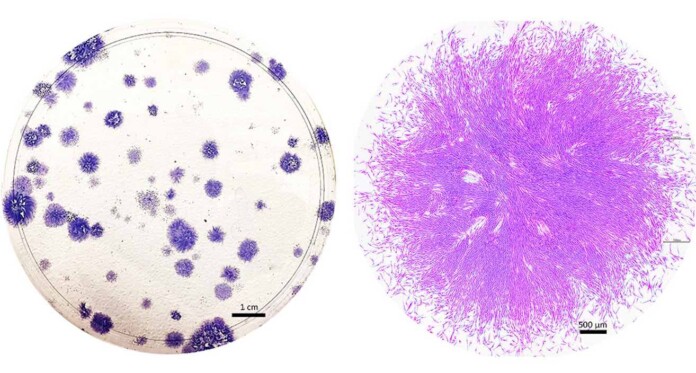
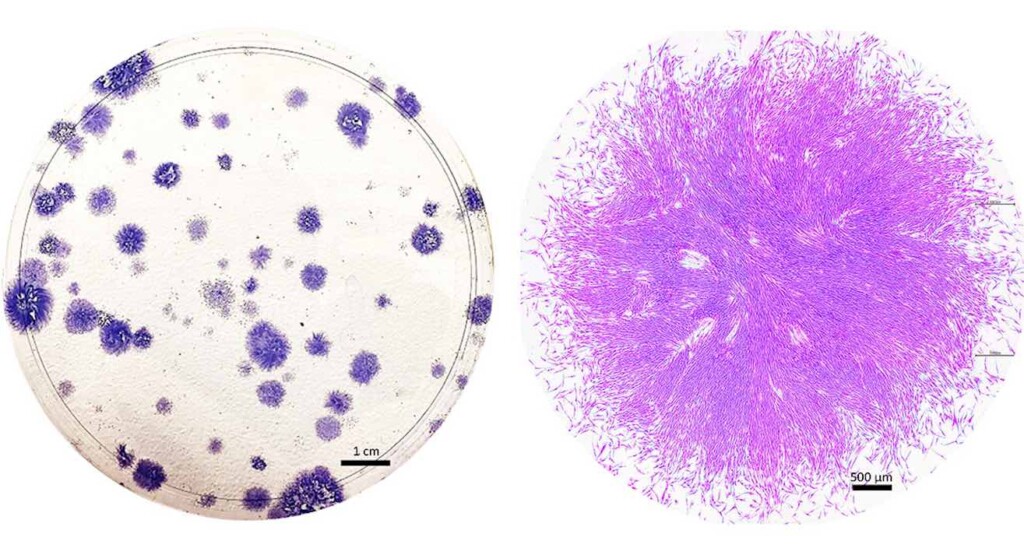
stem cells in menstrual fluid-CREDIT: K. SCHWAB, C. TAN and C. GARGETT at Monash University-released
Purple blobs are clones of the stem cells that Caroline Gargett and colleagues identified in menstrual fluid-CREDIT: K. SCHWAB, C. TAN and C. GARGETT, The Ritchie Centre, Hudson Institute of Medical Research and Monash University Department of Obstetrics and Gynecology in Melbourne

(Originally published by Knowable Magazine – written by Sneha Khedkar)

Long overlooked, menstrual stem cells could be the source of important medical applications.

Roughly 20 years ago, a biologist named Caroline Gargett went in search of some remarkable cells in tissue that had been removed during hysterectomy surgeries. The cells came from the endometrium, which lines the inside of the uterus. When Gargett cultured the cells in a petri dish, they looked like round clumps surrounded by a clear, pink medium.

But examining them with a microscope, she saw what she was looking for — two kinds of cells, one flat and roundish, the other elongated and tapered, with whisker-like protrusions. Gargett strongly suspected that the cells were adult stem cells — rare, highly valued, self-renewing cells, some of which can become many different types of tissues.

She and other researchers had long hypothesized that the endometrium contained stem cells, given its remarkable capacity to regrow itself each month. The tissue, which provides a site for an embryo to implant during pregnancy and is shed during menstruation, undergoes roughly 400 rounds of shedding and regrowth before a woman reaches menopause.

But although scientists had isolated adult stem cells from many other regenerating tissues — including bone marrow, the heart, and muscle — “no one had identified adult stem cells in endometrium,” Gargett says.

Such cells are highly valued for their potential to repair damaged tissue and treat diseases such as cancer and heart failure. But they exist in low numbers throughout the body, and can be tricky to obtain, requiring surgical biopsy, or extracting bone marrow with a needle. The prospect of a previously untapped source of adult stem cells was thrilling on its own, says Gargett. And it also raised the exciting possibility of a new approach to long-neglected women’s health conditions such as endometriosis.

Before she could claim that the cells were truly stem cells, Gargett and her team at Monash University in Australia had to put them through a series of rigorous tests. First, they measured the cells’ ability to proliferate and self-renew, and found that some of them could divide into about 100 cells within a week. They also showed that the cells could indeed differentiate into endometrial tissue, and identified certain telltale proteins that are present in other types of stem cells.

Holistic Approach to Endometriosis: THC Holds Promise As Possible First-of-Kind Treatment for Women With Endometriosis

Gargett, who is now also with the Hudson Institute of Medical Research, and her colleagues went on to characterize several types of self-renewing cells in the endometrium. But only the whiskered cells, called endometrial stromal mesenchymal stem cells, were truly “multipotent,” with the ability to be coaxed into becoming fat cells, bone cells, or even the smooth muscle cells found in organs such as the heart.

Around the same time, two independent research teams made another surprising discovery: Some endometrial stromal mesenchymal stem cells could be found in menstrual blood.

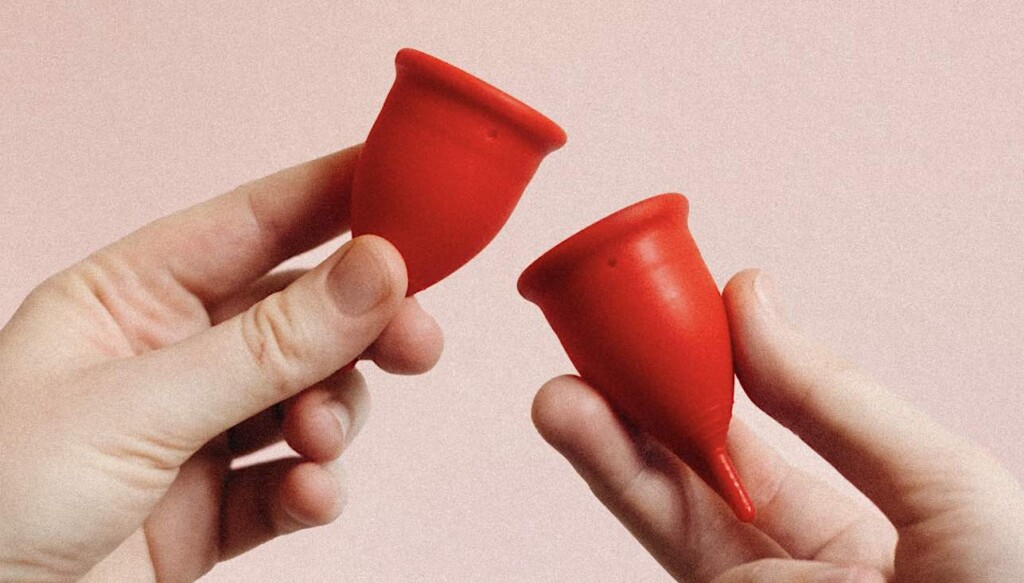
Gargett was surprised that the body would so readily shed its precious stem cells. Since they are so important for the survival and function of organs, she didn’t think the body would “waste” them by shedding them. But she also recognized the finding’s significance: Rather than relying on an invasive surgical biopsy to obtain the elusive stem cells she’d identified in the endometrium, she could collect them via menstrual cup.

By Monika Kozub

Gargett’s team has shown that these special stem cells are present in both the lower and upper layers of the endometrium. The cells are typically wrapped around blood vessels in a crescent shape, where they are thought to help stimulate vessel formation and play a vital role in repairing and regenerating the upper layer of tissue that gets shed each month during menstruation.

CHECK OUT: The Feminine Reason for African Girls Dropping Out, and An Engineer’s Simple Solution

This layer is crucial to pregnancy, providing support and nourishment for a developing embryo. The layer, and the endometrial stem cells that prod its growth, also appears to play an important role in infertility: An embryo can’t implant if the layer doesn’t thicken enough.

Endometrial stem cells have also been linked to endometriosis, a painful condition that affects roughly 190 million women and girls worldwide. Although much about the condition isn’t fully understood, researchers hypothesize that one cause is the backflow of menstrual blood into a woman’s fallopian tubes. Endometrial stem cells that get deposited in these areas may cause endometrial-like tissue to grow outside of the uterus, leading to lesions that can cause excruciating pain, scarring and, in many cases, infertility.

Researchers are still developing a reliable, noninvasive test to diagnose endometriosis, and patients wait an average of nearly seven years before receiving a diagnosis.

But studies have shown that stem cells collected from the menstrual blood of women with endometriosis have different shapes and patterns of gene expression than cells from healthy women. Several labs are working on ways to use these differences in menstrual stem cells to identify women at higher risk of the condition, which could lead to faster diagnosis and treatment.

Menstrual stem cells may also have therapeutic applications. Some researchers working on mice, for example, have found that injecting menstrual stem cells into the rodents’ blood can repair the damaged endometrium and improve fertility.

Other research in lab animals suggests that menstrual stem cells could have therapeutic potential beyond gynecological diseases. In a couple of studies, for example, injecting menstrual stem cells into diabetic mice stimulated regeneration of insulin-producing cells and improved blood sugar levels. In another, treating injuries with stem cells or their secretions helped heal wounds in mice.

A handful of small but promising clinical trials have found that menstrual stem cells can be transplanted into humans without adverse side effects.

LAW FOR WOMEN: New Illinois Law Allows Women to Get Birth Control Pills from a Pharmacist Without a Doctor Involved

Gargett’s team is also attempting to develop human therapies. She and her colleagues are using endometrial stem cells — those taken directly from endometrial tissue, rather than menstrual blood — to engineer a biodegradable mesh to treat pelvic organ prolapse, a common, painful condition that is often caused by childbirth.

Despite the convenience of collecting adult multipotent stem cells from menstrual blood, research exploring and utilizing the stem cells’ power — and their potential role in disease — still represents a tiny fraction of stem cell research, says Daniela Tonelli Manica, an anthropologist leading studies at Brazil’s State University of Campinas.

But, she and others have turned menstruation into an exciting new frontier in regenerative medicine; it’s not just a monthly inconvenience anymore.

This article originally appeared in Knowable Magazine, a nonprofit publication dedicated to making scientific knowledge accessible to all. Sign up for Knowable Magazine’s newsletter, here. The author, Sneha Khedkar, is a biologist and former research fellow turned freelance science journalist in Bengaluru, India.

“Shared joy is double joy, and shared sorrow is half sorrow.” – Swedish proverb

Quote of the Day: “Shared joy is double joy, and shared sorrow is half sorrow.” – Swedish proverb

Photo by: (copyright) GWC

With a new inspirational quote every day, atop the perfect photo—collected and archived on our Quotes page—why not bookmark GNN.org for a daily uplift?

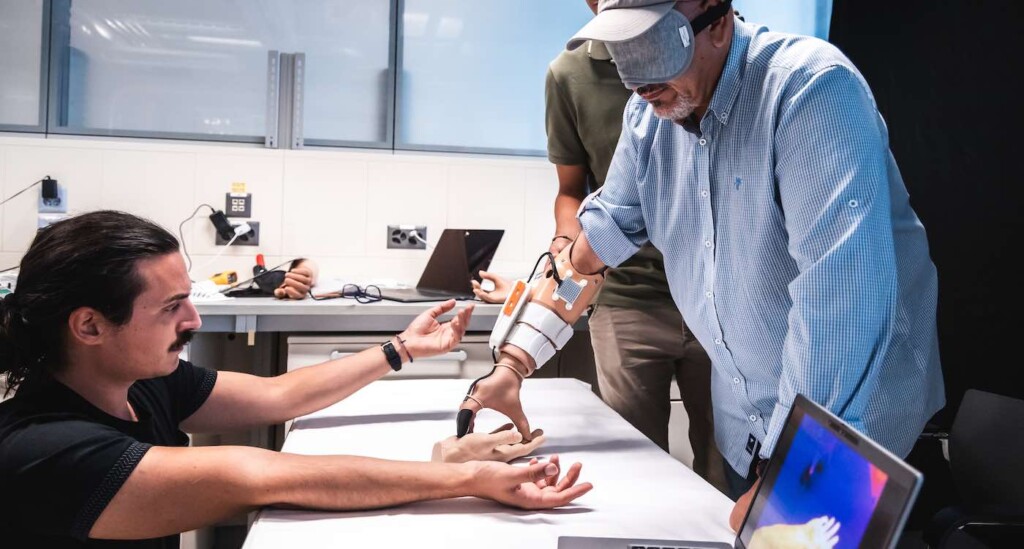
New Prosthetic Hand Allows Man to Sense Temperature: ‘I could feel the warmth of another person’

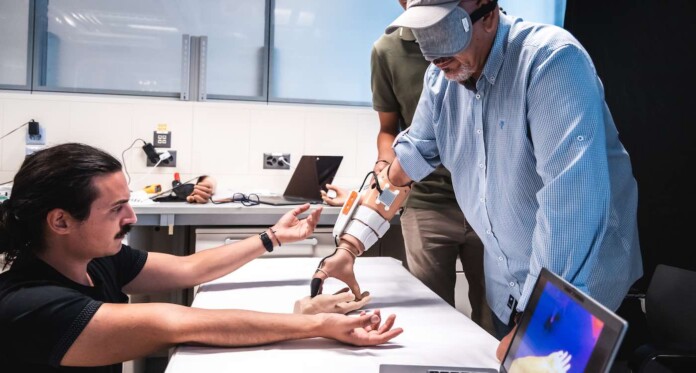
Fabrizio gets to try first prosthetic limb that allows wearer to sense temperature using a MiniTouch – SWNS

The first-ever prosthetic limb that allows the wearer to sense temperature and feel the warmth of another person has been created.

The MiniTouch device allows amputees to perceive and respond to temperature, an ability that developers hope will improve their human connections.

It works by transmitting thermal information from the fingertip of the prosthetic hand to the wearer’s residual arm.

Using the device, a man in Italy who’s been an amputee for three decades was able to differentiate between hot and cold objects with 100 percent accuracy.

The scientists in Italy and Switzerland hope it could soon restore a full range of sensations through prosthetics.

The MiniTouch prosthetic hand provided realistic and real-time thermal sensory feedback to a 57-year-old man from Pistoia—the first amputee to try the device.

Fabrizio was overcome with emotions after feeling the warmth of another person again, 37 years after his hand was amputated from the wrist.

“It was a very strong emotion for me. It was like reactivating a connection with someone.”

Using the MiniTouch, Fabrizio was able to discriminate between, and manually sort, objects of different temperatures or materials. (See the video below from Reuters…)

“When one of the researchers placed the sensor on his own body, I could feel the warmth of another person with my phantom hand,” said Fabrizio.

The team says the new technology, presented in a study published in the journal Med, marks the first time natural temperature sensations have been incorporated into a functional artificial limb—one of the last frontiers for restoring sensation to robotic hands.

CHECK OUT: Researchers Unveil Ultra-Precise, Mind-Controlled Prosthetic: ‘It’s like you have a hand again’

“For the first time, we’re really close to restoring the full palette of sensations to amputees,” reported Professor Silvestro Micera, a joint senior author of the study from the Sant’Anna School of Advanced Studies. “And it can be easily integrated into commercial prostheses.”

The MiniTouch uses off-the-shelf electronics integrated into commercially available prosthetic limbs and does not require any surgery. Rather, the device is attached to a point on the wearer’s same limb, producing sensations in their phantom index finger.

Clinical tests in Bologna, Italy at the Inail Prosthesis Centre in Vigorso di Budriothe, showed that Fabrizio was able to perfectly distinguish between three similar bottles containing cold (12°C), cool (24°C), or hot (40°C) water with total accuracy. The device improved Fabrizio’s ability to quickly classify metal cubes of differing temperatures.

“When you reach a certain level of dexterity with robotic hands, you really need to have sensory feedback to be able to use it to its full potential,” said Dr. Solaiman Shokur, co-author from the École Polytechnique Fédérale de Lausanne (EPFL) in Switzerland.

“We think having the ability to sense temperature will improve amputees’ embodiment—the feeling that ‘this hand is mine’.”

DREAM MAKERS: Student Can Pursue Her Dreams of Being a Cellist After Teens Build Her a Specialized Prosthetic

EPFL’s Jonathan Muheim, another study co-author, believes that thermal sensations in neuro-prosthetics has been neglected, even though there’s increasing evidence of their importance in our everyday life.

The next step for MiniTouch is to integrate thermal information from multiple points of an amputee’s limb, instead of just the index finger. For example, enabling some sensation in the back of the hand which allowing amputees to sense when another person touches their hand.

Their long term goal is to develop a multimodal system integrating touch, perception, and temperature that would be able to tell the user ‘this is soft and hot’, or ‘this is hard and cold’. Prof. Micera concludes it’s all to offer a “richer and more natural perception of the tactile world.”

WATCH the MiniTouch video below from Reuters….

SHARE THE GOOD NEWS With Ability Groups on Social Media…

Penguin Becomes ‘Guide Bird’ Companion For Zoo Pal Suffering with Cataracts: Waddle I do Without You?

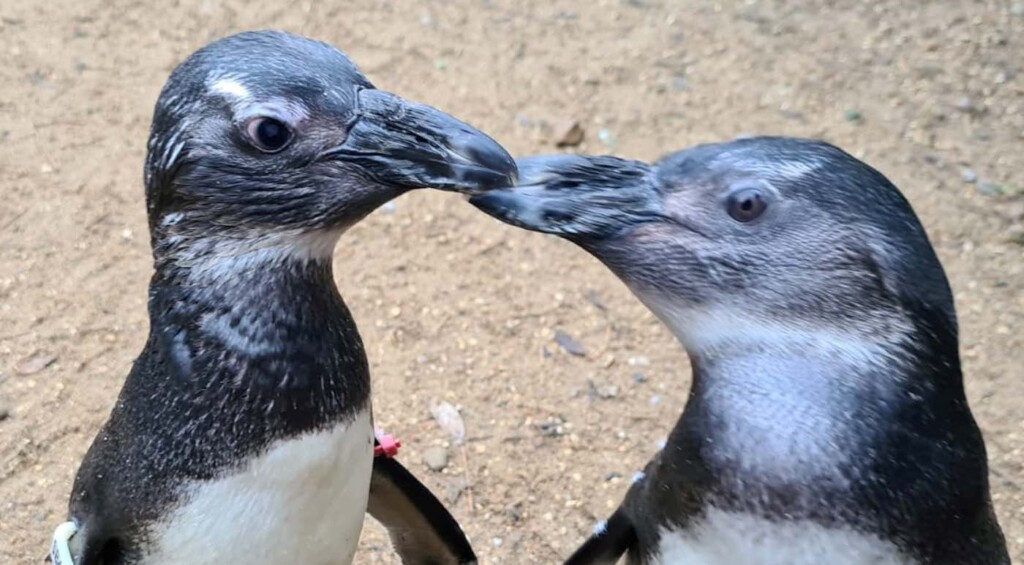
Penguin and Squid –Photo released February 8, 2024 by Birdworld via SWNS

A penguin has become a ‘guide-bird’ for a fellow African Penguin with poor eyesight, escorting her around their enclosure to get food and build confidence.

The animal helper named ‘Penguin’ has bonded with ‘Squid’ the three-year-old that suffers from cataracts, a debilitating condition that clouds the lens of the eye.

Squid is often disoriented during busy feeding times and relies on Penguin’s “unwavering calmness”.

Penguin has become Squid’s beacon, guiding her around the enclosure and acting as her ‘eyes’.

The hand-reared birds are now inseparable—to the delight of their human keepers at Birdworld who are sharing their remarkable relationship.

“The intuitive behavior observed between Penguin and Squid has revealed a remarkable level of empathy and understanding, showcasing the profound connections that can form within the animal kingdom,” said Polly Branham a spokesperson for the aviary in Surrey, England.

WATCH: Penguin in Antarctica Leaps into Passing Tourist Boat to Enjoy a Respite

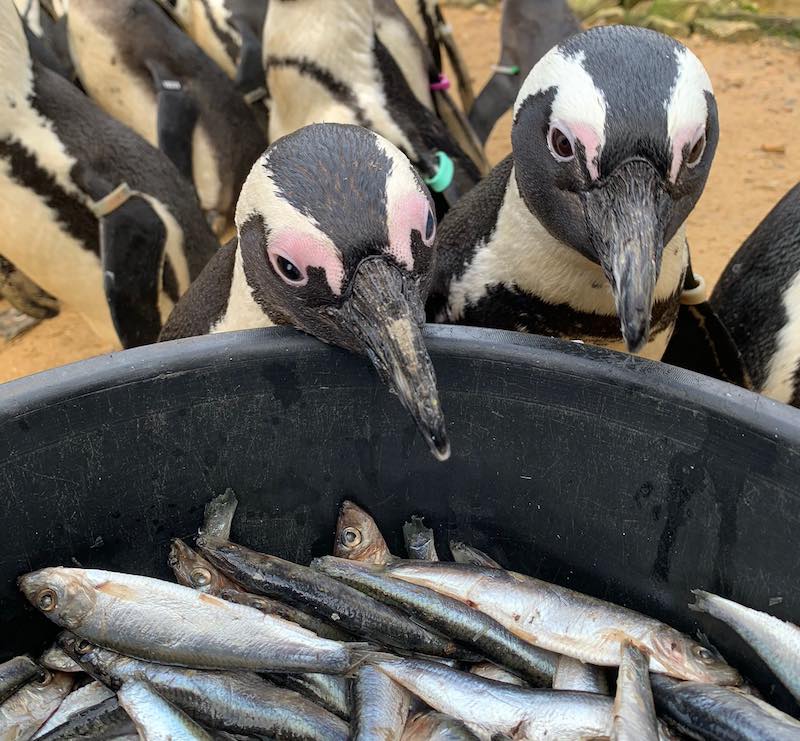
Squid (left) and Penguin getting some dinner – Photo released by Birdworld via SWNS

When Squid was hatched, she displayed the typical lively and vocal traits of a penguin chick, despite developing cataracts at just six weeks old—a unique occurrence within her otherwise healthy family.

Waddle I do without you?

Having been nurtured within the colony, Squid honed her skills alongside her peers—learning the essence of being a penguin—but she used to be quite anxious about approaching the fish bucket at feeding time.

“The excitement of the other penguins created a more unpredictable environment, and she would shy away from this for fear of getting caught in the crossfire of beaks,” explained Branham. “That is how Penguin has been such an enormous help to her.

“His stability was something she could rely on, the base from which she has steadily expanded her world.”

DOGS HELP PENGUINS: Big White Dogs Save the World’s Smallest Penguin in Australia

Senior Penguin Keeper, Natalie Marshall said of the inspiring duo, “We didn’t expect Penguin and Squid to form such a close bond, and it’s evident that Penguin’s resilience significantly influenced Squid’s self-assurance.”

“Given that she has not known any different, Squid has adjusted without realizing, and we see in the way she walks (stooping forwards) and how she behaves around the other penguins (being taken by surprise if approached from a blind spot) that she compensates and is fully integrated into the colony.”

Although cataracts are an operable condition in some penguin cases, the staff believes she is thriving without it.

LOOK: Senior Home Residents Surprised By Festive Penguins Bringing Christmas Cheer

Birdworld is one of the UK’s largest bird parks, and is home to over 150 species of birds, some of which are facing extinction.

SLIDE THIS ADORABLE STORY to Friends By Sharing on Social Media…

Amateur Paleontologists Discover Site of Epic Importance–400 Fossils from 470M Years Ago Amid Global Warming

Artistic reconstruction by Prehistorica_CM of the Cabrières Biota – Photo released February 9, 2024 via SWNS
Sylvie Monceret-Goujon co-discovered the Cabrières Biota containing fossils from 470 million years ago – SWNS

Two amateur paleontologists have discovered a site of ‘worldwide importance’ in France containing nearly 400 fossils that date back 470 million years.

The exceptionally well-preserved fossils provide evidence that this site was a place of refuge for animals escaping global warming.

The site in Montagne Noire is one of the world’s richest and most diverse fossil sites dating to the Ordovician period, which lasted for about 42 million years, during a time when southern Europe, Africa, South America, Antarctica, and Australia were bunched together in a super-continent that was moving towards the South Pole.

The amateurs who came across these fossils were over the moon when they realized the importance of their discovery.

“We’ve been prospecting and searching for fossils since the age of 20,” said Eric Monceret and his wife Sylvie. “When we came across this amazing biota, we understood the importance of the discovery and went from amazement to excitement.”

The fossils are in a remarkable state of preservation, and contain extremely rare soft elements such as digestive systems and cuticles.

AMAZING NEWS: Dinosaur Evergreens Thought Extinct for 2Mil Years Discovered by Park Ranger–the Grove is the ‘Find of the Century’

Analysis of the site, known as the Cabrières Biota, revealed the presence of arthropods (a group that includes millipedes and shrimps) and cnidarians (which includes jellyfish and corals), as well as many algae and sponges.

Artistic reconstruction by Prehistorica_CM of the Cabrières Biota – Photo released February 9, 2024 via SWNS

The site’s high biodiversity suggests that this area served as a refuge for species that had escaped the high temperatures prevailing further north at the time.

Moreover, this biota was once located very close to the South Pole, revealing the composition of Ordovician southernmost ecosystems.

“At this time of intense global warming, animals were indeed living in high latitude refugia, escaping extreme equatorial temperatures,” said lead author Dr. Farid Saleh from the University of Lausanne, in Switzerland.

DINO DREAMS: Complete Stegosaurus Fossil Found With Skin Still On in Northern China

This is only the beginning for the Swiss researchers and their colleagues at The French National Center for Scientific Research (CNRS), who published their findings in Nature Ecology & Evolution.

Using innovative methods and techniques, they aim to reveal the internal and external anatomy of the organisms, as well as to deduce their phylo-genetic relationships and modes of life in a polar ecosystem.

GIVE HOPE TO FOSSIL HUNTING FRIENDS By Sharing the Find on Social Media…

Your Horoscope for This Week – ‘Free Will Astrology’ From Rob Brezsny

Our partner Rob Brezsny, who has a new book out, Astrology Is Real: Revelations from My Life as an Oracle, provides his weekly wisdom to enlighten our thinking and motivate our mood. Rob’s Free Will Astrology, is a syndicated weekly column appearing in over a hundred publications. He is also the author of Pronoia Is the Antidote for Paranoia: How All of Creation Is Conspiring To Shower You with Blessings. (A free preview of the book is available here.)

Here is your weekly horoscope…

FREE WILL ASTROLOGY – Week of February 10, 2024
Copyright by Rob Brezsny, FreeWillAstrology.com

AQUARIUS (Jan. 20-Feb. 18):
Reading through the annals of famous authors’ quotes about love, I’m horrified by the relentlessness of their sour assessments. “Love is merely a madness,” wrote Shakespeare. “Whoever is not jealous is not in love,” said St. Augustine. “General incivility is the very essence of love,” declared Jane Austen. “It is impossible to love and be wise,” moaned Francis Bacon. “Real love always has something hidden—some loss or boredom or tiny hate,” says Andrew Sean Greer. I am allergic to all that dour noise! Personally, I have been entangled in a lot of romantic love during my time on Earth, and most of it has been interesting, educational, and therapeutic. I am deeply grateful for ALL of it, even the heartbreaks. Any wisdom I have developed owes a great debt to my lovers. What about you, Aquarius? Where do you stand on these issues? I suspect the coming months will provide you with ample reasons to embrace my attitudes.

PISCES (Feb. 19-March 20):
Have you discovered all there is to know about your sexual feelings and proclivities? Have you come to a complete understanding of what turns you on and how you might express it? I hope your answer to those questions is “no,” Pisces. In my view, all of us should keep evolving our relationship with eros. There is always more to discover and explore about the mysteries of our desires. Always more to learn about what excites and inspires us. The coming days will be an excellent time for you to enjoy this research.

ARIES (March 21-April 19):
In honor of the Valentine season, and in accordance with astrological omens, I offer you a love letter from an unpublished novel by an Aries friend. Consider saying something similar to a person who would be thrilled to hear it. Here it is. “We will seize the sexiest joy we can conjure. We will turn each other into boisterous deities in quest of liberation from all unnecessary limitations. We will tenderly shock each other with mysterious epiphanies and rivers of bliss. ‘Wild’ will be too mild a word for the awakenings we provoke in each other’s futures.”

TAURUS (April 20-May 20):
“The greater the fool, the better the dancer.” Composer Theodore Hook said that. Poet Edwin Denby agreed. He said, “There is a bit of insanity in dancing that does everybody a great deal of good.” Choreographer Martha Graham added, “Dance is the hidden language of the soul of the body.” I bring these thoughts to your attention because the coming weeks will be an excellent time for you to get freer, more sensuous, and more unconstrained. Dancing your inhibitions into oblivion will be an excellent way to pursue these goals. So will doing everything with a dancer’s abandon.

GEMINI (May 21-June 20):
Emotionally and spiritually, you will ripen at a robust rate in 2024. Your intelligence will mature into wisdom in surprising and gratifying ways. Harvesting rich lessons from long-smoldering confusions and long-simmering mysteries will be your specialty. PS: Some of you Geminis joke around and say you never want to grow up. But I hope you minimize that attitude in the coming months.

CANCER (June 21-July 22):
A psychic told me that in one of my past lives, I was Numa Pompilius, the second king of Rome. It’s an intriguing theory that could help explain why my horoscopes are popular in Italy. What about you, my fellow Cancerian? Is there an aspect of your reincarnational history that aids your current destiny? Or are there past events in your current life that are becoming more influential? The coming weeks will be a good time to meditate on these possibilities. While you ruminate on your history, check in with the spirits of your ancestors and departed allies to see if they have any inspirational messages for you.

LEO (July 23-Aug. 22):
Kevin Kelly wrote the book Excellent Advice for Living: Wisdom I Wish I’d Known Earlier. There he observes, “Listening well is a superpower. While listening to someone you love, keep asking them ‘Is there more?’ until there is no more.” Dear Leo, this is excellent advice for you in the coming weeks. I urge you to specialize in gathering the deep revelations of those you care for. Opening yourself to them in unprecedented ways will boost your soul power and enrich your wisdom.

VIRGO (Aug. 23-Sept. 22):
Imagine you are walking on a hill at night. You are headed to meet a person you adore, who awaits you with champagne and chocolate. The weather is balmy. The moon is full. You are singing songs you both love, announcing your arrival. The songs tell stories about how much you two love to yearn for each other and how much you love quenching your yearning. When you arrive, dear Virgo, what will you tell your beloved to make them feel supremely understood and appreciated?

LIBRA (Sept. 23-Oct. 22):
Has your approach to togetherness become infused with habit or numbness? When was the last time you got extravagant for the sake of love? Has it been a while since you tried a daring romantic move or two? I bring these questions to your attention, Libra, because now is an excellent time to rev up your imagination as you upgrade intimacy, companionship, and collaboration. I hope you will authorize your fantasy life to be lush, unruly, and experimental. Spur yourself to dream up departures from routine that intrigue your close allies.

SCORPIO (Oct. 23-Nov. 21):
I suggest we choose the brilliant Scorpio physicist and chemist Marie Curie (1867–1934) as your role model in 2024. She is the only person to win a Nobel Prize in two different fields. She managed to pursue a rigorous scientific career while raising two children and having a fulfilling marriage. Being of service to humanity was a central life goal. She grew up in poverty and sometimes suffered from depression, but worked hard to become the genius she aspired to be. May the spirit of Marie Curie inspire you, dear Scorpio, as you make dramatic progress in expressing your unique soul’s code.

SAGITTARIUS (Nov. 22-Dec. 21):
The Valentine season is looming, and many of us are receptive to advice about togetherness. I’ll offer some principles that I believe are essential to you Sagittarians as you nourish ALL your close relationships, including your romantic bonds. They are from novelist Graham Joyce. He wrote, “Two people in love don’t make a hive mind. Neither should they want to be a hive mind, to think the same, to know the same. It’s about being separate and still loving each other, being distinct from each other. One is the violin string, one is the bow.”

CAPRICORN (Dec. 22-Jan. 19):
Lately, I have been intoxicated a lot. Not because I’ve ingested drugs and alcohol. Not because I have been doing three-hour meditations or studying sacred texts. I’ve felt so wildly free and euphoric because life has been dismantling some of my fears. Once it happened when my psychotherapist spoke just the right curative words at a pivotal moment in our session. Another time, I came upon a very large hare while strolling in the woods and had an epiphany about how to heal a painful trauma in my past. On another occasion, I dreamed of a healer exorcizing my abandonment fears. There were three other similar events, as well. I bring this to your attention because I suspect you may soon also get intoxicated through the loss of fears.

WANT MORE? Listen to Rob’s EXPANDED AUDIO HOROSCOPES, 4-5 minute meditations on the current state of your destiny — or subscribe to his unique daily text message service at: RealAstrology.com

(Zodiac images by Numerologysign.com, CC license)

SHARE The Wisdom With Friends Who Are Stars in Your Life on Social Media…

“A foolish consistency is the hobgoblin of little minds with nothing to do.” – Ralph Waldo Emerson

Quote of the Day: “A foolish consistency is the hobgoblin of little minds with nothing to do.” – Ralph Waldo Emerson

Photo by: Luke Chesser

With a new inspirational quote every day, atop the perfect photo—collected and archived on our Quotes page—why not bookmark GNN.org for a daily uplift?

Family of Fallen Soldier Given Keys to New Home Built by Volunteers in N. Carolina-WATCH

Courtesy of Operation Coming Home and Garman Homes (Facebook)

14 years after the death of an Army Sgt. in Iraq, his widow and children walked into a brand new house—gifted to them in honor of his memory.

The “Hero Home #27” was built through Operation Coming Home, a mission to help injured troops and families of fallen service members, and is located in Fuquay-Varina, North Carolina.

“We thank God for everybody who had anything to do with it,” said Ava Bradley. “We appreciate everybody. Everybody.”

Staff Sgt. Juantrea Bradley is survived by Ava and two children who moved into their new house in January. Singing and ceremony, tears and tributes filled the spacious front lawn before Ava was handed the keys.

Volunteers from Garman Homes organized to build the house, but all kinds of local and national businesses donated components like windows and air conditioning to furnish the home and ensure Ms. Bradley and her kids are comfortable.

MORE VETERANS HONORED: Military Veterans Who Lost Limbs Receive Mortgage-Free Homes to Honor Their Service

“When our business and values align, we get to do something meaningful and powerful with the best people we know—for a hero we never got to meet,” Garman Homes wrote in a statement.

“It shows they appreciate what their dad and my late husband did. We are not alone,” Ava said, reports local news. “They see it, and they love us, too.”

WATCH the story from WRAL News… 

SHARE This Incredible Effort To Ensure A Man’s Family Was Looked After… 

The Greatest Conservation Story Ever Told Isn’t Really Being Told

wikimedia commons Lord_Howe_Island_-_panoramio cc license wikimedia commonsDavid Stanley
Lord Howe Island – David Stanley CC 3.0. Wikimedia commons

This week GNN reported that for the first time in over four decades, Peruvian diving petrels have four active natural nests on Chañaral Island, Chile, after a dedicated conservation group cleared the island of a deadly invasive species. But this is just one chapter in a long, often untold story.

Reporting on the climate crisis became one of the most popular beats for journalists around the world, and the term “sixth mass extinction” quickly and repeatedly found its way onto front pages across the West. It’s not even close to an appropriate term, though, since the previous 5 mass extinctions involved the die-off of 70% or more of all species on Earth.

But even if there are parts of the globe where that term accurately describes the degradation of the natural environment, just on its own, the success of protecting and restoring isolated island ecosystems like Chañaral, experienced in the last 2 decades merits the abandonment of the phrase “sixth mass extinction.”

For example, GNN has reported on successful eradication campaigns of invasive species on the islands of, Macquarie, Lord Howe, Tetiaroa Atoll, Redonda, Sombrero, and Hawadax.

When the Aichi Biodiversity Targets set between the decade 2010 and 2020 came due, the only target that was considered achieved was the eradication of invasive species; mostly on islands.

Hawadax Island in the Aleutian archipelago. USFW

The report cites 800 invasive mammal eradications on 181 islands worldwide, ensuring the survival of 236 native terrestrial species, and even more seabirds. Island Conservation, the non-profit working on Chañaral, has on its own successfully restored 65 islands worldwide, benefiting 1,218 populations of 504 species, and subspecies, with recent examples on Kamaka in French Polynesia, Ngerkeklau Island in Palau, and the Wallis and Futuna Islands.

YOU MAY ALSO LIKE: Wild and Wonderful Saiga is No Longer Endangered with a Million Roaming Now in Central Asia

Island Conservation reports there have been over 1,000 island invasive species removal projects worldwide, “all resulting in long-term benefits to native species and other 851 seabird restoration projects targeting 138 seabird species,” the organization stated recently.

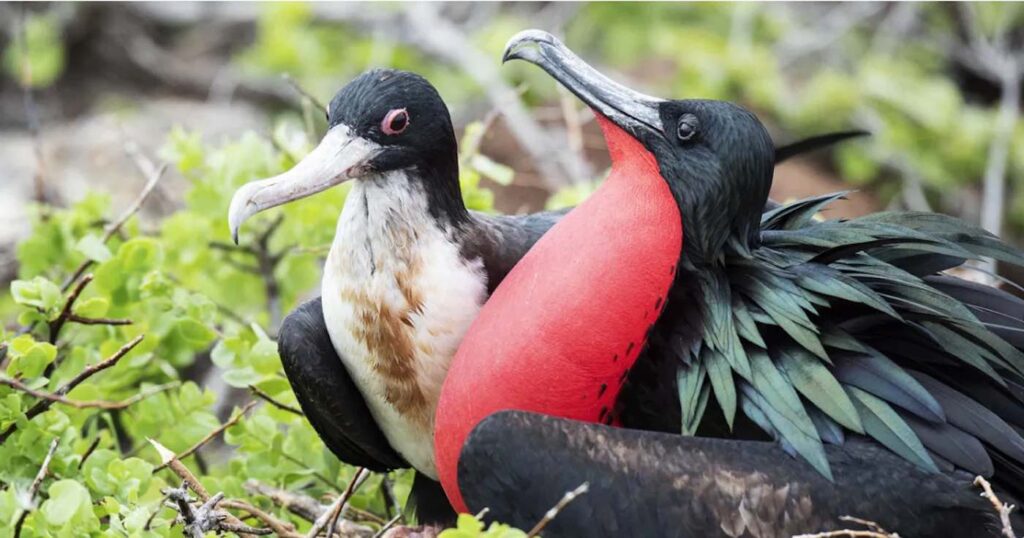
Magnificent frigate birds nesting on Seymour Norte Island – Island Conservation, released.

On the Galapagos archipelago alone, giant tortoises have been restored from the very brink of extinction to their native habitat on Española, land iguanas were returned to Santiago Island for the first time in 200 years, and eradication programs restored the native habitat on Seymour Norte and Mosquera islands, befitting seabirds like those above.

BUT ALSO ON LAND: Norway Rewilds Arctic Coal Mining Town in Largest Operation of its Kind, Gives New Hunting Ground for Polar Bears

In 2020, the UK government established the Atlantic Ocean’s largest marine protected area when they enclosed the 200 square kilometer island of Tristan da Cunha, and 700,000 square kilometers of ocean—an area three times as large as Britain.

Far from there being a sixth mass extinction event taking place, newspapers might be missing what’s becoming the greatest conservation story ever told.

TELL The Greatest Conservation Story Ever Told To Your Friends…

Man Awarded for Quick Rescue Response to House Fire in the Washington Mountains

Released photo by Washington State Department of Transportation – WSDOT

A humble maintenance worker for the Washington State DoT is being honored for rescuing several people from an intense blaze.

The story comes from Blewett Pass on US 97 where Brandon Haight was checking conditions on a route he frequents for his work. Amid the snow and the failing light, he noticed a red glow coming from a residential area and black smoke swirling up among the pines.

Pulling over, he discovered a house had caught fire. Thinking quickly, Haight radioed the traffic management center, since there is typically no mobile phone service in that section of Blewett Pass.

With fire and rescue made aware of the emergency, Haight flew to the scene and began banging on the doors and windows of the home yelling “fire!”

All the residents had made their escape just minutes before the whole house was engulfed in flames and spread to a nearby RV, but Haight had warned the man inside it as well, and all those present cleared the area.

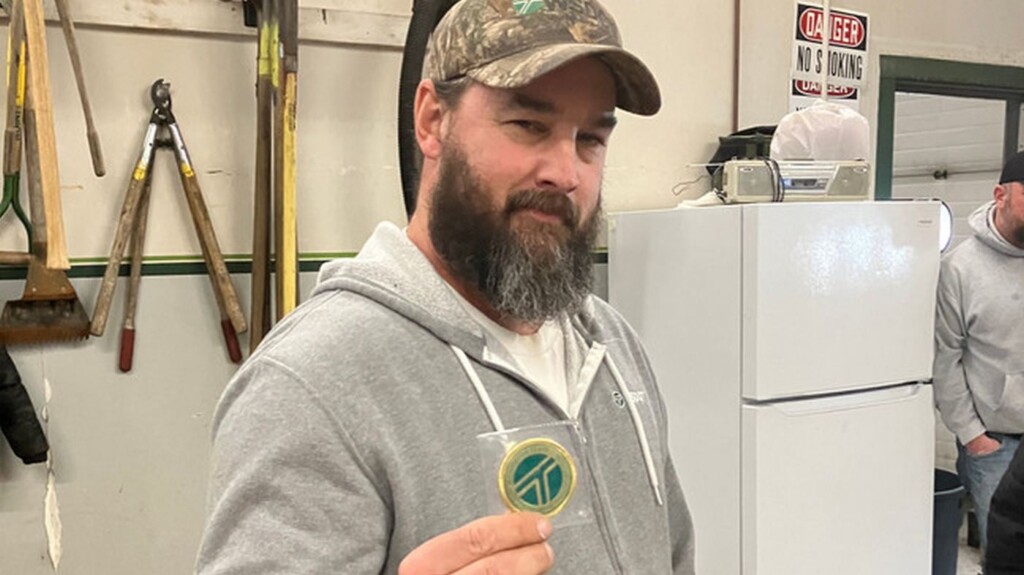
Brandon Haight with his DoT Safety Challenge Coin – Released photo by Washington State Department of Transportation – WSDOT

KOMO News reports that a state trooper said the fire was so intense it could be felt from the road, and it caused many of the surrounding pines to catch fire as well. The trooper added in his report that the fact that no one died is almost certainly because of Haight’s efforts.

ANOTHER FIRE RESCUE:  Hero NYC Cops Carry Four Elders Out of Burning Building on Their Shoulders (WATCH)

Haight was awarded WSDOT’s Safety Challenge Coin to honor his commitment to safety in his community and for his heroic efforts.

SHARE This Man’s Right-Place-Right-Time Heroics With Your Friends… 

Blind Jazz Sax Teacher Inspires Students to ‘Feel’ Their Instruments–Uses His ‘Disability’ as Teaching Tool

Matt Weihmuller and students - photo by Rob-Harris Productions Inc.
Matt Weihmuller and students – photo by Rob-Harris Productions Inc.

From a Tampa performing arts conservatory comes the story of a blind jazz saxophonist who uses his disability as a teaching tool. Like Obi-Wan Kenobi, he encourages his students to act on instinct; to feel the music through their instruments, and not let the waking world deceive them.

“Welcome to every day of my life,” says Matthew Weihmuller in his jazz improvisation class after turning the lights off. “Then we have a big laugh,” he adds.

Profiled in Fox 13’s “Extraordinary Ordinary” segment with Walter Allen, Weihmuller teaches jazz advanced, basic, and improv at the Patel Conservatory in Tampa.

When Weihmuller started playing, he needed braille sheet music, and pieces would take months; even years to learn. As if that weren’t difficult enough, few people in the country were capable of providing braille music, so he started “brailling” his own, with the help of his mom—all the way through college.

“They can’t look at their instrument. Now, they have to feel their instrument with their fingers and hands, right?” Weihmuller told Fox 13. “Now, we’ve got to listen to the music. We can’t read it… It forces the students to use their other senses.”

MORE STORIES LIKE THIS: Blind Hockey Goalie Invited to Play on Sighted Team: ‘An Incredible Experience!’

Advanced jazz musicians will understand that during improvisational sessions, a musician has to be ready for sudden changes in time signature or key. This is nearly impossible to express through sheet music. At least in this regard, the children are learning in the best way for this unorthodox, yet traditional form of jazz music.

OTHER INSPIRATIONAL FIGURES: Third-Generation Craftsman Goes Viral–Now has Millions Watching Him Fix Shoes as ‘America’s Cobbler’

As an educator with blindness, Weihmuller stresses turning any disadvantage into an advantage, a teaching philosophy that has led some students to tell the man that he has changed the way they look at life.

“It’s everything for me, as an educator to hear someone say that you changed their life,” he states. “It’s awe-inspiring and I hope that I can inspire others who are dealing with their situations, disabilities, barriers, and challenges in the same way that I have.”

WATCH Weihmuller play below… 

SHARE The Wisdom And Command Of This Tampa Music Teacher…

“Seek the lofty by reading, hearing or seeing great work at some moment every day.” – Thornton Wilder

Quote of the Day: “Seek the lofty by reading, hearing or seeing great work at some moment every day.” – Thornton Wilder

Photo by: Caught In Joy (cropped)

With a new inspirational quote every day, atop the perfect photo—collected and archived on our Quotes page—why not bookmark GNN.org for a daily uplift?

Incredible New Image Captures Evidence of Once-Flowing River on Mars

Riverine gravel ridges on Mars as captured by the Mars Reconnaissance Orbiter - NASA via SWNS
Riverine gravel ridges on Mars as captured by the Mars Reconnaissance Orbiter – NASA via SWNS

The picture above was taken not on Earth, but by the Mars Reconnaissance Orbiter (MRO) as it searches for signs of water and ice on the Red Planet.

Photographed above an ancient river system in the Aeolis Planum region, the incredible pictures conjure imaginative images of a Martian surface very different to that of today.

The MRO typically flies at an altitude of about 155 to 196 miles (250 to 316 kilometers) above the planet’s surface, allowing it to capture intricate details.

These ridges show the location of the old river beds in Mars’ distant past.

“River beds often get filled with gravel and the surrounding terrain is often built up of fine-grained mud from river overflows. The gravely river bottom and the fine-grained surroundings can lead to a strange phenomenon that geologists call inverted channels,” the space agency wrote.

“After the river disappears, the fine-grained surroundings can be easily eroded away leaving the gravely river bed as a high-standing ridge. The angle at which the ridges join together indicates that these rivers flowed from top-right to bottom-left.”

The image was captured by the High-Resolution Imaging Science Experiment (HiRISE) camera on MRO, and was catalogued by NASA on the final day of January 2024.

Riverine gravel ridges on Mars as captured by the Mars Reconnaissance Orbiter – NASA via SWNS.

The MRO is a spacecraft designed to search for the existence of water on Mars and provide support for missions to Mars, as part of NASA’s Mars Exploration Program.

OTHER MARTIAN DISCOVERIES: Ancient Lake Sediment on Mars Builds Excitement for Evidence of Life in the Perseverance Rover Samples

It was launched from Cape Canaveral in August 2005 and reached Mars in March 2006.

As of July 2023, the MRO has returned over 450 terabits of data, helped choose safe landing sites for NASA’s Mars landers, and discovered pure water ice glaciers in new craters in the Northern polar region. It has also found chloride deposits, suggesting that lakes may have been scattered over large areas of the Martian surface.

SHARE This Dramatic Evidence Of Waterflow On Mars…