Halley's Comet as seen from the Kuiper Airborne Observatory - NASA.
Halley’s Comet as seen from the Kuiper Airborne Observatory – NASA.
Halley’s Comet passed the farthest point in its orbit beyond Neptune and is now heading back toward Earth.
The most famous of all comets has a flattened elliptical orbit that sees it go from the Sun to the outer limits of the solar system. It arrived at the ‘perihelion’ or the closest point to the Sun, in February of 1986.
On December 8th, 2023, it passed its ‘aphelion’ or the furthest point from its orbit, and over the next few decades, there will be better and better chances to see it.
The Marshall Plan was still in the process of rebuilding Germany after World War II the last time Halley had passed its aphelion.
It should be able to be visible when it enters the area of Jupiter, in 2058. By May 2061, it will pass Mars, before arriving near Earth in June.
Space.com has all the details—a truly staggering amount—one could want for planning a Halley’s Comet viewing party 38 years from now including where it will be in the sky at what time of the year, when it’s in opposition to the Sun or brighter planets, and when the best time is to see its blue ion tail.
SHARE This Story With Stargazers In Your Social Media…
Quote of the Day: “The most important wealth is health.” – Ralph Waldo Emerson
Photo by: Katie Smith
With a new inspirational quote every day, atop the perfect photo—collected and archived on our Quotes page—why not bookmark GNN.org for a daily uplift?
'Grandpals' Madhavi Sule and Mukund Sule with their 'goodfellow' Rupesh - Niki Thakur, provided to the Better India
‘Grandpals’ Madhavi Sule and Mukund Sule with their ‘goodfellow’ Rupesh – Niki Thakur, provided to the Better India
In India, a group of considerate young people calling themselves the “good fellows” are changing the lives of India’s senior citizens by pairing them with volunteer grandkids.
Meant to combat loneliness and help bring these elders back into society, the organization allows members of the elder’s family to nominate them as a “grandpal” in search of a “good fellow,” typically if their spouse or closest family member isn’t around anymore.
The Goodfellows was started by Shantanu Naidu, Niki Thakur, and Gargi Sandu, a trio of young Indians from Mumbai who all shared a love of hanging out with their grandparents. Today, they have a team of 65 young men and women aged between 18 and 24, and 400 grandpals signed up.
Once nominated, Mr. Naidu, who leads recruitment, has a basic interview with them to gauge their cognitive faculties, but more importantly, their interests in order to pair them with a good fellow who is interested in the same things.
The Better India spoke with two good fellows, aged 23 and 24, who volunteered to pair with grandpals for the program, and they explained that there’s no telling what might happen during any given day. One of them noticed his grandpal needed a new pair of sandals, and so took him shoe shopping for 3 hours to find the perfect pair.
“Kersi uncle has been my grandpal for the last five months,” 23-year-old Aarohi Sawant told The Better India. “We genuinely look forward to hanging out. He’s had his fair share of tough moments, but he swears on focusing on the beautiful bits. He has inspired me to hold onto the moments that make life happy.”
One grandpal calls herself the luckiest lady in the world, because her good fellow is a tech-savvy listener with a good memory; skills that led her to begin writing the 81-year-old woman’s memoirs.
In some cases, the pairing lasts as long as the grandpal’s remaining years, and in these situations, the good fellow is encouraged to take time off to grieve and take care of their mental health if needed.
“We’ve come across so many grandpals who tell us they feel alone. Aside from a few utility people, the [doorbell] never rings. But our model is now changing things. They are hopeful and excited on the designated days of the week. They look forward to the bell ringing,” Ms. Thakur told The Better India.
An animated impression of Jezero Crater filling with water over the years - credit NASA-JPL
An animated impression of Jezero Crater filling with water over the years – credit NASA-JPL
NASA’s Perseverance rover has officially completed exploring Jezero Crater, an ancient crater lake that the agency determined would be an excellent place to search for signs of life.
Having just passed its 1,000th day of operations, Perseverance has collected 23 samples of regolith, containing silicates, fine-graned silica, phosphates, and carbonates—in other words, a recipe for life as we know it.
Ever since the 5th Martian rover touched down on the Red Planet, Perseverance has been exploring a fan-shaped delta of an extinct water system.
With the help of the rover, NASA scientists have charted the path of the history of the Jezero Crater lake.
Presented at the American Geophysical Union fall meeting in San Francisco on Tuesday, Jezero formed from an asteroid impact almost 4 billion years ago.
After Perseverance landed in February 2021, the mission team discovered the crater floor is made of igneous rock formed from magma underground or from volcanic activity at the surface. They have since found sandstone and mudstone, signaling the arrival of the first river in the crater hundreds of millions of years later.
Above these rocks are salt-rich mudstones, signaling the presence of a shallow lake experiencing evaporation. The team thinks the lake eventually grew as wide as 22 miles (35 kilometers) in diameter and as deep as 100 feet (30 meters). Later, fast-flowing water carried in boulders from outside Jezero, distributing them atop the delta and elsewhere in the crater.
“We picked Jezero Crater as a landing site because orbital imagery showed a delta—clear evidence that a large lake once filled the crater. A lake is a potentially habitable environment, and delta rocks are a great environment for entombing signs of ancient life as fossils in the geologic record,” said Perseverance’s project scientist, Ken Farley of Caltech.
“After thorough exploration, we’ve pieced together the crater’s geologic history, charting its lake and river phase from beginning to end.”
The samples collected along the way have been stored in tubes about the size of sidewalk chalk, which were described before the mission launched as the “cleanest place in the universe”.
Made of sterilized sapphire, the tubes had to be prepared in such a way as to be sure that any evidence of life found upon their return wouldn’t be mistaken as Martian, when it really was a contaminant from Earth.
Using the Planetary Instrument for X-ray Lithochemistry, or PIXL, designed by NASA’s Jet Propulsion Laboratory, Perseverance has been able to color-code various mineral signatures in the ground below its wheels to determine where to drill for samples.
NASA’s Perseverance Mars rover took this selfie over a rock on September 10, 2021 Credits: NASA/JPL-Caltech/MSSS
Phosphate, a critical component of human DNA and cell membranes shows up in green, while silica, a fine-grained material that’s excellent at preserving fossilized life on Earth, shows up as a kind of Burnt Siena.
Of course, Perseverance’s instruments are also capable of detecting both microscopic, fossil-like structures and chemical changes that may have been left by ancient microbes, but they have yet to see evidence for either.
The exploration of Jezero may have concluded, but the still state-of-the-art rover is far from retired, and will soon be exploring the furthest reaches of the canyon where the river would have flown into the lake. Rich carbonate deposits have been spotted along the margin which stands out in orbital images, and in any case, the rover has a lot of time to kill until the sample return mission arrives in the second half of the decade.
SHARE This Milestone Mission Update With Your Friends Who Love Space…
A breast cancer tumor, credit NASA/Goddard Space Flight Center.
A breast cancer tumor, credit NASA/Goddard Space Flight Center.T
A drug that targets the deadliest form of breast cancer has recently been found to elicit no side effects, and triggered an immune response in 75% of patients.
Conducted at the Cleveland Clinic with funding from the Pentagon, the vaccine was administered to 16 women in three separate doses. The form of the vaccine that went through trials is meant to stop the return of this aggressive form of cancer in those who have already been treated.
Further research will tool it to attack tumors in women who have yet to undergo treatment.
mRNA vaccines for cancer tumors are really where this technology comes into its own. Using a piece of the tumor to train immune cells like bloodhounds to search them out is far more effective than using it to train a single component of a constantly mutating virus, as was done to try and combat COVID-19.
It could be available in five years, estimates ABC’s medical correspondent Dr. Jennifer Ashton, who didn’t participate in the research.
According to Anixa Biosciences, the firm behind this vaccine, the drug will target a lactation protein, known as α-lactalbumin, that is present in the majority of triple-negative breast cancer patients.
“The data from our Phase 1 trial to date has exceeded our expectations, and we are pleased with our progress. This vaccine is designed to direct the immune system to destroy TNBC cancer cells through a mechanism that has never previously been utilized for cancer vaccine development,” stated Dr. Amit Kumar, Chairman and CEO of Anixa Biosciences.
This year, GNN reported on another cancer vaccine with immense promise; this one for melanoma, which is predicted to be the second-most common type of cancer in the US by 2040.
In a phase 2b trial, 107 participants were treated with both the vaccine and immunotherapy drug pembrolizumab. Their melanoma returned in only 24 patients (22.4%) within two years, compared with 20 out of 50 (40%) who received only pembrolizumab.
WATCH the story from GMA below…
SHARE This Promising Treatment Coming Down The Pike With Your Friends…
Approach Design Studio / Zhejiang University of Technology Engineering Design Group
Approach Design Studio / Zhejiang University of Technology Engineering Design Group
Set amid the rows of identical block apartments in the background, Huizhen High School is a breath of positive air for the students of Ningbo city, and it recently won one of architecture’s highest honors.
Recently hailed as World Building of the Year at the World Architecture Festival (WAF) in Singapore on Friday, it was made to blur the distinction between inside and outside; a variety of treehouse-like rooms and corridors connecting various open-air spaces like a lecture hall and study area.
Years of modern booming property markets and a hardcore communist past left decades of school construction amorphous, grey, and without aesthetic of any kind. But in a country with deep societal pressures for educational attainment and classrooms that can number as many as 60 students, a more welcoming and refreshing design could be considered imperative.
Huizhen High School was designed by Approach Design Studio, based in Hangzhou. They partnered with the Zhejiang University of Technology and Engineering, and managed to beat Newark Liberty International Airport’s recently opened Terminal A, Australia’s Holocaust Museum in Melbourne, and new national stadiums in both Cambodia and Senegal the win the top distinction in addition to the best school distinction.
“Our focus was not just about designing a school, or working with new forms, spaces, materials, and facades, but about designing new school life and bringing the power of nature into the building,” said Di Ma, director at Approach Design Studio and the Zhejiang University of Technology Engineering Design Group, in a statement.
Approach Design Studio / Zhejiang University of Technology Engineering Design Group
Approach also said that while teaching is nationally standardized to be efficient, the areas of the school are meant to help students “release stress, adjust their body and mind and discover beauty” outside the classroom where trees blend in with concrete and inside with outside.
Judged on 18 different criteria by a panel of 140 experts, the WAF World Building of the Year is considered to be one of architecture’s highest honors.
Last year’s winner was Sydney’s spectacular Quay Towers, which rather than being knocked down, were “upcycled” into a new and incredible construction at half the price. The upcycling saved thousands of tons of CO2 emissions from the lack of demolition operations.
SHARE This Spectacular School And Changing Attitudes In China On Social Media…
Quote of the Day: “Change and impermanence have a positive side. Thanks to impermanence, everything is possible.” – Thich Nhat Hanh
Photo by: Michal Hlaváč (cropped)
With a new inspirational quote every day, atop the perfect photo—collected and archived on our Quotes page—why not bookmark GNN.org for a daily uplift?
There’s a small town in Wyoming where the people are outnumbered; by animals, by trees, and even by snowmen.
It was back in July when snow was equal distance a hope and a memory that Pauline Parker of Burlington, Wyoming began making personalized snowmen for everyone in her town.
Painted onto wood to ensure they didn’t melt, it was a hobby that grew and grew and grew until there were more snowmen than people, and a centerpiece snowman was one of the tallest things in the town at 27 feet high.
“I think snowmen bring joy to you,” Parker told KTVQ. “My last count was 316; you can find brown-eyed snowman, or blue or green.”
News doesn’t only travel fast in a small town, but also across small towns, and soon neighboring hamlets wanted their own. One town, with a population of just 10, got a snowman version of every person posing together under the roadsign, replicating a real-world picture of the same scene.
Throughout this month, Parker has decided to host a community snowman scavenger hunt, with snowman-shaped treats as a reward for getting the 20 questions correct across Burlington, and the nearby towns of Otto and Emblem.
The joyful crusade has won Parker a variety of fans, among art classrooms in the county, but also among the locals who love that she’s spruced up their town in a unique way.
Amorphophallus titanum (corpse_flower) (left) Sailing Moose (right) W. Barthlott - CC 4.0. BY SA
Amorphophallus titanum (corpse_flower) (left) Sailing Moose (right) W. Barthlott – CC 4.0. BY SA
There is more than one species of ‘corpse flower’ and in an incredible coincidence, two managed to bloom at the same time in a Japanese botanical garden, allowing the two to pollinate naturally.
The result of this incredible stroke of fortune is that one of the corpse flowers has now fruited, bearing 736 seeds critical for conserving this wondrous botanic enigma.
While the most famous corpse flower may be the Rafflesia genus, these Amorphophallus titanum, or titan arums for short, share all the same wonders.
In the rainforests of the Indonesian islands of Sumatra and Borneo, these flowers produce massive blooms at completely random intervals spanning years. Of the 10 titan arums in the Tsukuba Botanical Gardens of Japan’s National Museum of Nature and Science, only one has bloomed since 2012. Once the flower, which is the world’s largest, comes out into the sun, it begins to release a chemical scent to attract pollinating insects.
But it isn’t looking for nectar feeders, Rafflesia and Amorphophallus are looking for carrion flies. The smell has been described as everything from rotting meat to rancid garlic, and made it difficult for the workers at Tsukuba to gather the pollen from the giant flowers.
Every artificial attempt at pollinating these plants in captivity has failed, and none of the plants have pollinated naturally.
“We don’t know why, whether pollination can’t occur with pollen from this one plant, or whether pollen has a limited shelf life,” Head researcher Chie Tsutsumi told the Mainichi.
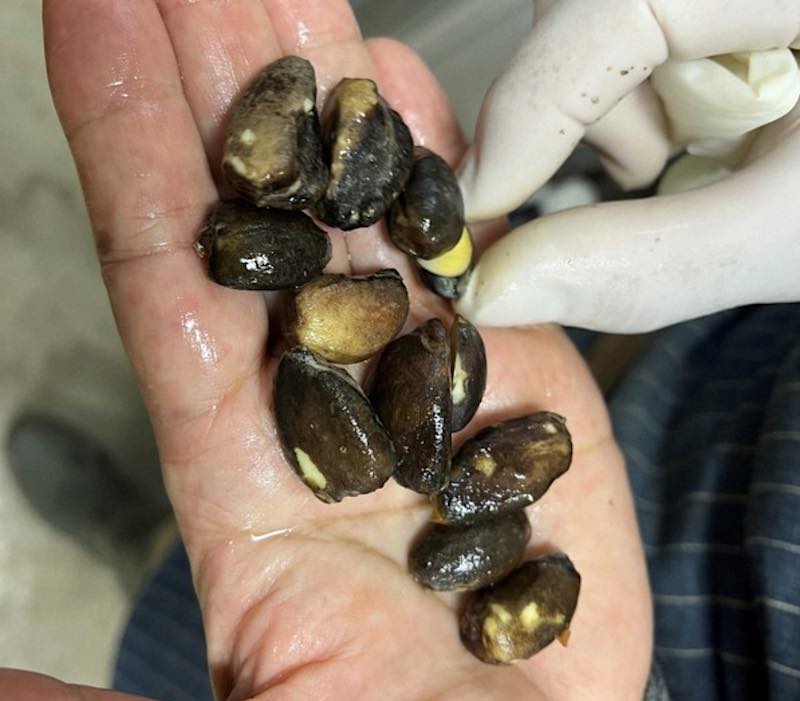
Seeds of titan arum plant – Photo provided by Japan’s National Museum of Nature and Science
Then, in May of this year, a female plant in their gardens produced a small bloom 8 days before a male plant produced an enormous one. They quickly took pollen from the first one and used it to pollinate the second one.
It took about an hour to carefully swab the pollen onto the female plant, all the while the staff were bathed in a famous reek that was very difficult to get out of their clothes, the Mainichi reports.
In November, the plant fruited, and the team gathered the persimmon-like seeds from over 700 small red fruits for cultivation.
“It’s a difficult plant to cultivate, but I’m looking forward to growing it from seed,” said Tsutsumi.
In February of 2022, GNN reported on the work of Sofi Mursidawati, a Ph.D. in agriculture at the Bogor Botanical Gardens, who is attempting to create the world’s first nursery for a more famous corpse flower, Rafflesia arnoldii, which has a very different character to titan arum.
Rafflesia is a parasitic specimen that has no leaves, roots, or stems, but rather only one giant, one-meter-long, 20-pound bloom. By contrast, titan arum has a root system—it’s the largest single corm, or tuber, on Earth—weighing over 200 pounds.
Rafflesia arnoldii flower with buds – By Raphaelhui, CC license / Wikipedia
With seeds the size of sawdust grains, pollinated flowers infect a genus of vines called Tetrastygma, before slowly growing over many months into an enormous cabbage-sized bulb. The curiosities don’t end there. In fact, it barely qualifies as a plant.
It branched away from having genetics that code for photosynthesis millions of years ago, and relies entirely upon its host for energy. Furthermore, and unlike most flowers that have pollinating and pollination equipment, Rafflesia blooms are sexually monomorphic, which means that even after taking a year to grow a flower once it’s time to reproduce, it can only succeed if there is another flower of the opposite sex within the same territory of the carrion flies attracted to the scent of rot from its nectar.
SHARE These Incredible Plants And The Lucky Botantists Working With Them…
Last year, GNN reported on the kind heart of 11-year-old Isaac Winfield, who opened a food bank in his garden shed to help the poor during COVID-19 lockdowns.
Now, Isaac is preparing to open a “gift bank” for moms and dads who can’t afford presents for their children, in addition to a fifth shed-born foodbank.
December is a big month for Isaac. It’s his birthday month, but there’s also Christmas, and the anniversary of the launch of his food bank, which he started with money from his birthday.
He went on to open additional food banks in his hometown of Redditch, in Worcestershire, England, after realizing how many people in his community needed a helping hand.
His gift bank opened last week, after enlisting the help of the local Greenland Pub to store the hundreds of toys and gifts for needy families he’s received from donors.
“Christmas can be a stressful time and Isaac wanted to help as many people as possible have a celebration without worrying about what is under the tree,” said his mother, Claire.
“He is absolutely ecstatic seeing his shelves full of toys and gifts for families. His dedication his weekends and spare time to helping is the best Christmas present he could have asked for.”
According to Claire, they had 200 children arrive on the first day of their present bank.
“The response has been phenomenal. We’ll be holding present bank days another three times at this same pub and put on more dates if there’s still the demand,” says Claire.
“We’ve had baby toys, books, dolls, teddies, Nerf guns, blankets, toiletries, there’s just a bit of everything here. It has all been quite overwhelming to see. “
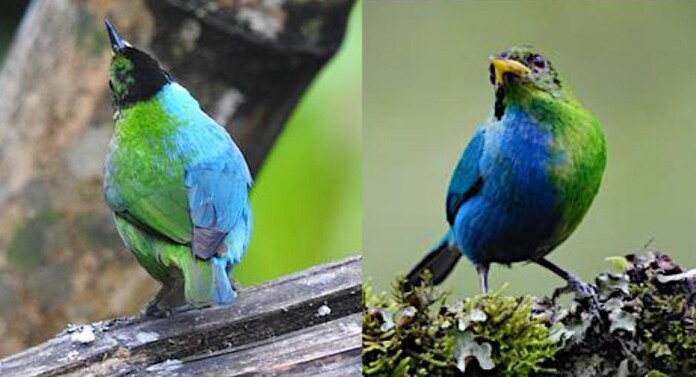
Green Honeycreeper in Colombia – CREDIT: JOHN MURILLO
Green Honeycreeper in Colombia – CREDIT: JOHN MURILLO
A Kiwi professor of zoology was visiting Colombia and got the surprise of his life.
The South American country has more birds, both endemic and overall, than any other country, but when his companion spied a curious-looking honeycreeper with blue and green plumage, Professor Hamish Spencer was sure it was a once-in-a-lifetime entry on his life list.
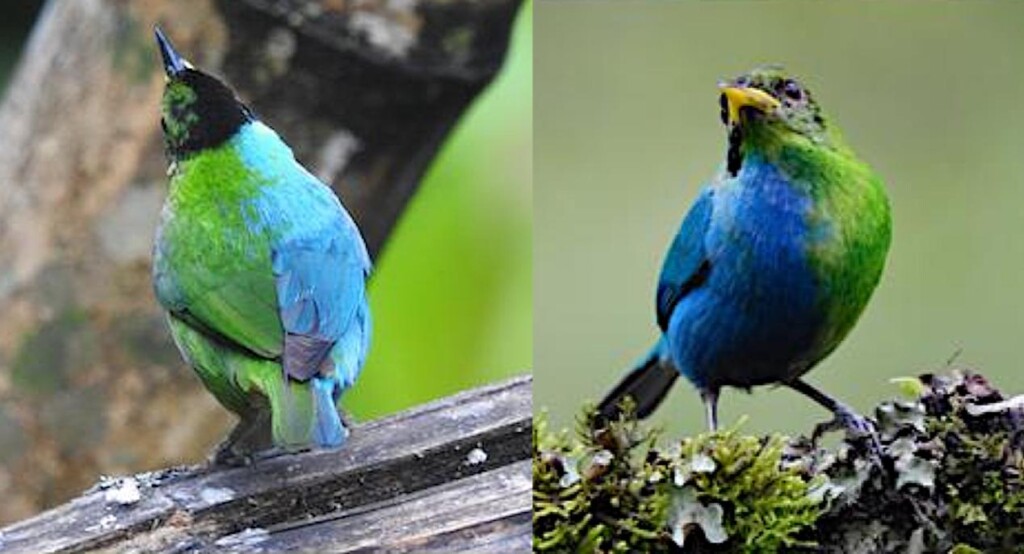
Amateur ornithologist John Murillo was with Spencer, and managed to take some incredibly good still photographs of the green honeycreeper. Half of its body was blue, which meant that the men were looking at a “bilateral gynandromorph,” or a bird that had half-female half-male plumage.
“Many birdwatchers could go their whole lives and not see a bilateral gynandromorph in any species of bird. The phenomenon is extremely rare in birds, I know of no examples from New Zealand ever,” said Spencer.
Murillo and Spencer published a paper on their discovery. Published in the Journal of Field Ornithology, it’s just the second time that a bilateral gynandromorph has been observed in this species in 100 years.
Professor Spencer says gynandromorphs are important for our understanding of sex determination and sexual behavior in birds.
The main groups in which the phenomenon has been recorded include animal species that feature strong sexual dimorphism; most often insects, especially butterflies, crustaceans, spiders, and even lizards and rodents.
“The phenomenon arises from an error during female cell division to produce an egg, followed by double-fertilization by two sperm,” Spencer explains to his university press.
With a new inspirational quote every day, atop the perfect photo—collected and archived on our Quotes page—why not bookmark GNN.org for a daily uplift?
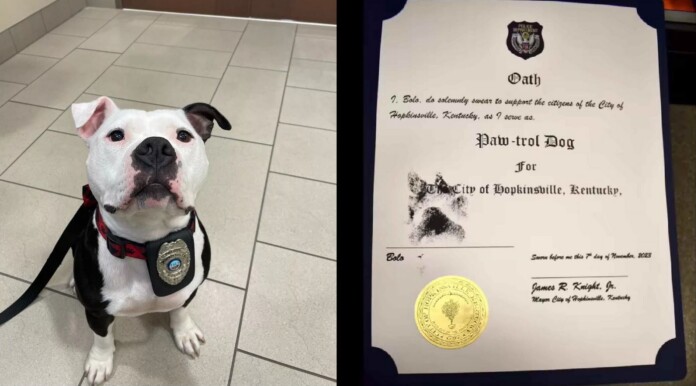
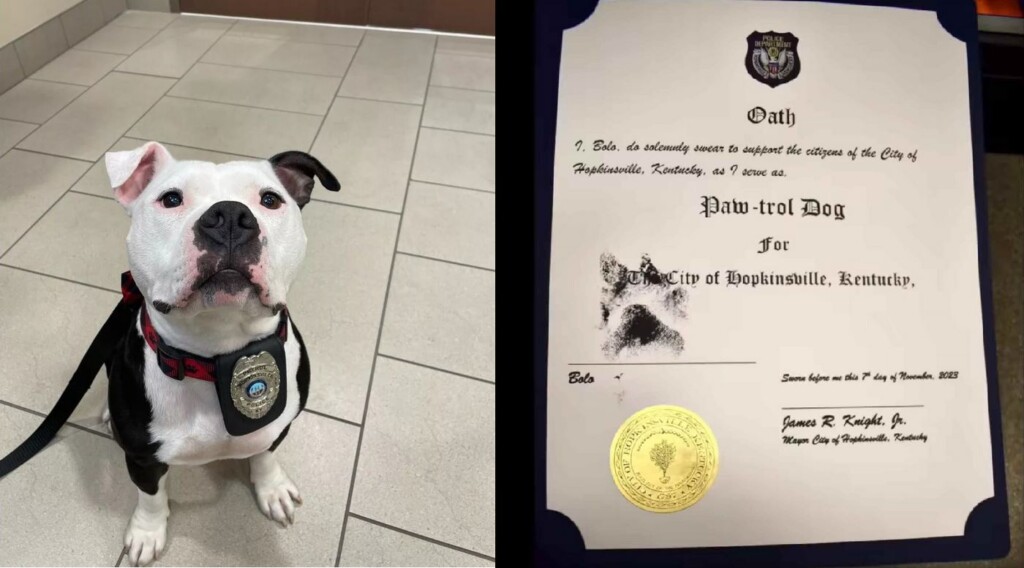
credit - Hopkinsville Police Department retrieved from Facebook
credit – Hopkinsville Police Department retrieved from Facebook
A pit bull named Bolo needed just one day with the officers at the Hopkinsville Police Department for them all to fall in love.
Now sworn in as the first-ever “Paw-trol Officer” Bolo has found his fur-ever home.
Arriving at the station in Hopkinsville Kentucky as part of a publicity program for the nearby Christian County Animal Shelter, Bolo was only meant to stay for a day and contribute his handsome face to the Department’s social media posts as a means to help him find a home.
“Oddly enough, everybody fell in love with him,” said Police Chief Jason Newby.
“So when it came time for him to go back that day, they got him in his cage, and he kind of dropped his head and whimpered, and everybody’s heart melted, and we decided to adopt him.”
They didn’t just adopt him, they signed him up for the blue and black.
credit – Hopkinsville Police Department retrieved from Facebook
“[O]n Tuesday, during the Hopkinsville City Council meeting, Bolo was officially made a part of the team and sworn in by Mayor J.R. Knight as HPD’s very first Paw-trol Officer! We can’t wait to follow this sweet pup’s career on the force,” the Department wrote on Facebook.
In it, the mayor recited the traditional oath about supporting the citizens of Hopkinsville Kentucky as Paw-trol dog.
A wise man once said that aging is the gradual acceleration of comfort-seeking, and Englishman Lew Burja, who’s 92 and still practices kung fu and tai chi, certainly seems to think so.
A grandfather with three grandkids, decades of remaining spry has ensured he can keep up with the little ones, and keep up a diet rich in the best kinds of delicious foods like oven roasts and chocolate.
“At my age, I have friends dying all around me and [tai chi] has kept me going,” said Burja. “It’s really important to keep moving—which is lucky because I can’t stand still.”
He found tai chi in his 50s after suffering from repeat chest infections and a bad back. He had already done sports most of his life, which included rugby, weightlifting, track, Judo, and English football, but had never done tai chi before.
Captivated by watching a tai chi demo at a fair he attended, he decided to give it a go and started weekly two-hour sessions, also including a half-hour of kung fu.
Tai chi is an internal Chinese martial art practiced for health, known for its slow, intentional movements, while kung fu refers to any skill achieved through hard work in a general sense, and doesn’t specifically refer to martial arts.
“I was fit and healthy. But these chest infections just kept coming back just a few months after I stopped antibiotics,” he said. For some reason, I was really attracted to the slow movement and deep breathing of the tai chi.”
“There’s a specific sequence of movements you can do to manage certain health conditions. That’s how I stopped getting chest infections. I’d often had colds before starting tai chi and they stopped too.”
Burja, from Leeds, can still walk up to seven miles a day and he says running is no problem. He is also training to become a thriller writer to keep his mind sharp.
“Plenty of exercise is what keeps you going, and it also gives you a really positive outlook on life,” said Burja on this point. “And it’s kept me fully compos mentis. I’m training to be a thriller writer.”
“I don’t fight in kung fu anymore but I can still do the hits and kicks.”
WATCH Lew in action below…
SHARE This All-Action Granddad With Your Friends Who Need A Bit Of Inspiration…
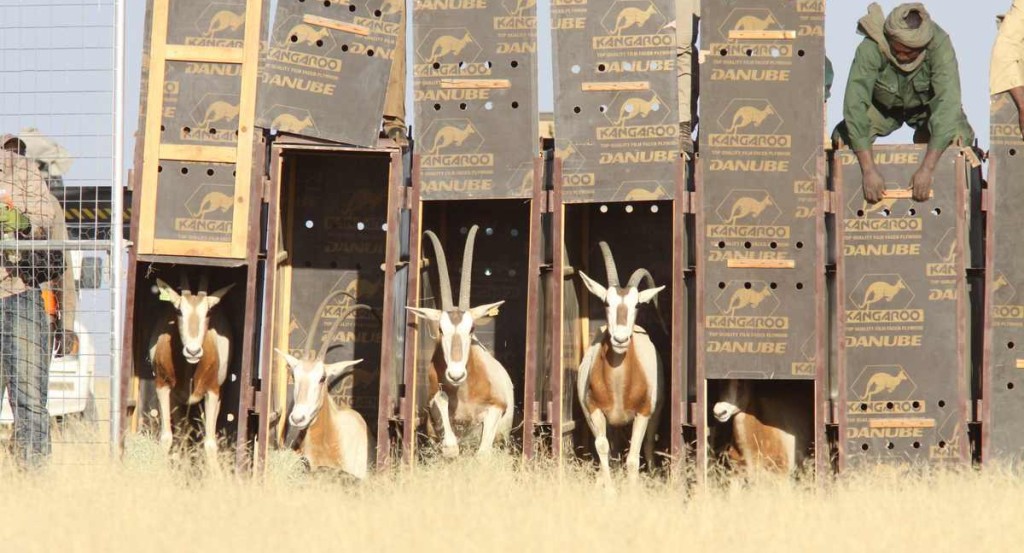
Scimitar-horned oryx being released in Chad - SWNS
Scimitar-horned oryx being released in Chad – SWNS
In one of Africa’s last great wildernesses, a remarkable thing has happened—the scimitar-horned oryx, once declared extinct in the wild, is now classified only as endangered.
It’s the first time the International Union for the Conservation of Nature (IUCN), the world’s largest conservation organization, has ever moved a species on its Red List from ‘Extinct in the Wild’ to ‘Endangered.’
The recovery was down to the conservation work of zoos around the world, but also from game breeders in the Texas hill country, who kept the oryx alive while the governments of Abu Dhabi and Chad worked together on a reintroduction program.
Chad is one of the most corrupt countries on Earth, and ranks second-lowest on the UN Development Index. Nevertheless, it is within this North African country that can be found the Ouadi Rimé-Ouadi Achim Faunal Reserve, a piece of protected desert and savannah the size of Scotland—around 30,000 square miles, or 10 times the size of Yellowstone.
At a workshop in Chad’s capital of N’Djamena, in 2012, Environment Abu Dhabi, the government of Chad, the Sahara Conservation Fund, and the Zoological Society of London, all secured the support of local landowners and nomadic herders for the reintroduction of the scimitar-horned oryx to the reserve.
Environment Abu Dhabi started the project, assembling captive animals from zoos and private collections the world over to ensure genetic diversity. In March 2016, the first 21 animals from this “world herd” were released over time into a fenced-off part of the reserve where they could acclimatize. Ranging over 30 miles, one female gave birth—the first oryx born into its once-native habitat in over three decades.
In late January 2017, 14 more animals were flown to the reserve in Chad from Abu Dhabi.
In 2022, the rewilded species was officially assessed by the IUCN’s Red List, and determined them to be just ‘Endangered,’ and not ‘Critically Endangered,’ with a population of between 140 and 160 individuals that was increasing, not decreasing.
It’s a tremendous achievement of international scientific and governmental collaboration and a sign that zoological efforts to breed endangered and even extinct animals in captivity can truly work if suitable habitat remains for them to return to.
SHARE This Three-Decade-Long Breeding Effort Coming To Fruition…
Irish wind turbines - David de la Iglesia Villar, marked CC License.
Irish wind turbines – David de la Iglesia Villar, marked CC License.
The Emerald Isle is greener than its reputation holds, as it turns out, since more than half of electricity on some days is generated by renewable energy.
Though it’s common to have all four seasons in a single day in Ireland, one can pretty much bet on the wind, which generated an all-time high for contribution to the Irish power grid with 4.62 gigawatts on Wednesday last week.
By midnight, 71% of all the day’s electricity needs were met with wind power.
In 2022, HeatMap reports that Ireland was third in the world for energy generated from wind. The Green Collective, which provides insights into the Irish energy grid, reports that the previous record was around 4.56, and was generated last year.
Wind generation has been falling since about 6pm so we're calling it: the new all-time, all-island high for wind output on the Irish grid is 4629MW, seen at 4pm this afternoon 🥳
Wind generation so far today equivalent to 73% of electricity demand - full report tomorrow!
Wind energy is a big industry for the gusty nations of Northern Europe like Denmark, Norway, Lithuania, and Ireland, but is also highly developed in Uruguay, which is the second-highest producer of wind energy.
SHARE This Green News From The Emerald Isle On Social Media…
Quote of the Day: “Please, do poetical justice to your soul.” – Albert Camus
Photo by: Joel Olives, CC license (cropped)
With a new inspirational quote every day, atop the perfect photo—collected and archived on our Quotes page—why not bookmark GNN.org for a daily uplift?
A new and creative study shows that rejecting undesired invitations to parties can be beneficial in avoiding holiday burnout.
The study also found that even if the invitation comes from loved ones, they don’t care about rejections as much as we imagine they do.
More than three-quarters of people in a survey confessed to accepting an invitation to an activity they did not want to attend because they were concerned about the consequences of declining.
This is supposedly even more prominent over the Christmas season when invitations are typically higher.
“I was once invited to an event that I absolutely did not want to attend, but I attended anyways because I was nervous that the person who invited me would be upset if I did not – and that appears to be a common experience,” said Dr. Julian Givi from the American Psychological Association.
“Our research shows, however, that the negative ramifications of saying no are much less severe than we expect.”
To get their results the team from the APA conducted five experiments with more than 2,000 participants.
In one experiment, the researchers asked participants to read a scenario where they either invited friends, or were invited by one of their friends, to dinner on a Saturday night at a local restaurant with a celebrity chef.
The participants who were given the invitation were told to imagine they declined because they already had plans during the day and wanted to spend a night at home relaxing.
The participants who imagined giving the invitation were told their friend declined for the same reason.
The researchers found that participants who imagined turning down their friend’s invitation often believed it would immediately have negative ramifications for their relationship.
These participants were much more likely to say their friend would feel angry, disappointed, and unlikely to invite them to attend future events than the rejected group rated themselves.
“Across our experiments, we consistently found that invitees overestimate the negative ramifications that arise in the eyes of inviters following an invitation decline,” said Dr. Givi.
“People tend to exaggerate the degree to which the person who issued the invitation will focus on the act of the invitee declining the invitation as opposed to the thoughts that passed through their head before they declined.”
In another experiment, the researchers recruited 160 people to participate in what was called a couple’s survey with their significant other.
In this experiment, 74% of the couples had been together for more than five years. One member of the couple had to write an invitation, and the other had to reject it so they could relax.
The person who rejected their partner’s invitation to a fun activity tended to believe that their partner would be angrier or more likely to feel as if the rejection meant they did not care about their partner as much as they actually did.
The researchers believe their findings, published in the Journal of Personality and Social Psychology, show people consistently overestimate how upset someone will be when they decline an invitation, even if they have a longstanding, close relationship.
“While there have been times when I have felt a little upset with someone who declined an invitation, our research gives us quite a bit of good reason to predict people overestimate the negative ramifications for our relationships,” Dr. Givi said.
“Burnout is a real thing, especially around the holidays when we are often invited to too many events. Don’t be afraid to turn down invitations here and there. But keep in mind that spending time with others is how relationships develop, so don’t decline every invitation.”
SHARE This Unique Psychological Insight With Your Friends…
In a creative use of the justice system of English Common Law, a woman in Ohio was sentenced to two months’ work at a fast food restaurant after she was recorded throwing hot food in the face of a Chipotle worker.
Reminiscent of the Seinfeld episode where Jerry and George come up with the pilot for a TV show about a man sentenced to be George’s butler for a year, the woman was asked if she preferred jail time or to walk in her victim’s shoes.
According to the woman’s attorney, the offender pleaded guilty in the court of the Hon. Timothy Gilligan to a misdemeanor assault charge, and was given either the choice of 90 day’s jail time or 30 days with 60 days of mandatory service as a fast food worker, in addition to a $250 fine.
A statement provided to the court by the woman’s attorney read that she was “truly sorry for what happened that day.”
“I was thinking,” Judge Gilligan told CNN, ‘What else can I do rather than just have her sit in jail.’”
“I don’t see her as any greater risk than anyone who walks in off the street,” he said, pondering whether her reputation would make it impossible to get a job at a restaurant. “I looked at it as someone who lost her cool.”
“She’s going to learn to work in fast food, and hopefully it will be good,” said the Chipotle worker who was assaulted.
Judge Gilligan hopes for the same, pointing out that it could hardly be otherwise when considering the quality difference between jail food and even a poorly prepared burrito bowl.
GNN has reported on judges giving instructive sentences before to the benefit of the perpetrator and society at large. Judge Barnette in Hennepin County, PA, gave the “benefit of the doubt” to a serial, non-violent drug abuser because she had managed to get into law school.
That drug abuser, Sarah Gad, became a criminal defense attorney and even managed to win a case defending a client in Judge Barnette’s court years later.
SHARE This Instructive Lesson In Interpretive Justice On Social Media…
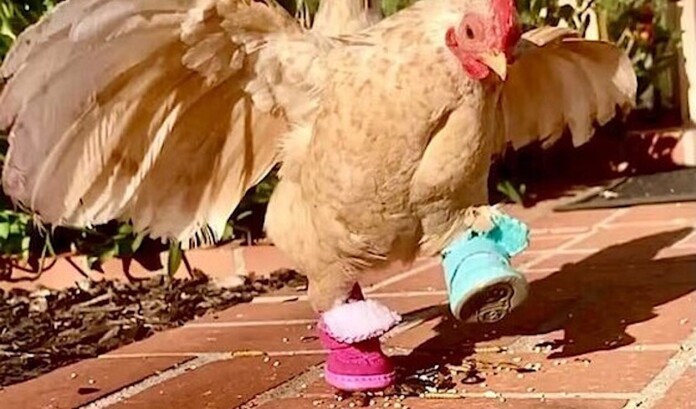
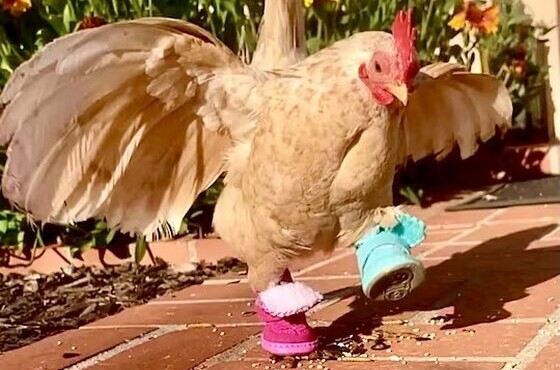
A California dog walker had the opportunity to adopt a disabled chicken, and social media loved him so much they’ve sent over 60 pairs of tiny shoes and boots.
The Malaysian Serama breed chicken lost his toes to leg scale mites, a debilitating arachnoid parasite. New owner Meech Davignon of Escondido California had to suffocate them using vaseline and cotton wool which she had to change three times a day.
Nursing him back to health, she began affectionately calling him “Nubz” after the short ends of his toes.
But this loving attention won her a most charismatic chicken, who “rules the roost” among her dogs, cats, guinea pigs, and 11 other chickens, even though he hobbled around.
Davignon realized he had trouble moving on hard surfaces, and remembered she had a pair of tiny dog slippers that her smallest pooch never used. She thought they might help Nubz.
“As he got more comfortable wearing his little shoes, I’d leave them on longer each time,” Davignon told the Washington Post. “Pretty soon, he was getting around a lot better than he did without them because they were great little mobility devices. I’d let him wear them to walk on wood chips and anything else that was rough on his feet.”
Last January, the odd couple celebrated 1 year of companionship, and Davignon celebrated by making a TikTok account for Nubz with videos of him walking about in his little slippers. It created a viral firestorm of interest in the chicken, with commenters asking if it would be okay to send Nubz more shoes.
Because it deserves more attention, just look at his little strut 😭🥰❤️ This little dude has improved so much!!! Help us share his awesomeness! Please like, comment, share, interact... we are trying to raise money for a sanctuary and every view helps us ❤️❤️❤️
“They’ve been a great blessing—it’s surreal to have so many people love my tiny little chicken,” said Davignon.
The packages began arriving by the dozen, and soon Nubz could pick between Sunday shoes, blue suede shoes, dinosaur claw boots, plush booties, sandals, and more.
She keeps them all in a dresser in her room, and every time a new pair comes in the mail she posts a video on TikTok of the chicken strutting his stuff. Davignon said his favorite pair are some dark blue boots that look somewhat like Ugs. He can move about faster than normal in them.
Currently, the 3-year-old bird is in physical rehab for a pair of degenerative disks in his neck, which she was able to treat with—get this—avian acupuncture, with the help of her TikTok followers.
Currently in a little wheelchair, she is sure he will be back to his plucky self before long.
SHARE The Social Media Sensation of Poultry in Boots With Your Friends…