













All News - Page 232 of 1716 - Good News Network
Home Blog Page 232

These 385 Million-year-old Tree Roots Look Just Like Ours, and Tell a Tale Just Like Ours

Photo released to Smithsonian by William Stein and Christopher Berry
William Stein and Christopher Berry

Trees were one of the oldest dominant life forms on Earth, but the most important component of a tree, the roots, are currently shrouded in evolutionary mystery: when they first evolved, how they evolved; these are unanswered questions.

In New York’s Catskill mountain range, a fossilized forest is clueing in paleobotanists as to the origins of woody deciduous trees, and answering, if only partially, some of these questions.

The ancient woodland is 385 million years old. While their trunks have long since turned to dust, their root systems mineralized underground, and the imprints seen today outside Cairo, New York, look remarkably similar to those of our own forests today.

Yet they belong to a different sort of dendron, as they were species that predate the rise of seed disperses. The authors of a study on these Devonian root systems conclude trees came upon the strategy of roots early on, and have stuck with it essentially until our present time.

Belonging to the genus Archaeopteris, the roots branch out in sturdy and intricate patterns, were more able to guzzle up water and nutrients than the roots of other plants at the time, and also offered the support and solidity we associate with trees today.

While seemingly obvious, this was a radical new way for trees to live back in the mid-Devonian when Archaeopteris was evolving. The other dominant genera all had spindly, fast-growing roots that would be replaced over short intervals.

Photo released to Smithsonian by William Stein and Christopher Berry

While Archaeopteris wasn’t a seed-bearing tree, it had a large thick trunk that allowed it to grow both tall and wide, and broad leaves to soak up as much nutrients as possible. Combined with the roots, it shows this Devonian tree ancestor had a serious metabolic engine.

YOU MAY ALSO LIKE: Nature’s Famous Spiral is Coded into 400 Million Years of Plants–But Not in This New Fossil

Nearby the forest at Cairo, another fossilized forest called Gilboa has long been thought to be the oldest in the world. But despite being separated by only 25 miles, the two ecosystems had several differences. Gilboa is filled with Eospermatopteris fossils, a genus that resembled tree ferns and which grew fleshy, hollow trunks, fronds instead of leaves,  and the spindly roots mentioned above.

Eospermatoperis may have succeeded in colonizing much of the world, but it was Archaeopteris that actually changed the world.

Giant crowns of leaves sopped carbon from the air, storing it in giant woody trunks and in deep woody root systems. The roots burrowed, and died, deep underground, altering the chemical makeup of the world’s soils forever. The leaves shaded the ground, preventing moisture and life from burning up under the sun’s rays. The whole Earth would have been experiencing a reverse of what it’s experiencing today as trees are cut down, carbon is released, and the ground is exposed to UV light.

MORE PALEOZOIC HISTORY: Long Before Trees Overtook the Land, Our Planet Was Covered by Giant Mushrooms

The Devonian experienced a prolonged period of glaciation resulting from the global cooling of so much carbon leaving the atmosphere, about 9°F or 5°C according to scientists. This resulted in an icebox state called the Late Paleozoic Ice Age which caused the Capitanian mass extinction event.

“What’s happening today is the opposite of what happened in the Devonian,” Paleobotanist William Stein, an author on the paper, told Smithsonian Magazine. “Once again, sweeping change begins and ends with trees.”

WATCH some drone footage of the forest… 

SHARE This Heritage Of Our Modern Trees With Your Friends… 

Tiny Golden Mole Not Seen in Almost 100 Years Rediscovered Thanks to Sniffing Dog and Determined Scientists

De Winton's Golden Mole, photo by team member JP Le Roux
De Winton’s Golden Mole, photo by team member JP Le Roux

A little species of golden mole has been rediscovered in South Africa thanks to an intrepid band of conservationists and a sniffing dog.

De Winton’s golden mole was last scientifically documented in South Africa—in Port Nolloth—in 1936. There were no photographs taken of this tiny blind mammal, and little information existed about its behavior.

Furthermore, without any physical specimen to examine, it was impossible to train a sniffing dog to find these little creatures that burrow under the sand and navigate by detecting vibrations through the tissue in their large noses.

Thinking that maybe De Winton’s mole smells the same as another of the 21 golden mole species, the team led by program manager Cobus Theron from South Africa’s Endangered Wildlife Trust (EWT) trained a border collie named Jessie to lay down on the ground when she smelled one of these other moles.

Another challenge lay in the habitat of De Winton’s golden mole: sand dunes. After a certain number of hours, sand dunes will have moved by some number of meters as winds blow the sand in different directions. Because the moles only burrow 4 inches under the ground, their tracks and dens are easily scrubbed away.

The third challenge was how do you identify De Winton’s Golden Mole without a historical sample, without a detailed description of how the species differs from other golden moles, and without DNA?

Fortune was on the side of Theron and his team, for when they arrived at Port Nolloth for a 2022 expedition, a rainstorm had frozen the tracks of the area’s moles in time in the wet sand. Ironically, Jessie the collie was completely uninterested in the scene, meaning that the tracks were made by a mole whose scent she didn’t recognize.

MORE LOST SPECIES FOUND: Lost for 97 Years, Rediscovered Magnolia Tree Spurs Hope for its Restoration in Haiti

“The team collected more than 100 samples from the sand to take back to the lab for eDNA—short for environmental DNA—analysis,” writes Re:wild, one of the organizations that supported the effort.

“eDNA focuses specifically on the nuclear or mitochondrial DNA animals leave behind as they move through their environment, including hair cells, skin cells, and scat.”

Re:wild supports the rediscovery of lost species through their innovative and wildly successful “25 Most Wanted” list, which highlights important species that are lost to science, organizes expeditions to find them, and funds conservation based on the publicity of the rediscoveries. So far, De Winton’s golden mole is the 12th the org has crossed off its list.

With the eDNA sequences, the team was able to compare mitochondrial DNA to a specimen of mole held at the Port Nolloth Museum: it was a match.

“It’s been so exciting for me to make this discovery alongside a group of people with a shared interest and vision for golden moles to raise awareness about their presence, about their plight,” says Samantha Mynhardt, a conservation genetics researcher at the Endangered Wildlife Trust.

The only reason journalists and scientists can pronounce a “6th mass extinction” is because many small and seemingly unimportant species like De Winton’s golden mole are going extinct every year. Altogether, they paint a picture of a global biodiversity crisis.

MORE NEWS LIKE THIS: Earless Dragon Feared Extinct is Rediscovered After 50 Years in Australia

For that very reason, however, the rediscovery of this tiny mammal, which many people will never see, nor make an effort to, nor regret not seeing if it were extinct, is actually tremendous news, because if the loss of dozens of small unknown species like it causes a crisis, the survival of dozens of them causes healthy ecosystems.

“I think it’s just fantastic that in 2023 we can still rediscover species,” said team leader Theron. “All of our stories around conservation are doom and gloom. Here we have an opportunity to say that, actually, there are opportunities to make change.”

SHARE This Sniffing Dog, Tiny Mole, And Hope For The Future With Your Friends…

“You’ve been given the gift of 86,400 seconds today. Have you used one to say thank you?” – William Arthur Ward 

Quote of the Day: “You’ve been given the gift of 86,400 seconds today. Have you used one to say thank you?” – William Arthur Ward 

Photo by: Dhaya Eddine Bentaleb

With a new inspirational quote every day, atop the perfect photo—collected and archived on our Quotes page—why not bookmark GNN.org for a daily uplift?

Violent Crime and Homicide Falling Across Major US Cities, with Detroit on Track for a 60-Year Low

Detroit - Unsplash via Doug Zuba
Detroit – Unsplash via Doug Zuba

After a special task force was created to address a criminal case backlog in Detroit, the city is on pace for the lowest homicide rate in 60 years, with violent crime in general falling at combined rates of 56%.

By the end of the government-enforced lockdowns of the criminal justice system in Wayne County which includes Detroit, there were 4,000 felons awaiting trial; the special task force has reduced that number to 1,400.

As a result of their various efforts, which really just amounted to budget increases and allowing judges and others to work from home, three metrics of violent crime from the first 11 months of 2023 compared with 2022 went down dramatically, with the homicide rate down 18%, and carjackings down 36%.

“We know why violent crime soared in America. The criminal courts shut down—you could not put 12 jurors in a room,” Mayor Mike Duggan said about the program and the reasons behind it.

From another city famous for violent crime, Chicago remains on pace for double-digit percentage declines in the number of homicides and shootings, according to a report from WTTW. 

Arriving at a pre-pandemic rate, the year-over-year numbers of shootings and homicides have fallen 19%. Overall crime is also falling, as well as violent crime on public transport.

OTHER POSITIVE TRENDS FROM THIS YEAR: Young Driver Fatality Rates Have Fallen Sharply in the US, Helped by Education, Restrictions

Similar reductions in violent crime are occuring further west as well. While property crime and petty theft are rising in Los Angeles, violent crimes of aggravated assault, homicide, shootings, and rape are all down by double digits; some by quite a lot.

Between August of 2022 and August 2023, homicides have fallen by a quarter and rape reports by 17%.

WATCH the story from Fox… 

SHARE This Sunny Statistic With Your Friends… 

World’s Largest Experimental Fusion Reactor Generates First Plasma in Japan

credit - JT-60SA
credit – JT-60SA

The largest operational nuclear fusion reactor on Earth just produced its first plasma when it came online over the weekend in Japan.

A tokamak-style nuclear fusion reactor, the JT-60SA used superconducting magnets to heat and contain a gas to 200 million Celsius, turning it into a form of matter called plasma.

Nuclear fusion is billed as the Holy Grail of renewable energy, the solution to Earth’s energy needs, and even the last revolution in energy. It mimics the process that powers our Sun, but in a way that produces no emissions, and no radiation.

Originally developed in the Soviet Union in 1958, the tokamak, which is a Russian acronym for “toroidal chamber with magnetic coils,” is a doughnut-shaped reactor made of magnetic coils that can generate the pressure needed to contain the plasma within. When heavy hydrogen isotopes tritium and deuterium are injected into the chamber, their nuclei are fused, which creates energy in the opposite way to nuclear fission, in which an atom is split.

The JT-60SA measures 13.7 meters across and 15.4 meters high, and was assembled by a team representing more than 70 contracted companies and 500 scientists and engineers from Europe and Japan

Work on the device began in 2007 as part of an agreement between the European Union and Japan which aimed to build the JT-60SA as a smaller version of an even larger fusion reactor called ITER which is currently being assembled in France.

EU energy commissioner Kadri Simson said the JT-60SA was “the most advanced tokamak in the world” and called the start of operations “a milestone for fusion history”.

WANT MORE FUSION: China’s Artificial Sun Just Broke a Record for Longest Sustained Nuclear Fusion Ten Times Over

“Fusion has the potential to become a key component for energy mix in the second half of this century,” Simson added.

Governments and a few private firms around the world have been struggling to advance nuclear fusion technology past the point where it generates more energy than it uses, which has been achieved before at the Lawrence Livermore National Laboratory in the US, but not for very long.

MORE NEW ENERGY SOURCES: The Perfect Energy Source Is Already Here – Endless Geothermal Is Poised for Release From Deep in the Earth

Some firms have their own ideas of the best way in which to generate energy with plasma, but the overall industry has a long way to go, even though it has already come on in leaps and bounds.

Data from the JT-60SA will be used to better inform the construction and operation of ITER, if it can come online in time for the originally predicted date of operation in 2025.

SHARE This Next Step In The March Toward Nuclear Fusion Revolution… 

Woman Lets Her Baby Scribble on the Walls–Now He’s A Talented Young Artist

Child prodigy painter Daniel Peña García – SWNS

Four-year-old Santiago Daniel Peña García started scribbling on the walls before his first birthday, but rather than fretting about the labor and cost of repainting the wall, his mom focused on what the habit might allow him to become.

Adianée Peña García never stopped him, and now her son paints every day and produces new pieces daily, including a version of Starry Night by Van Gogh.

Adianée said she saw her son was so happy with his crayons and a big white wall as a canvas, and she couldn’t bring herself to stop him.

“I had just bought some colored pencils and I didn’t want him to ruin them, so I got him crayons,” she said, explaining when it took off. “He basically painted every wall in the house. Our bedroom, the hallway, the kitchen, and the living room were covered.”

Santiago Daniel’s drawings were such that the family even had to re-paint the apartment before they moved out, but Adianée thinks it was worth it because she raised an artist.

Santiago Daniel’s scribblings weren’t everybody’s tastes, and Alianée’s brother, who lived with the pair at the time, didn’t like it.

“At the beginning, my brother didn’t like it because it wasn’t our house, but then he saw how much Santiago Daniel enjoyed it,” she said. “The landlord saw it too when we left and he looked so shocked, but we were already painting over it so it was fine.”

Alianée believes that stopping the tot would have stifled his passion for art and says other parents should follow her lead.

“I think if he had done it and I had taken away his crayons it would have killed his passion for creativity,” she said. “I’ve seen parents do that and their kids just don’t enjoy painting like Santiago Daniel does. I would recommend other parents let their children be.”

YOU MAY ALSO LIKE: Teen Started Painting in Lockdown and is So Good She’s Exhibiting in Galleries, and Getting $10,000 For One Canvas

“They probably won’t all be artists because they scribbled on the walls but they shouldn’t limit something that could help their growth, their creativity.”

Now, as a four-year-old, Santiago Daniel will spend about 40 minutes a day painting, and has moved from scribbles born in his mind to what he sees in a book or on television, such as Micky Mouse or other children’s cartoons.

A passionate artist herself who would often make toys for her son, Adianée moved to Peru from Venezuela in 2017 with no money and had to make do with handicrafts.

The single mom said that she could see him learning from her as she worked.

MORE PARENTING IDEAS: What’s the Key to Raising Confident Kids? Here’s What the Majority of Parents Say…

“I made him books, Teddy bears, I made a chimney for us one Christmas, so we could have a classic Christmas. Santiago Daniel would lie next to me and watch while I painted them, he would grab at my paintbrushes too,” she said.

“He’s been so smart since he was a baby I could see that when he held my paintbrushes he used the same grip as me. Of course sometimes he would hold them in his fist like a normal baby, but he tried to do it correctly.”

WATCH the young Da Vinci in Action in this music-only video below… 

SHARE This Brilliant Young Talent With Your Friends… 

Exciting Clinical Trials of New Stem Cell Injection Treatment Shows Promise for Halting Multiple Sclerosis

University of Milano-Biocca - credit University press
University of Milano-Biocca – credit University press

A collaborative study involving experts in Europe and the US found the treatment of stem cells appears to protect the brains of MS patients from further damage.

In the first-ever clinical trials in humans, the researchers found patients injected with the stem cells exhibited no increase in disability or worsening of symptoms.

The promising study, published in the journal Cell Stem Cell, is hoped to lead to further clinical trials that could provide treatment for progressive MS.

More than two million people live with MS across the globe and, whilst some treatments currently available can reduce the severity and frequency of relapses, two-thirds of patients still transition into a debilitating secondary progressive phase of the disease within 25 to 30 years of diagnosis.

An autoimmune disorder like Lupus, ALS, and Crohn’s, MS is characterized by the body’s immune system attacking and damaging myelin—the protective sheath of tissue around nerve fibers, disrupting messages sent around the brain and spinal cord.

An immune cell called a microglial can attack the central nervous system in progressive forms of MS, causing chronic inflammation and damage to nerve cells.

Recent scientific advances involving the transplantation of stem cells have raised expectations that therapies could be developed to help ameliorate this damage.

Previous experiments in mice from the Cambridge University unit of the new study team have shown that skin cells reprogrammed to be brain stem cells and transplanted into the nervous system can help to reduce inflammation, and may even be able to help repair damage caused by MS.

The research team behind the latest study, incorporating experts from the UK, US, Switzerland, and Italy, completed a world-first early-stage clinical trial in which neural stem cells were injected into the brains of 15 patients with secondary MS recruited from two Italian hospitals.

Along with the Cambridge unit, teams performed the trials at the University of Milano-Bicocca, the Casa Sollievo della Sofferenza and Santa Maria Terni hospitals in Italy, the Ente Ospedaliero Cantonale hospital in Lugano, Switzerland, and the University of Colorado in the United States.

The transplant patients were followed for 12 months. No deaths or serious adverse events related to the treatment were observed throughout the year. Side effects were mild, transient, and reversible.

All patients had a high degree of disability at the start of the clinical trial—for example, they were wheelchair-bound—but during the 12-month observation period, they showed no increase in disability or worsening of symptoms. None of the patients showed symptoms that would indicate a relapse or signs of clinical progression, suggesting substantial stability of the pathology.

A subgroup of patients was also assessed for changes in the volume of brain tissue associated with disease progression, which found that the larger the dose of injected stem cells, the smaller the reduction in this brain volume over time.

HOPE FOR AUTOIMMUNE DISORDERS: MS Breakthrough: New Genetic Clues to What Triggers Multiple Sclerosis Discovered by Scientists

The researchers speculate that this may be down to the stem cell transplant dampening inflammation.

Professor Stefano Pluchino, a co-leader of the study from the University of Cambridge, admitted that though the research had limitations, the findings were extremely promising.

“We desperately need to develop new treatments for secondary progressive MS, and I am cautiously very excited about our findings, which are a step towards developing a cell therapy for treating MS,” he said.

OTHER STEM CELL STUDIES: Sound Waves Convert Stem Cells Into Bone in Regenerative Breakthrough

“We recognize that our study has limitations: it was only a small study and there may have been confounding effects from the immunosuppressant drugs, for example, but the fact that our treatment was safe and that its effects lasted over the 12 months of the trial means that we can proceed to the next stage of clinical trials.”

Professor Angelo Vescovi, another co-leader of the study from the University of Milano-Bicocca, added that it has taken nearly three decades to translate the discovery of brain stem cells into this experiment, which he said will “pave the way” to broader studies “soon to come.”

SHARE This Latest In Stem Cell Science with Your Friends… 

“Maybe courage is like memory—a muscle that needs exercise to get strong.” – Geraldine McCaughrean

Quote of the Day: “Maybe courage is like memory—a muscle that needs exercise to get strong.” – Geraldine McCaughrean

Photo by: Deva Darshan

With a new inspirational quote every day, atop the perfect photo—collected and archived on our Quotes page—why not bookmark GNN.org for a daily uplift?

You Have a Hidden Potential That Only Travel Can Unlock–And You Hold the Key

Author Andy Corbley explores Bruges in Brussels
Author Andy Corbley explores Bruges, Brussels

Soon you may be contemplating New Year’s resolutions, and along with desires to read more, learn a language, or stop smoking, finding time to travel will definitely be on people’s minds.

But, of all possible resolutions, travel is often the easiest to ignore or postpone.

After all, we can’t imagine the beauty and wonder of places or people that we can’t imagine—they’re all ‘unknown unknowns’. Things we don’t know, we just don’t know.

That’s precisely why, of all resolutions, travel may be the most important thing to push oneself to do. Without imagination, the mind grays—the same way the body ages quicker without exercise. And, the best way to fuel imagination is to load up on new sights, strange smells, fascinating cultures, distant lands, and different people.

Giving in to the desire to see the world can supercharge your life. That’s why we’re recommending a new book: On the Face of It: A Traveler On His World—just in time for the New Year. It explores the extraordinary benefits and unique results of traveling to a strange place. Here’s a few excerpts:

Not everyone can create great beauty and wonder in their lives. Not everyone has the belief that they can manifest something entirely unique. But these folks can still find a corner of the world that interests them, and go have an experience that is singular in history and time; singular and entirely their own; impossible to recreate, and possessing stories, characters, plots, and memories that no one else can string together. Out of it they could draw any inspiration, joy, or valuable lesson they need or want, using it as fuel for a creative fire in any furnace, whether entrepreneurial or artistic.

There’s no child who could be raised that wouldn’t absorb an unforgettable lesson about the nature of the world they should come to inhabit if shown its strangeness and vastness firsthand. And, any man or woman who could presume to further their life’s passion and purpose without the endless insight and perspective offered from the fascinating people and places of the world is needlessly holding themselves back.

If an unfamiliar place keeps the brain alert, what other effects could it have on the traveler’s cognition? Could it make aromas stronger? Could it make colors brighter and music sweeter? Are memories sharper when formed around unfamiliar places, people, and things? 

Traveler in Peru meets a local – by Elina Volkova

If one waits for exactly the right time in their life to put a months’ worth of clothes into a backpack and jet off to another continent, there’s a distinct possibility that the singular moment, as they imagine it in their dreams, will never arrive for them. Herein lies the counseling set forth in this book.

Dreams tend to be born among the clouds and made reality in the dirt, that is to say that high-minded ideas will, like the clouds, remain forever out of reach unless the dreamer realizes that by putting their hands on something solid, they can build whatever dream they want. So it goes with travel; any kind of travel.

Don’t wait to give yourself the most meaningful gift of all: Just do it!

The book is available now on Amazon and Kindle. Check out the free preview below...

NUDGE YOUR FRIENDS to Travel Together By Sharing This on Social Media…

Man Visits Shelter Dog Every Day for 2 Months to Earn Her Trust Before Fostering Her

Joe Rotunda and Alva (tawny) screengrap from KVUE ABC - fair use
Joe Rotunda and Alva (tawny) screengrap from KVUE ABC – fair use

A man in Austin has fallen head over heels for a dog that’s heels over heads. Alva the dog has wobbler syndrome, but that didn’t stop Joe Rotunda from knowing they were meant to be together.

Arriving at Austin Pets Alive! in November 2020 at just 5 months old, Alva was flea-ridden, malnourished, and in need of a helping paw. She had a hard time standing and walking on account of the syndrome.

After almost 24 months of shelter stays and foster care, the rigors of her life with wobblers and multiple owners had made her self-protective, territorial, and shy.

Mr. Rotunda had originally seen Alva on APA’s Instagram, and felt he had to do something to help her.

“I just looked at her and said, ‘I bet everyone has given up on you,'” Rotunda allegedly told APA! “‘I’m not going to do that to you.'”

YOU WILL ALSO LIKE: Police Officer Jumps Fence to Save Chained Dog from Fire, Not Giving Up Even When Heat Turned Severe

Nor did he, but instead visited her at APA every single day for two months to earn her trust in the hopes he could welcome her into his home for foster care. Seeing that there was a potential end to Alva’s difficulties, APA staff worked in the shelter to provide more accommodations for her Parkinson’s-like motor instability, in addition to a kind of physical therapy.

Eventually Rotunda got what he wished for, and Alva was able to move in with him and his other dog whom she also made friends with.

He outfitted his house with various ramps and padded corners to ensure she had a safe, maneuverable environment.

OTHER MISFIT DOGS FINDING HOMES: Stray Dog Escapes Animal Shelter 3 Times to Claim Sofa in Elderly Care Facility–Now He Calls it Home

“Alva gave me a gift every time I saw her, and that was: inspiration. It is her spirit that is so infectious, she shines, and nothing gets in her way,” Rotunda told APA! “She does not know she is different.”

WATCH the video below from KYUE… 

SHARE This Persistant Pet Owner, Sweet Dog, And Happy Ending On Social Media…

Immunotherapy for Hard to Treat Cancer Just Granted FDA Fast Track During Promising Clinical Trial

By Iván Díaz (public domain)

An Australian pharma company has been granted fast-track status by the United States FDA for cancer treatment trials of bile duct cancer.

This rare form of cancer has been found to be resistant to both conventional and immunotherapy treatments, but the firm’s new version of an existing treatment, developed as part of a collaboration with the US-based City of Hope, has shown exceptional promise.

In May of last year, City of Hope, a world-renowned cancer research and treatment organization in Los Angeles, dosed their first patient with a low amount of their oncolytic virus (i.e. a virus that infects oncolytic cells) in a phase 1 safety trial.

“Our previous research demonstrated that oncolytic viruses can stimulate the immune system to respond to and kill cancer, as well as stimulate the immune system to be more responsive to other immunotherapies, including checkpoint inhibitors,” said Daneng Li, M.D., principal investigator and assistant professor of City of Hope’s Department of Medical Oncology & Therapeutics Research.

The virus was engineered by Professor Yuman Fong, and it’s now been licensed by City of Hope to the Australian company Imugene for use in its Vaxinia treatment, known technically as “CF33-hNIS” for bile duct cancer, with CF33 being the virus, and hNIS being an additional chemical that allows researchers to image and track the virus in order to apply radiochemo treatment with extreme precision.

Bile duct cancer occurs inside and outside the liver and is rare in the US, with just 8,000 people on average receiving a diagnosis per year.

Fong’s original oncolytic virus has been extensively studied and played a role in wiping out smallpox around the world. It has a short and well-understood lifecycle that doesn’t involve the use of the human genome. It can both deliver tumor-destroying agents and reduce their size itself.

MORE NEWS LIKE THIS: Trial Skin Cancer Vaccine Dramatically Reduced Melanoma Relapse in Patients Receiving Immunotherapy

In City of Hope preliminary trials in animals and cultured cells, it was shown to shrink colon, lung, breast, ovarian, and pancreatic cancer tumors.

Imugene’s trial under FDA guidance, called the MAST (metastatic advanced solid tumors) trial, began with low doses of Vaxinia to patients who have had at least two prior lines of standard-of-care treatment, according to the West Australian.

OTHER PROMISING TREATMENTS: New Hope as Groundbreaking Cancer Treatment Could Save Child With Extremely Rare Condition

The fast-track status will allow the company to work more closely with the wealthy FDA, and have quicker data reviews in the future.

Both Imugene and City of Hope are looking to recruit such patients at 12 different sites across the two countries.

SHARE This Cutting-Edge Collaboration For Cancer Treatment With Your Friends…

Teen Who Sends ‘Silly’ Socks 4 Seniors Launches Christmas Drive to Warm Toes and Hearts in Nursing Homes

credit Elle Gianelli GoFundMe

Thanks to a generous soul, there are dozens of people across the nation getting socks for Christmas—but they couldn’t be happier about it.

Elle Gianelli of Stockton California has been making colored socks with silly designs on them for years, sending them to seniors in nursing and care homes to brighten up their day.

It all started from the closer-than-close friendship she has with her grandmother, which instilled the value of spending time with the elders.

The high school junior started the project Socks 4 Seniors all the way back in the 7th grade, and has so far spruced up 92 care homes in 48 states, making a few pen-pals along the way.

But as Christmas approaches, she’s doubling down on her hobby to send boxes of silly socks to seniors in all 50 states in time for the big day.

“I know they have Toys for Tots and things for kids you know and you always seem to forget about seniors,” Gianelli told CBS. “Maybe they don’t have family or maybe they live super far away and they’re only getting like a postcard.”

To ensure that these seniors’ toes and hearts remain warm this holiday season, Gianelli is hoping to raise $10,000 through a GoFuneMe for a big sock drive. She’s so far received  95% of her total in donations with 19 days to go.

WATCH the story below from CBS, readers outside the US watch it HERE… 

SHARE The Story Of This Kind And Considerate Teen On Social Media…

“Attention is the rarest and purest form of generosity.” – Simone Weil

Quote of the Day: “Attention is the rarest and purest form of generosity.” – Simone Weil

Photo by: Etienne Boulanger

With a new inspirational quote every day, atop the perfect photo—collected and archived on our Quotes page—why not bookmark GNN.org for a daily uplift?

Ecofriendly Tabletop Furniture is Being 3D Printed in Milan from Famous Italian Food and Drinks

credit Krill Design, released to the press.

Milan may be the new center of eco-chic design on the Italian Peninsula after a company “took a risk” and invested in a way to turn food waste into 3D printing materials which they then use to print tabletop furniture.

They’ve made table lamps, incense holders, magazine racks, key bowls, clocks, and bookends, all with lemons and oranges from the islands of Naples and coffee grounds from the bars of Milano.

They may be expensive, but the company says they are popular within their price point, and every kilogram of printing material they produce is one kilogram of carbon emissions saved from being created in a landfill.

The little Milan-based firm called Krill has a patent on their printing goo which they call ReKrill, and corporations like San Pellegrino and Four Seasons are already using their products.

“If all that furniture was made using our materials, we would be able to recover them, crush them, and print other furniture with the same material,” Marco Di Maio, director of operations at Krill, told CNN. “If, by mistake, any of our material ends up in the ocean, it is biodegradable and doesn’t produce any microplastics.”

ANOTHER IDEA JUST LIKE THIS: These Guys Make Edible Cement From Food Waste – And You Can Literally Add it to Your Gingerbread House

You could also create compost with the furniture if you wanted to, and if you have a problem hound who loves to gnaw on the chair legs, they wouldn’t be poisoned from doing so.

As part of Krill’s mission to reduce landfill waste, they have partnered with non-profits looking to channel city food waste like coffee grounds into sustainable recycling projects.

SHARE This Great Idea With Your Friends Who Need A New Table Lamp…

Groundbreaking Wearable Device Takes Ultrasound Images of Muscles During Exercise for Better Diagnosis, Treatment

Credit Parag Chitnis

A George Mason University bioengineer has developed a wearable ultrasound system that can detect immediately if that twinge or tweak in your back or shoulder that you got in physical rehab is a muscular or skeletal injury or not.

It does so by using ultrasonic monitoring through a skin patch, and could provide real-time information on muscle tissues during a workout.

Millions of people suffer from musculoskeletal injuries every year, and the recovery process can often be long and difficult.

During the following slow rehabilitation, medical professionals routinely evaluate a patient’s progress via a series of tasks and exercises. However, because of the dynamic nature of these exercises, obtaining a clear picture of real-time muscle function is extremely challenging.

Then there’s the period after rehab—which is sometimes even more difficult—where the recovered doesn’t feel any discomfort or pain but is still hesitant to trust the same movements that triggered their injury in the first place.

Parag Chitnis of George Mason University led a team that developed this new wearable ultrasound system that can produce clinically relevant information about muscle function during dynamic physical activity.

Many medical technologies can give doctors a window into the inner workings of a patient’s body, but few can be used while that patient is moving. Parag’s monitor can move with the patient and provide an unprecedented level of insight into body dynamics.

“For instance, when an individual is performing a specific exercise for rehabilitation, our devices can be used to ensure that the target muscle is actually being activated and used correctly,” said Chitnis.

“Other applications include providing athletes with insights into their physical fitness and performance, assessing and guiding recovery of motor function in stroke patients, and assessing balance and stability in elderly populations during routine everyday tasks.”

OTHER INNOVATIVE WEARABLES: ‘Wearable Muscles’ Restore Mobility in Those Who Have Trouble Moving Their Arms

Designing a wearable ultrasound device took much more than simply strapping an existing ultrasound monitor to a patient. Chitnis and his team reinvented ultrasound technology nearly from scratch to produce the results they needed.

“Traditionally, ultrasound systems transmit short-duration pulses, and the echo signals are used to make clinically useful images,” said Chitnis. “Our systems use a patented approach that relies on transmission of long-duration chirps, which allows us to perform ultrasound sensing using the same components one might find in their car radio.”

MORE NEWS LIKE THIS: Regenerative Medicine Breakthrough: Cellular ‘Glue’ Heals Wounds, Potentially Regrows Nerves and Tissue

This modified approach allowed the team to design a simpler, cheaper system that could be miniaturized and powered by batteries. This let them design an ultrasound monitor with a small, portable form factor that could be attached to a patient.

Soon, Chitnis hopes to further improve his device and develop software tools to more quickly interpret and analyze ultrasound signals.

He will present his work at the Acoustics 2023 event running this week at the International Convention Centre Sydney.

SHARE This Really Brilliant Idea For Muscle Injury Rehab On Social Media… 

Dozens of ‘Flash Dads’ Cheer On Students Arriving at Schools in Kentucky–For 7 Years Giving High Fives and Support

NBC screengrab
NBC screengrab

If you’re a student at a Louisville elementary school, Wednesday might just be your favorite day of the week.

Perhaps because of its reputation as the “hump day,” it’s also become the day of action for the “Flash Dads” a volunteer group of fathers from the school district of all different races, creeds, and professions who surprise the children with fist bumps and high fives to start the school day.

The Flash Dads struck on February 8th of this year at Rutherford Elementary School, and struck again in the new school year on October 26th at Wyk Elementary. First responders, elected officials, fraternity members; dads of all kinds were there cheering the youth on to their classrooms.

Their official title is the Jefferson County Public Schools (JCPS) Flash Dads, and they were put together by a JCPS program aimed at boosting morale among students.

“Every time we have a flash dads event, students, principals, and teachers always say ‘man the day was so much better,'” said Greg Vann, an associate from the JCPS program. “Students are positive and uplifted, they can’t believe people are there for them.”

MORE PROGRAMS LIKE THIS: Fantasy Wonderland of 500,000 Balloons Gives Sick Kids Most Uplifting Fundraising Event Ever – LOOK

Dr. Kenya Natsis, principal at Rutherford, told WHAS11 News that this is the positive energy they need to start their day.

“I think it’s important to have ‘Flash Dads’ in all the schools come out and visit the schools but more importantly it gives the kid just a wonderful start to their day,” Dr. Natsis said.

WATCH the story below from NBC Nightly News…

SHARE The Uplifting Energy From These Dope Dads On Social Media… 

Ancient California Redwoods Defy Scientists’ Expectations and Sprout New Shoots From Blackened Trunks

Melissa Enright - US Forest Service
Melissa Enright – US Forest Service

A devastating fire sparked fears that California’s redwoods would never recover, but these old timers had a trick up their trunks, and utilized deep stores of energy in their roots to sprout new growth weeks after they were charred.

The story begins after lightning sparked a fire in California’s Big Basin Redwoods State Park during the early years of the recent drought. Scientists were worried about the ancient trees, but also knew that they evolved to deal with fire over millions of years.

Nevermind their thick shaggy bark which acts like a fireman’s coat—the fire blazed right up to their crowns, torching every needle along the way, and frightening scientists into thinking they would never recover.

“It was shocking,” Drew Peltier, a tree ecophysiologist at Northern Arizona University, told Science Magazine. “It really seemed like most of the trees were going to die.”

Though thin, the pine needles of a redwood contain all the necessary equipment for photosynthesis, and when the fire burned them all, it was unclear how the tree would create energy for itself, but a new paper published by Peltier and his colleagues shows that new buds had been lying dormant for a long time under the bark of these trees, and sugars produced from photosynthesis decades ago were used to power these buds out into the sunlight.

MORE BIG TREE NEWS: Genetic Lineage of Thousand-Year-Old Oak Trees Seed an Experimental ‘Super Forest’

Along with offering a cheerful news headline that these ancient trees in Big Basin, some of which are over 2,000 years old, will recover in time, the study presented a fascinating finding that changes how we short-lived fleshlings perceive our slow woody neighbors.

Melissa Enright of the US Forest Service used black plastic bags to block the sunlight on some of the charred trees from reaching the shoots as they emerged. Nevertheless, the shoots carried on shooting, and soon they were little pine boughs. Then Enright and her colleagues like Peltier were able to radiocarbon date the sugars in the boughs to assess their age.

MORE NEWS LIKE THIS: Tree-Loving Brits Crowdsource a National ‘Ancient Tree Inventory’ – 200,000 Unique Trees

The average age of the sugar molecules was 21 years—meaning the tree was using energy it generated over two decades ago to power new growth. Then, by looking at the individual carbon molecules inside the sugars, they saw that some of the carbon was three times as old as that.

Peltier says it challenges the whole image of tree metabolism, and gives real hope that our planet’s older trees can survive fires and other hazards that may be occurring because of a changing climate.

SHARE This Delightful Surprise And Amazing Dendrology With Your Friends…

“If you need to visualize the soul, think of it as a packet of information.” – Tom Robbins

Quote of the Day: “If you need to visualize the soul, think of it as a packet of information.” – Tom Robbins

Photo by: Markus Spiske

With a new inspirational quote every day, atop the perfect photo—collected and archived on our Quotes page—why not bookmark GNN.org for a daily uplift?


Fishing Nets and Carpets Can Be Recycled Molecularly Thanks to Genius Chemist and Brand New Catalyst

credit Tobin Marks, Northwestern University
The catalyst that can deconstruct Nylon-6 – credit Tobin Marks, Northwestern University

A team of chemists has developed a low-cost, non-toxic catalyst that can easily deconstruct the complex plastic polymers of fishing nets, promising that a method to decisively remove these sources of ocean pollution may only be a few years away.

The team from Northwestern University explained that the main issue with Nylon-6, the plastic inside fishing nets, industrial carpets, and clothing, is that it’s too strong and durable to break down on its own.

The chemists’ new catalyst quickly, cleanly, and almost completely breaks down Nylon-6 in a matter of minutes without generating harmful byproducts. It requires no toxic solvents, expensive materials, or extreme conditions, making it practical for everyday applications.

“Plastic is a part of our society; we use so much of it,” said study senior author Professor Tobin Marks. “But the problem is: what do we do when we’re finished with it? Ideally, we wouldn’t burn it or put it into landfills. We would recycle it.”

Up to one million pounds (453,000 kilos) of fishing gear is abandoned in the ocean each year, with fishing nets composed of Nylon-6 making up at least 44% of the notorious Great Pacific Garbage Patch, according to the World Wildlife Federation.

Although other labs have explored catalysts to degrade Nylon-6, those catalysts require extreme conditions such as temperatures above 500°F, high-pressure steam, or toxic solvents that only contribute to more pollution.

“You can dissolve plastics in acid, but then you are left with dirty water. What do you do with that?” Professor Marks told the university press.

Marks suggested the use of a novel catalyst he already had in his laboratory, which harnesses yttrium, an inexpensive Earth-abundant metal, and lanthanide ions.

When the researchers heated Nylon-6 samples to melting temperatures and applied the catalyst without a solvent, the plastic fell apart, reverting 99% to its original building blocks without leaving byproducts behind.

MORE STORIES LIKE THIS: ‘Superworm’ With Appetite for Polystyrene Could be Key to Mass-Scale Recycling

“You can think of a polymer like a necklace or a string of pearls. In this analogy, each pearl is a monomer. These monomers are the building blocks,” he explains. “We devised a way to break down the necklace but recover those pearls.”

There are real advantages with this method, said Marks, who points out that the catalyst selectively reacts to Nylon-6 even if surrounded by other polymers. This cuts the need to hire human labor or buy expensive robotic sorting machines to separate Nylon-6 in municipal waste streams.

MORE INNOVATIVE RECYCLING METHODS: Breakthrough in Recycling EV Batteries Can Recover 100% of Aluminum and 98% of Lithium Thanks to Swedish Scientists

After filing a patent for the new process, Marks and his team have already received interest from potential industrial partners.

They hope others can use their catalysts on a large scale to help solve the global plastic problem.

SHARE This Potentially Ocean-Changing Recycling Solution On Social Media… 
76,000 Gold and Silver Artifacts Recovered from Chinese River Charts Infamous 17th Century Warlord’s Conquests

The Min River near Jiangkou - provided to Archaeology Magazine by team leader Jiu Zhiyan
The Min River near Jiangkou where excavations are an effort of landscape engineering – provided to Archaeology Magazine by team leader Jiu Zhiyan

There is a textbook for English readers in Hong Kong universities on 6,000 years of Chinese history. After reading the first part, which documents the political history of the country, a trend is immediately identifiable—that ruling dynasties rose from peasant rebellions and fell to peasant rebellions.

Now, in southern China’s Sichuan Province, a series of archaeological discoveries consisting of over 70,000 artifacts of gold, silver, bronze, military equipment, symbols of high office, and more tell the tale of one such rebellion—a doomed effort to carve out a new dynasty during the conflagration of the old regime.

At the confluence of the Min and Jin rivers, an expedition of ships belonging to the 17th-century peasant warlord Zhang Xianzhong was ambushed while supposedly carrying his entire treasury—the plundered wealth of many small Ming Dynasty fiefdoms—which he needed to safeguard his legitimacy and pay his soldiers.

The treasure is rumored to be worth one hundred million of the standard liang silver coins, which weighed 40 grams—or 8.8 million pounds of silver in simpler terms. Set upon by the supreme commander of the Ming armies, Yang Zhan, the fleet was sent to the murky bottom near the modern town of Jiangkou along with the treasure, thousands of soldiers, and any chance Zhang had of successfully ruling his proclaimed kingdom of Daxi.

Now, a featured story in Archaeology Magazine, a publication of the Archaeological Institute of America, speaks with the Chinese excavators who, like generations of fishermen and royal officials before them, are scouring the depths of the Jin and Min rivers for Zhang’s treasure.

So far, the team from the Sichuan Provincial Institute of Archaeology and Cultural Relics has dammed parts of the Min River where it flows by Jiangkou and surveyed 250 acres of riverbed since 2016.

Underneath the water, bedrock chutes hid many of the artifacts of Zhang’s treasure fleet from divers and treasure hunters, where they have now been recovered by the excavation team by the tens of thousands.

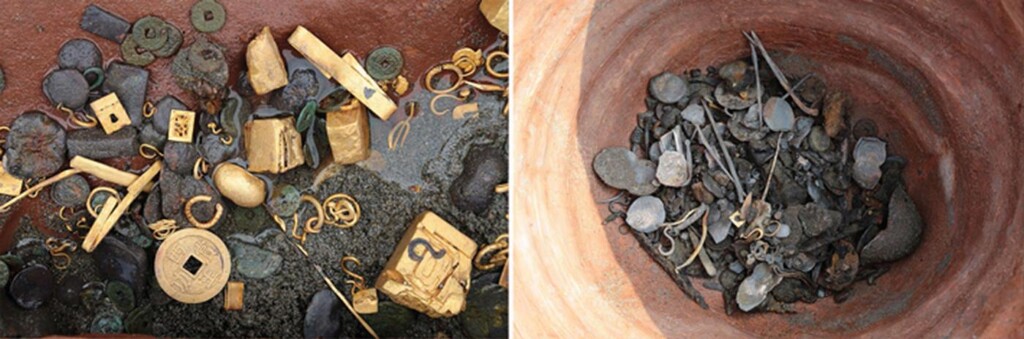
Ming Dynasty cold and silver found in the excavations – provided to Archaeology Magazine by team leader Jiu Zhiyan

“These finds not only verified historical records about the Jiangkou battle and the sunken treasure, but also shed light on the extensive social turmoil at a time of dynasty change, as well as on Zhang Xianzhong himself as a controversial historical figure,” said Liu Zhiyan of the Sichuan Provincial Institute and team leader of the excavations.

Conquest and plunder

Zhang was an archetypal oriental despot, and though he came from humble origins, he ruled over his mostly agricultural population with a mailed fist, using terror and raiding as his main instruments of statecraft. The artifacts found at the site of his fleet’s demise chart his bloody path of conquest across the flagging years of the Ming Dynasty.

OTHER SHIPWRECK STORIES: Treasure For 3 Miles: A Scatter Trail from the Most Famous Shipwreck is Uncovered Behind the Maravillas

Like all the Chinese dynasties, the Ming rose out of a peasant rebellion to topple to Mongol-led Yuan Dynasty, and they established their rule in Beijing around a series of at-first-effective administrative and economic reforms. But like all the other dynasties to precede them, the Ming administration had flaws that grew into cancerous tumors.

For the Ming, it was a bureaucratic process known as the enfeoffment system, which granted county-sized landholding monopolies or “fiefs” to nobles. These fief lords were given “conferring tablets” to denote their authority to collect taxes. This delegation created a network of little emperors that taxed the peasantry into squalor and famine—the conditions out of which Zhang rose to power like a wild spark from a fire.

He used his aptitude as a soldier and general to rally bandits and farmhands to his cause and went to war on the Ming Dynasty, cutting a swath through the fiefdoms.

MORE CHINESE HISTORY: 4,200-Year-Old Ceramic Storm Drains in Ancient Chinese Town Are the Oldest of Their Kind

Many of the artifacts found in the river near Jiangkou tell the tale of these victories, as they’re almost all plunder from cities and palaces taken during this campaign. The treasures include gold conferring tablets and other symbols of office such as a silver tablet commissioned by the King of Chu to the Ming Emperor for annual taxation, and a 200-year-old gold seal that weighed more than 17 pounds and had been used by 13 generations of rulers from the Shu vassal state.

In 1643, Zhang’s army also occupied the city of Changde, and captured another pair of gold conferring tablets owned by the King of Rong, another vassal to the emperor.

It’s one of those special occasions when historical accounts match with the archaeological evidence.

“The items unearthed from the Jiangkou battleground site match well with Zhang’s route of conquest as recorded in the literature,” Liu told Archaeology Magazine’s Ling Xin.

They also found coins minted in Daxi, the brief kingdom set up by Zhang in Sichuan Province, of which only a single example has been found previously in China.

FROM THE WRITERS AT ARCHAEOLOGY: 300 Epic Ancient Murals ‘Unique in the World’ Depict Creation Myths on Texas Rock: ‘Oldest Books in North America’

Arguably the most important piece of treasure was a royal seal used by Zhang himself, embellished in gold with a tiger to suit his warlord name of “huang lao hu” or “Yellow Tiger.”

After he lost his treasury, Zhang’s path to kingship descended into what some historians call madness, but which was at least heavy-handed tyranny. He sacked several of his own cities in internal disputes and taxation enforcement, and witnessed mass defection in the ranks to the Ming Dynasty as a result.

SHARE This Remarkable Confluence Of Rivers, History, And Archaeology…