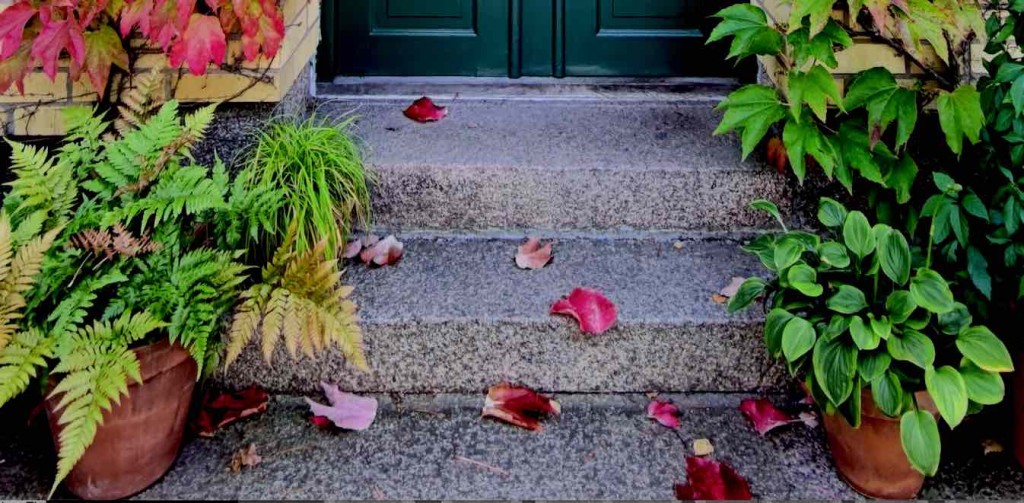
Quote of the Day: “We learn to keep going, because all the times we thought we couldn’t take one more step, we did.” – Shauna Niequist
Photo by: Nazrin Babashova
With a new inspirational quote every day, atop the perfect photo—collected and archived on our Quotes page—why not bookmark GNN.org for a daily uplift?
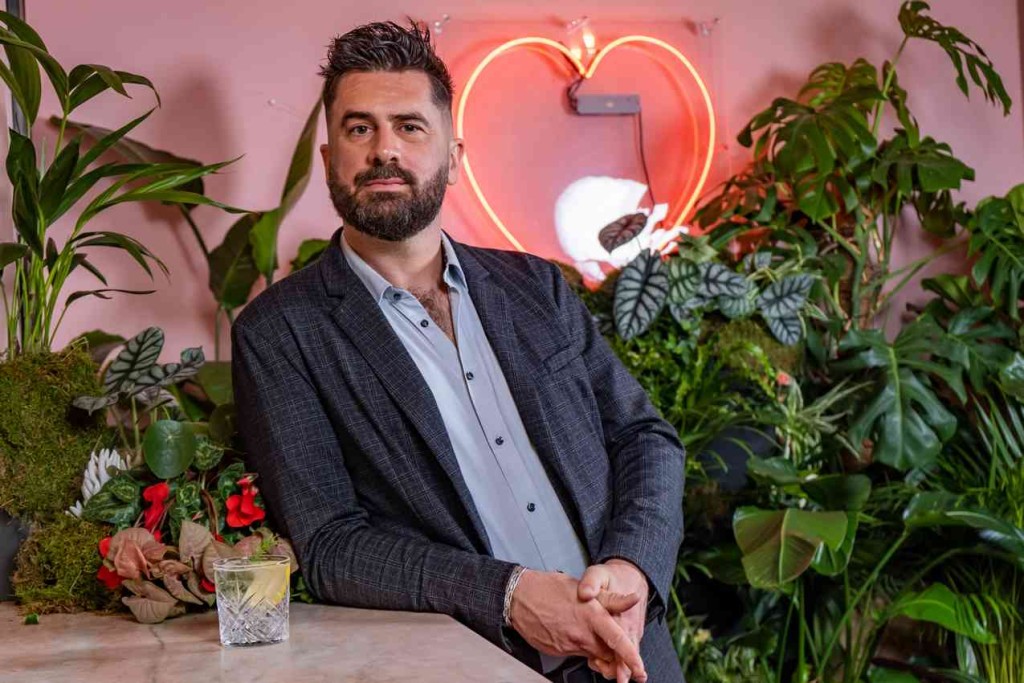
A ‘plant dating’ pop-up has appeared in London to help Brits find their perfect ‘plantner’.
The ‘Lonely Plants Club’ match-making service has been set up to marry the public with the perfect houseplants to suit their lifestyles and personalities.
It gives them the opportunity to get to know a new houseplant love interest before getting too involved and taking one home.
Taking place at the Lucky Club Mayfair, the event was created after a study found 78% of adults take their time researching their options before committing to a new ‘relationship’ with a houseplant.
It was set up by plant inspiration site, The Joy of Plants, with the help of TV’s Mr. Plant Geek, and attendees at the launch of the pop-up last night were given the opportunity to find their perfect plant match and take it home with them.
The research also found the typical adult has owned a single plant for as many as five years, with just 7% claiming they have managed the same length of time in a human relationship.
While 79% browse Google for plant-spiration, with 16% turning to Instagram when looking for ideas.
And 21% admitted to being green with envy at anyone who has a thriving houseplant collection.
“Finding a new plant love isn’t all that different to finding a new partner,” said a spokesman, from TheJoyofPlants.co.uk “It takes a lot of research, some trial and error and a sprinkle of chemistry to find ‘the one’.”
“So, we’ve set up this plant dating pop up to help match plant singletons with their leafy love matches.”
The study also found the average person boasts six potted pals in their home. Two groups of exactly the same amount of people (60%) reckoned respectively that they’re good at taking care of these botanical beauties, and that they had let a plant die by not taking good enough care of it.
When deciding which plants to commit to, the top three statistics adults look for include how much water they need, what type of light suits them and where they might fit in within their home’s current aesthetic.
And 9% believe houseplants and flowers make a good companion in their life, with 34% considering plants a great topic of conversation for a first date, God love them.
It also emerged that 83% would go as far to say they’d be impressed if someone had an extensive knowledge of plants.
The poll of 2,000 plant enthusiasts, carried out via OnePoll, found six in 10 have taken a keen interest because it’s a great way of bringing nature inside your home.
51% enjoy watching their beloved plants thrive and grow.
“Houseplants are a great way to experience the mood-boosting feelings you get from caring for someone—or something—else and watching them thrive and grow as a result of the time, care and attention you put into them,” said the UK’s Mr. Plant Geek, horticulturalist, TV presenter and host of the event.
SHARE This Opportunity to Plant Some Roots For The Long Term…
Illustration of a black hole consuming a star (Credit: DESY, Science Communication Lab)
Illustration of a black hole consuming a star (Credit: DESY, Science Communication Lab)
In October 2018, a small star was ripped to shreds when it wandered too close to a black hole in a galaxy located 665 million light years away from Earth.
Though it may sound thrilling, the event did not come as a surprise to astronomers who occasionally witness these violent incidents while scanning the night sky.
But nearly three years after the event the same black hole is lighting up the sky, and scientists believe that they’re witnessing the outflow of that star’s remnants years after it would normally happen, prompting a whirlwind of questions.
“This caught us completely by surprise—no one has ever seen anything like this before,” says Yvette Cendes, a research associate at the Center for Astrophysics at Harvard and lead author of a new study analyzing the phenomenon.
The team concludes that the black hole is now ejecting material traveling at half of the speed of light, but are unsure why the outflow was delayed by several years. The results, described this week in the Astrophysical Journal, may help scientists better understand black holes’ feeding behavior, which Cendes likens to “burping” after a meal.
The team spotted the unusual outburst while revisiting tidal disruption events (TDEs)—when encroaching stars are pulverized by black holes—that occurred over the last several years.
Radio data from the Very Large Array (VLA) in New Mexico showed that the black hole had mysteriously reanimated in June 2021. Cendes and the team rushed to examine the event more closely.
The team collected observations of the TDE, dubbed AT2018hyz, in multiple wavelengths of light using the VLA, the ALMA Observatory in Chile, MeerKAT in South Africa, the Australian Telescope Compact Array in Australia, and the Chandra X-Ray Observatory and the Neil Gehrels Swift Observatory in space.
Radio observations of the TDE proved the most striking.
“We have been studying TDEs with radio telescopes for more than a decade, and we sometimes find they shine in radio waves as they spew out material while the star is first being consumed by the black hole,” says Edo Berger, also at Harvard University and co-author on the new study.
“But in AT2018hyz there was radio silence for the first three years, and now it’s dramatically lit up to become one of the most radio luminous TDEs ever observed.”
TDEs are well-known for emitting light when they occur. As a star nears a black hole, gravitational forces begin to stretch, or spaghettify, the star. Eventually, the elongated material spirals around the black hole and heats up, creating a flash that astronomers can spot from millions of light years away.
Some spaghettified material occasionally gets flung out back into space. But the emission, known as an outflow, normally develops quickly after a TDE occurs, not years later.
Taking the conversation to Reddit, the astronomers were asked if the phenomenon was like how in a food processor, there’s a ring of material always just outside the reach of the blades.
“Basically yea,” Cendes replied. “This material was in an accretion disc surrounding the black hole after [the star] was unbound. In 20% of cases you then see a radio outflow at the part where it’s torn apart.”
The outflow of material is traveling as fast as 50% the speed of light. For comparison, most TDEs have an outflow that travels at 10% the speed of light, Cendes says.
“This is the first time that we have witnessed such a long delay between the feeding and the outflow,” Berger says. “The next step is to explore whether this actually happens more regularly and we have simply not been looking at TDEs late enough in their evolution.”
SHARE This Fun Fact With Your Space-Loving Friends…
150 people, smartphones out, watched an electric flying car perform a successful test down at Dubai’s skydiving range. There they caught a glimpse of what the not too distant future will bring.
A gaggle of flying taxi companies around the world all seem to be on the verge of populating the skies with different versions of “eVTOL” vehicles, or “electric vertical take-off and landing.”
XPeng Motors’ X2 flying taxi is a teardrop-shaped two-seater EVTOL that can cruise at around 1,000 meters in elevation at 81 miles per hour. The battery currently can store electricity for a 35 minute flight, enough for a CEO’s quick carbon-free jaunt across a skyline.
The test was unmanned, and done by automated control.
“XPeng’s X2’s public display in Dubai represents a significant milestone for XPeng AeroHT and the international achievement of flying cars,” said Brian Gu, Vice Chairman and President of XPeng.
XPeng – released
“Dubai is a world-renowned ‘City of Innovation,’ which is the reason we decided to hold the X2 first public flight event here. Today’s flight is a major step in XPeng exploration of future mobility.”
Bloomberg reporting on the test noted that XPeng is in competition with other companies like TCab Tech and AutoFlight for pole position as Asia’s urban air mobility’s leader, a market expected to reach $1 trillion over the next 20 years.
“The flying car is the epitome of ambition, innovation and future-oriented vision that has always inspired Dubai,” said Dubai Chamber of Commerce President and CEO Hassan Al Hashemi.
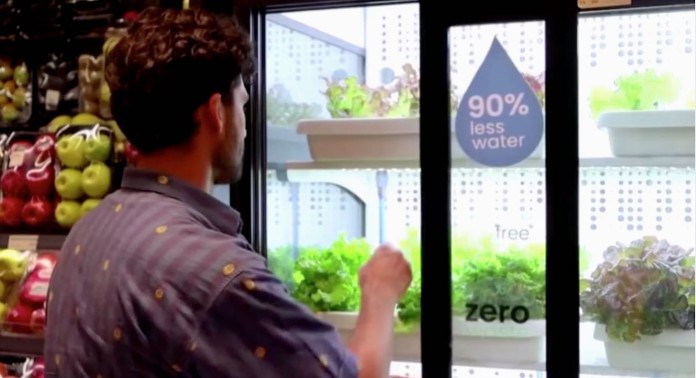
Down in Cairo, a supermarket is taking its produce aisle to a new level of freshness.
A hydroponic fridge grows different kinds of lettuce right there in the store, ensuring that no one has to complain about freshness or travel distance.
A hydroponic system is a way of growing certain plants in humid tubes without soil, supplemented with liquid fertilizer and nutrients. The system uses 90% less water than soil gardening, and is perfect for fast growing greens.
Schaduf, the company, hopes to expand the technology to other stores to help reduce the carbon footprint of the travel associated with fresh fruit and veg.
Egyptian company Schaduf is growing vegetables inside a hydroponic fridge, allowing customers to buy fresh produce straight from the supermarket in Cairo pic.twitter.com/QRRfgDJUlP
Quote of the Day: “Today is going to be a good day. I am enough just as I am. I will figure this out. Every day, I’m getting a little stronger.” – Mel Robbins
Photo by: Bailey Zindel
With a new inspirational quote every day, atop the perfect photo—collected and archived on our Quotes page—why not bookmark GNN.org for a daily uplift?
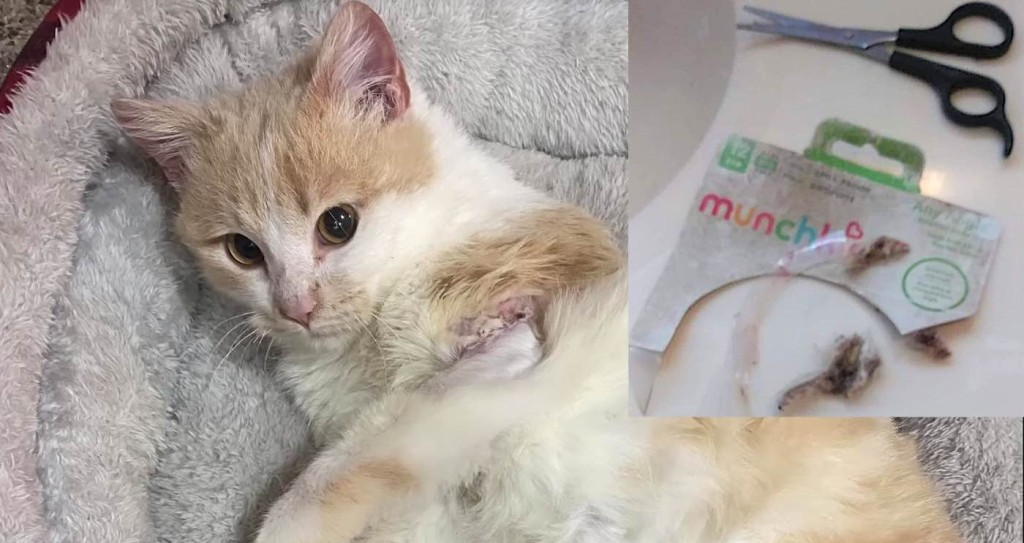
It’s so easy to pantomime corporations as mass polluters of the environment, but they’re run by humans, who reacted exactly as anyone else would when they saw a picture of Munchkin the orange Tabby.
The stray kitten was taken in by rescuers after it was found with a plastic packaging ring from a Munchkin “Any Angle Cup” stuck around his neck. It had begun to grow into the kitten’s skin.
The impact of this single photo brought about a corporate revolution that will reduce plastic use by 643,630 pounds annually.
Alerted to the kitten’s plight, Munchkin, who manufacture baby products, contacted the rescue group, Itty Bitty Kitty City, and paid for Munchkin the kitten to receive topnotch medical care, and donated $2,500 to the organization.
“It was soul crushing to read Laura’s [the rescuer] note and look at the photos of that sweet kitten, both personally because I’m a passionate advocate for animals and a pet parent myself of two cats, and professionally,” Diana Barnes, Chief Brand Officer and Creative Director at Munchkin
“We’ve all seen marine life and animals that are entangled in plastic, but no executive ever wants to imagine their brand is the source of this suffering. Laura asked us for nothing, she simply wanted awareness, she was asking us to do better.”
If the story ended there, it would be enough to tighten your throat, but it gets better, way, way better.
Barnes described cups as the “holy grail” of Munchkin’s product line. However they had just finished a total reconfiguration and branding of all 500 varieties of packaging. But the image of little Munchkin the kitten with the plastic hurting him was too much, and so Barnes and her team went right back at it.
After a year of research and development and over 250 packaging transit tests, Munchkin developed animal-safe packaging for 478 Munchkin cup SKUs.
The new design is free of plastic and utilizes e-flute corrugated linerboard made of 60-70% recycled content. Should another animal find itself in a similar situation as Munchkin the Cat, the packaging will easily break apart.
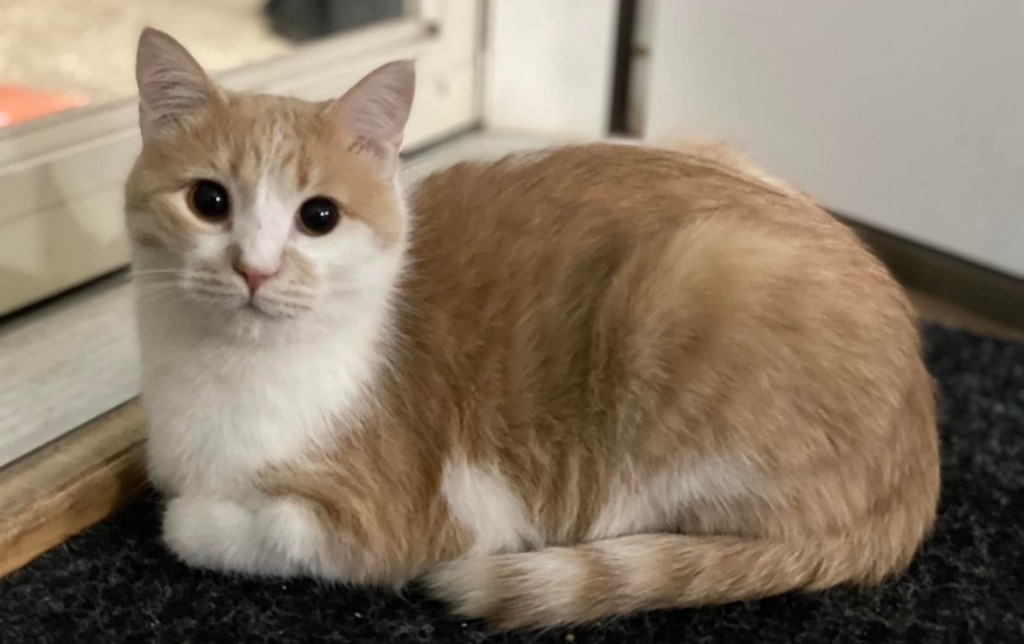
Munchkin the Cat, all grown up – courtesy of Munchkin
During the redesign process, Munchkin (the company) incorporated QR codes on the cup packaging, directing consumers to digital instructional manuals. This allowed the brand to remove the paper manuals, resulting in 37,278 lbs. of paper saved annually. If all Munchkin’s cup instruction manuals were placed end-to-end, they would have spanned the length of California 1.5 times.
The new packaging – courtesy of Munchkin.
The volunteers at Itty Bitty Kitty City were stunned and “overwhelmed” to watch this large nationwide corporation go through this massive financial expenditure simply in order to protect animals and the environment, but maybe we shouldn’t be surprised that a pair of wounded kitten eyes have that power of persuasion.
WATCH the video the put together by the company in the aftermath…
SHARE This Inspiring ‘Tail’ Of Corporate Responsibility…
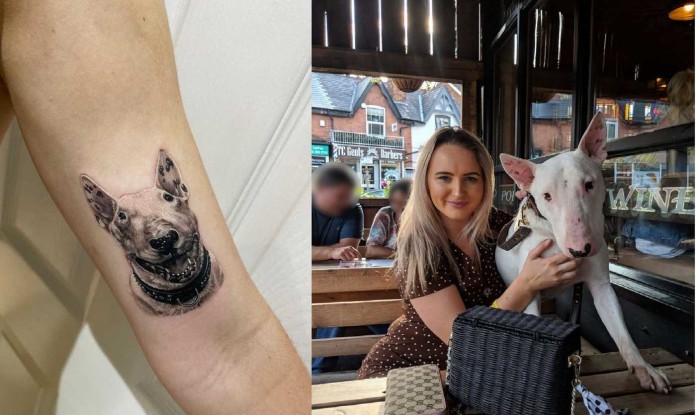
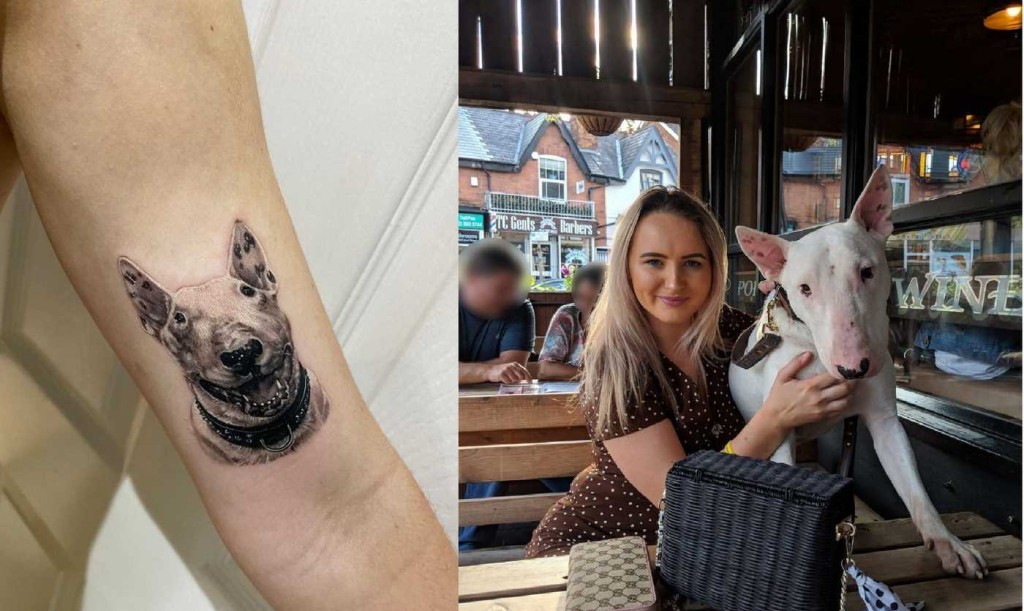
A devoted dog owner was so heartbroken when her beloved bull terrier passed away that she got his ashes inked permanently into her skin, so that he’s ‘always with her.’
Robyn Moscrop rescued her bull terrier Bronson back in 2019 who she “spoilt rotten” and “treated like a baby.”
The 27-year-old was devastated when her pampered pet suddenly died last July from unknown causes when he was only around the age of three.
To commemorate her very special dog, her boyfriend who conveniently worked as a tattooist, immortalized her favorite portrait of him with his ashes mixed into the ink.
Robyn said the tattoo provided her with a sense of closure given it means Bronson’s “always with his mum” and will never be forgotten.
“It’s not something I could lose or misplace, it’s always there,” she said. “Seeing it when it was done was really emotional, I did have a cry.”
“It sounds silly really, but sometimes when we’re at places and say I’m just wearing a t-shirt, I just think ‘oh, he’s here with me and seeing all this too.”
It was the cremationist who, after saying she would make a clay pawprint, mentioned she heard some pet owners using ashes in tattoos before. Ashes can be used to make all kinds of things, since they are a high quality form of carbon. GNN has reported that certain companies will press ashes into memorial stones, and some will even make vinyl records with them.
“I’d never heard of that before,” Robyn admitted. “I told my boyfriend and he said ‘yeah, I’ve heard artists have done it,'” adding that he would love to do it for her.
Robyn grew up with bull terriers and loves the breed so much that when she wanted her own pet, she decided to rescue Bronson. Not much was known about his history other than he was a stray, deaf and was around one when he was rescued.
“He was a crazy dog. He made such an impression on everyone because he had such a personality,” she remembers. “He just kept me really busy and I’d see other people with their really well-behaved dogs and I’d be thinking ‘oh my god, why can my dog not be like that?'”
“But I still absolutely loved him, he was spoilt rotten. He had his own social calendar. He’d go on playdates where we’d hire fields out and let 20 bull terriers off the lead for them all to play. He honestly had such an incredible life.”
SHARE This Touching Story With Your Fellow Dog-Moms…
A designer has adapted ancient methods of A/C into a modern, stylish wall ornament that powerfully regulates indoor temperatures without a watt of electricity.
The Nave is a large terracotta radiator filled with cold water, inspired by the Jarrah of ancient Palestine. Pores in the terracotta release tiny amounts of water which evaporate and cool down the interior of the Nave, cooling the wall radiatively, and thus the room.
Humans have been baking in the heat of the deserts and the tropics for millennia, and long before the invention of air conditioning, engineers and architects had methods for cooling down built into their homes.
Yael Issacharov, industrial designer at the Holon Institute of Technology, says the Nave performs best in desert climates where the dry air will gestate evaporation at a faster rate. The invention won her the gold at the IDA Design Awards, and bronze at the A’Design Awards.
She says its price would be more expensive than a regular A/C unit, but along with recouping the cost through energy savings, the Nave is actually quite beautiful to look at, and frees up the use of the window.
The Jarrah of Palestine was actually used to store drinking water, as the evaporation process helped keep the water cool, as well the room it was stored in.
Other desert cultures like the ancient Persians used wind-catching towers mounted on their buildings to channel desert breezes down into the living areas of the house.
Jaali from Mughal India is another passive-cooling system built into the cultural architecture, and can be found on buildings like the Taj Mahal. A perforated slab of intricately carved marble or sandstone takes advantage of a natural law of thermodynamics that means air must speed up as it passes through small spaces.
Air coming into a room through a jaali cools down as it sweeps through the small hexagonal holes, which double as humidifiers at night as the humid night air deposits moisture around the holes when it enters.
Like the jaali and the windcatchers, the Nave can keep a space at a comfortable 77°F in the desert heat.
At the moment, no one has expressed commercial interest in the Nave, but Fast Company reports that Issacharov is certainly open to offers as she expands the design to be able to fit with more installation and construction methods.
Harry Kane has become the most prolific goal-scoring Englishman in modern history, and he’s channeling this star power to help England break its stigma with mental health.
He’s launched the Harry Kane Foundation to use his influence to help fund critical mental health work by coaching the power of positive thinking and resiliency, especially among youth.
No one understands stress, pressure, and anxiety like English National Football Team players, who under the spotlight of the English sports media endure the harshest scrutiny of perhaps all national team football.
Before Kane became the first name on the starting lineup for London team Tottenham Hotspur, he spent four consecutive years loaned out to different teams in lower divisions. Sometimes whole seasons would go by without him ever getting a sustained period of football.
He kept his chin up and eventually made it into the Tottenham lineup during the 2014-2015 season, when he won Young Player of the Year.
Drawing on that experience, Kane is now using his celebrity profile to fund and popularize volunteer-supported mental health groups like The Mix, and Mind, that specialize in helping young adults deal with stress; particularly through anonymous helplines offering free counseling with embarrassing problems and “please-don’t-make-me-say-it-out-loud thoughts” that we all have.
Kane’s collaboration with the Premier League’s Charitable Trust has created resilience and positive mindset lesson plans for more 18,000 schools across Britain, that feature Harry talking about the power of positive thinking.
He’s teamed up with some smashing animators to produce the film below to narrate his story thus far, and the journey on which he is soon to embark.
WATCH Harry Kane’s Story…
I'm very proud to launch the Harry Kane Foundation - it marks the start of a journey for me as my Foundation aims to transform a generation’s thinking about mental health. pic.twitter.com/oZzNcviyp3
Quote of the Day: “When you cannot calm the storm, remember to access the safe and calm within you.” – Maureen Sharphouse
Photo by: Ditto Bowo
With a new inspirational quote every day, atop the perfect photo—collected and archived on our Quotes page—why not bookmark GNN.org for a daily uplift?
Colorado is blessed with one of the finest-dealt hands of public land in North America, and it’s still growing.
A nearby ranch was bought by a non-profit and turned over to the National Park Service to expand Great Sand Dunes National Park by 9,350 acres, (3,783 hectares).
Encompassing biodiverse wetlands, the transfer of the Medano-Zapata Ranch helps bring the park closer towards its original, envisioned footprint.
“The lands being transferred to the Park contain important springs and wetlands that support a rich diversity of life,” said Great Sand Dunes National Park Superintendent Pamela Rice. “This acquisition marks an important step toward completing the plan for Great Sand Dunes National Park that was established in 2004.”
The Nature Conservancy is one of the world’s largest environmental non-profits, and they had acquired the land through an agreement with the ranch back in 1999. This year they were then compensated for their member-supported purchase with money from the federal government’s Land and Water Conservation Fund, which takes royalties from oil and gas drilling to pay for conservation projects.
Since its inception more than 50 years ago, the LWC has funded $4 billion worth of conservation projects nationwide, and in 2019 it was reauthorized by Congress permanently.
Approximately 12,498 acres of the Medano-Zapata Ranch lie within the boundaries of Great Sand Dunes National Park; TNC plans to transfer the remaining 3,192 acres to NPS in the future, which includes a herd of grazing bison, currently on a 7-year lease from the Dept. of Interior.
Great Sand Dunes National Park was established as a national monument in 1932 and redesignated as a national park and preserve in 2000 to protect the tallest dunes in North America for current and future generations.
The dunes are the centerpiece in a diverse landscape of grasslands, wetlands, forests, alpine lakes and tundra. Last year, more than 603,000 visitors came to experience the singular dunes and starry skies, and learn about the cultural history.
In 2021, park visitors spent an estimated $41.3 million in local gateway regions while visiting Great Sand Dunes National Park & Preserve, supporting more than 530 jobs.
We are proud that Good News Network has passed a major milestone—celebrating our 25th anniversary of delivering positive news to tens of millions of people worldwide. Instead of throwing a party, I’ve decided to do a huge giveaway to groups in the U.S. who are tackling depression and anxiety, like we do here at GNN.
UPDATE (10/25): I was so excited to begin mailing cases of our books to groups around the country this week, but I wanted to announce that we are still looking for applicants who want our Good News gift books. READ below, if you are serving a large number of people who are dealing with depression… Then, email me!
Do you know any organizations or individuals who are working with troubled youth, adults with depression, or people who could use a bit of good news?
Each case contains 120 books, and we’ll ship them for free (must be in the USA). Simply email us at gnn@goodnewsnetwork and let us know WHO you are, WHAT you do, and HOW you plan to use the case books. [Put Book Giveaway in the subject header.]
If you want to buy any books yourself, they are now available at Amazon.com—and they make a great gift for anyone who needs a lift!
We’re hoping these valuable essential service groups will send us photos after distributing the paperbacks, so we can share them on social media—and here on the website—to show millions of loyal fans what our 25th anniversary party looked like.
Feel free to reach out by ‘snail mail’ at our new location:
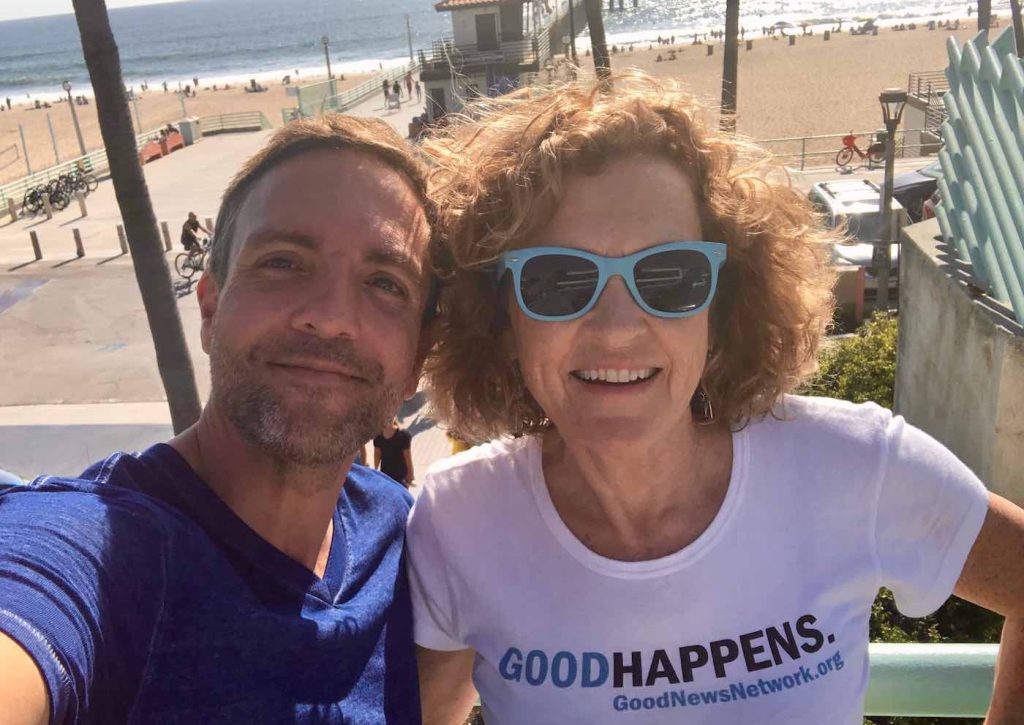
GNN Founder, Geri Weis-Corbley (right) with GNN co-owner Anthony Samadani – GNN merchandise including this T-shirt can be purchased on CafePress.com/goodnewsnetwork
Citroen’s new family car, the Oli, can change from a family sedan, to a pickup truck, to a low-weight city car, and its battery can be used to add solar energy to the grid.
For two decades manufacturers have been trying to create electric cars that are more practical, cost-effective, and attractive to the average consumer.
The Oli is not following that beaten path, but rather is described as a “laboratory of ideas,” which Citroen hope trickle down into other automobiles, but also help push the concept of the car, such as it is, along.
In science-fiction movies, cars always take on a dozen of additional roles that would never be found in a car today. In the new TV version of Lost in Space their car becomes a mobile communications hub, and an escape pod capable of traveling through space.
The Oli “concept car” attempts to replicate that, not least of which because of its near-military appearance with the flat windscreen and boxy bonnet.
Its fabrication is achieved with 100% recycled material, and made as light as possible to extend the range. The base model has a 250 mile, 400 kilometer range. Once charged up, which takes around industry-standard times, the roof panels double as a workstation where the owner can run their laptop or charge their devices.
Here in picnic-pickup configuration – Citroen.
The roof panels are also totally flat and climbable, making them perfect for a picnic. The whole thing is meant to tackle any situation one could find in the modern city, whether that’s moving furniture, picking up a gaggle of kids from school, maneuvering tight spaces, or reducing air pollution.
The designers imagine that in a world of solar and wind power, Olis would help solve renewable energy’s biggest hurdle which is storage. During the height of the sun and wind, the car could be charged, and then discharged into one’s house at the end of the day for peak hours when the sun has gone down.
100,000 Oli owners then act as little storage hubs to help the grid through dark hours when demand for electricity is high.
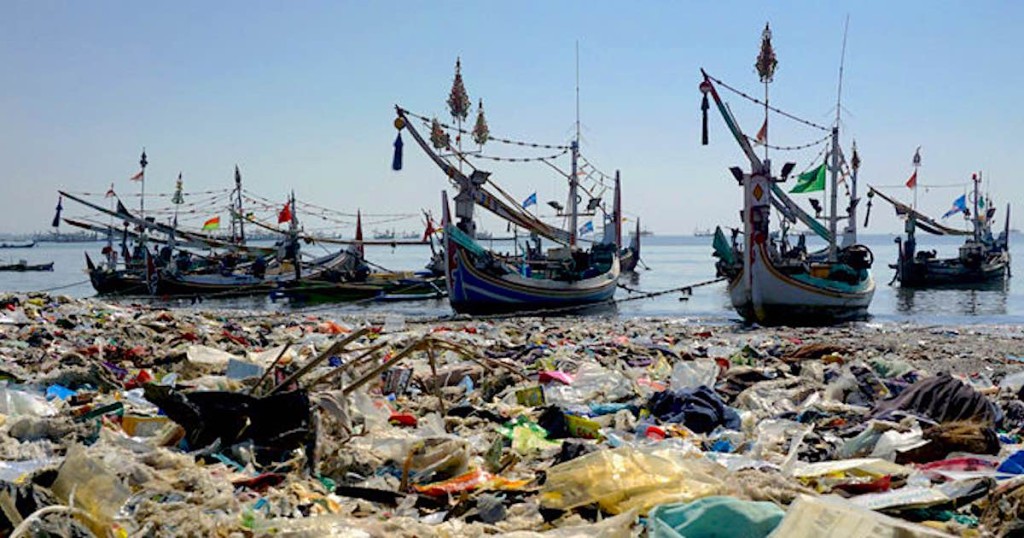
Plastic pollution in Indonesian ports. Image by Anton Wisuda/Mongabay Indonesia
Plastic pollution in Indonesian ports. Image by Anton Wisuda/Mongabay Indonesia
In Indonesia, small-time fishermen are being paid as part-time ocean cleanup crews, as the archipelago seeks to tidy their seas and raise awareness among stakeholders at the same time.
The Ministry of Fisheries announced on October 4th they had stashed around $70,000, or 1 billion rupiah, with which to pay fisherman for any plastic trash they recovered from the oceans.
Many countries around the world are setting environment or climate goals for themselves. One of the largest contributors of ocean going plastic waste, Indonesia is looking to shake off that reputation by spending $1 billion over the next 3 years to reduce plastic entering the oceans from their shores by 70%.
If an Indonesian fisherman working off the main islands can collect 4 kilograms of trash per day, the government will pay out around $10 for it, which is slightly more than they would get if they spent their day catching fish to sell at market prices.
“This activity is very simple,” Sakti Wahyu Trenggono, the fisheries minister, said at a press conference in Jakarta. “But at least this will raise awareness among the stakeholders at sea and the people around the world.”
“The most important thing is prevention,” Sakti said. “If we can properly conduct prevention, then there shouldn’t be any waste in the sea. Because once the trash gets to the sea, then it’s already damaged.”
Indonesia is located in one of the fastest-developing regions on the planet economically-speaking, and the use of plastic waste has outpaced the instalment of recycling infrastructure, especially on the smaller islands.
According to the UK’s Pew Trust, 95% of all fishing activities are small-scale. Small fisheries can’t absorb costs from things like ocean pollution or additional taxes like large-scale fisheries can, making this bottom-up approach to ocean cleanup uniquely suited to Indonesia.
Furthermore, Indonesia is surrounded by some of the most biodiverse shallow seas on earth, a Mecca for divers and snorkelers, who aren’t interested in wading through plastic while they do it.
Scott Oughton-Johnson (far left) and the Westminster chapter of the Proper Blokes Club after a walk and talk. - credit Facebook.
Scott Oughton-Johnson (far left) and The Westminster chapter of the Proper Blokes Club after a walk and talk. – credit Facebook.
An Englishman who went through nearly 10 years of mental turmoil has started a walking group to break the stigma associated with men and their mental health.
After years of stuffing down a painful separation and a long custody battle, Scott Oughton-Johnson felt he couldn’t take it anymore, and so decided to go for a walk.
Reasoning that walking was always something he enjoyed, and that exercise is a calming, endorphin-driven activity, he thought he might see if anyone else in the neighborhood wanted to join him. He recorded a video of himself walking and talking on Facebook, and invited men going through rough patches to join him.
“I was disheartened at first,” he says when only one “lad” showed up. “I thought hundreds might turn up. But we were together for eight hours that night. We had so much to chat about.”
The next week they went from 2 to 4, and in continued growing until The Proper Blokes Club was born. Through the club, walk leaders organize walks to share in each other’s difficulties through talking and walking from Monday to Thursday all around England.
This week walk and talks are going on in Greenwich, Finchley, Wallington, Southwark, Sutton, and Woolwich.
Anywhere from 2 to 35 lads might turn up. The youngest “lad” as Oughton-Johnson always calls them, is 19, while the oldest is 79. Walkers can peel off when they want; no pressure is put on them to continue for the full 2 hours. Every lad is added to a WhatsApp group, and walk leaders will write daily check in messages: “Morning lads, hope you’re well, have a great day.”
“We’ve had incidents where people say, ‘I’m not in a great place; is anyone about?’ And people have gone and met them, or called them up,” he explains.
“People have gone to each other’s weddings and birthdays,” he added. “Sometimes I take a step back, and think, this group of lads never knew each other a few months ago, and they’ve found lifelong friends out of it. It’s amazing.”
In the UK, emphasis on mental health communication, and of stressing a stigma claimed to be associated with it, is stronger than in the US, where things like stress, depression, and anxiety are well-established medical conditions. Perhaps it’s all those “Keep Calm and Carry On” signs.
Oughton-Johnson hopes that The Proper Blokes Club can become a “community interest company,” rolled out nationwide by health authorities.
Quote of the Day: “There is no greater wisdom than kindness.” – Thomas Kinkade
Photo by: Ditto Bowo
With a new inspirational quote every day, atop the perfect photo—collected and archived on our Quotes page—why not bookmark GNN.org for a daily uplift?
Xiulin Ruan, a Purdue University professor of mechanical engineering, holds up his lab’s sample of the whitest paint on record. (Purdue University/Jared Pike)
Xiulin Ruan, a Purdue University professor of mechanical engineering, holds up his lab’s 2021 sample of the whitest paint on record. (Purdue University/Jared Pike)
A stunningly-white coat of paint could be used to reduce reliance on air conditioning, after it was demonstrated to reflect 98.7% of incoming sunlight.
Just the paint alone was shown in a demonstrations to keep surfaces 19°F cooler than the surroundings by completely reflecting incoming solar radiation.
It was in 2021 that Xiulin Ruan, a Purdue University professor of mechanical engineering, first developed the paint, and with a new tweak that’s achieved the same results with a thinner coat, it has the potential of becoming an industry standard.
“I’ve been contacted by everyone from spacecraft manufacturers to architects to companies that make clothes and shoes,” said Xiulin Ruan. “They mostly had two questions: Where can I buy it, and can you make it thinner?”
The 2021 world’s whitest paint, for which Ruan was entered into the Guinness World Records, had to be applied at a layer of 400 microns thick, which is only possible for robust and stationary objects like buildings.
For things like airplanes, cars, or anything that comes with weight restrictions, 400 microns is too dense a coating to be useable. That’s why Ruan and his colleagues went back to experimenting with new materials, and replaced the barium oxide with hexagonal boron nitride.
the 2021 paint layer compared to the new and improved paint. credit – Purdue University photo/Andrea Felicelli
The hexagonal structure reflects the sunlight more totally, and the paint also incorporates voids of air which make it highly porous on a nanoscale. This lower density, together with the thinness, provides another huge benefit: reduced weight.
The newer paint weighs 80% less than barium sulfate paint yet achieves nearly identical solar reflectance, which Ruan says opens the door to whole new domains of commercial application.
Most importantly he notes, compared to A/C, which takes the hot air from one’s house or office and deposits it into the air of the city, or with eyes on a larger scale, the Earth as a whole, ultra-white paint reflects the sun’s rays entirely, sending the thermal energy outside the Earth’s atmosphere.
“We are in discussions right now to commercialize it,” said Ruan. “There are still a few issues that need to be addressed, but progress is being made.”
A tile-mosaic floor depicting birds and other animals has been found under a field in Gaza so well-preserved it could have been buried yesterday.
Olive farmer Salman al-Nabahin was planting new trees in his grove in Bureij Refugee Camp when he and his son chanced upon the ancient relic which is believed to date from the Byzantine era.
Some of the new trees weren’t taking root, and digging down into the soil their tools struck something hard and unfamiliar which led to the discovery.
Before any archeologists could come to see it, al-Nabahin and his son looked it up on the internet and determined based on the style it was probably Byzantine.
The Empire of Byzantium was the eastern portion of the Roman Empire, which developed later than the western half, but lasted longer—long into the Viking Age. The Byzantines were one of many cultures that controlled Palestine over the centuries, along with ancient Rome and Egypt, the Ottomans, Crusader states and the Biblical Philistines.
“The archaeological discovery is still in its early stages and we await to know more of the secrets and civilization values,” the Palestinian Ministry of Tourism and Antiquities said in a statement.
On Thursday, President Biden announced in a video statement he was pardoning thousands of people convicted in federal courts for the possession of cannabis.
Speaking-specifically, he issued full pardons to anyone charged in a federal court under the sentencing guidelines for the simple possession of the Schedule 1 drug nationwide and D.C.
The New York Times estimates this will clear the rap sheet over perhaps more than 7,500 non-violent drug offenders held in federal prisons.
The pardons stop short of those convicted of selling or trafficking cannabis, as well as anyone charged in state courts for breaching state laws, but he said to continue locking up people for cannabis “makes no sense.”
“The federal government currently classifies marijuana as a Schedule 1 substance,” he said, “the same as heroin and LSD and more serious than fentanyl. It makes no sense.”
It’s the kind of sweeping move that Democratic voters have been waiting a long time for, as during the 2020 Democratic debates it was almost unanimous opinion that the federal government should do more to relax restrictions on cannabis, particularly with the scheduling being as harsh as cocaine or heroine.
The pardon will remove barriers for anyone looking to apply for a credit card, mortgage, university, employment, or federal benefits, and Biden urged state governors to follow his lead.
Too many lives have been upended because of our failed approach to marijuana. Hear from @POTUS on the three steps he is taking to right these wrongs. pic.twitter.com/IqOxHxjgue
“Sending people to jail for possessing marijuana has upended too many lives — for conduct that is legal in many states,” Mr. Biden said on Twitter on Thursday. “That’s before you address the clear racial disparities around prosecution and conviction. Today, we begin to right these wrongs.”
He added that there should still be important limitations on the trafficking and sale of cannabis, indicating that his change in position likely falls short of federal decriminalization, and probably steps in line with the policies laid out by some states.
For thousands of families who will get to see their loved ones out of from federal people-cages, it’s an October Surprise in a delightful sense of the phrase.