













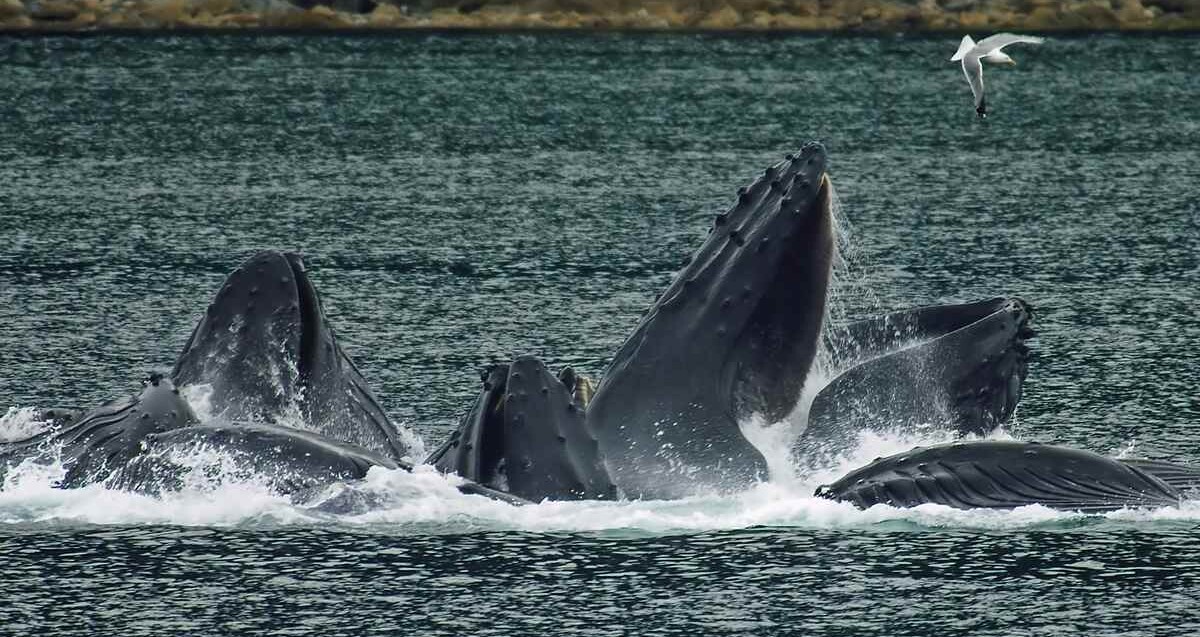
Two photographers recently set a world record for the number of individual baleen whales seen in a single group at 304.
It’s not just hard rockers that can form supergroups. Humpback whales seem to like it too, though scientists don’t know why.
What they do know, however, is that they will congregate in numbers as large as several dozen, even several hundred, and that when they do, the ocean quakes.
Renowned wildlife photographers Chris Fallows and his wife Monique described to the BBC that their breaching was like “bombs going off” and said that the constant blowhole spray stank up the ocean air for miles around.
A supergroup is defined as 20 or more whales swimming within 5 body lengths of each other. They often form during the austral summer off the coast of South Africa where the major ocean current known as the Benguela upwelling brings nutrients from the cold depths up to the surface to cause major plankton and krill proliferation.
This is feeding time and tide for the whales, who gorge themselves on the tiny animals, using a special keratin plate in their mouths called a baleen to filter the krill from the seawater which they then eject through their blowholes.
Humpback whales are one of the planet’s great conservation success stories from the perilous latter days of the whaling industry. Since then, they’ve breached 125,000 known individuals worldwide, and the population recorded by the Fallows contains many new whales never documented before.
Humpback supergroups began to be documented in 2011 off the west coast of South Africa.
Scientists documenting the phenomena at the time and since have several theories. First, they supposed it could be the result of changes in prey availability leading to a novel feeding strategy, or a historically unobserved strategy that became apparent as populations recovered from whaling.
They also thought it might be that increasing whale abundance elsewhere resulted in the exploration of alternative feeding strategies or areas, or even that supergroups had always existed, and just the probability of seeing them increased as a result of population recovery.
WHALE STORIES: Scientists Hail Record Number of Sightings in January as Auspicious for Endangered Right Whales
New research measuring concentrations of chlorophyll-A in ocean plankton published in 2021 seems to indicate the second of these hypotheses has the sturdiest legs.
Whatever the reason, Simon Elwen, a marine biologist at South Africa’s University of Stellenbosch says that now the average supergroup reaches hundreds of whales, and that the surprise isn’t seeing a supergroup, but not seeing a supergroup.
OTHER STORIES LIKE THIS: ‘Superpod’ of More Than 2,000 Dolphins Frolic off California Coast – (WATCH)
The Fallows found themselves in the midst of a right mess—hundreds and hundreds of whales breaching, splashing, blowing, and making a thunderous racket. They ended up photographing 472 whales, of which 304 were individuals according to the artificial intelligence powering the citizen science project Happywhale.
“We didn’t go out with the intention of breaking a record,” Mr. Fallows told the BBC. “There were just so many whales around us. Monique and I were laughing, because there was just so much going on that you didn’t even know what to photograph. It was like rapid fire.”
BLOW The News Over To Your Friends Social Media Feeds…