












Scientists called “astonishing” the first indisputable evidence of a new species of Spinosaurus found in over a century—uncovered in a remote area of the Sahara Desert.
The newly discovered scimitar-crested dinosaur was described as a “hell heron” that fed on fish despite living hundreds of miles from the sea.
Paleontologists say it appears to have been a wading predator of fish like its close relatives, but its habitat was more than 600 miles inland from the Tethys Sea in present day Niger.
Study leader Professor Paul Sereno said the new species called Spinosaurus mirabilis, lived 95 million years ago as a shallow water predator alongside long-necked dinosaurs.
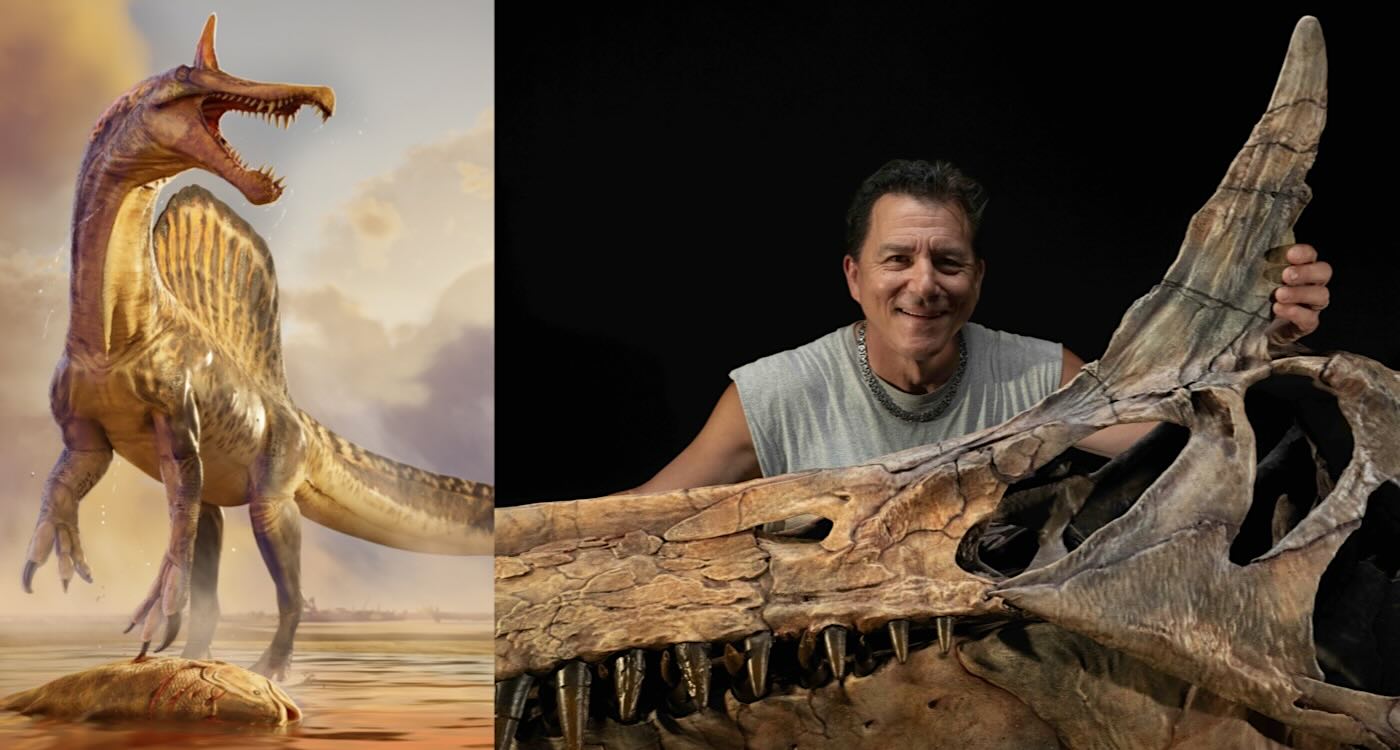
It was similar in size and skeletal form to Spinosaurus aegyptiacus—but was crowned with a unique scimitar-shaped bony crest.
Prof. Sereno said the discovery of the crest was so large and unexpected that the team didn’t initially recognize it for what it was when they plucked it and some jaw fragments from the desert surface.
Returning with a larger team, they found two additional crests, and realized the novelty of the new species they had unearthed.
“This find was so sudden and amazing, it was really emotional for our team,” said Sereno, a professor of organismal biology and anatomy at the University of Chicago, who led the 20-person team.
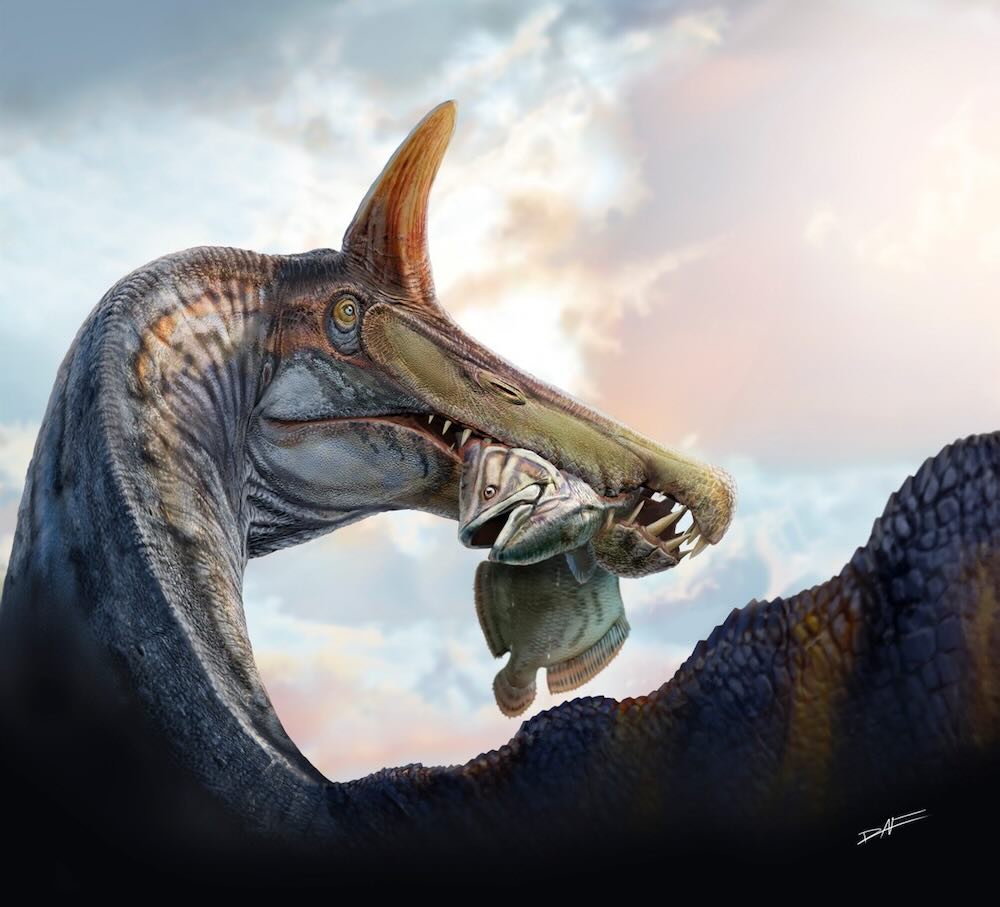
They believe that the crest was brightly colored, curving toward the sky as a blade-shaped beacon, and sheathed in keratin. It may have been used for visual display rather than locomotion or hunting.
“I’ll forever cherish the moment in camp when we crowded around a laptop to look at the new species for the first time, after one member of our team generated 3D digital models of the bones we found to assemble the skull—on solar power in the middle of the Sahara.
“That’s when the significance of the discovery really registered.”
The fossil find, described in the journal Science, may represent a ‘third phase’ of evolution of the massive, fish-eating dinosaurs, according to the research team.
Previously, spinosaurid bones and teeth had only been found principally in coastal deposits not far from the shoreline, leading some experts to believe that the fish-eating theropods may have been fully aquatic, pursuing prey underwater.
But the new fossil area in Niger documents animals that were living inland, up to 620 miles from the nearest marine shoreline.
MORE DISCOVERIES:
• How One Man Stumbled Upon Complete Stegosaurus Skeleton Set to Auction for Millions
• Giant New Dinosaur Species Named Loki-ceratops for Horns That Look Like the Norse God
• Newly Unveiled T-Rex Relative Was Sitting in Museum Drawer for 50 Years and ‘Rewrites’ Family Tree
The researchers say that the “striking” interdigitating upper and lower tooth rows made a deadly trap for slippery fish.
“I envision this dinosaur as a kind of ‘hell heron’ that that had no problem wading on its sturdy legs into two meters of water, but probably spent most of its time stalking shallower traps for the many large fish of the day,” Sereno explained.
Their proximity to partial skeletons of long-necked dinosaurs—all buried in river sediments—suggest they lived in a forested inland habitat dissected by rivers, according to the research team.
What inspired him to go to the desert in the first place–and fall in love with it
The journey that culminated in the new discovery started with a single sentence in a monograph from the 1950s: a French geologist mentioned finding a single saber-shaped fossilized tooth resembling those of the giant predator Carcharodontosaurus found in Egypt’s Western Desert at the turn of the last century.
“No one had been back to that tooth site in over 70 years,” he says.
“It was an adventure. A year and a half wandering into the sand seas to search for this locale and then find an even more remote fossil area with a new species.”
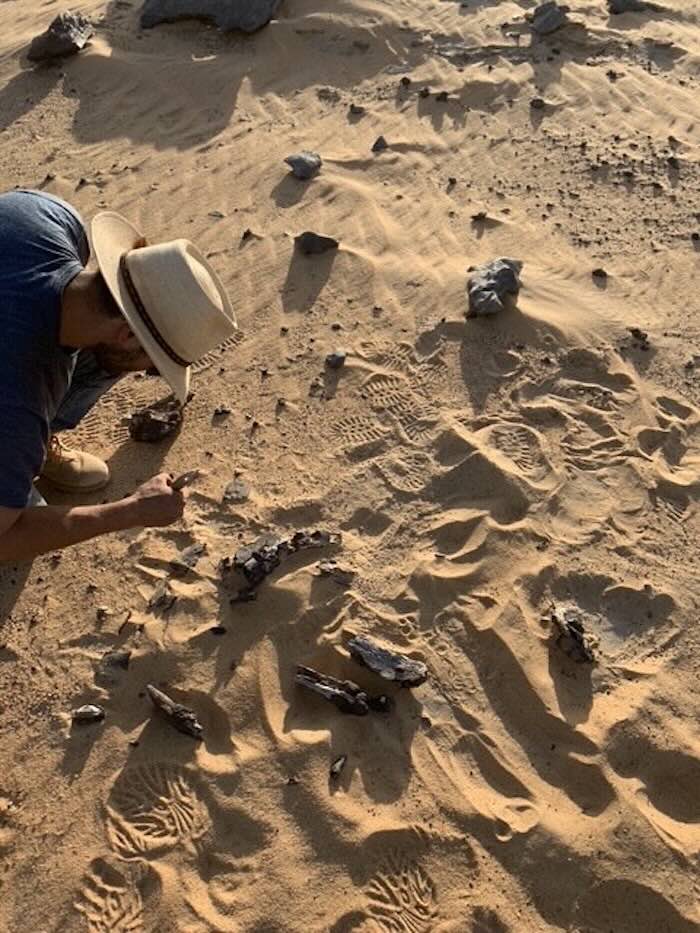
The team ended up meeting a local Tuareg man who led them on his motorbike deep into the center of the Sahara, where he had seen huge fossil bones.
After nearly a full day of travel, they reached the site—where the team found teeth and jaw bones of the new species of Spinosaurus.
“There’s nowhere else like the Sahara. If you can brave the elements and are willing to go after the unknown, you might just uncover a lost world.
“Now all of the young scholars who joined me are co-authors on the report gracing the cover of Science.”
The dinosaur fossil will now be showcased in the Museum of the River, in Niger’s capital of Niamey, a zero-energy institute that Prof. Sereno founded.
“The local people we work with are my lifelong friends now, including the man who led us to Jenguebi and the astonishing spinosaur.
“They understand the importance of what we’re doing together, for science and for their country.”
MORE DINO DYNAMOS:
• Family Discovers 8 Huge Dinosaur Footprints While Walking on Eroded Beach (Photos)
• Dinosaur With Rows of Bristles On its Head Like a Toothbrush Has Been Discovered–LOOK
Back in Chicago, his team cleaned and then CT scanned the teeth and bones, assembling a digital rendering of the skull for the research report.
Using the rendering, Prof. Sereno worked with paleo-artist Dani Navarro in Madrid to create an action scene involving a reconstruction of the new species towering over a coelacanth carcass.
Navarro then created a detailed 3D physical model of S. mirabilis by adding flesh over a skeletal reconstruction. The team also prepared a replica of the newly discovered skull and a touchable, colorful model of the scimitar crest.
Both replicas will be added to Sereno’s dinosaur exhibit at the Chicago Children’s Museum on on March 1, where youngsters will be among the first to get up close and personal with the latest dinosaur find.
“Letting kids feel the excitement of new discoveries – that’s key to ensuring the next generation of scientists who will discover many more things about our precious planet worth preserving.”
SHARE THE AMAZING DINO DISCOVERY With Paleo Pals on Social Media…