











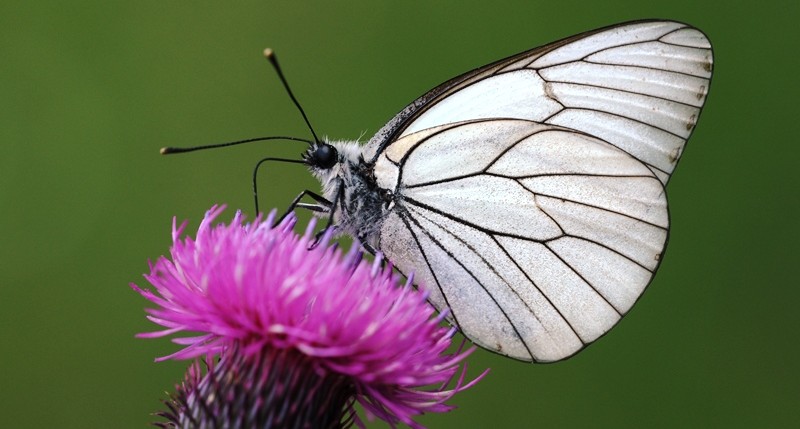
As GNN has reported before, Britain loves her butterflies, and this black-veined beauty is getting special attention as it prepares to re-establish itself across the island.
Extinct in the UK since the early 20th century due to land-use changes, habitat loss, and harsher weather due to climate change, the black-veined white butterfly seems set for a return thanks to a reintroduction project.
The work has been organized by the Knepp Wildland Foundation, the nonprofit arm of Britain’s most famous rewilding project on Knepp Estate in West Sussex, where a struggling landowner turned his family’s failing ancestral farm into one of the most biodiverse places in England.
The mosaic of newly-naturalized wooded grasslands teems with animals, including large concentrations of endangered birds like nightingales, and insect species like the purple emperor butterfly.
The black-veined white butterfly is still widespread across continental Europe, and for the reintroduction program larvae were flown from France in special containers. They overwintered in flight cages in Devon where they’ve been monitored by Knepp’s partner Ambios Ltd.
The work is an ongoing collaboration between Ambios, Butterfly Conservation, The Zoological Society of London, and Natural England.
Early signs suggest the insects are doing well, growing as would be expected on hawthorn and blackthorn shrubs that make up their diet and habitat.
This is especially encouraging since, according to Bird Guides UK, several attempts to reintroduce this butterfly have failed.
INSECT INTRIGUE:
• Beautiful Tortoiseshell Butterfly Recolonizes England Decades After Elm Disease Had Eliminated it
• European Orchard Bee is Now a Valuable Pollinator in UK–As Weather Warmed
• Scientist Discovers New Bee Species with ‘Devil-like’ Horns–Names Her ‘Lucifer’
Prior to the importation, Knepp Wildland Foundation carried out extensive climate and environment studies to ascertain whether conditions across Southern England, and Britain more broadly, would be appropriate for these Lepidopterans after such a long absence.
If all goes the plan, future operations will try to connect the population to ancestral hotspots like Devon and the south coast, where Knepp is already hard at work restoring the butterfly’s homeland.
SHARE This Great Work To Recover Britain’s Butterfly Species…