














Burrowing bees generally prefer to make their nests in the open, but some 20,000 years ago their ancestors lived in a cave where they used the bones of prey animals rather than soft soil.
The groundbreaking discovery was made in a Caribbean cave that narrowly escaped being turned into someone’s toilet.
The island of Hispaniola, divided between Haiti and the Dominican Republic, is dotted with limestone caves. Evidence, including owl bones and eggshells, suggest that giant ancestors of the modern barn owl lived in the cave through many successive generations.
The researchers say that the owls would sometimes cough up pellets containing the bones of their prey, which landed on the cave floor. The bees would then use the bones’ empty tooth sockets as nests, according to study published in the journal Royal Society Open Science.
The American research team that published the study believe a lack of topsoil outside the cave and an abundance of accumulated silt within led to the anomaly.
Cueva de Mono in the southern Dominican Republic is a deposit of many fossils, and the study’s lead author Dr. Lazaro Viñola-López, of the Field Museum in Chicago, repeatedly explored the cave looking for them.
“If you go in at night, you see the eyes of the tarantulas that live inside,” he told the museum’s press. “But once you walk down a 10 meter-long tunnel underground, you start finding the fossils.”
There were multiple layers of fossils, separated by carbonate layers resulting from rainy periods in the distant past. Many of the fossils belonged to rodents, but there were also bones from sloths, birds, and reptiles, amounting to more than 50 different species.
Despite the scientific sensitivity and value, the team one day discovered, having studied the cave for several years, that a local had built a house near the opening and was preparing to use the cave as his septic tank.
The resident’s plans were thwarted, but the scientists decided they weren’t going to wait around for any other wiseguys to damage the layers of paleontological history.
“We had to go on a rescue mission and get as many fossils out as possible, and we got a lot of them,” said Dr. Viñola-López. “We think that this was a cave where owls lived for many generations, maybe for hundreds or thousands of years.”
“We find fossils of the animals that they ate, fossils from the owls themselves, and even some turtles and crocodiles who might have fallen into the cave.”
The discovery of the bees occurred when Viñola-López, who was primarily interested in the bones from the mammals that the owls ate, noticed that in the empty tooth sockets of the mammal jaws, the sediment didn’t look like it had just randomly accrued.
“I was like, ‘Okay, there’s something weird here.’ It reminded me of the wasp nest.”
Several years earlier, a paleontologist had shown him the ancient remains of wasp cocoons which looked a lot like smooth dirt lining the tooth sockets from the cave fossils.
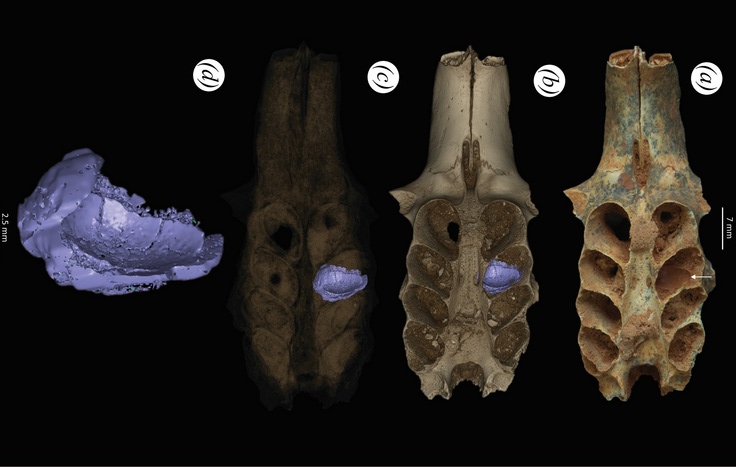
To better examine the potential insect nests present in the cave fossils, Dr. Viñola-López and his colleagues CT scanned the bones, X-raying the specimens from enough angles that they could produce 3D pictures of the compacted dirt inside the tooth sockets without destroying the fossils or disturbing the sediment.
The shapes and structures of the sediment looked just like the mud nests created by some bee species today. The researchers believe that the bees mixed their saliva with dirt to make tiny individual nests for their eggs.
“It’s possible that they belonged to a species that’s still alive today—there’s very little known about the ecology of many of the bees on these islands,” he said. “But we know that a lot of the animals whose bones are preserved in the cave are now extinct, so the bees that created these nests might be from a species that has died out.”
Viñola-López said it’s a perfect example of how bees can surprise you.
“Even if you’re looking primarily for fossils of larger, vertebrate animals, you should keep an eye out for trace fossils that can tell you about invertebrates like insects. Knowing about insects can tell you a lot about a whole ecosystem, so you have to pay attention to that part of the story.”
SHARE This Hidden Wonder Of Extinct Ecology, Rescued, And Revealed…