













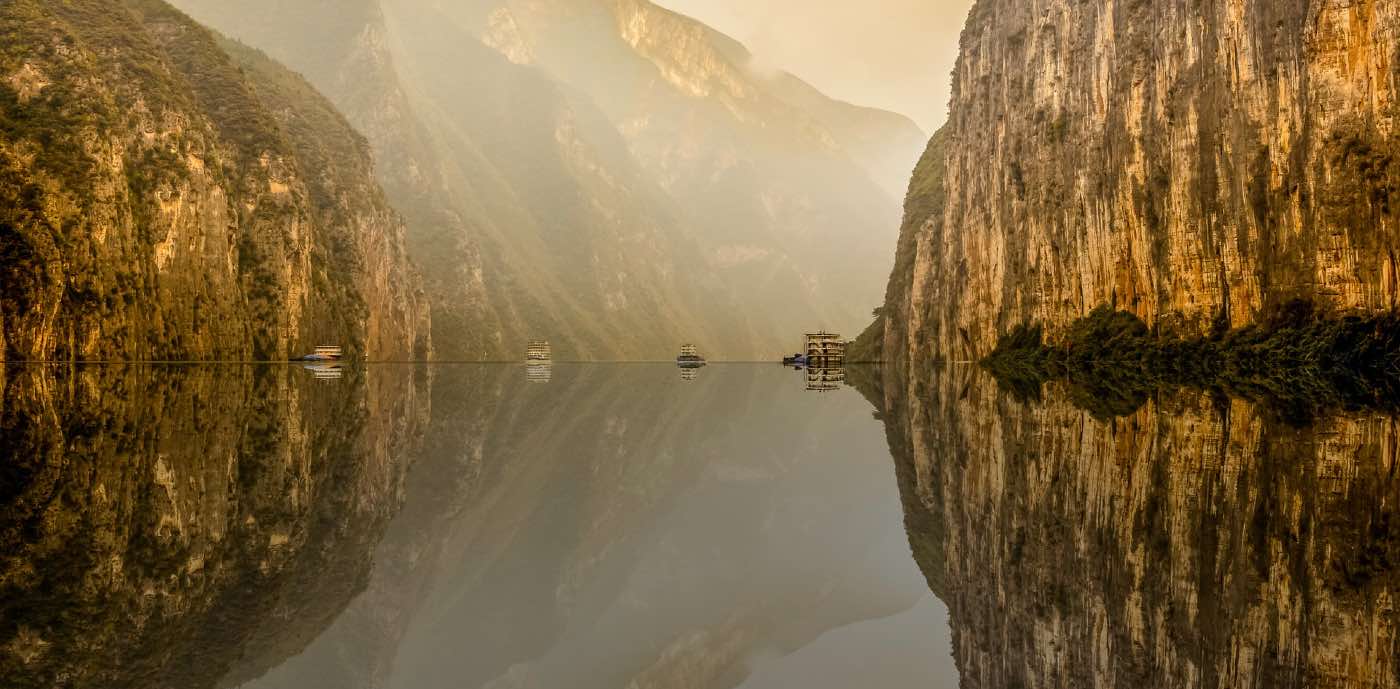
The mighty Yangtze river has experienced a dramatic improvement in ecological health halfway through a 10-year fishing moratorium.
The focus of a $2.7 billion restoration project, this crucial aquatic artery had been severely degraded by decades of damming, overfishing, fragmentation, pollution, and neglect.
Now, a new study reports a tripling of fish biomass, increases in the Yangtze finless porpoise numbers, and disproportionate increases in the amount of large, game fish species.
GNN reported in 2021 on the Yangtze river fishing moratorium. One of the three great rivers of China and the third-longest in the world, its estuary at Shanghai is one of the busiest freshwater ports in the world, while its length and abundance is home to 60% of China’s freshwater fisheries that together employ over 200,000 people.
In many ways, water is a key part of the identity of the Chinese people. Going back as far as 4,000 BCE, society was organized for the first time around the management of water, and the nation’s founding myth—that of the Yellow Emperor taming the raging waters of the Yellow River, stands in testament to the enduring power of China’s rivers both as economic engines, and sacred places.
But like so many rivers around the world, even the Yangtze could not withstand industrialized society. Continual construction of dams, sand mining, dumping from huge factories that stand along its course, and decades of overfishing gradually eroded its ecological integrity.
As the Chinese boom continued into the 21st century, and wealth replaced poverty in much of the country, calls began to ring out for greater protections of the Yangtze, but not before the extinction of the Baiji—a freshwater dolphin native to the river that was worshiped as a goddess.
Perhaps this tragedy was the catalyst for an unprecedented restoration program led by an international team of freshwater biologists. The proposal was a 10 year moratorium on fishing coupled with a massive welfare program to reemploy all the fishermen thusly disposed of their livelihoods.
110,000 fishing boats were impounded with compensation, shoreline mining and extractive industry was halted, and water quality improvements were mandated. The results were succinct. Even halfway through the 10-year ban, 70 years of degradation were seemingly rolled back.
“The seven-decadal biodiversity loss was halted with improvements in fish biomass, body condition, species diversity, and initial recovery of threatened species,” the authors of the study measuring the impacts of the legislation wrote in their abstract.
“Eliminating fishing pressure was likely key to this recovery, in addition to actions targeting water quality improvement, hydrological and riparian habitat restoration, and vessel traffic reduction.”
CHINA CLEANING HERSELF UP: China’s War on Pollution Improved Air Quality 42%, Reduced Global Pollution Average, and Returned 2 Years of Life to Citizens
The study team, which included Chinese and Western biologists, surveyed 57 river sections across the Yangtze basin, comparing data from the pre-ban period (2018–2020) with the early post-ban years (2021–2023).
Overall fish biomass rose by 209%, rising to 235% for game fish like bream. The Yangtze finless porpoise also benefited substantially.
RIVER RESTORATION: Toronto River Once So Polluted it Caught on Fire Now Is Flush with Fish
“Its population rose by one-third, from 445 individuals in 2017 to 595 in 2022. This rebound is likely attributable to a more abundant prey base, reduced mortality from fishing gear and vessel collisions, and lower underwater noise pollution,” Chen Yushun, a professor at the Institute of Hydrobiology, Chinese Academy of Sciences, wrote in the paper.
High up the flow of the Yangtze remains the Three Gorges Dam, a hydroelectric plant and accompanied reservoir so large it changed the equilibrium point of the Earth by a fraction of a percent. This likely puts an upper limit on just how much restoration the river can and will enjoy, as many species will likely have their historic spawning grounds beyond the dam’s reaches.
YOU MAY ALSO LIKE: 4 Dams Set for Removal in Maine Will Open Hundreds of Miles of River for Salmon, Herring and Sturgeon
Hundreds of dams have already been dismantled along the river, unlocking hundreds of miles of habitat connectivity otherwise isolated.
The authors in their paper said similar programs could be used to reverse ecological decline along other major rivers like the Amazon and Mekong.
SHARE This Incredible Return Of Nature Along The Yangtze…