













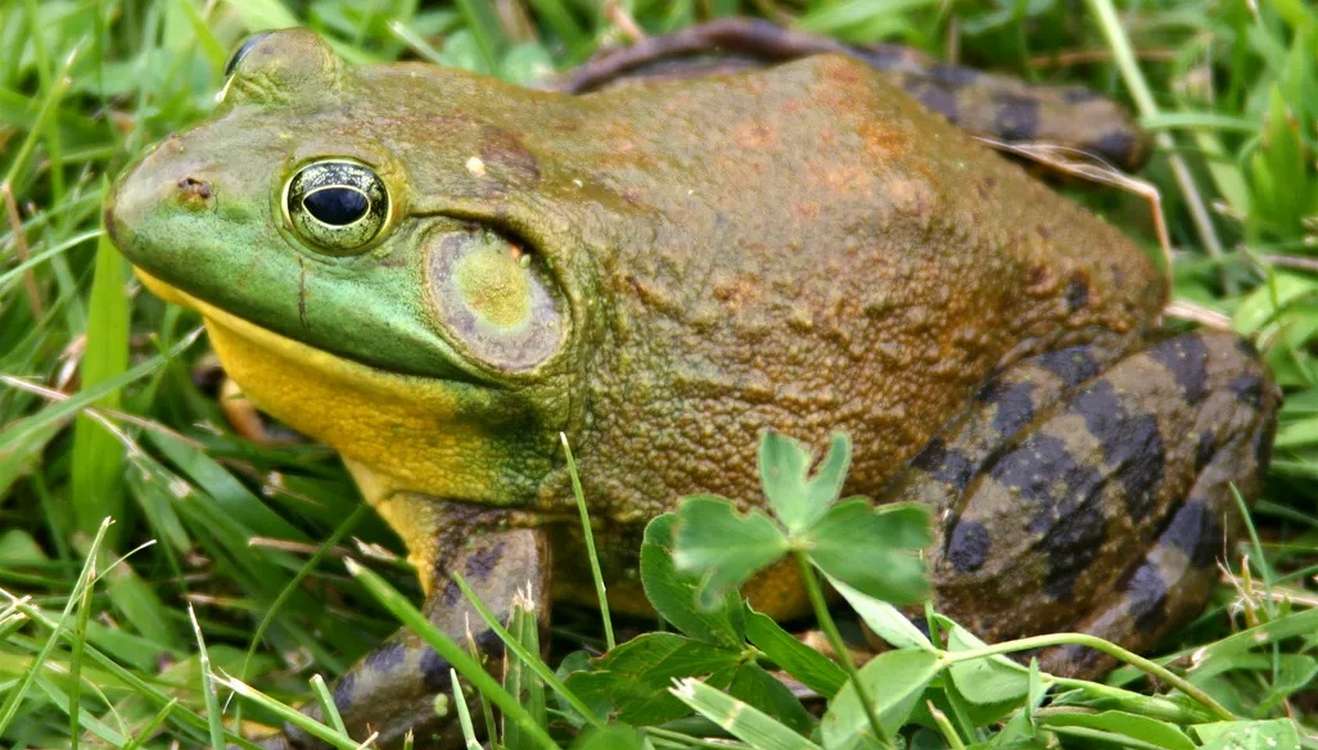
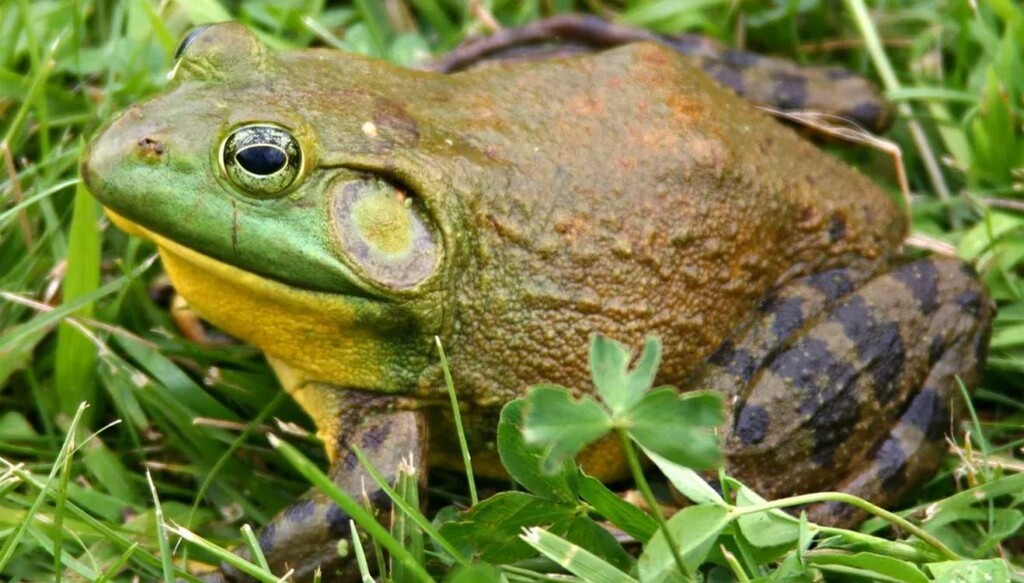
He’s no poison-arrow frog, but that doesn’t mean the American bullfrog doesn’t understand poison—far from it, according to scientists.
Hidden within the humble bullfrog’s genetics is the equipment to produce an antidote to a deadly shellfish toxin that afflicts thousands of people every year.
It’s sometimes thought that a phenomenon of blooming marine microorganisms known as “red tide” is why shellfish is not kosher. These algal blooms produce saxitoxin, or STX, which accumulates in shellfish and causes paralytic shellfish poisoning (PSP) when consumed.
STX is considered a chemical weapon under international law, was stockpiled by the US during the Cold War, and featured in the famous case of American Air Force pilot Gary Powers, whose U-2 spy aircraft was shot down over the Soviet Unio. The CIA had issued Powers a suicide pin containing STX to use should he face capture.
Powers declined to take the suicide route, which interestingly enough is believed to have won him sympathizers among the judges at his trial for espionage in Moscow as it underlined, as they saw it, the cruelty of their opponents—that they would instruct their patriotic sons to commit suicide; at least according to Jan Morris’ coverage of the trial for the Manchester Guardian. That’s enough history for now though.
Paralytic shellfish poisoning affects some 2,000 people worldwide officially, although the vast majority of cases go unreported, according to experts.
There is no antidote for STX, but a new UC San Francisco study is likely to change that.
In research published July 16th in Nature Communications, a team led by Daniel Minor, PhD, and professor in UCSF’s Cardiovascular Research Institute, found that a protein called saxiphilin can neutralize saxitoxin in mice, preventing and even reversing otherwise lethal poisoning.
The protein, which occurs naturally in bullfrogs and other frogs around the world, acts like a molecular sponge. It binds tightly to saxitoxin in the bloodstream before the toxin can reach the nerve and muscle cells it normally attacks.
Earlier efforts to find an antidote against the toxin focused on interrupting the complex biological processes it uses to disable nerve cells—or trying to trigger immune responses against it. Those approaches were largely unsuccessful.
“It turns out that one naturally occurring protein is all that’s required to take this toxin out of commission,” Minor said.
The discovery could have important public health implications, helping to protect recreational harvesters worldwide, as well as coastal indigenous communities in the US and Canada who face the highest exposure to red tide through traditional subsistence harvesting, often far from emergency medical care.
The current study builds on 2021 research in which Minor and colleagues showed that saxiphilin binds strongly to saxitoxin, essentially soaking it up like a sponge and blocking its toxic properties. But whether that interaction would work inside a living organism remained uncertain.
ALSO CHECK OUT: CRISPR Identifies Commonly Available Drug That Works as Cobra Venom Antidote
To find out, Minor and postdoctoral PhD scholars Samantha Nixon and Sandra Zakrzewska tested saxiphilin in mice exposed to lethal doses of STX. When saxiphilin was given before or along with STX, the protein prevented poisoning. It also cured nearly all mice who got the protein after they were exposed to STX, a scenario that most closely resembles what would occur when someone unknowingly eats poisoned shellfish.
Minor said this latter scenario was particularly encouraging, given the size of the antidote molecule, which the researchers thought might slow down its action.
“We had this really big protein that needed to catch up with a tiny toxin molecule that has a running start on it,” Minor said. “We really weren’t sure this was going to work.”
BETTER ANTITOXINS: Revolutionary Antidote Neutralizes Venom of 19 of World’s Deadliest Snakes–Thanks to Man Who Immunized Himself
The protein not only improved survival but also reduced symptoms associated with severe poisoning, with no harmful side effects.
The team also discovered that saxiphilin spread throughout the body, reaching the brain, heart, and muscles, allowing it to intercept the toxin wherever it traveled.
STX is not a single toxin but a family of over 50 variants with closely related structures. In two studies, published in 2025 and 2026, Minor showed that saxiphilin can bind a wide range of these variants, making it a good candidate for an antidote.
SURPRISES FROM THE AMPHIBIAN WORLD: Tiny ‘Frog Saunas’ Help Endangered Amphibians Fight off Fungal Disease
His next goal is to determine whether smaller, engineered versions of saxiphilin could provide the same, or maybe even better, protection against an array of STX variants. More broadly, he believes the work offers a blueprint for finding antidotes to many other natural toxins that currently have none.
“Nature has had to solve this problem multiple times,” he said. “So, there is resilience to toxins all over the biological world.”
SHARE This Brilliant Science Revealing A Potential Antitoxin On Social Media…