












Some animals like salamanders can regenerate entire limbs, and by flipping a few genetic switches scientists have potentially unlocked innate human regeneration.
The key is essentially to deprogram the natural response to build scar tissue and reprogram cells to build back bone, ligaments, muscle, and skin.
“Why some animals can regenerate and others, particularly humans, can’t is a big question that has been asked since Aristotle,” said Dr. Ken Muneoka, a professor in the Texas A&M College of Veterinary Medicine and Biomedical Sciences (VMBS).
“I’ve spent my career trying to understand that.”
In their study, published in Nature Communications, Muneoka and his colleagues detail a newly developed 2-step treatment that led to the regeneration of bone, joint structures and ligaments in mice. While the results were imperfect, the team believes this approach could be used more immediately to reduce scarring and improve tissues repair after amputations.
In mammals, injuries typically trigger fibrosis, a process in which fibroblast cells rapidly close the wound and form scar tissue. This response prioritizes survival by sealing the injury quickly, but also limits the body’s ability to rebuild missing structures.
In regenerative species, like salamanders that can regrow lost limbs, those same types of cells organize into a blastema, a temporary structure that enables tissue regrowth.
“It’s as if these cells can move in 2 different directions,” Muneoka said. “They could either make a scar or make a blastema. Our research focused on redirecting the behavior of fibroblasts already present at the injury site.”
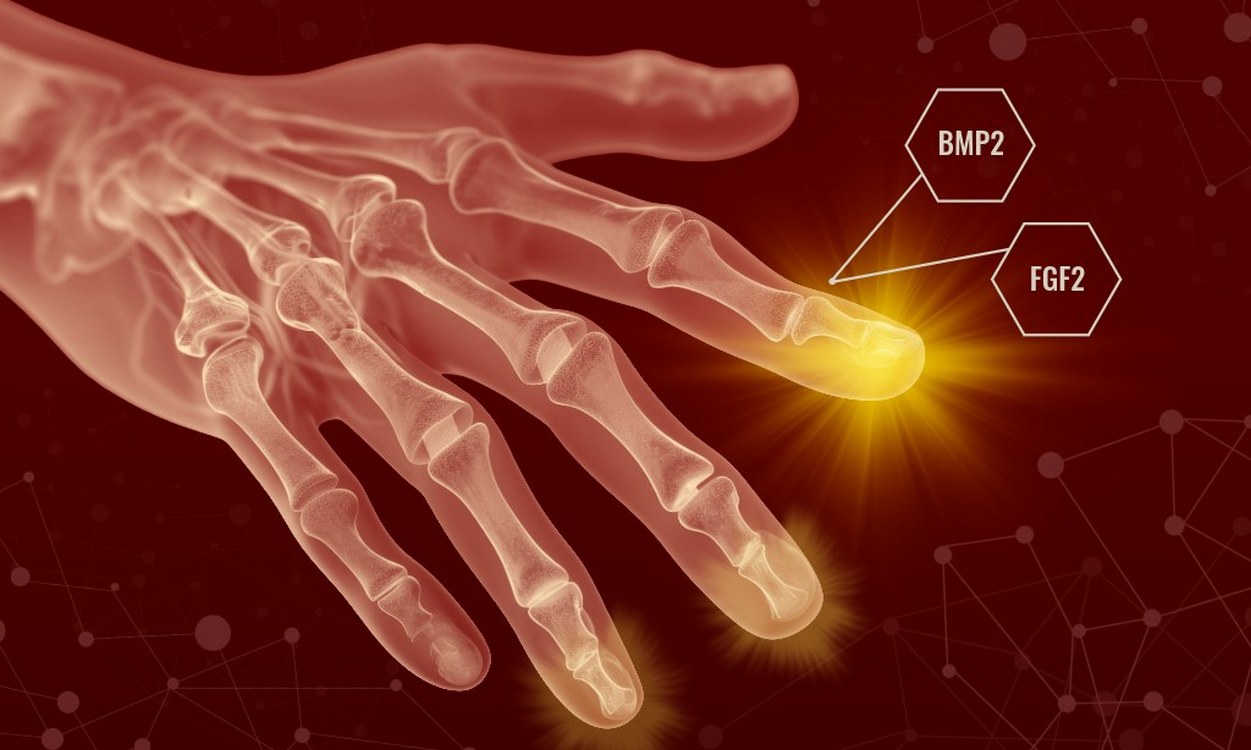
To test whether mammalian healing could be shifted toward regeneration, researchers developed a sequential treatment using two well-studied growth factors.
The first step involved applying fibroblast growth factor 2 (FGF2) after a wound had already closed. This timing allowed the body to complete its typical healing response, and then the team “changed what happens next.”
FGF2 stimulated the formation of a blastema-like structure—something that does not normally occur in mammals following this type of injury; several days later, a second treatment—using bone morphogenetic protein 2 (BMP2)—was applied, triggering those cells to begin forming new structures.
“This is really a 2-step process,” Muneoka said. “You first shift the cells away from scarring, and then you provide the signals that tell them what to build.”
A key implication of the study is that regeneration does not depend on adding external stem cells, as many current approaches in regenerative medicine attempt to do.
“You don’t have to actually get stem cells and put them back in,” Muneoka said. “They’re already there—you just need to learn how to get them to behave the way you want.”
The study also showed that cells can be redirected to form structures beyond their original location—a concept known as positional re-specification, which plays a critical role in development.
This means cells that would normally contribute to one part of the body can be instructed to rebuild a different structure after injury.
Although the regenerated structures were not exact replicas of the original anatomy, researchers were able to restore all the expected components removed during amputation, such as the bone, tendon, ligament and joint.
FUTURE WOUND HEALING: ‘Game-Changing’ Skin Printer Works Like a Paint Roller, Speeding Up Healing on Even Bigger Wounds
The results included both skeletal elements and connective tissues, organized in a way that reflects the natural structure.
“We regenerated what you would expect to see at that level of injury,” Muneoka said. “The structures are there, just not in a perfect form.”
The findings also revealed that regeneration occurs through multiple biological pathways, indicating that rebuilding tissue is more complex than relying on a single mechanism.
REGENERATIVE MEDICINE: UPDATE—World’s First Drug to Regrow Teeth Enters Clinical Trials
While the research is still in early stages, it may have more immediate applications in improving how wounds heal. Rather than focusing solely on regrowing entire structures, researchers believe the approach could first be used to reduce scarring and improve tissue repair.
“People should start thinking about using these signals during the healing process,” Muneoka said. “Even shifting the response slightly away from scarring could have real benefits.”
Because BMP2 is already FDA approved for certain medical uses and FGF2 is in multiple clinical trials, the pathway to clinical exploration may be more accessible for entirely new therapies.
HEALING NOT TREATING: Revolutionary Treatment Heals 3rd Degree Burns Across the Face of World’s First Human Recipient
For Muneoka, those questions have guided decades of research, and now, finally, have a new foundation.
“Regenerative failure in mammals can be rescued,” he said. “Now we have a model to begin figuring out how.”
SHARE This Important Step Towards Future Wound Healing On Social Media…