














For the most train-dependent transportation system in the world, the debut of its first high-speed or “bullet” train, is now tantalizingly close.
It’s set to begin phased passenger operations starting from August 15th, 2027, provided there are no more delays to the project.
Set to connect the financial center of Mumbai with Ahmedabad in the western Indian state of Gujurat, the Japanese-style high-speed train will shorten travel times by more than 4 hours. Surat, the global diamond cutting center, and current all-weather boom town in India, will also be on the line.
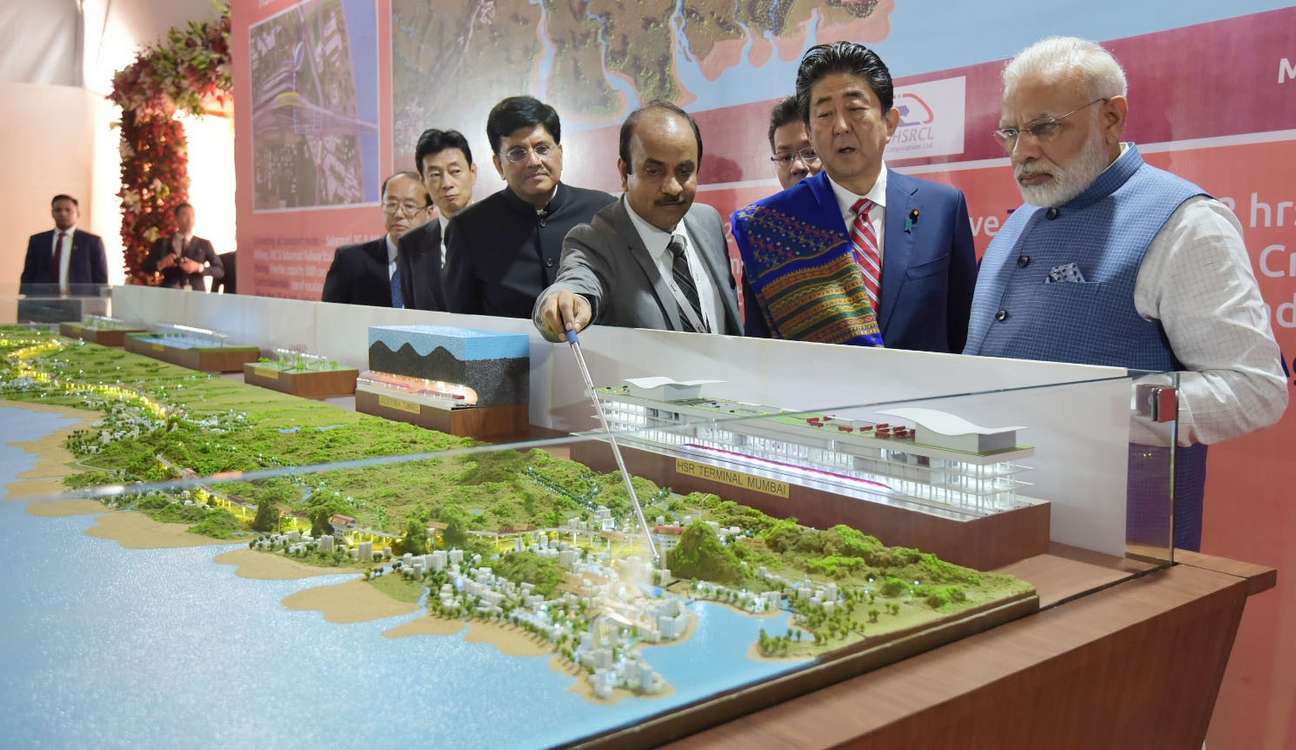
The Mumbai-Ahmedabad high-speed rail project, as seen in the image above, has been a long time in the making. In it, Shinzo Abe—the long-since assassinated Prime Minister of Japan, inspects a mock-up of one end of the train terminal.
Japanese engineering expertise was enlisted—along with a large loan—to help India begin modernizing its massive railway system.
“A considerable amount of work on the entire corridor has already been completed,” Dharmendra Tewari, Indian Railways’ additional director general, told AFP. “The first section of the bullet train will be operational in 2027, between the cities of Surat and Vapi,” the latter being a big chemical manufacturing hub.
Capable of traveling at 164 mph, Japan’s Shinkansen is earthquake-resistant, and comes with an exceptional safety and operational record dating back decades.
An article on the 300 mile-long Mumbai-Ahmedabad line published by AFP describes New Delhi as having pumped billions of dollars into overhauling creaking colonial-era railway infrastructure in recent times.
BIG ENGINEERING PROJECTS: New Railway Between Europe and China Will Shave a Week Off Delivery Times, Boost Kyrgyzstan Economy
It is the world’s most extensive rail network, carrying 7.41 billion passengers and 1.67 billion tons of freight. Around 45,000 miles of rail routes are plied by trains that run 63 miles per hour.
The nation’s indigenous speedy service is called the Vande Bharat, and can travel around half as fast as a Shinkansen.
NEW HIGH SPEED LINES: High-Speed Railway Progresses Towards a 200-mph Train Line From Dallas to Houston
To build the line to Mumbai, the contractors had to undertake a couple of national firsts, including India’s first undersea tunnel, and the longest conventional tunnel in the country. The project has already been delayed by 4 years, a result of planning the route through areas where permitting and land acquisition has proved much more complicated than first expected.
If the roll-out is safe and successful, future connections to the tech hubs of Pune and Chennai are envisioned in the 2030s.
SHARE This Better Way To Travel In India With Your Friends…