













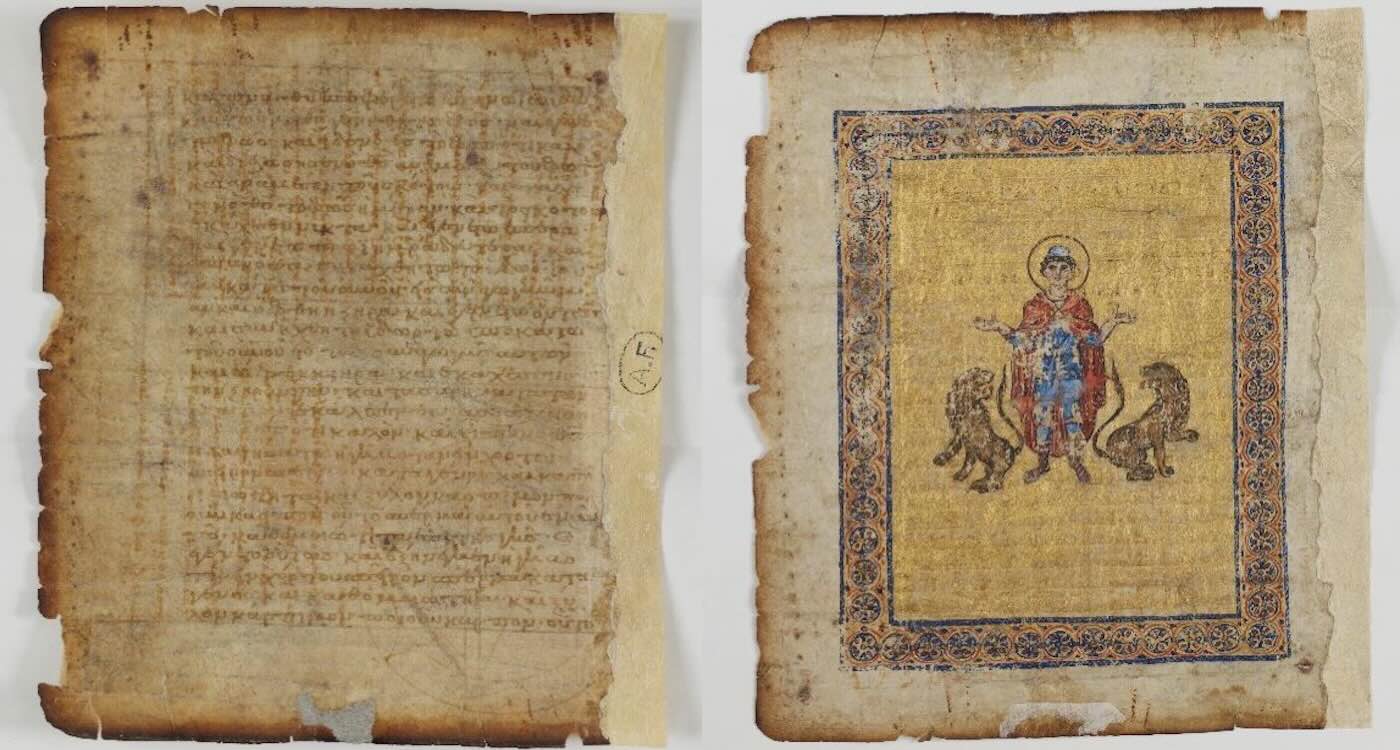
A page of writing from legendary Greek scientist Archimedes, which was lost for several decades, has been rediscovered by a French national researcher working at the Musée des Beaux-Arts in Blois, France.
The leaf, from what is considered one of the most important surviving manuscripts of antiquity, contains a passage from the treatise On the Sphere and the Cylinder, Book I (Propositions 39 to 41)—and much of it remains largely legible on the 10th Century parchment.
It was identified in the museum’s collection by Victor Gysembergh, a researcher at the National Center for Scientific Research (CNRS), as being the missing page known from century-old photographs taken of the text in 1910, which are now preserved at the Royal Danish Library.
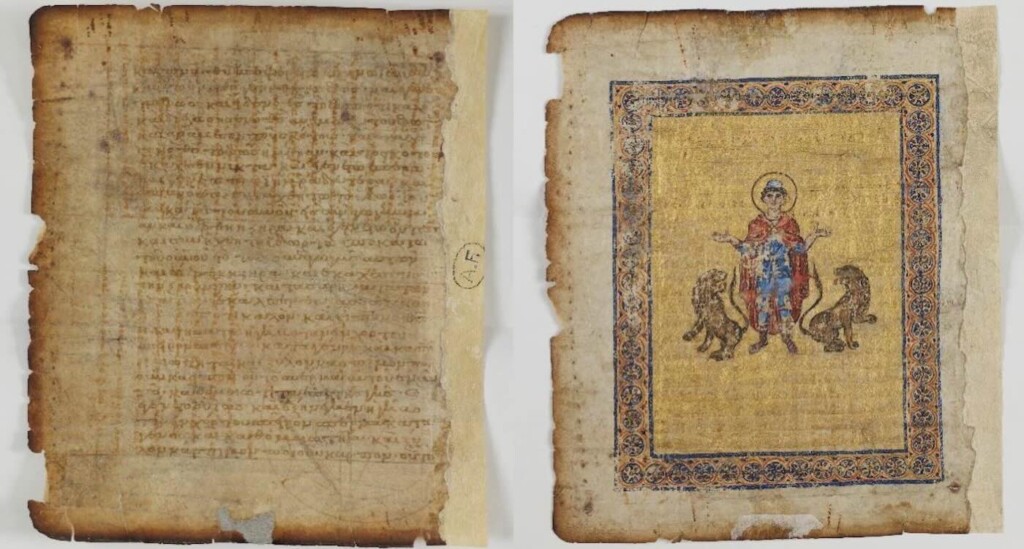
On one of its two sides, a text of Greek prayers partially covers geometric diagrams, while the other side is covered by an illustration added in the twentieth century depicting the Prophet Daniel surrounded by two lions, beneath which the ancient text remains to this day, but inaccessible while using conventional methods of examination.
Gysembergh and his colleagues at the CNRS’ Léon Robin Center for Research on Ancient Thought plan to conduct the first X-ray imaging studies within a year, after obtaining the necessary authorizations, to document what was written beneath the illustration.
To understand both the value of the discovery, as well as why a single page was missing and stuffed in a French museum, and why there are passages hidden beneath an illustration, one must understand the incredible story of the text’s provenance.
Some believe the manuscript was copied from an earlier compilation made by the legendary Isidore of Miletus (475 CE–mid-550s CE), the mathematician and architect who designed the original building that became the Hagia Sophia church in then-Constantinople (Istanbul).
It contained works of the Classical Greek mathematician Archimedes and others. Archimedes was known in his day (C. 287–212 BC) as the best mind in Greece. He approximated pi, and formulated multiple theorems for determining the areas of various geometrical shapes.
Placed onto parchment in 950 CE, the codex was later evacuated to a Greek Orthodox monastery in Palestine as crusaders were getting ready to sack Constantinople in 1204. There it existed for centuries, during which the paper was washed and reused for Greek religious scripture—a process known as palimpsesting. In 1899 it was still in the hands of the Greek church, and was photographed by Johan Heiburg in Istanbul in 1906.
OTHER TREASURES OF ISTANBUL: Must See: 16th Century Turkish Baths Reopening in Istanbul as Part-Antique Spa, Part-Museum
Around 1922, a page from the manuscript went missing in the midst of the evacuation of the Greek Orthodox library during a tumultuous period following World War I, during which it entered a private French collection.
Within the Archimedes Palimpsest, on the reused paper with washed-out text, the original writing is still visible, running left-to-right across the parchment, and contains two works of Archimedes that were thought to have been lost—the Ostomachion and the Method of Mechanical Theorems—as well as the only surviving original Greek edition of his work On Floating Bodies.
CNRS stated that the Ministry of Culture eventually approved the manuscript’s export to Christie’s Auction House in New York City in 1998, where it was put up for sale by the daughter of the Frenchman who owned the work. It was contested by the Greek church, but a US court ruled in favor of the auction, and the incomplete manuscript was purchased by an anonymous buyer, “Mr. B,” to be deposited for conservation and study at the Walters Art Museum in Baltimore. (The German newspaper Der Spiegel reported that the buyer was most likely Jeff Bezos, the founder and CEO of Amazon.)
ANCIENT LITERATURE: Timbuktu’s Medieval Manuscripts Return Home After a Decade Away Safe from Insurgents
Regarding the newly found missing page, the scientists plan to use a multispectral approach combined with a series of synchrotron-based X-ray fluorescence analyses to generate the text beneath the illustration of Prophet Daniel.
SHARE These Lost Pages Of A Relic With An Incredible History…