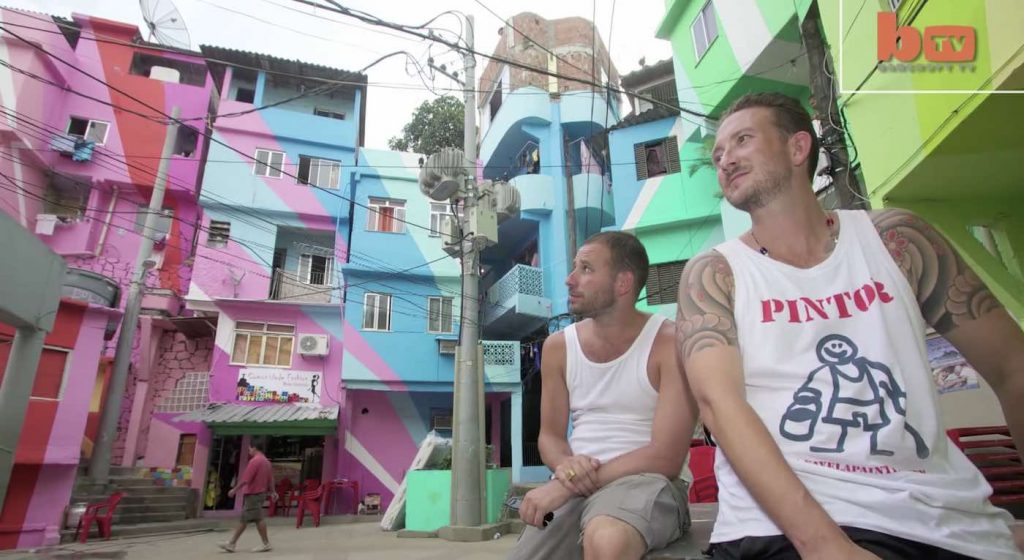
Two Dutch artists are transforming a shanty town clinging to the hillside in Rio de Janeiro using buckets of bright neon colored paint.
With the help of 20 local youths in the Santa Marta slum, stacks of huts on several streets are now a kaleidoscope of color.
“It gives the community life!” said Edimar Marcelinho Franco, who once was a local drug dealer and now is a professional painter after having being trained in the skill and transformed 34 of the buildings.
Brazilian paint company Coral, a subsidiary of Holland’s AkzoNobel, offered to help with raw materials and training for the locals.
The ‘Back to Rio’ project became a global story when it raised $112,000 through an online fundraising campaign. Their goal was to paint an entire hillside favela community. In the process, the Dutch mural artists aimed to provide employment for locals and uplift the self-esteem of a heavily populated, tumultuous neighborhood.
“While painting the houses brings a visual improvement, plastering them helps with controlling moisture, acoustics and temperature,” Haas and Hahn wrote for their Kickstarter campaign. “More people coming to see the artwork will bring new business and employment opportunities for locals.”
“Visual beautification, job creation and boosted pride and self esteem can help to change perception and remove negative stigma.”1711 people donated money to The Favela Painting Foundation and twenty-two individuals gave at least a thousand dollars.
Syria’s chemical weapons facilities are “inoperable,” the Joint Mission of the Organisation for the Prohibition of Chemical Weapons (OPCW) and the United Nations overseeing the destruction of the country’s weapons program confirmed yesterday.
“The Joint Mission is now satisfied that it has verified – and seen destroyed – all of Syria’s declared critical production and mixing/filling equipment,” according to a statement released by the joint OPCW-UN team.
Last week my son and I chased down and captured a balloon on a windy day for a sad-faced little boy. It looked like he lost his best friend.
Living amongst mostly Indian people (from the Asian country) I’ve been friendly, but I don’t know if I’ve won their trust.
Today that changed a little.
[Editor’s note: The Good News Network is getting ready to unveil its new website that will offer blogging opportunities for users. This little story submitted by Richard is a great example of things we want to see posted in your good news blogs. Thanks, Richard, for providing a fine example, although entries do not have to be as short as this one.]
Three friends from Australia, Matt, Janis and Greg, have embarked on an adventure of a lifetime going 3,500 km across India in an autorickshaw. The two-week journey, called the ‘Rickshaw Run’ will culminate in bringing a new learning center to Bangalore’s underprivileged children.
So far, the 2013 Atlantic hurricane season has been one of the weakest since modern record-keeping began about half a century ago, marking the first time in 45 years that the strongest storm to form was just a minor Category 1 hurricane. –Global Post
An estimated $1.3 million worth of art from more than 130 international artists, mostly from Syria and Lebanon, is being auctioned at below-gallery prices in Beirut to raise money for Syrian refugee children.
“This is first time that you have so many artists from the Middle East mobilize for a cause.”
Australian scientists studying the ocean have found that coral is more resilient than first thought, and has the ability to deal with increasing temperature. – ABC News
Georgia teenager Zach Hodskins was told he’d never play college basketball, but now he’s earned a spot on one of the nation’s top teams, the University of Florida. The 17-year-old was born without the lower half of his left arm.
“I just see myself as another player that’s worked hard to reach his goals,” said Hodskins.
He “loves” to flip stereotypes of his disability around.
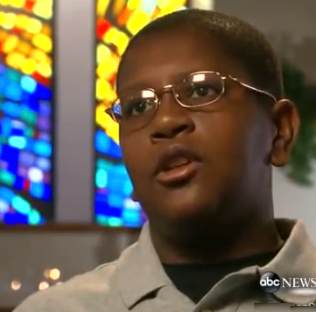
A heartbreaking story ran in the Tampa Bay Times on October 8 about a brave boy, 15, who stood up in front of a church during Sunday services to ask someone to love him.
The orphan had been raised in foster care and lived in a group home for boys where the bathroom remained locked and surveillance cameras recorded everything.
The Times reporter wrote, “Davion always longed for a family. His caseworker took him to picnics, put his portrait in the Heart Gallery. But he had thrown chairs, blown his grades, pushed people away.”
But when he learned his birth mother had died in June along with her long rap sheet of convictions, everything changed. The boy with four names – the last thing his parents ever gave him — Davion Navar Henry Only, realized now that he would never have a loving family if he didn’t abandon his anger.
His case worker, who had believed in him and arranged for him to speak at the church told the Times, “He decided he wanted to control his behavior and show everyone who he could be.” All summer, he worked on dropping his defenses. He lost weight and earned A’s in school.
Holding a bible, and dressed in an ill-fitting black suit and donated tie, he got scared at the last minute, but somehow found the courage to ascend to the pulpit to tell his story: “My name is Davion and I’ve been in foster care since I was born. . . . I know God hasn’t given up on me. So I’m not giving up either.”
“I’ll take anyone — old or young, dad or mom, black, white, purple. I don’t care. And I would be really appreciative. The best I could be.”
Since the story with its poignant photos was published, more than 10,000 families have come forward to adopt Davion. Others wanted to mentor the boy, send him gift cards, contribute to his college fund. He was on the Today show and The View for which he flew in a plane for the first time to New York City.
The latest story from the Tampa newspaper says Davion could be in a new home by Christmas.
And the best part, according to the boy, is he has raised so much awareness for boys in his situation that “The Davion effect” will more than likely find forever families for some of the other boys waiting in foster care across America.
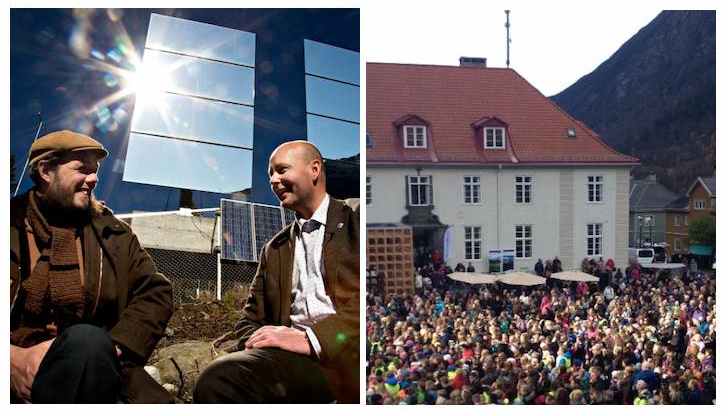
Residents of a remote village nestled in a steeply sided valley in southern Norway are enjoying winter sunlight for the first time ever thanks to giant mirrors.
The tall mountains that surround the village of Rjukan are high enough to deprive its 3,500 inhabitants of direct sunlight for six months a year.
That was before a century-old idea was brought to life: to install mirrors on a 400-metre (437-yard) high peak to deflect sun rays towards the central square.
A pair of brothers in Washington DC are working toward becoming the air traffic controllers of food, trying to redirect discarded food from dumpsters to hunger relief groups.
Startups like Food Cowboy, founded by Richard and Roger Gordon, see wasted food as a business opportunity.
Some, like CropMobster, are using Craigslist or Twitter so that people who have crops or surplus they can’t use, can post the availability to others who can divert it to better use.
Jon Pimlott is blessed with a wife, two beautiful kids, a job and a healthy body ready for life. He’s also got the persistence of a blood hound.
Since 2009, under the spell of an inventor’s frenzy, he has labored to give people with limited mobility the freedom to be able to float on the surface of Canada’s blue-green lakes.
The spark of the idea came to him while rowing at Diver Lake Park in Nanaimo, British Columbia in May 2009. He had seen the men in wheelchairs casting their lines from the accessible fishing dock. ‘Too bad they couldn’t be out bobbing in a canoe or rowing their way around the calm waters’. Then, a vision came to him: All at once he knew he could build it and it would work.
I gasp and look to the sky in amazement. I know it will work even before testing my theory.
Since then he has constructed prototype after prototype, inspired by the thought of wounded warriors and even grandfathers in their last weeks of cancer rolled out on a gurney to fish with their grandchild one last time aboard a canoe pontoon, a portable dock.
“Imagine giving your dad a boat trip, a fishing pole, sitting him under an umbrella,” he swooned.
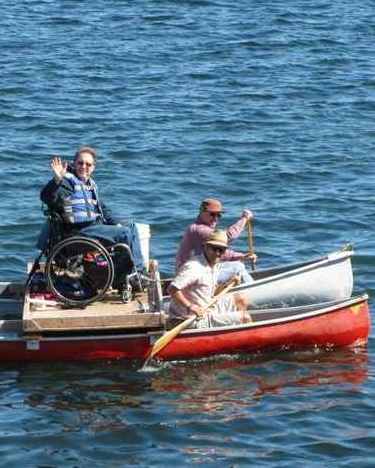
His first design was simple (and still his favorite). Take any two canoes and lay five 12-foot planks fastened together as a breakaway 5-piece dock. The wheelchairs can be rolled onto the platform (even from a shoreline) and paddlers in the canoe are stationed on each of the four corners rowing the vessel. The chair bound passenger sits atop — with a spouse, a child or a loyal dog — feeling exactly as if atop a 10×12 foot floating dock. Other models use three canoes and a trolling motor to power the makeshift catamaran.
Canoeing For All
To Jon’s knowledge no one has ever built anything like this before. “I guess simplicity sometimes gets overlooked,” he told the Good News Network.
“It’s been amazing putting a fishing rod into the hands of someone who hasn’t been on the water in 10 or 12 years,” said Pimlott, who dreams of giving water access to people of modest means across Canada.
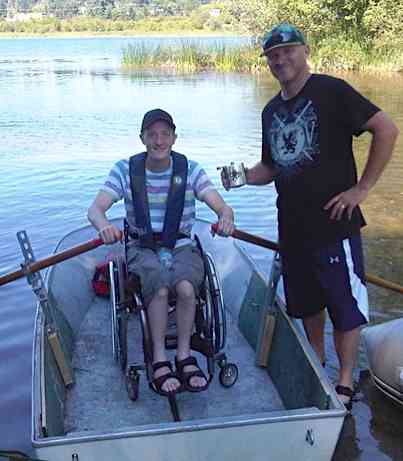
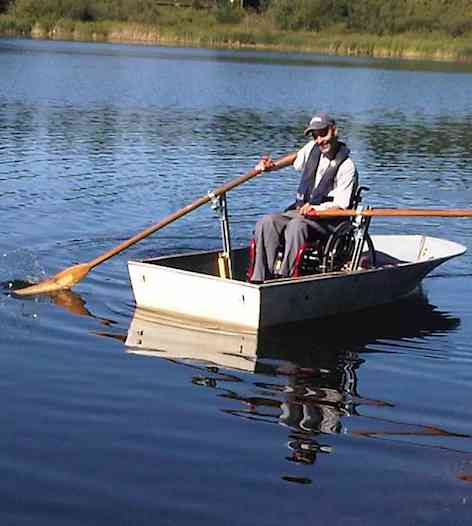
Another basic prototype for getting wheelchairs on the water uses a rowboat. Pimlott calls it the Chairower and it uses a short interior ramp descending into the hull: “Just roll on, and cast off.” To develop the craft, which should easily pass national safety regulations, Jon needed to make modifications to raise the oar height using extenders.
Releasing my grasp on the transom, I watch my friend, Bert Abbott, row for the first time in 30 years. I search for words to describe the moment. I do not know if I will find them.
To find testers to help with the project, he contacted a resource group called Access Nanaimo. Now he has a whole team of testers, some with cerebral palsy, some quadriplegic. Many he calls friends now, including Paul Winkler.
“The rowboat is definitely one of my favorites, for the independence and freedom it offers.” said Winkler in a telephone interview. “It was so surprising how perfectly engineered it was,” he explained. “I could row the boat unassisted.”
Winkler, now 40, was 32 when he became paralyzed from the chest down in a diving accident and lost some of his hand function. Enjoying nature has been difficult for him while living in a wheelchair because hills are such an obstacle. Since meeting Jon he has been able to catch his first fish in eight years, saying, “It was amazing.”
Pimlott has experimented with different blade sizes to come up with optimal ease of use for his new friend.
“It’s so fluid and amazing the way the oars are balanced,” testified Winkler. “Once I lift them out of the water, I can shift them ahead and let them fall into the water and it completes the stroke for me.”
“Rowing that boat, it was as if I had no injuries.”
The Future
Whether offering the Canoe Catamaran or the Chairower, Pimlott’s goal is to be able to rent or sell the vessels, or create a non-profit organization to donate them. “It’s untapped,” Pimlott says of the future. “I’m considering a crowd funding campaign to pay for the next Chairower.”
Jon Pimlott, right
With every hour of work the inventor has devoted, visions of his friends keep him going. The college buddy who lost his mobility after a mountain biking accident; Norm Hemstreet, his first volunteer, who eagerly testing each new development. Norm now “contributes in spirit only”, after his death in 2010. His estate left Jon a thousand dollars to fuel his passion for helping others. . . This project is for them.
As the second person ever to test Pimlott’s inventions, Paul Winkler insists there is no stopping this man.
“He’s already met so many challenges. He’s come up against fines, financial burdens, family restrictions – things that the average person would give in to,” Winkler said with admiration. “He’s not that guy.”
“He’s doin’ it, and his gas tank is full.”
Equally important, his supporters have gas tanks to match.
– WATCH the beautiful video below
SHARE This on Social Media So That Others Can Row!
After nearly five years of planning, a large-scale attempt to turn a big chunk of Detroit blight into an urban forest is now underway. The purchase of more than 1,500 vacant city-owned lots on the city’s lower east side – a total of more than 140 acres – got final approval from Detroit Emergency Manager Kevyn Orr and Michigan Governor Rick Snyder earlier in October.
A wealthy resident, John Hantz, has committed in phase 1 to clearing 50 derelict structures, cleaning up years of trash and overgrown brush, planting 15,000 trees, and maintaining regular mowing. Future plans include a farm growing local food.
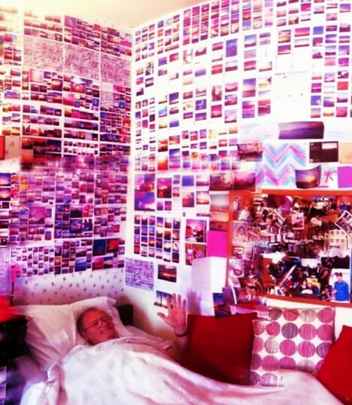
More than 2,600 people from around the world may have helped prolong the life of a dying Nebraska father by sending photos, notes and postcards all colored with sky-blue pink.
His son, a digital brand manager with Red Bull, started an online campaign for people to post sunsets and skies using Twitter or Instagram to help fill his father’s room with his favorite scenes. They printed out the photos at home and covered the wall of his bedroom.
63-year-old Brian Curtis was given six months to live by his cancer doctors in spring of 2012, but instead got to spend 15 more months among his loving family.
His son Brandon thanked all the people who wrote songs and tagged their photos with #skybluepink.
“You made it wonderful and surrounded him with love that he always refereed to as “better than medicine.” It brought so much happiness and smiles.”
Remember that old song, Photograph, by Ringo Star?
Well, “all he had was a photograph,” but Ringo Starr wanted to know: Who were the teens in this picture he took in 1964 while in New York City?
49 years later, he began the search by asking in USA Today to help find these fans. They grew “old and gray” but the former New Jersey teens have reunited to become part of Beatles history.
For the first time, Ralph Lauren is featuring shelter dogs in its fashion advertising, showing off its line of fall accessories alongside adorable rescue dogs. The beautiful ad campaign not only wants to sell handbags and gloves, it is also designed to promote the adoption of shelter dogs.
A miniature dachshund named Roxy, was one of ten dogs participating in “The Dog Walk” campaign, a collaboration with the ASPCA that kicked off on Oct. 15.
The charming pups were plucked from shelters and featured in a short film, set on city streets. Though the brand has never shied away from including dogs in print ads in the past, this is the first time the company has let rescue dogs take center stage in a fashion show alongside their human model counterparts.
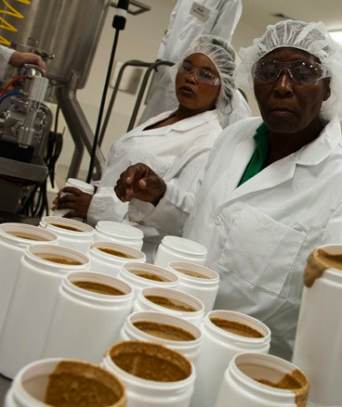
A crew of Haitian workers clad in white lab coats, rubber-soled boots, safety goggles, and hair nets pass through a corridor and into a sterile production area that’s lined with hulking stainless steel devices, one of which looks like a giant KitchenAid Mixer. At 8:30 a.m., the machinery starts whirring and roaring. Before long, the distinct aroma of crushed peanuts hangs in the air.
From the outside, the two-story white building looks like a standard warehouse you’d see on the outskirts of any American city. But located in Haiti’s Central Plateau, the Nourimanba Production Facility is a state-of-the art operation that’s helping tackle one of the country’s most pressing challenges—malnutrition. It also uses only locally grown peanuts, making it a reliable market for local farmers to sell their yields.
In Haiti, malnutrition is the leading cause of death among children 5 years old and younger. And it’s not just children who are affected—pregnant women and teenagers also experience the disastrous consequences of poor nutrition.
For decades, Partners In Health has tackled malnutrition through a multipronged approach targeting clinical, economic, and social factors that drive the condition. A key component of the strategy is Nourimanba, this ready-to-use therapeutic food. It tastes similar to peanut butter, but it’s fortified with vitamins that are crucial to physical and cognitive development.
Within a few months of officially opening this year, the facility has already created more than two dozen jobs and churned out more than 6,000 kilograms of the lifesaving treatment.
“This center will have a major impact on the community—a lot of people are working here, and new industries help develop communities,” says Myrlene Arthus, production supervisor at the facility. “I love what I do because I am working for children that are sick. The product I make is helping save children’s lives.”
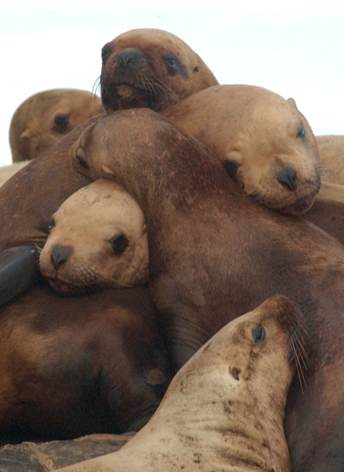
A five year plan to shore up dwindling populations of eastern Steller sea lions, the threatened species that roams from Alaska to California, has succeeded. NOAA Fisheries announced last week it will be delisting the animal as a threatened species, having exceeded its goal for annual population growth by more than thirty percent.
As marine predators that forage on a variety of fish, squid, and other species, Steller sea lions are a vital component of North Pacific Ocean ecosystems. Their recovery is a testament to the value and success of the Endangered Species Act in ensuring the health of marine ecosystems for future generations.
In Tucson, Arizona, the idea is spreading to elect special teens into the Homecoming Courts at school dances.
Mountain View High School followed in the footsteps of Canyon Del Oro High School which voted for a senior named Kevin for homecoming king.
In the report below, Lani was only nominated, but on Saturday, Mountain View students watched as Lani Fuentes-Cordova was selected as the Homecoming Queen for 2013.












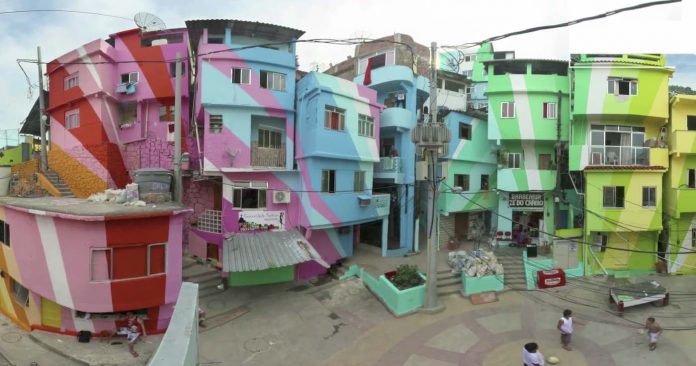
 Two Dutch artists are transforming a shanty town clinging to the hillside in Rio de Janeiro using buckets of bright neon colored paint.





 Jon Pimlott is blessed with a wife, two beautiful kids, a job and a healthy body ready for life. He’s also got the persistence of a blood hound.
 “It’s been amazing putting a fishing rod into the hands of someone who hasn’t been on the water in 10 or 12 years,” said Pimlott, who dreams of giving water access to people of modest means across Canada.