The Mayo Clinic has conducted the first clinical studies of green tea extract in cancer patients and the results are good news for leukemia sufferers.
An extract of green tea, which offers very low toxicity, appears to merit clinical application after chronic lymphocytic leukemia (CLL) patients used it in a phase II trial.
The findings, presented last Monday during the annual meeting of the American Society of Clinical Oncology, are the latest in a series of Mayo studies to show promise for use of the chemical epigallocatechin gallate (EGCG) — the major component of green tea — in reducing the number of leukemia cells in patients with CLL. Mayo first tested EGCG in a variety of laboratory assays about eight years ago, and it was found to reduce the survival of CLL leukemic cells. This laboratory finding was followed by a successful phase I clinical trial — the first time green tea extract had been studied in CLL patients.
People with autism often have a hard time finding and keeping jobs, so more schools are creating programs to help students with autism get prepared for the workplace. One of those programs helped change the life of Kevin Sargeant.
Things weren’t looking good for Kevin just a few years ago. He was antisocial, desperately unhappy and doing poorly in school.
“He was pretty much a broken child,” says his mother, Jennifer Sargeant. “We really didn’t see that he would be able to go to college, or even have a job.”
Six years later, Kevin is a lot more social. He’s a good student. And he’s working — as an intern in the IT department at the Parks & People Foundation. Kevin says computers are a good fit for him.
While the world’s attention affixes to the FIFA World Cup, Brazil and the City of Rio are preparing for the 8th annual World Cup for homeless men and women. 64 national teams of homeless players – including 16 women’s teams – will be united in September on Copacabana Beach for the week-long, annual football tournament aimed at beating homelessness globally.
Over 30,000 homeless players around the world are aiming for the chance to stand proud and represent their country on the global stage in Rio. A street soccer stadium with 3 pitches holding a crowd of 5,000 will be built on Copacabana Beach with the statue of Christ the Redeemer on Corcovado Mountain as the remarkable, iconic backdrop.
Mel Young, president of the Homeless World Cup said, “The Homeless World cup is an opportunity for homeless people to move from the invisible margins of society to standing proudly on a global stage and change their lives.”
Here’s a bright idea for the planet. A Hong Kong-based company has introduced what it bills as the world’s only solar-powered light bulb with the hope of reaching millions of people with little or no access to electricity.
The Nokero solar bulb in its rainproof plastic housing is hung outside during the day and then turned on at night. Batteries inside provide up to four hours of light when the device is fully charged.
With no need for electric power lines, this bulb can assist people in remote areas who normally burn dangerous substances like kerosene just to light their homes.
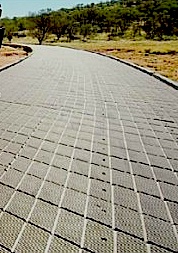
The folks at West MacDonnell National Park in Australia had a brilliant idea for a new bike path connecting Alice Springs and Simpsons Gap. They made it out of junked ink cartridges. The material can last far longer than timber, and is a great way to reuse plastics. Plus, it looks great, and all for a fraction of the cost.
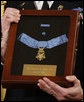
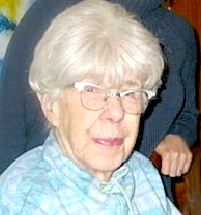
Margaret Zerwekh, 90, of Delafield, Wis., has won her fight to have a Medal of Honor awarded to Lt. Alonzo Cushing, a hero of the Battle of Gettysburg.
She spent 23 years fighting to get Lieutenant Cushing honored for his brave service. In the beginning, politicians responded mostly with form letters. But in the early 2000s, Senator Russ Feingold, Democrat of Wisconsin, took up her cause, moved by the elderly woman’s passion for a long-ago hero. He consulted historians, who affirmed Lieutenant Cushing’s valor, and began a long push to ask the Army to award him the Medal of Honor.
Mr. Feingold said her work showed how ordinary people can shape the telling of history.
Feisty and frugal, 98-year-old Verna Oller never bought new clothes or went to the hairdresser. But, she was a savvy investor, reading the Wall Street Journal and Barrons at the library.
By the time of her death, the Long Beach, Washington resident had amassed a fortune of $4.5 million and she directed her close friend to spend every cent of it on her home town.
Feisty and frugal, 98-year-old Verna Oller never bought new clothes or went to the hairdresser. But, she was a savvy investor, reading the Wall Street Journal and Barrons at the library.
By the time of her death, the Long Beach, Washington resident had amassed a fortune of $4.5 million and she directed her close friend to spend every cent of it on her home town.
Preventive measures to help people lower their risk of heart disease have been so effective that a new study documented a drop of 24% in the number of serious heart attacks over ten years.
Among the 46,000 patients studied between 1999 and 2008, the most damaging heart attacks fell even more, 62 percent, according to the study, published in the New England Journal of Medicine,
Preventive measures include lowering blood pressure and cholesterol levels, decreasing or eliminating smoking and the use of beta-blockers and/or aspirin.
A rare revolutionary operation at a Birmingham hospital is allowing patients to “regrow a knee” from scratch in a lab.
Although shock absorbent cartilage tissue is unable to regenerate in the body, medics at Good Hope Hospital, in Sutton Coldfield, are using advanced treatments to give sports enthusiasts, arthritics and young patients a second chance with their damaged knees.
A Washington, DC man’s year-long campaign of generosity inspires others to give, too. Even though Reed Sanders is unemployed, he has become a philanthropist who gives ten dollars to a stranger each and every day. He calls it his “year of giving,” and tries to choose those who need an extra hand in hard economic times. The effort was inspired by his mother.
The inspiration goes beyond his personal giving to a website that documents specific needs, like a pair of shoes, or pants for a particular individual that he met along the way. His readers are helping fulfill those requests.
BP has ordered 32 centrifuge machines from Kevin Costner’s Ocean Therapy Solutions to be deployed in the Gulf clean-up effort.
Upon delivery, the machines, tested by BP and found to be highly efficient, will clean 6 million gallons of water per day, separating the oil for commercial reuse.
Costner, who was on Capitol Hill testifying before congress on Wednesday, spent more than $24 million of his own money to develop the machines and said manufacturing is being ramped up for the new demand.
BP has ordered 32 centrifuge machines from Kevin Costner’s Ocean Therapy Solutions to be deployed in the Gulf clean-up effort.
Upon delivery, the machines, tested by BP and found to be highly efficient, will clean 6 million gallons of water per day, separating the oil for commercial reuse.
Costner, who was on Capitol Hill testifying before congress on Wednesday, spent more than $24 million of his own money to develop the machines and said manufacturing is being ramped up for the new demand.
After reading about a woman who motivates commuters via chalkboard messages, a Good News Network subscriber, Eleanor Melograna, wanted to step in to help. She felt compassion for the woman, Penny Proudfoot, who said she had recently ruined her camera, and with it, her creative outlet for expression.
As a result, Eleanor thought to herself, “I’ve got a Canon Rebel camera that I was going to sell on e-Bay, but I’d love for her to have it, if she wants it.” It wouldn’t replace the one given to her by her father, but it might give her the chance to reignite her passion.
So, she tracked down Penny Proudfoot’s phone number on the internet, and called her. Penny broke into tears when she heard the stranger say she wanted to give her the camera.
“She couldn’t believe it,” Eleanor wrote in an email to GNN. “I packed it up and mailed it, and am so happy it went to a good home.”
Penny called to say she had received it and was so appreciative. The emotions experienced by both women were “worth so much more than any money” the generous donor could have made by selling the camera on e-Bay.
“Thank you for connecting us and making this good-feeling opportunity happen for both of us,” Eleanor concluded. “It’s so worth the subscription I pay each month for the Good News Network.”
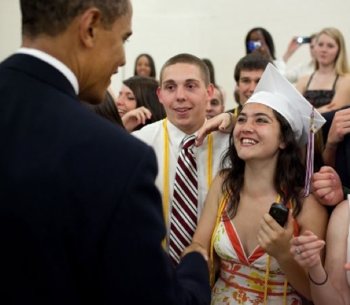
Kalamazoo Central High School beat out more than 1,000 applicants to win the “Race to the Top High School Commencement Challenge” and the honor of having President Obama deliver the school’s graduation speech, which took place on Monday night.
As an urban school in Michigan, K-Central had big gaps in their graduation rates. Crime-related stories seemed to grab as many headlines as those about learning achievements and sports victories.
But in recent years, the academic improvement in Kalamazoo has been dramatic. For one thing, since 2006, 91 percent of K-Central graduates have gone to college for at least one semester. Key to that achievement has been an innovative program called the Kalamazoo Promise, which pledges scholarship money to graduating students from anonymous donors. The number of students at K-Central taking Advanced Placement courses sky-rocketed, with triple-digit increases among minority students
This spring, the president himself pickied K-Central to win the School Commencement Challenge from among six finalists, which included two magnet schools, two charter schools, and a suburban public school.
In the winning video, senior Cara Cunliffe said, “We accept any student at K-Central, whether they’re right out of jail, have a low income. It doesn’t matter. The other schools in the competition accept minorities, but they don’t accept everyone like K-Central does.”
President Obama told the graduating seniors: “Understand that your success in life won’t be determined just by what’s given to you, or what happens to you, but by what you do with all that’s given to you; what you do with all that happens to you; how hard you try; how far you push yourself; how high you’re willing to reach. True excellence only comes with perseverance.”
“This wasn’t something I really understood when I was back your age,” he continued. “As my mother put it, I had a tendency sometimes to act a bit casual about my future. Sometimes I was rebellious. Sometimes I partied a little too much.”
“But after a few years, after I was living solely on my own and I realized that living solely for my own entertainment wasn’t so entertaining anymore, that it wasn’t particularly satisfying anymore, that I didn’t seem to be making much of a ripple in the world, I started to change my tune. I realized that by refusing to apply myself, there was nothing I could point to that I was proud of that would last. “
“Meaningful achievement, lasting success — it doesn’t happen in an instant. It’s usually about daily effort, the large choices and the small choices that you make that add up over time.”
“So, today, you all have a rare and valuable chance to pursue your own passions, chase your own dreams without incurring a mountain of debt. What an incredible gift. So you’ve got no excuse for giving anything less than your best effort… That’s my second piece of advice, very simple: Don’t make excuses. Take responsibility not just for your successes; take responsibility where you fall short as well.”
Kelsey Socha wrote in an essay, My Graduation Day with President Obama, on the White House Blog, “President Obama surprised us and arrived in our holding room a few hours before schedule, it was surreal, not only for the chance to hear the President speak but to have him mere inches away from us in a private setting. It was more than anyone could have dreamed of.”
“The honor went far beyond the President simply coming to our graduation or even shaking our hands. It was the fact that he made the experience wholly about us, using no political campaigns or agendas, that made it a truly special ceremony.
A Notre Dame professor and his son have determined the fastest way to win at Monopoly. The game that many families leave on the shelf because it takes too long, really only requires four turns and nine rolls of the dice to win.
Here’s what has to happen, according to an interview on NPR with sociology professor Daniel J. Myers:
“One player moves around the board very quickly, to buy Boardwalk and Park Place, and places houses on them. And the other one ends up drawing a Chance card that sends them to Boardwalk, and they don’t have enough money to pay the rent with three houses, and the game is over.”
However, the statistical odds of winning by using this exact sequence are very long: more than 250 trillion to one!
A Notre Dame professor and his son have determined the fastest way to win at Monopoly. The game that many families leave on the shelf because it takes too long, really only requires four turns and nine rolls of the dice to win.
Here’s what has to happen, according to an interview on NPR with sociology professor Daniel J. Myers:
“One player moves around the board very quickly, to buy Boardwalk and Park Place, and places houses on them. And the other one ends up drawing a Chance card that sends them to Boardwalk, and they don’t have enough money to pay the rent with three houses, and the game is over.”
However, the statistical odds of winning by using this exact sequence are very long: more than 250 trillion to one!
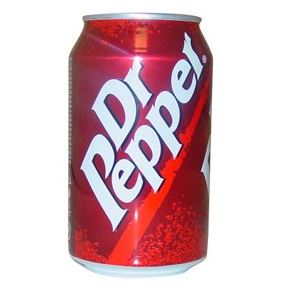
The Dr Pepper Snapple Group announced it will recycle 80 percent of its solid waste, improve energy efficiency and water usage by ten percent, and conserve more than 60 million pounds of PET plastic through package reengineering and increased use of post-consumer recycled material.
The improvements were laid out in the company’s first corporate social responsibility report, which outlines five-year goals for improving environmental and social performance across the company’s operations. They will also replace 60,000 vending machines and coolers with Energy Star equipment that is rated 30% more energy efficient and result in $7.6 million in electricity cost savings for customers.
Jews: want to fight anti-Semitism? Muslims: want to challenge islamophobia? There’s an easy way to do it: have coffee with one another.
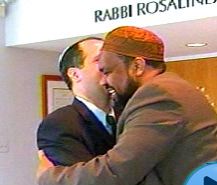
Last week, the rabbi and imam of Duke University, did just that. Amidst the tension between Muslims and Jews caused by the violence off the coast of Israel and Gaza, their regular coffee date felt like a political act.
They typically steer their discussion away from politics not because they feel uneasy on that turf; they know that they disagree on many core issues surrounding the Israeli-Palestinian controversy and are quite comfortable with that. They are careful because they know that when political discourse becomes the dominant mode — or the only mode — of interaction something essential may be lost: empathy.
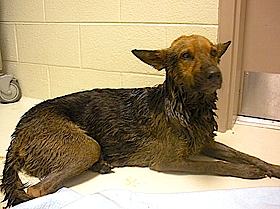
It was a call Sheila Zachar won’t soon forget. Her friend, James Beavers, a homeless veteran living at an abandoned car wash in East Memphis, Tenn., had just rescued a German shepherd from a 6-ft. pit of oil, and desperately needed Zachar’s help getting her out of the disturbing—and messy—situation.
Earlier, Beavers had noticed a truck speeding away from the car wash, followed by the sound of a dog in distress. He couldn’t pinpoint where the wails were coming from, but as the whimpering continued, he kept up the search.















 The Mayo Clinic has conducted the first clinical studies of green tea extract in cancer patients and the results are good news for leukemia sufferers.