












 From the Field of Positive Psychology — Researchers have discovered that groups are more productive if they focus on the good things already happening, a process some call Appreciative Inquiry. Doug Turner tells us what happened when he opened his monthly leadership meeting by asking for a discussion of what was going right, instead of the usual litany of what was going wrong. The benefits were amazing. “The tone of the rest of the meeting changed completely,” and researchers know why…
I am the voluntary leader of a religious congregation of over 400 members. Like many churches, we have various organizations to meet the needs of our membership, like groups for the young men, the young women, children, single adults, the unemployed, and a Boy Scout Troop. Every other month or so, I invite the leadership of these groups to my office for a stewardship report and update.
Early on, I noticed that the leadership teams came prepared to discuss the things they were struggling with and the things that were going wrong. “Our last activity was a disaster,” or “the attendance at our last meeting was disappointing,” or “we don’t have the volunteers we need to run our program,” were common reports.
If I were to take these reports at face value, I would have to conclude that our congregation was really struggling. However, as I interviewed individual members of our congregation, I heard stories of hope, gratitude, and faith. These stories came from people who were benefiting from the fine work the leadership teams were doing. Something was off.
When the next round of stewardship meetings came up on the calendar I decided to try something a little different. At the beginning of each meeting, I thanked each leadership team for their work and asked them to share three things that they were proud of and that were working well. The reactions and responses were very interesting. Some were absolutely stumped. It was as if they had been so focused on fixing problems that they missed all the wonderful things happening in their organizations. Some thought it was a little odd to talk about the positive things assuming that everyone already knew the good stuff. Others were almost relieved to finally have a forum to share the things they were doing that brought them so much satisfaction.
The Tone of the Meeting Changed Completely
I noticed that by beginning each meeting with the positive, the tone of the rest of the meeting changed completely. Instead of feeling like we were digging out of a hole, we felt like we were on top of a mountain surveying a beautiful landscape. Of course we still discussed the struggles and the challenges, but this discussion came from a much more optimistic and hopeful context and the ideas flowed freely.
Barbara Frederickson and Marcial Losada, both noted researchers in Positive Psychology, have studied this phenomenon. They observed the contrast between flourishing and languishing. Frederickson’s “broaden-and-build theory holds that unlike negative emotions, which narrow people’s behavioral urges toward specific actions that were life-preserving, positive emotions widen the array of thoughts and actions called forth (e.g., play, explore), facilitating generativity and behavioral flexibility.”
(Editor’s translation: People thought more creatively and productively, and danced outside the box!)
They also observed that “high ratios of positive to negative affect (emotion) would distinguish individuals [and teams] who flourish from those who [languish]. Several recent research reviews have concurred that ‘bad is stronger than good.’ The implication is that to overcome the toxicity of negative affect and to promote flourishing, experiences of positivity may need to outnumber experiences of negativity.”
That’s what was happening to the leadership of our church organizations — the toxicity of the negative was overpowering the positive. By simply focusing on the positive first, we began to push back the negative tide.
Making the Good As Strong As the Bad
Losada calculated that the “tipping point” ratio of positive to negative is 2.9013. This means that it takes 2.9 positive feelings, experiences, expressions, thoughts, etc. to fend off the languishing effects of one negative. This 2.9 tipping point is call the Losada Line. His calculations demonstrated the tenets of Frederickson’s broaden-and-build theory. “As predicted by the theory, higher levels of positivity [beyond 2.9 positives to 1 negative] are linked with (a) broader behavioral repertoires, (b) greater flexibility and resilience to adversity, (c) more social resources, and (d) optimal functioning.”
In addition to all this research and science, it’s just more fun to celebrate the positive and the successes. Recognizing what’s working well also recognizes where there is strength. Leaders can then leverage this strength to “broaden and build” their organizations in other areas. I have also noticed that the leaders who continue to languish are still focused on the negative while the leaders who are flourishing — and happy — leverage the positive and keep the negative in perspective.
My “broad-and-build” questions include the following:
Relative to your leadership role…
- What’s working well?
- What brings you great pride and joy?
- How have you made a difference for good in the lives of those you serve?
- What brings you quiet satisfaction?
- What have you learned over the last few months?
- How can you use this information (above) to move your organization forward?
In the words of an ancient prophet, “…behold I say unto you, that by small and simple things are great things brought to pass…” I hope this helps you to flourish in your leadership roles and to bring to pass great things.
Douglas B. Turner is the Vice President of Human Resources for the Washington, D.C., Metro Division of Centex Construction, LLC. Mr. Turner oversees all aspects of human resources, including leadership, management, employee training and development, team development, employee recruitment and retention, employee relations, and compliance.

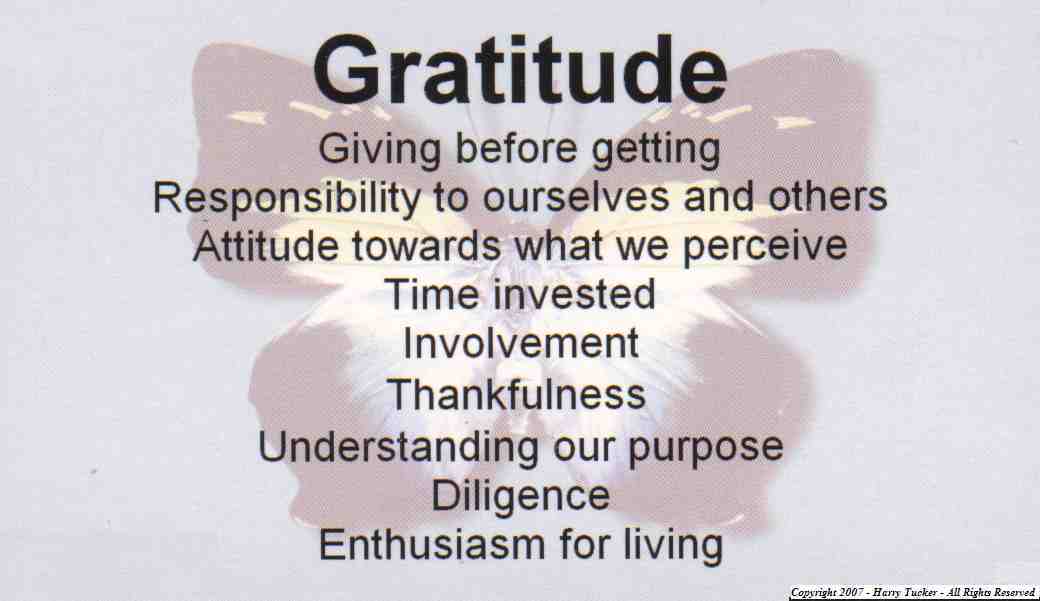 I printed a small card that I would like to offer each of you today that you can use as a bookmark, or carry in your wallet as a reminder of the benefits of gratitude. On one side are listed the terms that I associate with gratitude. On the other side, I outlined five ways of staying happy. (For those, I would like to thank Shirley Hong, a person who lives a very positive life and who provided these to me.)
 Also illustrating the card is an image of a water droplet hitting the surface of a pool and spreading in all directions. In a similar vein to the butterfly effect, every positive action that we perform, every positive thought that we have, every act of gratitude that we show, spreads good, positive energy equally in all directions. Others who experience this will in turn perform their own acts that will cause positive energy to radiate from them. There is no limit to how far this positive energy will expand.








 Simon and his Spiritual Cinema collegues have recently produced their first film. It is their February 2007 featured selection, Conversations With God, based on the best-selling non-fiction book by Neale Donald Walsch.

 Shortnose sturgeon have made a surprise recovery in New York City’s Hudson River, a new study shows. More than 60,000 occupy the river, greater by about four times than the number in 1970. The sturgeon comeback has been "so successful" that it may become one of the few species resurrected from the U.S. endangered species list — "becoming the first fish to do so." (